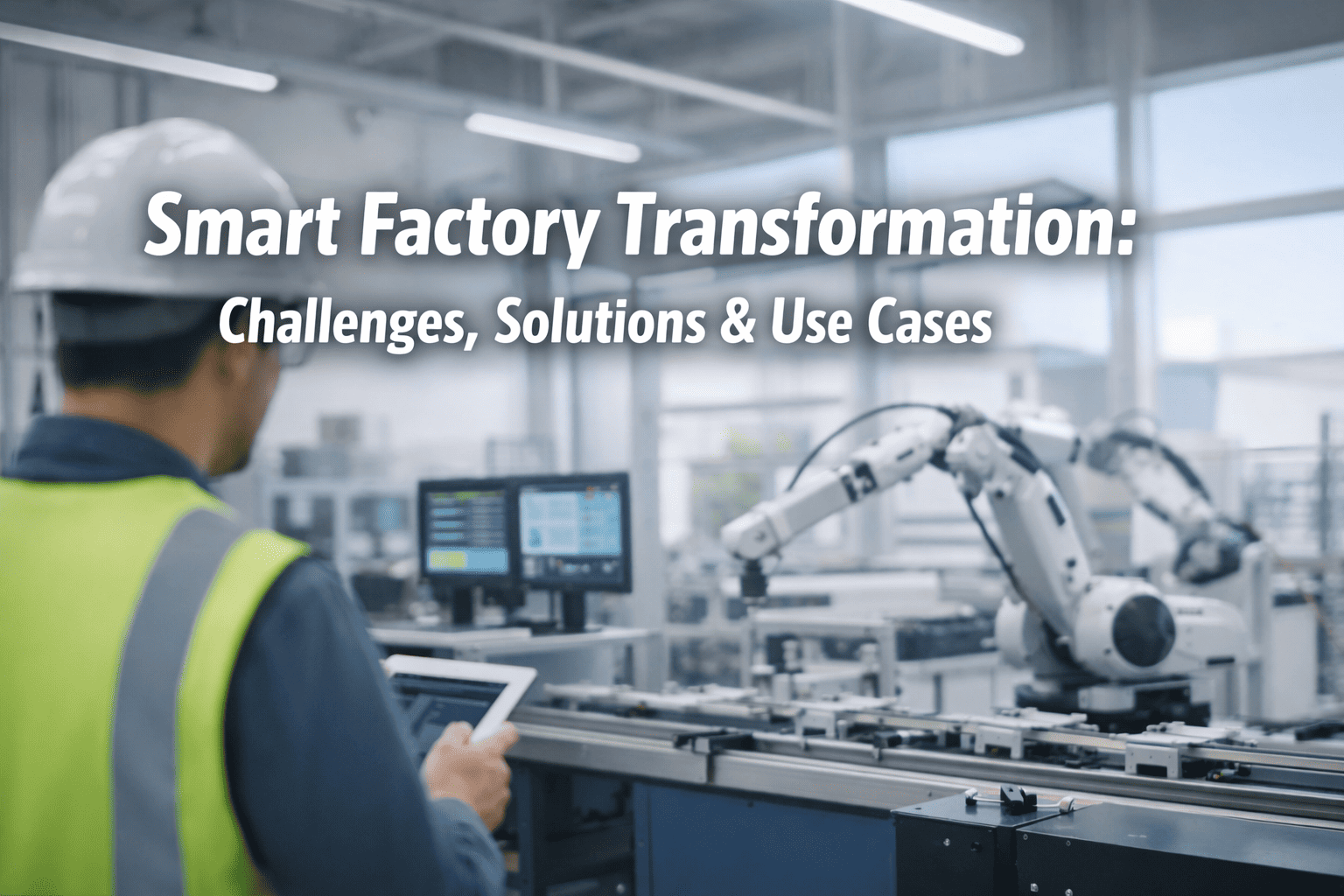
Your production line is bleeding throughput. Your competitors are deploying AI robotics in months while you're still scoping vendors, debating architectures, and waiting on quotes. The traditional path to manufacturing AI — multi-vendor integration, custom infrastructure builds, 18-month timelines, and the inevitable scope creep — is exactly why most AI projects fail to deliver before the business case expires. Turnkey AI manufacturing robotics changes that equation entirely. With pre-configured NVIDIA AI servers, factory-validated integration patterns and a 12-week deployment framework, plants are moving from kickoff to live production faster than most facilities can finish a procurement cycle. This is not theoretical. This is what a properly engineered turnkey AI rollout looks like in 2026.
12 Weeks
From contract signing to live AI production
73%
Faster deployment vs. traditional integration
24/7
Plant support with guaranteed response SLAs
10 mo
Average payback on turnkey AI robotics investment
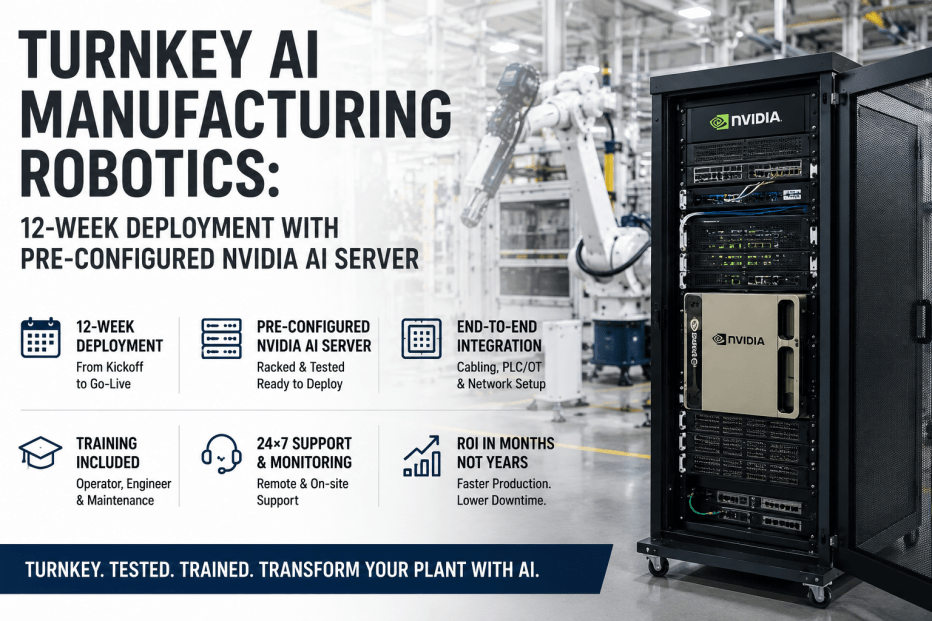
Turnkey AI Robotics — NVIDIA-Powered Deployment
Turnkey AI Manufacturing Robotics: 12-Week Deployment with Pre-Configured NVIDIA AI Server
How pre-configured NVIDIA AI infrastructure, factory-validated robotics integration, and managed deployment frameworks compress your AI rollout from 18 months to 12 weeks — without the integration risk, vendor finger-pointing, or budget overruns.
Why Most AI Robotics Projects Take 18 Months — and Most Never Finish
The conventional path to AI-powered manufacturing robotics involves stitching together vendors who have never worked with each other, infrastructure that has never been validated for industrial use, and integration teams who are learning your factory floor for the first time. The result is predictable: timelines slip, costs escalate, scope shrinks, and by the time something goes live, the business case has already expired.
Months 1–4
Vendor Selection Chaos
RFPs go out to robotics OEMs, AI software vendors, infrastructure providers, and systems integrators. Each promises end-to-end capability. None actually delivers it. Procurement cycles drag.
Months 5–9
Integration Hell
Robotics vendor doesn't speak the same protocol as the AI inference platform. PLC engineers and ML engineers can't agree on data formats. Every connection requires custom code that nobody wants to own.
Months 10–14
Infrastructure Surprises
GPU servers arrive months late. Network topology doesn't support real-time inference. Edge compute can't handle the inference load. Cooling and power weren't specified for the chosen hardware.
Months 15–18+
Pilot Purgatory
A scaled-back proof-of-concept finally runs on one line. Scaling it to the rest of the plant requires another integration cycle. Original ROI projections quietly disappear from board presentations.
The turnkey model exists because the industry finally accepted that the integration risk itself is the bottleneck. When NVIDIA infrastructure is pre-configured, robotics are pre-validated against AI inference workloads, PLC integration patterns are pre-tested, and a single accountable partner owns the full stack — the project stops being a science experiment and starts being an installation.
Ready to skip the 18-month integration nightmare? Book a Demo with iFactory's turnkey deployment team and see the 12-week framework applied to your plant.
What "Turnkey" Actually Means: The 12-Week Deployment Framework
Turnkey is one of those words that vendors abuse. In an actual turnkey AI manufacturing robotics deployment, every dependency that traditionally derails a project — hardware specification, software integration, PLC connectivity, operator training, plant validation, and ongoing support — is owned by one accountable partner working from pre-validated reference architectures. Here is what that looks like in practice over 12 weeks.
Discovery & Architecture Lock-In
Site assessment of production lines, target use cases (quality inspection, pick-and-place, defect detection, autonomous material handling), existing PLC and MES topology, and network infrastructure. Reference architecture confirmed and locked. Hardware bill of materials finalised.
Site survey
Use case definition
Architecture sign-off
Hardware Provisioning & Pre-Configuration
Pre-configured NVIDIA AI servers (including Jetson Thor edge modules where applicable) shipped with iFactory software stack pre-installed. Robotics arms, AI vision cameras, and edge gateways prepared and tested at the integration facility before arriving on site.
NVIDIA server config
Jetson Thor edge nodes
Factory acceptance testing
On-Site Installation & PLC Integration
Physical installation of robotics, AI vision cameras, and edge compute on the production line. PLC connectivity established using pre-validated OPC-UA, Modbus, and EtherNet/IP integration patterns. SCADA and MES integration verified. Safety systems certified.
OPC-UA / Modbus / EtherNet/IP
SCADA & MES sync
Safety certification
AI Model Tuning & Digital Twin Validation
Pre-trained AI vision and inference models tuned against actual plant data. Digital twin simulation validates the robotics behaviour against production scenarios before full ramp-up. Performance benchmarks confirmed against contractual KPIs.
Model fine-tuning
Digital twin simulation
KPI benchmarking
Operator Training & Production Pilot
Hands-on training for operators, maintenance technicians, and plant supervisors. Role-based dashboards configured. Pilot production runs on the live line with iFactory engineers on site for real-time issue resolution. Acceptance test protocol executed.
Operator certification
Live pilot runs
Acceptance testing
Go-Live & Handover to 24/7 Support
Full production cut-over. 24/7 managed AI factory support activated with guaranteed response SLAs. Continuous monitoring of AI model performance, equipment health, and inference accuracy. Quarterly optimisation reviews scheduled.
Live production
24/7 SLA support
Quarterly reviews
The Pre-Configured NVIDIA AI Server Stack
The single biggest reason most AI manufacturing projects slip is infrastructure. GPU servers ordered without proper specifications, networking that wasn't designed for real-time inference, edge compute that can't handle the inference load at the line speed required. A turnkey deployment eliminates that risk by shipping pre-configured, factory-validated NVIDIA infrastructure that is ready to run on day one.
Edge Layer
NVIDIA Jetson Thor / Orin Modules
Real-time AI inference at the production line. Sub-10ms response for vision-based defect detection, pick-and-place guidance, and robotic motion control. Ruggedised for industrial environments.
Real-time inference
Sub-10ms latency
IP65 industrial grade
Plant Server Layer
NVIDIA AI Servers (Pre-Configured)
Centralised inference for multi-line workloads, AI model training and retraining, digital twin simulation, and plant-wide analytics. iFactory software stack pre-installed and validated.
Multi-line inference
Model retraining
Digital twin compute
Cloud Intelligence Layer
iFactory AI Platform — Hybrid Cloud
Cross-plant analytics, fleet-wide model updates, executive dashboards, and integration with ERP, MES, and CMMS systems. Continuous learning across the entire deployment fleet.
Fleet analytics
Model versioning
ERP / MES integration
Where Turnkey AI Robotics Pays Off: Real Production Use Cases
Pre-configured AI robotics infrastructure is only valuable if it solves problems your plant actually has. The use cases below are where turnkey deployments have shown the strongest, fastest ROI — and each one is supported by pre-validated reference architectures in the iFactory platform.
Quality Inspection
AI Vision Defect Detection
Computer vision models trained on plant-specific defects identify cosmetic flaws, dimensional variances, and assembly errors at line speed. Replaces manual visual inspection with consistent, 24/7 detection accuracy that improves with every shift.
99.4%
Typical detection accuracy at full line speed
Pick & Place
AI-Guided Robotic Pick-and-Place
Vision-guided robotic arms handle mixed-SKU bin picking, kitting, and assembly tasks that traditional rule-based robotics cannot manage. Adapts to part variance, lighting changes, and new product introductions without reprogramming.
3x
Throughput improvement vs. manual handling
Predictive Maintenance
Autonomous Equipment Health Monitoring
Edge AI continuously analyses vibration, thermal, and acoustic signatures from rotating equipment. Failures predicted weeks in advance. Maintenance work orders triggered automatically in the CMMS before equipment goes down.
42%
Reduction in unplanned downtime
Material Handling
Autonomous Mobile Robot Coordination
Fleet of AMRs coordinated by the central AI platform handles raw material delivery, WIP movement, and finished goods staging. Real-time optimisation against production schedule, traffic, and priority changes.
60%
Reduction in manual material handling labour
Turnkey vs. Traditional Integration: The Real Cost Comparison
Turnkey deployment carries a higher upfront product cost than buying robotics, AI software, and infrastructure separately. That price difference is real and worth examining. What the line-item comparison misses is the total cost of ownership — and once integration risk, schedule delays, and operational ramp-up are accounted for, the math tilts dramatically.
| Dimension |
Traditional Multi-Vendor |
Turnkey NVIDIA Deployment |
| Deployment Timeline |
14–22 months |
12 weeks |
| Vendor Accountability |
Split across 5–8 vendors with finger-pointing |
Single accountable partner end-to-end |
| Infrastructure Risk |
Custom-specified, often wrong on first attempt |
Pre-validated NVIDIA reference architecture |
| PLC Integration |
Custom code for every protocol and system |
Pre-tested OPC-UA, Modbus, EtherNet/IP patterns |
| AI Model Readiness |
Models built from scratch, 6+ months tuning |
Pre-trained models, 2 weeks of plant-specific tuning |
| Operator Training |
Vendor-by-vendor, fragmented experience |
Unified training programme across full stack |
| Post-Go-Live Support |
Multiple support contracts, unclear escalation |
24/7 managed support with guaranteed SLAs |
| 3-Year Total Cost of Ownership |
Higher (integration overruns + delayed payback) |
Lower (faster payback + predictable opex) |
| Average Time to Positive ROI |
18–24 months |
10 months |
See the 12-Week Framework Applied to Your Plant
iFactory's turnkey AI deployment team will walk you through a tailored 12-week roadmap based on your production lines, target use cases, and integration requirements — with hardware, software, training, and 24/7 support included.
Expert Review: Why the 12-Week Model Works When 18-Month Projects Fail
After two decades of watching manufacturing AI projects either succeed or slip into oblivion, the pattern is unmistakable. The technology has not been the bottleneck since around 2022 — modern AI vision, robotics, and inference hardware are mature enough to deliver production value out of the box. What kills projects is the seam between systems: where the robotics OEM hands off to the AI software, where the AI software hands off to the PLC layer, where the PLC layer hands off to the MES, where the MES hands off to the ERP.
Every seam is a place where accountability evaporates. When something doesn't work in a multi-vendor project, the robotics vendor blames the AI vendor, the AI vendor blames the network team, the network team blames the PLC integrator, and the plant manager is left with a half-finished system that nobody owns. Eighteen-month timelines are not caused by complexity. They are caused by accountability gaps multiplying over the project lifecycle.
The turnkey model works because it collapses the seams. One partner owns the full stack — from the NVIDIA hardware through the AI models through the PLC integration through the operator training through the 24/7 support contract. When something doesn't behave the way it should, there is exactly one phone call to make. That single shift — from coordinating a federation of vendors to managing one accountable partner — is what compresses 18 months of integration work into 12 weeks of installation work.
The other factor that matters: pre-validation. A turnkey NVIDIA deployment is not engineered fresh for each customer. The reference architecture has been tested across dozens of plants, across multiple industries, against PLCs from every major OEM. When a plant signs a turnkey contract, they are not buying a custom integration project — they are buying a productised deployment that has already been de-risked at every layer. The remaining work is plant-specific tuning, not foundational engineering.
For manufacturing leaders evaluating AI investments in 2026, the question is no longer whether AI robotics deliver ROI — that case has been made. The question is which deployment model gets you to ROI before the business case expires. The 12-week turnkey framework is the answer for plants that need certainty on both timeline and outcome.
What's Included in a Turnkey AI Robotics Deployment
The phrase "turnkey" only means something if every dependency is genuinely covered. Below is the complete scope of what iFactory's turnkey AI manufacturing robotics deployment includes — and why each element matters for hitting the 12-week target.
01
Pre-Configured NVIDIA AI Infrastructure
NVIDIA AI servers and Jetson Thor edge modules pre-configured with the iFactory software stack, validated reference architecture, and factory acceptance testing completed before arrival on site.
02
AI Vision Cameras & Robotics Hardware
Industrial-grade AI vision systems, robotic arms, and edge gateways selected and tested against the specific use case requirements identified during the discovery phase.
03
Pre-Trained AI Models
Defect detection, pick-and-place, predictive maintenance, and quality control models pre-trained on industry datasets, requiring only plant-specific tuning rather than ground-up development.
04
Full PLC & MES Integration
OPC-UA, Modbus, and EtherNet/IP connectivity to existing PLCs. Bidirectional data flow with MES, SCADA, ERP, and CMMS systems via pre-built iFactory connectors.
05
Digital Twin Validation Environment
Production scenarios simulated against the digital twin before live deployment, eliminating commissioning surprises and de-risking the cut-over from pilot to full production.
06
Operator & Maintenance Training
Role-based training programmes for operators, maintenance technicians, supervisors, and plant managers. Certification programme ensures the plant team can run the system independently.
07
24/7 Managed AI Factory Support
Continuous monitoring of AI model performance, equipment health, and inference accuracy. Guaranteed response SLAs. Remote diagnostics and on-site escalation when needed.
08
Quarterly Optimisation Reviews
Model retraining cycles, performance benchmarking against contractual KPIs, and roadmap planning for additional use cases as the platform scales across the plant.
Want a full scope breakdown for your facility? Book a Demo and the iFactory team will walk you through what's included for your specific production environment.
Frequently Asked Questions
Is 12 weeks really achievable, or is it a marketing number?
Twelve weeks is achievable for plants that meet the framework's prerequisites: a clearly defined initial use case, existing PLC and network infrastructure that supports modern protocols (OPC-UA, EtherNet/IP, Modbus), and stakeholder availability for the discovery and acceptance phases. Plants with unusual constraints — heavily customised legacy systems, regulated environments requiring extended validation, or scope that expands mid-project — may extend to 14–16 weeks. The 12-week target is built around a productised reference architecture, not a custom engineering project, which is what makes it repeatable across deployments.
What happens to our existing PLCs, SCADA, and MES systems?
They stay. The turnkey AI deployment is architected to integrate with existing OT infrastructure rather than replace it. iFactory's pre-built connectors handle OPC-UA, Modbus, EtherNet/IP, and other major industrial protocols. SCADA, MES, ERP, and CMMS systems continue operating as the system of record while the AI layer provides intelligence on top. This protects existing investments and avoids the operational risk of rip-and-replace migrations.
Why pre-configured NVIDIA servers specifically?
NVIDIA's industrial AI stack — including Jetson Thor edge modules and data centre GPUs — is the de facto standard for real-time inference at production line speeds. Pre-configuration eliminates the most common source of deployment delays: hardware that arrives misconfigured, undersized for the inference workload, or incompatible with the chosen software stack. Validated reference architectures mean the infrastructure works on day one rather than becoming a multi-month engineering project.
What does 24/7 support actually cover?
Continuous remote monitoring of AI model performance, inference accuracy, equipment health signals, and integration data flows. Guaranteed response SLAs for incident escalation, with severity-based response times defined in the support contract. Remote diagnostics and resolution for software and AI model issues. On-site escalation when hardware intervention is required. Quarterly business reviews to benchmark performance against contractual KPIs and plan optimisation work.
How do we scale beyond the first deployment to additional lines or plants?
The reference architecture used for the first deployment is designed to extend. Additional production lines within the same plant can typically be added in 4–6 week increments once the base infrastructure is operational. Multi-plant rollouts use the same 12-week framework per site, with the cloud intelligence layer providing fleet-wide visibility, model versioning, and cross-plant analytics. The pre-configured nature of the deployment means each new site benefits from lessons learned across the entire fleet.
Conclusion: The 18-Month Era Is Over
Manufacturing AI projects used to take 18 months because nobody had productised the integration layer. Robotics OEMs sold robotics. AI vendors sold software. Infrastructure providers sold servers. Systems integrators stitched it all together with custom code, and plant managers absorbed the risk when the seams pulled apart. That era ended when pre-configured NVIDIA infrastructure, factory-validated integration patterns, and accountable single-partner delivery became the new baseline.
For manufacturing leaders evaluating AI robotics investments in 2026, the strategic question is no longer whether to deploy — competitors are already doing it. The question is whether to commit to another 18-month integration project with the usual scope creep and budget overruns, or to deploy a turnkey, pre-configured solution that gets you to production AI in 12 weeks with a single accountable partner. The math is increasingly hard to argue with.
iFactory Turnkey AI Manufacturing Robotics
12 Weeks to Live AI Production. One Partner. Zero Integration Risk.
Pre-configured NVIDIA AI servers, validated robotics integration, PLC connectivity, operator training, and 24/7 managed support — all delivered through a single accountable partner using the iFactory turnkey deployment framework. Skip the 18-month integration nightmare. Get to live AI production in 12 weeks.
12 wk
Deployment timeline
500+
Facilities on iFactory