Most manufacturing plants in 2026 still lose $5,000–$50,000 per hour to unplanned downtime—not because the technology to prevent it doesn't exist, but because their systems weren't built to see it coming. Smart factories powered by IoT, AI, and robotics are changing that. Book a demo—see smart factory AI in action.
A smart factory in 2026 uses IIoT sensors connected to AI models that predict equipment failures 2–4 weeks in advance, track OEE in real-time across every line and shift, and automate shift handovers and maintenance workflows—without replacing existing SCADA or PLC infrastructure. Plants see 30% less unplanned downtime, 15–45% OEE improvement, and measurable ROI within 6 weeks of deployment.
Why Smart Factories Are No Longer Optional
Across automotive assembly plants in the US Midwest, pharmaceutical facilities in India, food processing lines in Germany, and packaging operations in the UAE, one problem repeats: production stops that nobody saw coming. A bearing degrades for three weeks before it seizes. A seal wears down across 400 cycles before it fails. By the time a SCADA alarm fires, the line is already down.
Plant managers know the cost—not just the repair bill, but the overtime labor, expedited parts, cascade failures on adjacent equipment, and missed delivery commitments. What they often don't have is the visibility to prevent it. Real OEE data arrives monthly. Maintenance is scheduled on calendars, not equipment health. Shift handovers happen on paper. Smart factory technology in 2026 solves this visibility gap at every layer—from sensor to dashboard to maintenance workflow.
Equipment fails without warning because plants have no predictive visibility. A bearing degrading for weeks triggers no alert until it crosses an alarm threshold—or seizes. Emergency repairs run at overtime rates with expedited parts. A single unexpected stoppage often costs more than a month of smart factory platform fees.
Most plants calculate OEE from spreadsheets and monthly exports. By the time the report reaches management, the losses have already occurred, the conditions that caused them have changed, and the opportunity to intervene has passed. Shift supervisors can't optimize what they can't see in real time.
Critical operational knowledge—which adjustment fixed a quality issue, which parts supplier caused failures—lives in paper logbooks and individual memory. It disappears between shifts, and permanently when experienced technicians retire. Every new shift reinvents solutions to the same recurring problems.
Equipment data lives in SCADA. Maintenance schedules live in CMMS. Quality in MES. Finance in ERP. When a line fails, no system automatically connects the alert to a work order. Predictive models can't factor in production schedules. Quality events can't trigger equipment diagnostics automatically.
The Three Technologies Making Factories Self-Optimizing
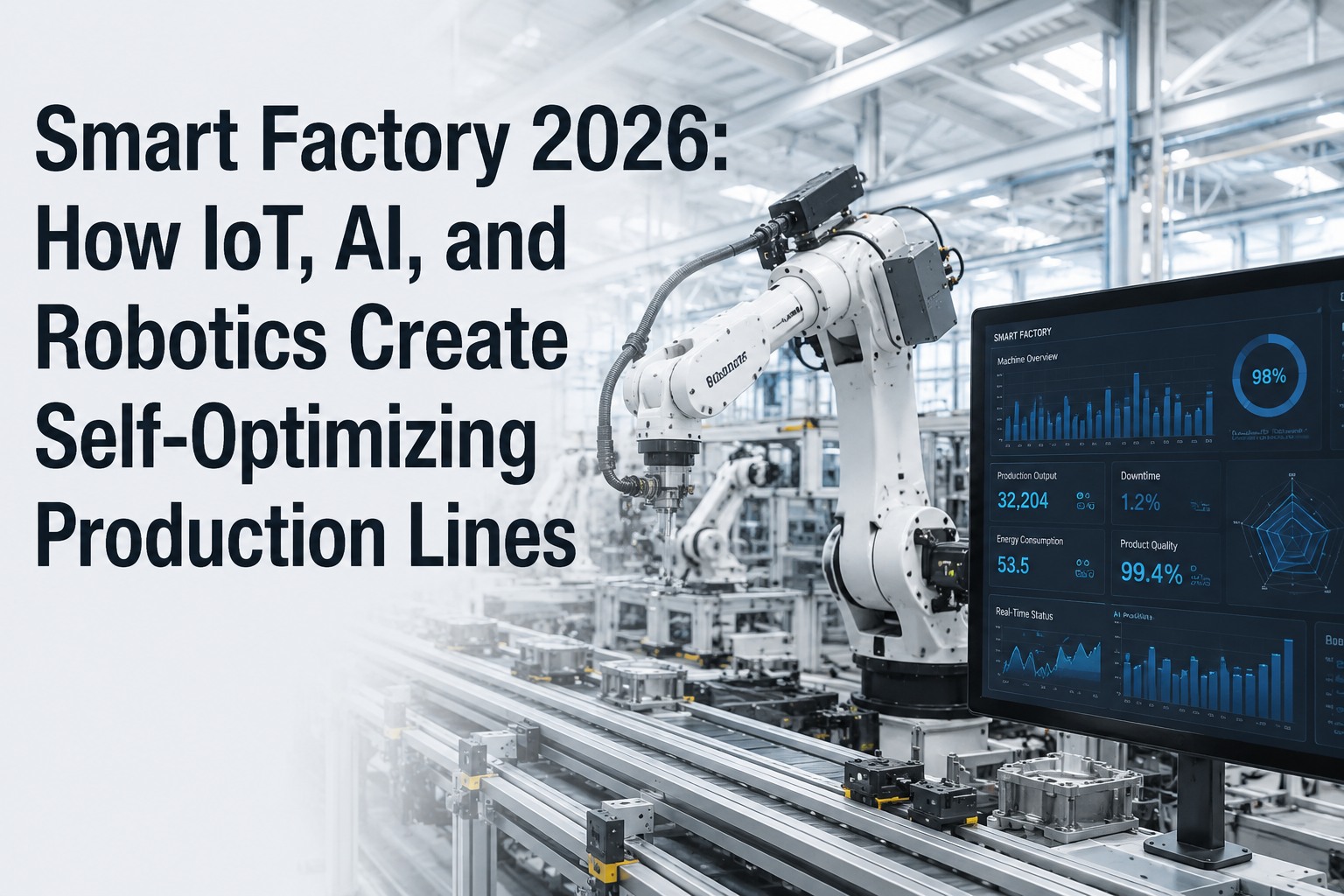
IIoT sensors at every production asset capture vibration, temperature, current draw, and pressure continuously. Edge computing nodes process this data locally in milliseconds—no cloud latency. Standard protocols (OPC-UA, MQTT, Modbus TCP) connect directly to Siemens S7, Allen-Bradley, Rockwell, and Schneider platforms without PLC reprogramming. Every machine talks to the intelligence layer, 24/7.
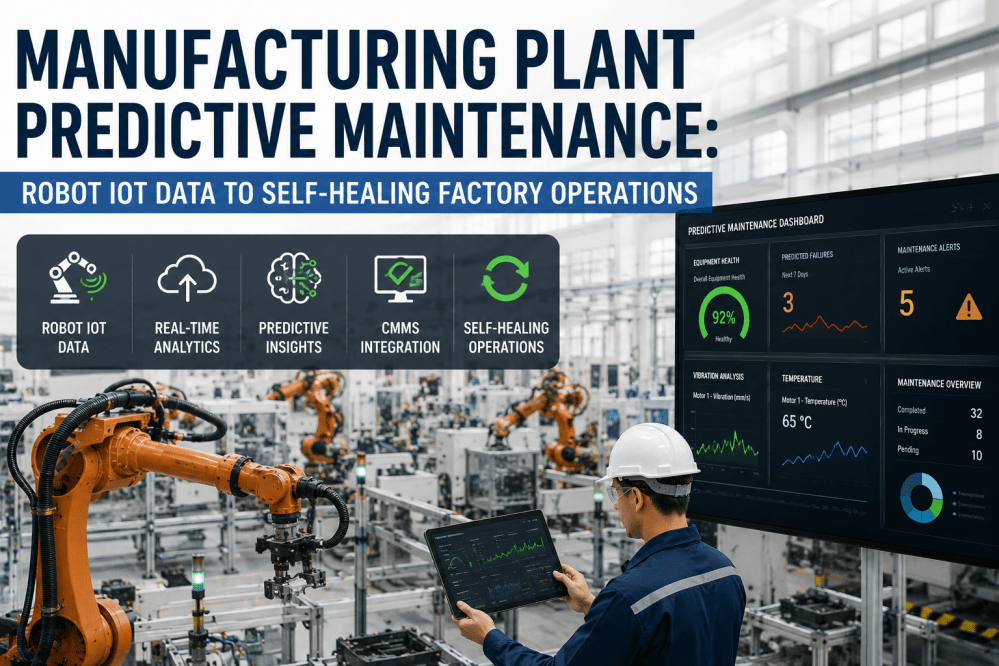
AI models trained on equipment baseline data detect bearing degradation, seal wear, and alignment drift 2–4 weeks before failure. The system automatically generates a work order with equipment ID, failure mode, recommended parts, and optimal service window. Maintenance teams act during planned windows—not at 2 AM. Maintenance costs drop 40–60% as emergency repairs become scheduled interventions. Book a demo: see predictive alerts on your equipment.
When line 3 drops from 84% OEE to 71% at 10:23 AM, a supervisor with real-time visibility can intervene at 10:26 AM—before the shift target is at risk. The same drop detected from monthly reporting arrives a month later, after 30 days of identical losses. Real-time OEE dashboards show availability, performance, and quality losses by line, shift, and product—so supervisors can act in the moment they matter.
From SCADA Connection to Predictive Alerts in 8 Weeks
Read-only connections to SCADA, PLC, and historian systems via OPC-UA, MQTT, or REST API. Real-time data flows begin. Zero production disruption.
12 months of historian data ingested. Equipment baseline signatures established. AI models trained and validated against known failure events.
Predictive maintenance alerts live. Work orders auto-generated. First prevented failures deliver immediate ROI—typically 5–10% downtime reduction in month one.
Real-time OEE live across all lines. Digital shift logbooks replace paper. Model refinement begins. 30%+ downtime reduction on track within 90 days.
Smart Factory Results: Real Manufacturing Use Cases
Tier-1 supplier with 150+ PLC-controlled robots. Unplanned downtime at 18–24%, hitting delivery commitments. iFactory predictive alerts prevented servo failures and conveyor bearing failures 2–4 weeks in advance. Downtime dropped to 8–12% within 12 weeks.
Four filling lines averaging 58% OEE. Real-time dashboards identified line 3 running 15% below target from recurring seal failures. Predictive alerts enabled pre-failure replacement. OEE reached 85% in 8 weeks.
FDA 21 CFR Part 11 regulated facility spending 8–12 weeks annually on compliance packages. Digital shift logbooks and automated work orders eliminated manual compilation. Audits that took weeks now complete in 2–3 days.
See Smart Factory AI Running on Your Equipment
iFactory connects to your existing SCADA and PLC systems in 8 weeks—no hardware replacement. First predictive alerts prevent failures by week 6. Book a 30-minute demo configured for your production environment.
iFactory vs. Legacy CMMS: What Actually Differentiates Smart Factory Platforms
| Capability | iFactory | IBM Maximo | SAP EAM | Fiix |
|---|---|---|---|---|
| AI Predictive Maintenance | 2–4 week failure prediction | Limited ML, heavy customization | No native AI capability | Basic failure trending only |
| Real-Time OEE Tracking | Pre-built by line, shift, product | Requires custom development | Separate MES integration needed | No OEE feature |
| SCADA/PLC Integration | Native OPC-UA, MQTT, REST API | Requires middleware/integrator | Requires SAP connector | REST API only |
| Deployment Speed | 8 weeks, ROI by week 6 | 6–12 months with consultants | 9–18 months enterprise | 10–14 weeks |
| Compliance Automation | FDA 21 CFR Part 11, ISO pre-built | Custom audit trail setup | Custom compliance module | Limited support |
Frequently Asked Questions
"Before iFactory, we were reactive firefighters. Now we have 2–4 weeks advance warning on failures. Downtime dropped 30%, our maintenance team stopped working weekends on emergency repairs, and OEE dashboards showed us two of our four lines were chronically underperforming—something we couldn't see in monthly reports. Deployment took 8 weeks, ROI by week 6."
— Plant Operations Director, Tier-1 Automotive Supplier, 350+ employees
Stop Reacting to Failures. Start Predicting Them.
iFactory connects to your existing SCADA/PLC systems, deploys in 8 weeks, and delivers predictive maintenance intelligence that prevents production stoppages before they happen. Book a 30-minute demo for your facility.


.png)