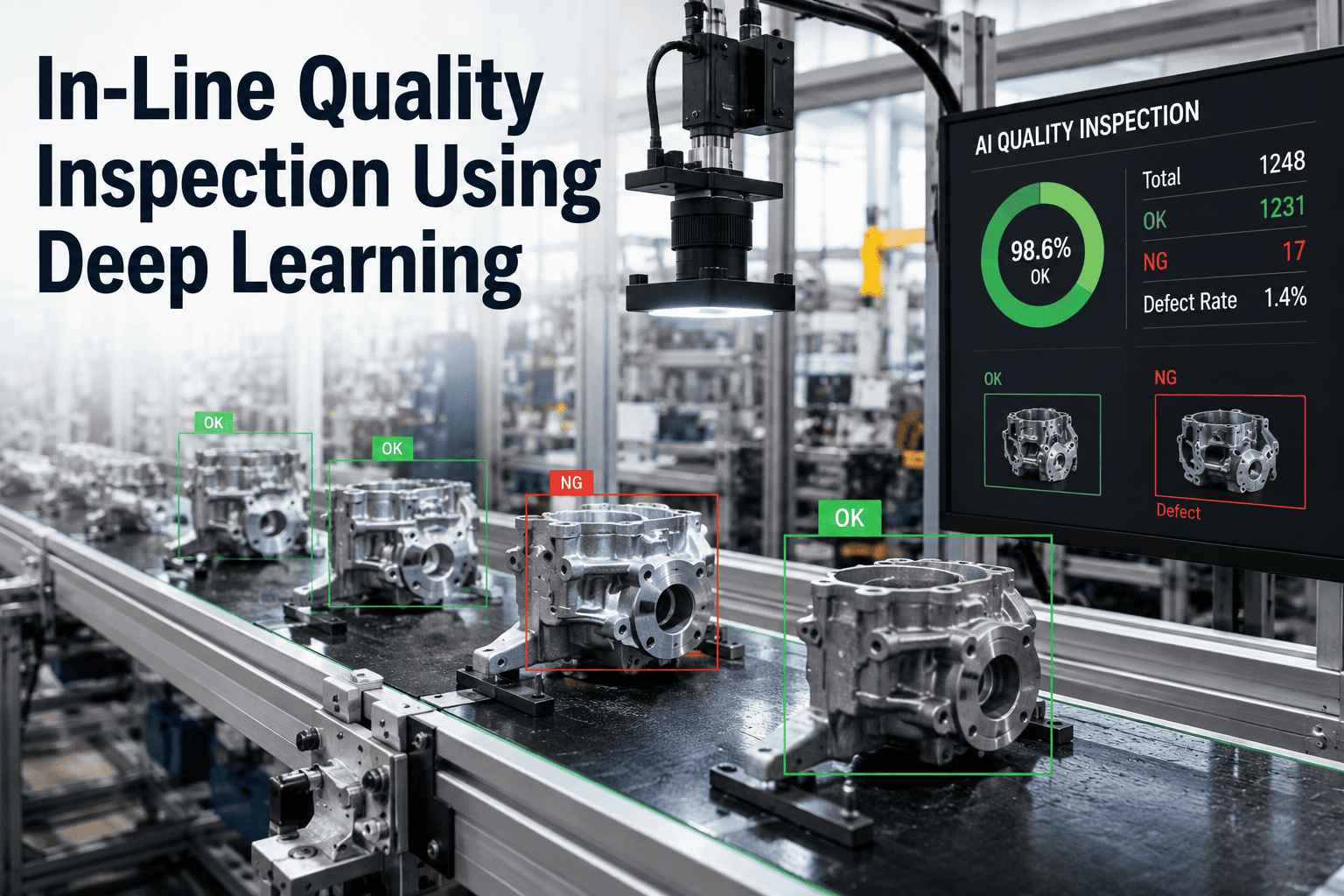
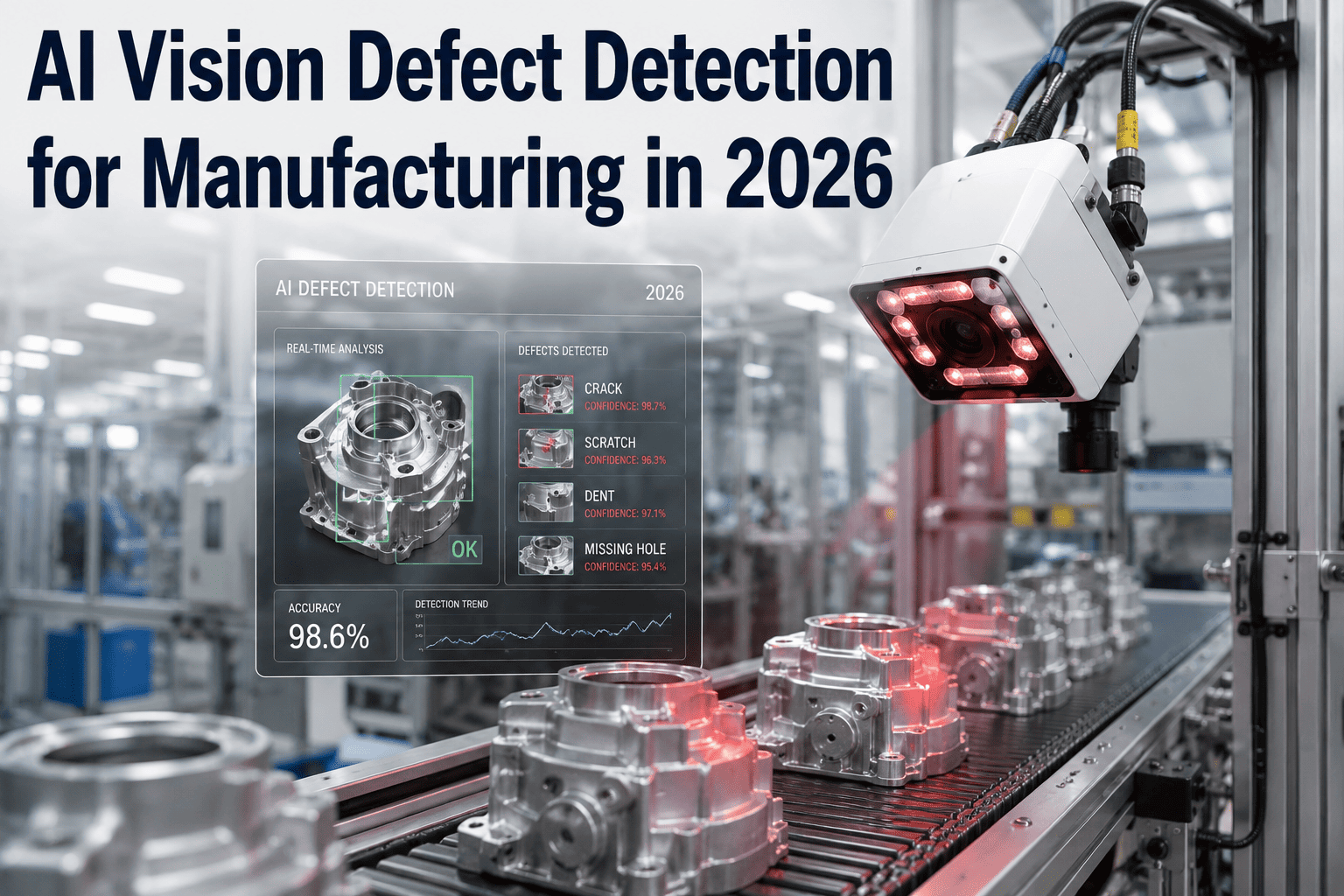
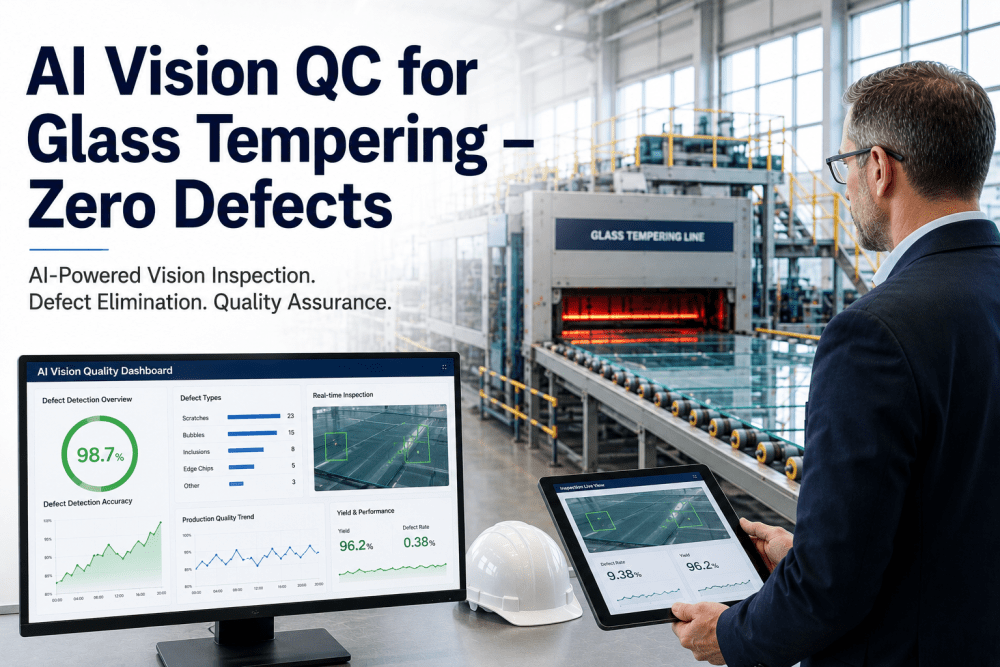
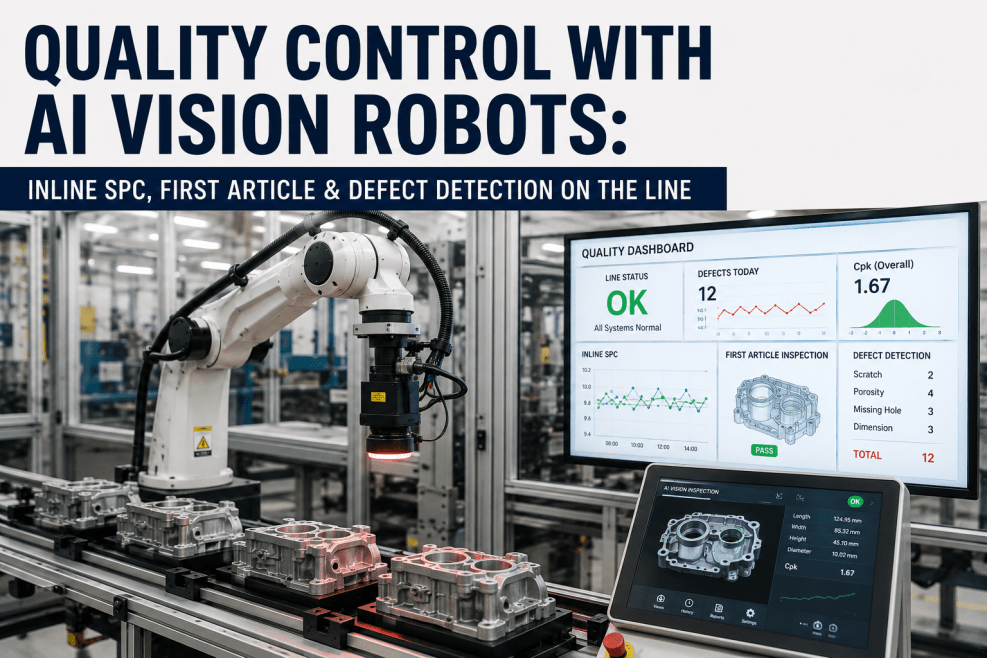
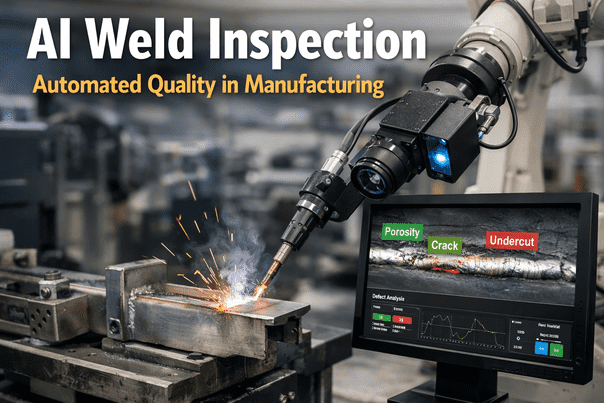
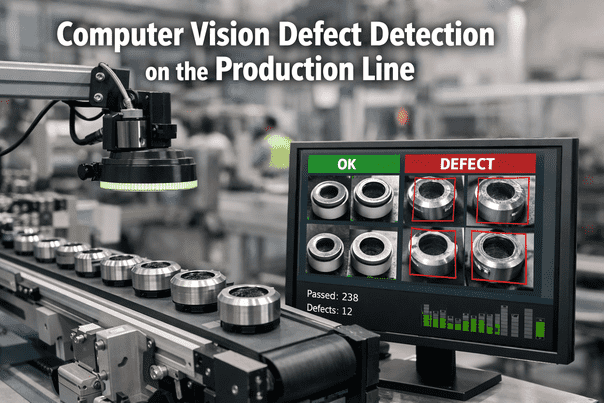
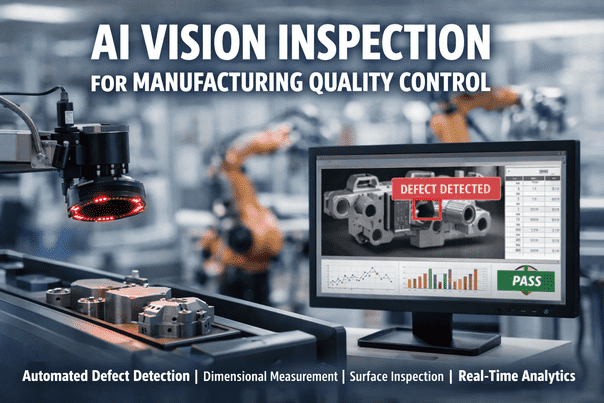
Manufacturing facilities lose an estimated $3.4 billion annually to defective products that slip past human inspectors — field failures, costly recalls, and rework expenses that erode margins on every production run. Traditional visual inspection, relying on trained workers performing repetitive checks at line speed, achieves 70–85% defect detection at best. AI vision inspection systems are closing that gap permanently, achieving 99.5%+ detection accuracy while inspecting 100% of products at full production speed — something no human team can match consistently across shifts. Book a Demo to deploy AI vision inspection across your manufacturing facility.
99.5%+
Defect detection accuracy at full production speed
100%
Product inspection vs. statistical sampling in manual QC
68%
Reduction in defect escape rate post AI vision deployment
8 wks
From line audit to live AI vision monitoring go-live
AI Vision Catches What Your Team Can't. At Full Line Speed.
The Complete AI Platform for Manufacturing Operations monitors 100% of products at production speed, integrates with your SCADA and MES systems, and generates real-time quality compliance documentation — preventing the defect escapes that cause recalls, chargebacks, and warranty claims.
Why Human Visual Inspection Fails at Scale
Human inspectors are extraordinary at detecting novel, unexpected problems — but poor instruments for consistent, high-speed repetitive inspection. Fatigue sets in within hours on a production line. Lighting conditions shift between shifts. Inspector attention degrades by 30–40% after the first two hours of focused visual work. Statistical studies across automotive, electronics, and food processing industries consistently find that human inspection catches between 70% and 85% of defects under optimal conditions — dropping significantly during night shifts, end-of-shift periods, and high-throughput runs.
Fatigue & Attention Degradation
Visual attention peaks within the first 30 minutes of an inspection task and degrades measurably over a 4-hour block. Defect escape rates increase up to 2× during the final hour of a shift compared to the opening period. AI systems maintain constant attention across every product, every minute, every shift without performance variance.
Statistical Sampling vs. 100% Inspection
Most facilities inspect 5–15% of output through sampling protocols. Statistically, a batch with 2% defect rate will pass a 10-sample AQL inspection 82% of the time. AI vision inspects every unit at line speed, converting sampling probability into certainty at no additional throughput cost.
Subjectivity and Standard Drift
Human inspectors interpret quality standards differently. What one inspector passes, another rejects. Over months, standards drift as cultural tolerance for marginal parts develops within teams. AI vision applies identical, immutable criteria to every part — eliminating inter-inspector variability and standard drift entirely.
The financial consequences compound beyond the immediate cost of defective parts. A single field failure in automotive components can trigger recalls costing tens of millions. In electronics, a defective solder joint discovered after PCB assembly means rework costs 10–50× higher than catching it at the solder stage. See how iFactory maps AI vision to your specific defect profile — book a 30-minute demo.
How AI Vision Inspection Systems Work
Modern AI vision inspection combines high-resolution industrial cameras, structured lighting systems, and deep learning neural networks trained on thousands of defect examples specific to your product type. Unlike older rule-based machine vision — which required engineers to manually define every defect pattern — deep learning models learn what good and defective parts look like from labeled image datasets, generalizing to new defect variations without reprogramming.
01
Image Capture & Illumination
Industrial cameras capture 2D and 3D images at speeds matching line throughput. Structured lighting — darkfield, brightfield, coaxial, or laser profilometry — reveals surface defects, dimensional deviations, and texture anomalies invisible under ambient lighting conditions.
02
Deep Learning Classification
Convolutional neural networks analyze captured images against learned defect signatures. Models trained on facility-specific defect libraries identify scratches, cracks, dimensional deviations, assembly errors, and surface contamination with sub-millimeter precision at full production speeds.
03
Real-Time Decision & Rejection
Defect classifications trigger immediate part rejection signals to line control systems within milliseconds of capture. Good parts continue downstream without interruption. Rejected parts are diverted for secondary review, rework routing, or scrap — maintaining throughput while eliminating defect escape.
04
Process Feedback Integration
Defect pattern analysis feeds upstream process parameters — detecting when a tool is wearing, a fixture is drifting, or a material batch has changed before defect rates spike. AI vision becomes a continuous process monitor, not just a pass/fail gate at line end.
05
SCADA & MES Integration
Vision system outputs connect to SCADA, PLC, and MES platforms — logging inspection results against lot numbers, shift data, equipment IDs, and operator records. Full traceability enables root cause analysis, supplier quality correlation, and regulatory documentation without manual entry.
06
Continuous Model Improvement
Active learning pipelines capture borderline cases for expert review, continuously retraining models on new defect variations. Systems improve over time rather than degrading — unlike human inspectors whose standards drift. Each facility generates proprietary defect intelligence that compounds as a competitive advantage.
Defect Types AI Vision Detects That Humans Miss
The most valuable capability of AI vision systems is catching the subtle, consistent, repeatable defects that human inspectors habituate to and begin overlooking over time. Micro-scratches below 50 microns, color shifts of 2–3 ΔE units, and dimensional deviations of 0.1mm are routinely missed by trained human inspectors working at line speed.
Surface Defects
Scratches, gouges, pitting, oxidation, discoloration, coating voids, surface porosity, and contamination. AI vision detects features as small as 10–50 microns depending on camera resolution and lighting configuration — well below the threshold of reliable human detection at production speeds.
Dimensional & Geometric Deviations
3D profilometry detects warpage, burrs, missing features, incorrect hole placement, thread profile deviations, and edge breakage. Measurement repeatability of ±5 microns is achievable in production environments where manual gauging achieves ±50 microns at best.
Assembly Errors
Wrong component placement, missing fasteners, incorrect orientation, improper seating, and incorrect label application. AI vision verifies every assembly attribute against defined specifications simultaneously — a task requiring multiple human inspection stations sequentially.
Process-Induced Defects
Weld spatter, solder bridges, incomplete fusion, adhesive voids, delamination, and molding flash. Pattern analysis across multiple units identifies when process-induced defect rates are increasing — providing early warning before defect escape rate exceeds acceptable thresholds.
Your production lines have a specific defect signature shaped by your materials, processes, and equipment age. See iFactory's AI vision detecting defects from your industry category in a live demo configured for your product type.
Integration With Production Lines, SCADA, and MES
Standalone vision systems that generate inspection data in isolation create partial value. The transformative capability comes from connecting AI vision outputs to the production systems already controlling your facility — so defect detection triggers automatic process corrections, work orders, and traceability records without manual intervention between systems.
iFactory integrates with Siemens, Allen-Bradley, Schneider Electric, ABB, and GE SCADA/PLC systems via OPC-UA and Modbus protocols. Connections to MES platforms (SAP ME, Opcenter, Plex) and CMMS systems (IBM Maximo, SAP PM, Fiix) create end-to-end quality traceability from raw material through finished goods shipment. When AI vision detects a defect pattern indicating process drift — for example, a progressive dimensional deviation suggesting tool wear — the system automatically generates a maintenance work order with full defect image evidence attached, flags the associated production lot for enhanced inspection, and notifies the process engineer via mobile alert. The interval between defect detection and corrective action compresses from hours to minutes.
SCADA/PLC Integration
Real-time equipment parameter monitoring connected to vision defect patterns. Automatic detection of process changes — spindle load increases, temperature drifts, pressure variations — correlated with defect rate changes. Process engineers notified before defect rates breach acceptable thresholds.
MES Traceability Logging
Every inspection result logged against lot numbers, equipment IDs, shift data, and operator records without manual entry. Full inspection history available for regulatory audits and customer quality documentation. Supplier quality correlation enables incoming material quality predictions.
CMMS Work Order Generation
Defect pattern analysis automatically generates maintenance work orders in IBM Maximo, SAP PM, or Fiix when equipment degradation signatures are detected. Work orders include full defect image evidence, trend data, and affected lot information — eliminating manual defect investigation and report compilation.
Use Cases and KPI Results from Live Deployments
These outcomes are drawn from iFactory AI vision deployments at operating manufacturing facilities across three quality inspection application categories. Each use case reflects 6-month post-deployment performance data. Request the full case study report for the inspection application most relevant to your facility.
A Tier-1 automotive stamping facility producing 4,200 parts per shift was experiencing a 1.8% customer return rate for surface defects — scratches and micro-deformations in Class A visible surfaces that human inspectors were passing under production pressure. Manual inspection covered 100% of parts visually but at speeds that made reliable micro-scratch detection impossible. iFactory deployed AI vision across 4 inspection stations with structured darkfield lighting specifically configured for metallic surface defect revelation. Within 6 weeks of go-live, the system was detecting 99.3% of defects previously escaping to customer receipt.
99.3%
Defect detection rate vs. 74% human baseline
$1.2M
Annual warranty cost reduction from eliminated defect escapes
Zero
Customer returns for surface defects in 6 months post-deployment
An electronics contract manufacturer producing 1,800 PCBs per shift was using legacy AOI equipment generating 12–15% false-positive rates — flagging boards as defective when actual defect rate was 2.1%. Technicians manually reviewing AOI rejects were passing approximately 40% of flagged boards, consuming 2.3 hours of technician time per shift without commensurate defect prevention. iFactory's AI vision module integrated with existing camera infrastructure while replacing the classification algorithm with a deep learning model trained on 8,000 facility-specific defect images. False positive rate dropped to 1.8% while true detection rate improved to 99.1%.
88%
Reduction in false positive rate freeing technician capacity
$680K
Annual rework cost avoidance from upstream defect interception
99.1%
True defect detection rate vs. 82% with legacy AOI system
A fast-moving consumer goods facility packing 14,000 units per hour across 3 packaging lines was experiencing label placement errors, barcode illegibility, and lot-code printing failures at a combined rate of 0.4% — generating 56 non-conforming units per hour escaping to distribution. Manual end-of-line audit caught approximately 60% of packaging defects, with the remainder discovered during retailer receiving or consumer complaints. iFactory AI vision deployed across all 3 lines simultaneously, verifying label placement, barcode scan quality, lot code legibility, and cap torque via vision estimation at full line speed.
100%
Label and barcode verification at full 14,000 UPH throughput
$420K
Annual cost reduction from eliminated retailer chargebacks
96%
Reduction in packaging non-conformances reaching distribution
Results Like These Are Standard. Not Exceptional.
Every iFactory AI vision deployment is scoped to your specific product types, defect profiles, and production line configurations so you get detection performance calibrated to your operations — not generic benchmarks.
How iFactory AI Vision Compares to Standalone Solutions
Standalone machine vision systems deliver inspection capability in isolation. iFactory's AI vision module delivers inspection capability connected to your entire manufacturing operations platform — maintenance, OEE, shift management, compliance documentation, and process control — creating value multipliers unavailable from point solutions.
| Capability |
Standalone Vision Systems |
iFactory AI Vision Platform |
| Defect Detection Intelligence |
Rule-based or basic deep learning. Models require specialist reprogramming for new defect types or product changeovers. Detection accuracy does not improve post-deployment. |
Continuously improving deep learning models trained on facility-specific defect libraries. Active learning captures new defect types automatically. Accuracy improves over deployment lifetime without reprogramming cycles. |
| Process Feedback Integration |
Inspection results stored in standalone system. Process engineers manually review reports to identify upstream causes. Lag between detection and corrective action measured in hours to days. |
Defect patterns automatically trigger upstream process alerts, maintenance work orders, and process parameter adjustments via SCADA integration. Corrective action lag reduced to minutes from detection event. |
| Traceability & Documentation |
Inspection records in proprietary vision system database. Manual export required for MES integration. Limited lot-level traceability without additional integration work and engineering effort. |
Automated traceability logging against lot numbers, equipment IDs, shift data, and operator records in MES. Full inspection history available for regulatory audits without manual compilation. |
| OEE Impact Visibility |
Rejection rate data available but not connected to OEE calculations. Quality losses not automatically quantified in production efficiency metrics alongside availability and performance data. |
Defect rates feed directly into OEE quality metric calculation. Quality losses visible alongside availability and performance data providing complete production efficiency picture in one dashboard. |
| Deployment Timeline |
4–9 months for installation, model training, and integration with existing systems. Significant engineering resource requirement for facility-specific configuration and timeline uncertainty. |
8-week fixed deployment program. Live inspection on pilot lines by week 4. Full facility coverage by week 8. Pre-built integration templates for major SCADA, PLC, and MES platforms eliminate configuration delays. |
8-Week Deployment and ROI Plan
iFactory's AI vision deployment follows a structured 8-week program with defined deliverables per phase — eliminating the open-ended timelines and scope creep common to vision system integrations. Measurable defect detection improvement begins at week 4 pilot validation, before full facility rollout completes. Request the full 8-week deployment scope document tailored to your manufacturing operations.
Weeks 1–2
Line Audit & Architecture
Production line survey identifying inspection points, product geometry, defect type history, and throughput requirements. Camera selection, lighting configuration specification, and SCADA and MES integration architecture design.
Defect image library collection from existing quality records, physical sample parts, and synthetic augmentation techniques building the training dataset for facility-specific model development.
Weeks 3–4
Model Training & Pilot
Deep learning model trained on facility-specific defect library. Pilot deployment on 1–2 highest-priority inspection points with live defect detection results available for accuracy validation from day one of go-live.
First ROI evidence: defects caught before downstream operations confirms value of interception versus escape cost. Training certification lapses and compliance gaps identified enabling proactive scheduling.
Weeks 5–6
Calibration & Expansion
Pilot accuracy validated, detection thresholds calibrated to minimize false positive burden on operators. Coverage expanded to remaining inspection points across the full facility.
Team training on vision system interface, exception handling procedures, and model feedback workflows completed. MES traceability logging and SCADA process feedback integration activated.
Weeks 7–8
Full Production Go-Live
Complete facility AI vision coverage live across all shifts, all lines, 24/7 continuous defect detection with full SCADA process feedback and MES traceability logging active across entire manufacturing operation.
Quality baseline report delivered quantifying defect escape rate reduction, false positive performance, and projected annual cost avoidance from prevented defect escapes and warranty claim elimination.
ROI IN 6 WEEKS: MEASURABLE RESULTS FROM WEEK 4
Manufacturing facilities completing the 8-week program report zero defect escapes to customer in first 6 months of full production monitoring with defect detection improving from 74% baseline (human inspection) to 99.5%+ continuous AI verification by week 4 pilot validation.
Zero
Defect escapes in first 6 months post-deployment
99.5%+
Detection accuracy by week 4 pilot validation
68%
Reduction in defect escape rate post full deployment
Full AI Vision Platform. Live in 8 Weeks. Detection Evidence in Week 4.
One Platform for Smart Manufacturing with AI-Powered Vision Inspection, OEE, and Operations. iFactory's fixed-scope deployment program means no open timelines, no extended camera configuration, and no integration delays before you see quality performance improvements on your production lines.
Frequently Asked Questions
How many defect images are needed to train the AI vision model for our product?
iFactory's model training methodology is designed for manufacturing realities where pristine labeled datasets don't exist. We combine existing quality records, physical sample parts, and synthetic data augmentation techniques to build effective detection models from as few as 300–500 defect examples per defect class. We assess your available data during the week 1–2 audit and specify exactly what collection is needed before model training begins.
Book a demo to discuss training data requirements for your specific product types.
Will AI vision work at our production line speed — we run 600+ parts per minute?
Yes. iFactory's vision architecture is designed for high-throughput manufacturing environments. Camera and processing configuration is specified to match your exact line speed during the audit phase. At 600 parts per minute, inspection cycles of 100 milliseconds per part are achievable with current industrial camera and edge processing hardware. Every installation is specified for the throughput, product geometry, and inspection requirements of your specific lines — not deployed as generic off-the-shelf hardware.
What happens when we introduce new product variants or change specifications?
Product changeovers are managed through the iFactory platform interface — quality engineers define new inspection specifications and defect acceptance criteria for new variants without requiring engineering intervention. For significant geometry changes, model retraining typically requires 1–3 days with available sample parts. For minor specification changes, threshold adjustments are made in the platform interface in minutes.
How does iFactory handle the false positive problem — our team can't manually review thousands of rejects per shift?
False positive management is a primary design objective. During weeks 5–6 calibration, detection thresholds are tuned specifically to your facility's tolerance for false rejection versus defect escape risk — the tradeoff is yours to define. Active learning continuously improves classification confidence on borderline cases, reducing false positive burden over time rather than holding it constant.
Can iFactory support multi-facility AI vision deployment for centralized quality management?
Yes. Multi-facility deployments provide centralized defect trend visibility across all sites with facility-specific inspection configurations, local edge processing for line-speed decisions, and enterprise dashboards for comparative quality performance. Defect models trained at one facility transfer to similar equipment and product types at other locations — accelerating deployment and enabling enterprise-wide defect intelligence.
Talk to a specialist about multi-facility vision deployment architecture.
Stop Shipping Defects. Deploy AI Vision Inspection in 8 Weeks.
iFactory gives manufacturing quality teams 99.5%+ defect detection at full production speed — connected to SCADA, MES, and maintenance systems — deployed in 8 weeks with measurable defect escape reduction starting in week 4. No open-ended timelines. No scope creep.
99.5%+ detection accuracy at full line speed
100% product inspection vs. statistical sampling
SCADA/MES integration in under 2 weeks
Active learning model improves continuously post-deployment