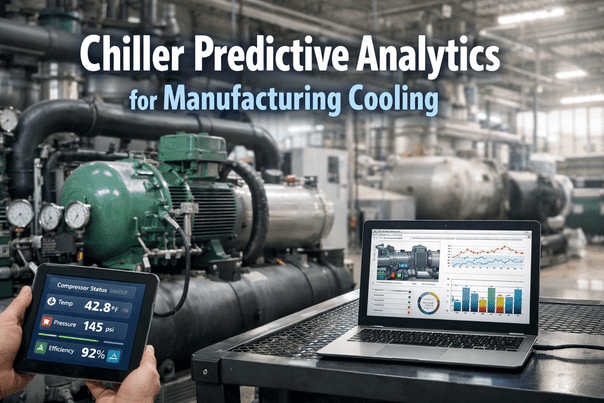
Manufacturing plants relying on heat exchangers for process cooling, steam generation, or thermal recovery face a persistent operational challenge: gradual fouling, tube corrosion, and thermal efficiency drift often go undetected until energy costs spike, production slows, or unplanned shutdowns occur. With heat exchangers accounting for up to 40% of a plant's thermal energy use, manual inspection logs and calendar-based cleaning schedules miss critical performance indicators — resulting in avoidable energy waste, reduced throughput, and compliance gaps against ISO 50001 and OEM maintenance standards. iFactory AI Heat Exchanger Maintenance connects directly to your SCADA, PLC, and IoT sensor networks to monitor thermal differential pressure, flow rates, and fouling indicators in real time — automating cleaning alerts, generating predictive maintenance work orders, and delivering audit-ready performance logs for energy compliance reviews. Book a Demo to see how iFactory reduces heat exchanger downtime by 45% within 6 weeks of deployment.
How iFactory Solves Heat Exchanger Maintenance & Energy Efficiency Challenges
Traditional heat exchanger maintenance relies on calendar-based cleaning, manual thermal calculations, and reactive failure response — all of which introduce missed fouling windows, energy waste, and costly compliance gaps. iFactory replaces this with a unified AI maintenance platform built for shell-and-tube, plate, and air-cooled heat exchanger workflows that automates real-time performance monitoring, integrates multi-sensor telemetry with machine learning models, and generates audit-ready energy logs for ISO 50001, OEM warranties, and internal efficiency reviews. See a live demo of iFactory detecting thermal drift, fouling buildup, and cleaning effectiveness across your manufacturing heat exchanger assets.
6-Week Deployment and ROI Plan
Every iFactory engagement follows a structured 6-week program with defined deliverables per week — and measurable ROI indicators beginning from week 3 of deployment. No open-ended implementations. No production disruption. Request the full 6-week deployment scope document tailored to your heat exchanger maintenance needs.
Use Cases and KPI Results from Live Manufacturing Deployments
These outcomes are drawn from iFactory deployments at operating manufacturing plants across three critical heat exchanger applications. Each use case reflects 6-month post-deployment performance data. Request the full case study report for the heat exchanger type most relevant to your facility.
Prevent Thermal Efficiency Loss with AI-Powered Real-Time Monitoring
Book a Demo for This Use CaseEliminate Cleaning Guesswork With Continuous Multi-Parameter Analytics
Book a Demo for This Use CaseAutomate Condenser Performance Monitoring With Real-Time Thermal Analytics
Book a Demo for This Use CaseRegional Compliance Support: Built for Manufacturing Energy Standards
iFactory's heat exchanger maintenance platform is pre-configured to meet the documentation and reporting requirements of major industrial energy frameworks. No custom development needed — compliance reporting is automatic.
| Region | Key Challenges | Compliance Frameworks | How iFactory Solves |
|---|---|---|---|
| United States | High energy costs, EPA emissions reporting, OEM warranty requirements | ISO 50001, EPA 40 CFR Part 60, OEM maintenance manuals | Pre-built ISO 50001 templates, EPA-ready energy logs, OEM-specific maintenance documentation, automated warranty claim support |
| United Kingdom | Post-Brexit supply chain complexity, legacy equipment integration, skilled labor constraints | ISO 50001, UK CA marking, OEM quality standards, GDPR data handling | Legacy PLC connector library, GDPR-compliant data handling, automated UK CA documentation, mobile-first interface for distributed teams |
| UAE | Extreme ambient conditions, rapid facility expansion, multi-OEM supplier networks | ISO 50001, ESMA standards, OEM maintenance protocols, Arabic documentation requirements | Heat-calibrated monitoring models, Arabic-language mobile interface, ESMA-aligned energy logs, multi-OEM maintenance classification support |
| India | High-volume production scaling, cost-sensitive operations, diverse equipment portfolios | ISO 50001, BIS standards, OEM maintenance guidelines, local energy regulations | Cost-optimized deployment templates, BIS-aligned reporting, multi-language support, automated local regulatory documentation |
| Europe | Stringent emissions-linked energy rules, multi-country supply chains, legacy system diversity | ISO 50001, EU Ecodesign Directive, country-specific energy mandates | EU Ecodesign-ready logs, multi-country compliance templates, legacy system integration library, automated cross-border energy reporting |
Competitor Comparison: Why Manufacturing Leaders Choose iFactory
When evaluating heat exchanger maintenance platforms, manufacturing energy teams compare capabilities across AI accuracy, integration ease, predictive power, and manufacturing-specific fit. The table below shows how iFactory delivers superior outcomes versus leading alternatives.
| Platform | AI Capability | Predictive Maintenance | SCADA Integration | Deployment Speed | Manufacturing Fit |
|---|---|---|---|---|---|
| iFactory | Multi-sensor fusion AI trained on thermal signatures; 92% fouling detection accuracy | Links thermal patterns to equipment health; predicts heat exchanger degradation | Native OPC-UA, Modbus, REST; 10-day PLC/MES integration | 6-week fixed deployment with pilot validation | Built for shell-and-tube, plate, air-cooled exchangers; ISO 50001 native |
| QAD Redzone | Rule-based alerts; limited thermal analytics; manual threshold configuration | Basic equipment monitoring; no thermal-to-health correlation | Custom API development required; 8–12 week integration timeline | Desktop-centric; complex workflow builder; 3+ day training | General manufacturing focus; requires customization for thermal workflows |
| Evocon | OEE-focused analytics; no thermal detection AI; manual energy logging | Production monitoring only; no predictive thermal insights | Limited PLC connectors; manual data mapping required | Simple dashboards; limited mobile support | Assembly line optimization; not designed for heat exchanger maintenance |
| Mingo | Basic thermal checks; single-sensor focus; no multi-parameter fusion | Reactive alerts only; no predictive capability | Cloud-first architecture; limited on-prem options | Intuitive UI; limited role customization | General quality management; lacks thermal-specific maintenance libraries |
| L2L | Workflow automation focus; no native thermal AI | Maintenance scheduling only; no thermal prediction | Heavy customization needed for PLC integration | Complex configuration; steep learning curve | Broad manufacturing; requires extensive setup for thermal maintenance |
| IBM Maximo | Enterprise asset management; AI requires custom development | Advanced predictive maintenance; but not thermal-focused | Complex implementation; 6+ month typical deployment | Powerful but complex; requires specialist administrators | Enterprise-scale; over-engineered for heat exchanger thermal monitoring |
| SAP EAM | Integrated with SAP; AI capabilities require add-ons | Strong asset lifecycle; limited real-time thermal integration | Best with full SAP stack; complex for non-SAP environments | SAP-native users benefit; steep learning for others | ERP-focused; not optimized for heat exchanger thermal workflows |
| Oracle EAM | Asset management core; thermal AI requires third-party integration | Comprehensive maintenance; limited thermal prediction | Oracle ecosystem preferred; custom work for mixed environments | Enterprise UI; requires dedicated admin resources | Broad industrial; lacks thermal-specific maintenance templates |
| Fiix | Work order management; no thermal inspection capabilities | Preventive maintenance scheduling; no predictive thermal | Mobile app focus; limited industrial protocol support | User-friendly mobile; limited desktop analytics | General maintenance; not designed for thermal production systems |
| UpKeep | Asset tracking focus; no computer vision or thermal AI | Basic equipment monitoring; no thermal correlation | Cloud-based; limited offline capability for shopfloor | Simple interface; limited advanced analytics | General CMMS; lacks thermal maintenance workflow support |