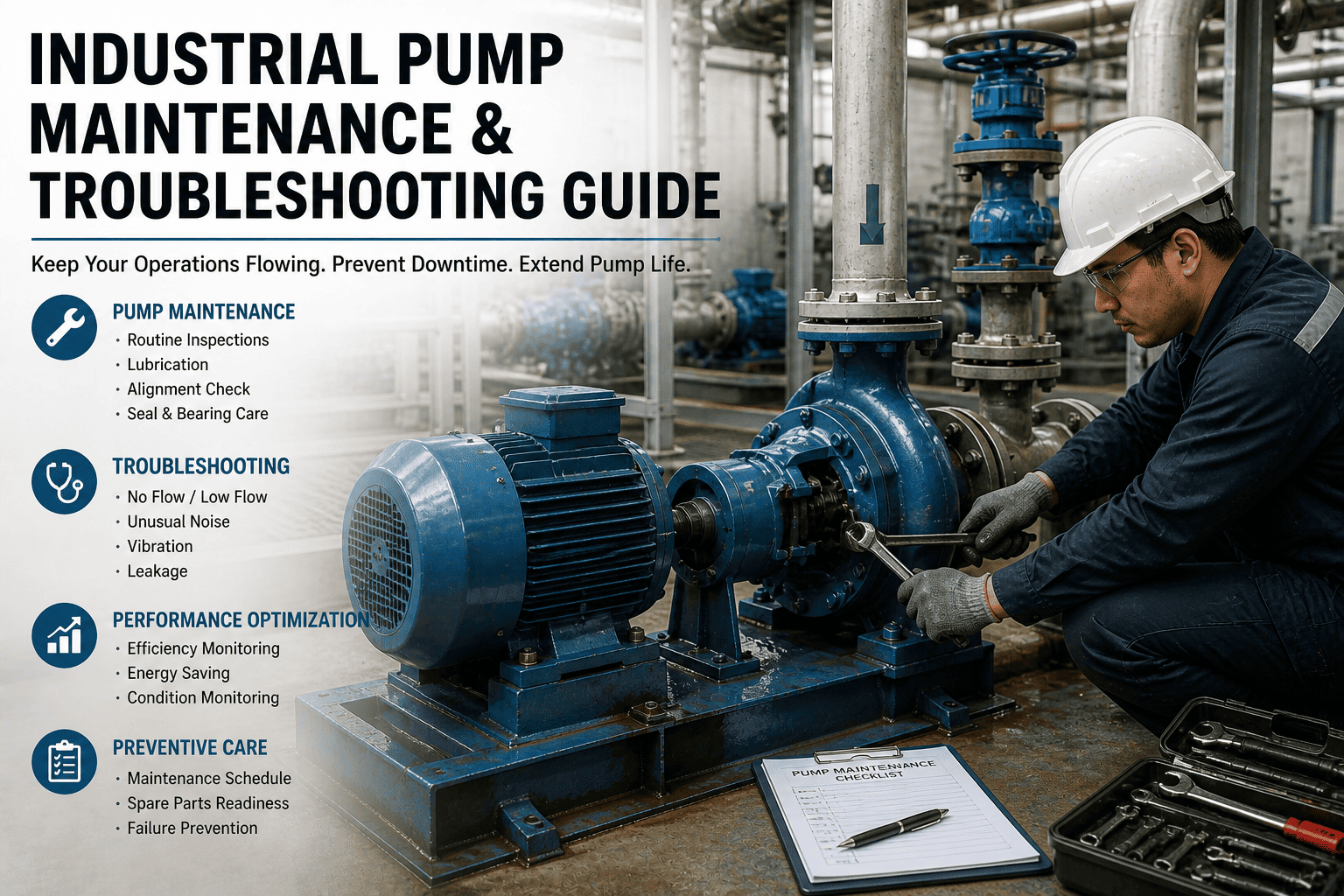
Industrial pumps move coolant through CNC machines, circulate process water through treatment systems, transfer chemicals between reactors, and pressurize hydraulic lines across assembly equipment. A single failed pump in a manufacturing plant does not cause a small delay. It stops the entire production line. A centrifugal pump bearing that fails at mid-shift closes operations for 6-12 hours while maintenance finds a replacement, installs it, primes the system, and restarts production. Unplanned pump failure costs $8,000 to $24,000 in lost production per hour, plus emergency contractor fees if the pump fails after hours. Most pump failures are preventable with a disciplined maintenance programme and early detection of degradation signals. Book a demo to see how iFactory's AI predicts pump failures 7-14 days before they occur.
Industrial Pump Types: Characteristics, Failure Modes, and Maintenance Requirements
Manufacturing plants deploy three dominant pump types, each with distinct failure signatures and maintenance profiles. Understanding the specific pump in your system is the first step to predicting failure before it stops production.
Converts rotational kinetic energy into hydrodynamic pressure. Single impeller design. Used for water circulation, coolant transfer, and general process liquids.
Delivers fixed volume per revolution. Maintains constant flow regardless of pressure. Used for high-viscosity fluids, precise metering, and hydraulic systems.
Pump and motor submerged in process fluid. Used for sump drainage, wastewater transfer, and coolant pit circulation in manufacturing plants.
Common Pump Failure Modes and Detection: How iFactory's AI Predicts Failure
Pump failures do not occur randomly. They follow predictable degradation curves. A bearing begins to wear imperceptibly at 0.5mm radial play. Over 14-21 days, that play increases to 3-4mm, generating increasing vibration. Acoustic sensors detect the vibration signature change. Thermal sensors measure bearing temperature rise. Accelerometers capture the frequency spectrum. An AI model trained on thousands of failed pumps learns the specific pattern signature that leads to catastrophic bearing seizure 7-14 days from now.
Signal: Vibration amplitude increases 15-25% over 10-14 days. Frequency content shifts to higher harmonics. Temperature rises 5-10°C above baseline.
Detection Method: Continuous vibration monitoring via accelerometer. AI-based trend analysis identifies deviation from normal degradation curve.
Lead Time: 7-14 days before seizure. Maintenance schedules bearing replacement during planned maintenance window.
Signal: External leakage appears at seal interface. Flow rate measured at discharge decreases gradually as internal leakage increases.
Detection Method: Flow meter at discharge, temperature sensor at seal, visual monitoring. AI correlates flow loss rate with seal remaining life.
Lead Time: 10-21 days from first visible leakage to complete seal failure. Parts can be ordered and staged.
Signal: Motor current increases while discharge pressure remains constant. Power consumption rises while flow output stays flat.
Detection Method: Current transformer on motor power line. Power analyzer calculates electrical power input vs flow-pressure product.
Lead Time: 5-7 days from first power loss detection to mechanical failure. Cavitation is often the root cause.
Signal: Sudden loss of discharge pressure despite constant motor speed. Suction pressure drops below vapor pressure of fluid.
Detection Method: Pressure sensors on suction and discharge lines. Acoustic signature of cavitation (high-frequency broadband noise).
Lead Time: Hours to days before impeller erosion becomes severe. Immediate corrective action required.
Signal: Vibration increases at pump running frequency. Displacement in radial direction. Pump mounting bolts may loosen.
Detection Method: Accelerometer in radial direction. Phase relationship between vibration and pump rotation. Spike in 1X frequency (pump speed).
Lead Time: 10-21 days before bearing damage from imbalance-induced side loads. Rework or replacement of impeller required.
Signal: Discharge fluid temperature rises 15-25°C above baseline in hours. Motor winding temperature approaches thermal cutout setpoint.
Detection Method: Temperature sensor on discharge line and motor winding (if equipped with RTD). Alert on temperature rate-of-change, not absolute value.
Lead Time: 4-6 hours from first temperature rise to thermal cutout trip. Identify root cause (blockage, cavitation, bearing friction) before restart.
Industrial Pump Maintenance Checklist: Daily, Monthly, Annual
How iFactory Solves Pump Maintenance: Predict Failures Before They Stop Production
iFactory's AI models are trained on historical pump failure data from 1,200+ manufacturing plants. The system learns the specific vibration, temperature, and pressure signatures that precede bearing failure, seal degradation, and cavitation. When a pump enters the degradation zone, iFactory sends a 7-14 day early warning alert — giving maintenance time to order parts, schedule the replacement during planned downtime, and avoid emergency production shutdowns.
Centrifugal pumps, positive displacement pumps, and submersible units all connect through SCADA and PLC systems. iFactory ingests sensor data (pressure, temperature, vibration, flow, current) every 10-15 seconds. Operations and maintenance teams see one unified dashboard: all pumps, their current health status, predictive alerts, and recommended actions.
No rip-and-replace. iFactory integrates with Siemens, Allen-Bradley, ABB, and generic Modbus-based systems. Pressure transmitters, RTD sensors, and acoustic monitoring equipment already in your plant feed data directly into iFactory. No hardware replacement required. Most plants deploy iFactory in 2-3 weeks.
When a pump failure is predicted 10 days out, iFactory automatically generates a maintenance work order, links it to the specific pump, identifies required parts (bearing kit, seal assembly, impeller if needed), and integrates with your ERP procurement system. Maintenance approves the order and stages parts before the predicted failure date. No emergency ordering. No rush fees.
Technicians no longer manually write daily inspection notes on clipboards. iFactory captures pump sensor data continuously and generates digital shift logbooks automatically. Temperature readings, pressure, vibration, and flow measurements are timestamped and stored. Compliance audits pull reports in seconds instead of requiring manual log searches.
Pump downtime directly impacts OEE (Overall Equipment Effectiveness). Unplanned pump stops reduce availability by 8-15%. iFactory tracks planned vs unplanned maintenance. As pump failures shift from reactive to predictive, OEE improves 3-6% on average. Operations teams see the real-time impact on their line efficiency dashboards.
Why iFactory is Different: Built for Manufacturing Plants, Not Generic CMMS
Most CMMS software requires 8-12 weeks of implementation, asset mapping, and training. iFactory deploys in 2-3 weeks. Your SCADA data flows into iFactory immediately. AI models begin learning from day one. First predictive alerts emerge by week 4.
iFactory is purpose-built for pumps, motors, compressors, and production lines. Not adapted from facilities management software. Features like shift-based scheduling, production line downtime correlation, and OEE impact tracking are native to the platform — not add-ons.
Generic maintenance software logs actions. iFactory's AI learns from equipment behavior. As your plant's pumps operate, the AI becomes increasingly accurate at predicting failures specific to your equipment, your operating conditions, and your maintenance practices.
Predictive alerts trigger work orders, which generate parts requisitions, which feed into purchasing — all automatically. Technicians never wait for paperwork. Parts arrive before the maintenance window begins. Downtime is minimized because the workflow is coordinated, not sequential.
AI Implementation Roadmap: 6-Step Path to Pump Failure Prevention
Connect SCADA/PLC systems to iFactory. Sensor streams (pressure, temperature, vibration, flow, current) begin flowing to the platform. Data validation confirms sensor accuracy.
Define each pump: type, model, location, rated capacity, OEM specifications. iFactory builds an equipment registry and links each pump to its sensor streams.
AI observes normal pump operation for 2-4 weeks. Establishes baseline pressure, temperature, vibration, and efficiency profiles for each pump.
AI models go live. When a pump shows degradation patterns that correlate with historical failure data, iFactory sends a predictive alert (7-14 days before failure).
Predictive alerts automatically generate work orders, identify required parts, and feed into procurement. Maintenance schedules replacement during planned downtime.
As the system matures, iFactory optimizes maintenance intervals based on actual failure data. Unnecessary preventive work is eliminated. Reactive maintenance is virtually eliminated.
ROI Timeline: How Quickly You See Results
Real-World Impact: Pump Maintenance Use Cases
Use Case 1: Tier 1 Automotive Supplier — Hydraulic Pump Failure Prevention
A stamping and assembly plant operated 12 hydraulic pumps supplying pressure to 40+ work stations. Unplanned pump failure occurred 3-4 times per year, each closure lasting 8-12 hours. A failed pump cost $24,000 in lost production plus $4,000 in emergency parts and labor.
iFactory deployed vibration sensors on all 12 pumps and integrated with their existing Siemens PLC system. Within the first 6 months, the AI identified 8 pumps entering degradation zones. Maintenance scheduled planned replacements during scheduled downtime. Zero unplanned pump shutdowns occurred. Annual savings: $192,000 in avoided downtime plus $48,000 in reduced emergency maintenance costs.
Use Case 2: Food & Beverage Processing — Centrifugal Pump Seal Monitoring
A dairy processing plant operated 8 centrifugal pumps circulating pasteurized liquid through heat exchangers. Seal failure was the leading cause of unplanned maintenance — averaging 2 seal replacements per pump per year. Each seal replacement required 4-6 hours of downtime and cost $8,000 in parts and labor.
iFactory monitored discharge flow rate, bearing temperature, and motor current on each pump. The AI detected seal degradation 10-14 days before external leakage became visible. Maintenance scheduled seal replacements on a predictive basis during slower production periods. Seal replacement frequency dropped to 0.5 per pump per year. Unplanned maintenance went from 16 events annually to 4. Cost reduction: 35% annual maintenance spend for pump operations.
Use Case 3: Chemical Manufacturing — Submersible Sump Pump Reliability
A chemical plant operated 6 submersible sump pumps draining process tanks. Motor winding insulation failure occurred unpredictably, destroying pumps with no advance warning. Average replacement interval was 3.5 years. Motor and mechanical overhaul cost $12,000 per pump.
iFactory monitored motor winding temperature (via RTD sensors) and motor current draw on each pump. The AI detected early winding stress 30-45 days before insulation failure. Root cause analysis revealed that coolant contamination in the sump was accelerating winding degradation. Maintenance increased filtration and implemented weekly sump contamination monitoring. Motor winding stress indicators normalized. Average pump life extended from 3.5 years to 5.0 years — effectively adding 18 months of life to every pump in the system.
Pump Maintenance Competitor Comparison
| Capability | iFactory | QAD Redzone | Evocon | Mingo | IBM Maximo |
|---|---|---|---|---|---|
| AI Predictive Maintenance | Yes, pump-specific models | No | Basic (rule-based only) | No | Add-on only |
| Real-Time Sensor Integration | PLC, SCADA, Modbus native | Manual data entry | Limited OPC-UA | REST API only | Complex middleware required |
| Deployment Speed | 2-3 weeks | 8-12 weeks | 6-10 weeks | 4-6 weeks | 12-16 weeks |
| Pump Failure Lead Time | 7-14 days | None (reactive only) | 2-3 days (unreliable) | None | None |
| Manufacturing-Specific Features | Yes (OEE, shift scheduling, line correlation) | Generic CMMS | Generic CMMS | Generic mobile app | Enterprise ERP (not focused) |
| Work Order Automation | Triggered by AI alerts automatically | Manual creation only | Semi-automatic | Manual | Manual workflow |
| ROI Realization Time | 6 weeks | 6-12 months | 8-16 weeks | 3-6 months | 12+ months |
Manufacturing Plant Pump Challenges by Region
| Region | Top Challenges | Compliance Standards | How iFactory Solves |
|---|---|---|---|
| North America (US, Canada) | High downtime cost, labor shortage, aging equipment, energy efficiency mandates | OSHA, ISO 9001, energy efficiency reporting | Predictive maintenance reduces downtime by 30-45%. AI-driven work order automation reduces labor demand. Real-time energy tracking shows cost savings. Automated compliance reporting for ISO audits. |
| Europe (UK, EU) | Stringent energy efficiency standards (EN 16001), ATEX compliance for hazardous areas, aging infrastructure | EN 16001, ATEX, ISO 50001 | iFactory tracks pump efficiency degradation. Early seal wear detection prevents leakage of hazardous fluids (ATEX critical). Energy consumption modeling optimizes operating point. Compliance documentation auto-generated for audits. |
| Middle East (UAE, Saudi Arabia) | Extreme temperature stress (50-60°C ambient), water scarcity (high pump criticality), unplanned failure cost, local labor constraints | ARAMCO standards, local HSE requirements | Thermal monitoring catches heat-induced bearing wear early. Cavitation detection prevents catastrophic failure in high-temperature operation. Predictive maintenance compensates for skill gaps in maintenance workforce. Automated alerts reduce response time. |
| India & South Asia | Pump reliability under high ambient temperature, power fluctuations, high cost of unplanned downtime, skill variability | ISO 9001, industry-specific standards (oil & gas, pharma) | Voltage and current monitoring detects power quality issues. Thermal management tracks heat stress from ambient conditions. Predictive alerts trigger maintenance before power-induced failures. AI compensates for variable technician skill levels. |
Core Platform Features for Pump Maintenance
Machine learning models trained on 1,200+ manufacturing plants. Predicts bearing failure, seal degradation, cavitation, and thermal overload 7-14 days in advance.
Automated sensor data capture replaces manual clipboards. Pump pressure, temperature, flow, and vibration logged continuously. Shift summaries generated automatically for compliance.
Predictive alerts automatically generate work orders. Parts requisitions created. Maintenance schedules replacement during planned downtime windows.
Pump availability directly impacts line OEE. iFactory tracks planned vs unplanned downtime. Operations see real-time impact of maintenance decisions on production efficiency.
Native connectors for Siemens, Allen-Bradley, ABB, Schneider, and Modbus systems. No middleware. Data flows directly from your plant floor to iFactory.
Every pump repair, every failure root cause, every maintenance decision is captured and fed into the AI model. System continuously learns from your plant's specific equipment and operating conditions.
Failure predictions trigger work orders automatically. Task lists, parts requirements, and estimated labor hours pre-populated. Technician approval sends order to procurement and scheduling.
ISO 9001, IATF 16949, and plant-specific compliance documented automatically. Audit reports pulled in seconds. No manual log searching.
Frequently Asked Questions
iFactory has native connectors for all major PLC vendors: Siemens (S7-200, S7-300, S7-400, S7-1200, S7-1500), Allen-Bradley (CompactLogix, ControlLogix), ABB, Schneider (M340, M580), and generic Modbus RTU/TCP systems. Pressure transmitters, temperature sensors (RTD/thermocouple), and vibration transducers feed directly into iFactory via existing fieldbus. Installation typically requires 2-3 days of on-site configuration. Book a demo and we'll review your specific system architecture.
Average ROI is 300-400% in Year 1. A manufacturing plant operating 8-12 pumps saves $1.2M-2.4M annually by avoiding unplanned downtime (30-45% reduction) and optimizing maintenance labor. Most plants achieve full payback of iFactory costs within 6 weeks of deployment. Contact support for a customized ROI calculator specific to your plant size and pump criticality.
Bearing failure predictions: 7-14 days. Seal degradation: 10-21 days. Thermal overload: 4-6 hours to days depending on root cause. Cavitation: hours to days. Lead time varies by failure mode and how quickly degradation progresses. Longer lead times allow parts ordering and planned scheduling. Start a free trial to see prediction accuracy on your specific equipment.
iFactory supports all three: centrifugal, positive displacement (gear, screw, piston), and submersible pumps. Each pump type has distinct failure signatures. AI models are specialized for centrifugal bearing wear, PD pump internal leakage, and submersible motor winding stress. Sensor setup varies slightly by type but deployment is straightforward for all.
Typical deployment: 2-3 weeks. Week 1: SCADA integration and asset registry. Week 2: Sensor connections and baseline data collection. Week 3: AI training and first alerts. Zero production disruption. Most sensor connections are non-invasive (pressure taps, temperature clamps, accelerometer mounts). Book a demo to discuss your plant layout and connectivity requirements.
Yes. iFactory auto-generates compliance documentation from sensor data and maintenance actions. ISO 9001 periodic maintenance records, IATF 16949 equipment qualification reports, and plant-specific audit trails are pulled automatically. Reduces compliance documentation time from hours to minutes. Support team can customize compliance templates for your specific industry and standards.