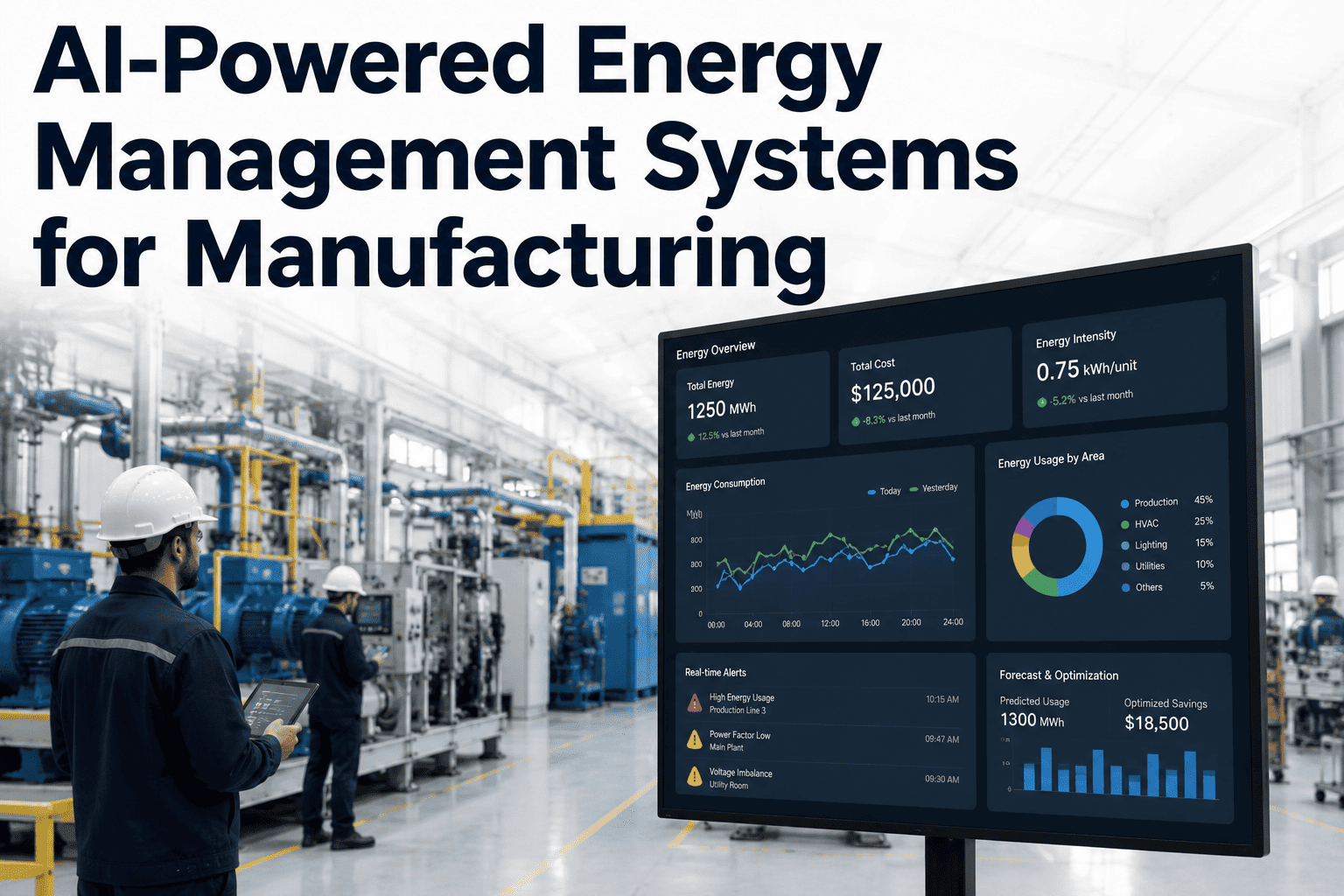
Manufacturing plants consume massive quantities of utilities every second. Compressed air powers pneumatic equipment on production lines, steam drives process heat, chilled water cools production equipment, and electricity runs everything from motors to control systems. Yet most plants lack unified visibility into how efficiently these utilities flow through operations. Compressed air leaks silently through aging piping, steam traps fail undetected, cooling towers operate at degraded capacity, and electrical distribution systems lose power in transformers and cable runs. The result is invisible waste that compounds across thousands of operating hours annually. A typical mid-sized manufacturing facility loses 20 to 35 percent of its compressed air to leaks, spends 30 to 50 percent more on steam generation than thermodynamic efficiency requires, and operates cooling water systems at 40 to 60 percent of design effectiveness. These are not minor inefficiencies. They represent millions in unnecessary energy costs annually. Unified utility systems management with real-time monitoring, predictive maintenance, and integrated control transforms utilities from an invisible cost center into a managed asset class that delivers measurable ROI.
The Complete AI Platform for Manufacturing Operations
Real-time utility monitoring across compressed air, steam, cooling water, and electrical systems. Detect leaks, optimize efficiency, prevent failures, and reduce energy costs by 15 to 30 percent.
Understanding Manufacturing Utility Systems
Modern manufacturing plants depend on four interconnected utility systems that operate continuously across shifts. Each system has distinct efficiency drivers, failure modes, and energy consumption profiles. Understanding these systems is essential for identifying where efficiency improvements deliver measurable ROI.
Pneumatic equipment on production lines consumes enormous quantities of compressed air. Air leaks through aging piping, valve ports, and equipment connections remain undetected until energy bills spike. A single quarter-inch leak at 100 PSI costs $2,500 to $3,000 annually in wasted electricity. Most plants operate 50 to 200 leaks simultaneously.
Steam powers process heat for dryers, presses, and chemical reactors. Failed steam traps allow condensate to return as steam, wasting 25 to 75 percent of thermal energy. Uninsulated piping losses can approach 40 percent of generated heat. Boiler inefficiency from scale buildup and improper tuning adds another 10 to 15 percent.
Cooling towers reject process heat and maintain chilled water for production equipment. Fouled heat exchanger tubes, degraded tower fill material, and improper water treatment reduce cooling capacity. Plants often operate at 40 to 60 percent of design cooling capacity, requiring larger towers and more chiller compressor runtime than necessary.
Electrical systems face transformer losses, cable voltage drops, harmonic distortion from variable frequency drives, and demand charges from peak consumption spikes. Power factor correction opportunities often go unmeasured, and peak demand management requires coordination that most plants lack.
Core Manufacturing Utility Problems
Seven interconnected challenges drive utility inefficiency across manufacturing operations. Traditional CMMS and energy management systems address these in isolation, missing the cross-system opportunities where real savings compound.
20 to 35 percent of compressed air escapes through leaks in piping, connections, and equipment. Detection requires specialized acoustic equipment. Most plants have no systematic leak detection program.
Steam traps fail silently, allowing live steam to escape or condensate to back up. Failure rates reach 15 to 20 percent of installed traps annually. A single failed trap costs $800 to $2,000 per year in wasted steam.
Cooling and chilled water heat exchangers accumulate scale and biological growth. Fouling reduces heat transfer coefficient by 20 to 50 percent, requiring larger towers, more compressor runtime, and increased water treatment.
Uncoordinated equipment startup creates demand peaks that trigger utility charges reaching $3 to $8 per kW per month. Demand reduction through load scheduling reduces these charges by 20 to 40 percent.
Compressed air, steam, cooling, and electrical systems are monitored independently if at all. Cross-system optimization opportunities go unrealized.
Most plants measure utility consumption through monthly meter readings, not real-time monitoring. Problems developing over hours remain undetected for days or weeks, costing thousands in unnecessary energy consumption.
Utility infrastructure ages without condition monitoring. Compressors, boilers, and chillers fail unexpectedly, triggering emergency repair costs that dwarf prevention spending.
How Unified Utility Management Solves Manufacturing Operations
Integrated utility systems management combines real-time monitoring of all four utility types with predictive maintenance, cross-system optimization, and automated efficiency improvements. Eight core modules work together as a unified utility intelligence platform.
Real-time flow monitoring detects leaks within minutes. Acoustic sensors identify leak location. Automated alerts enable technician response before leak impacts downstream equipment. Typical payback: 3 to 6 weeks from leak prevention alone.
Continuous temperature and condensate level monitoring detects trap failure within hours. Alerts trigger replacement before significant steam loss accumulates. Reduces annual steam waste by 15 to 25 percent.
Inlet and outlet temperature monitoring with flow rate enables calculation of heat transfer coefficient. Fouling reduces coefficient progressively, enabling cleaning before capacity loss impacts production.
Real-time power monitoring with predictive demand forecasting enables load scheduling that flattens peak consumption. Reduces demand charges by 20 to 40 percent without impacting production schedule.
Integrated control coordinates compressed air setpoints, steam generation rates, chiller operation, and electrical demand based on real-time production schedule. Reduces energy per unit produced by 8 to 15 percent.
Vibration analysis, temperature trending, and efficiency monitoring enable prediction of compressor, boiler, and chiller degradation weeks before failure. Enables planned maintenance instead of emergency repairs.
Machine learning models identify patterns in utility consumption correlated with production parameters. Recommends setpoint adjustments that improve efficiency without impacting process or quality.
Production team and facility managers see live utility consumption, efficiency metrics, and alert status. Enables rapid response to anomalies and supports shift-to-shift handover communication.
Why Unified Utility Management Is Different
Three fundamental capabilities distinguish integrated utility management platforms from point solutions that address single utility types.
Individual leak detection, steam trap monitoring, and demand management save money independently. But coordinated operation creates multiplicative benefits. Adjusting compressor discharge pressure by 5 PSI reduces air leakage by 10 percent while cutting compressor energy by 4 percent. Properly timed equipment startup flattens electrical demand while reducing chiller compressor cycling. Waste heat recovery turns steam trap failures from annual losses into captured energy.
Monthly utility billing hides problems that develop over hours. Real-time monitoring detects compressed air leaks, steam trap failures, heat exchanger fouling, and electrical anomalies within minutes of occurrence. Faster response windows dramatically reduce total energy wasted by any single event.
Demand management, compressor setpoint optimization, and chiller sequencing can be automated once control logic is established. Operators do not manually adjust setpoints in response to load changes. Integration with production scheduling enables predictive adjustments before demand materializes.
Utility Systems Implementation Roadmap
Deploying unified utility management accelerates savings delivery through sequenced approach: instrument all systems, establish baselines, identify quick wins, then implement optimization and predictive maintenance layers.
Deploy sensors on all four utility systems. Establish real-time data collection. Days 1 to 7.
Calculate consumption per unit, efficiency metrics, and hidden losses. Identify leak locations and failed traps. Days 8 to 14.
Repair identified leaks, replace failed traps, clean heat exchangers. First savings 8 to 12 percent. Days 15 to 21.
Deploy demand response, adjust compressor setpoints, implement chiller scheduling. Days 22 to 28.
Activate equipment health monitoring, remaining useful life models. Days 29 to 35.
ML models refine setpoints, identify improvements. Cumulative savings 15 to 30 percent by week 8. ROI achieved.
ROI Timeline: 6-Week Positive Cash Flow
Utility monitoring systems deliver measurable ROI faster than most manufacturing improvements because energy cost savings start within weeks of deployment. Most facilities achieve positive cash flow within 6 to 8 weeks.
Sensors deployed on all four utility systems. Data collection begins. Zero downtime through measurement only, no system changes yet.
Baseline established. Obvious inefficiencies identified: leaks, failed traps, fouled exchangers. First repairs completed. 5 to 8 percent energy reduction begins.
Control logic deployed. Demand response, compressor optimization, chiller scheduling active. Cumulative savings reach 12 to 15 percent. Monthly energy cost reduction exceeds system cost. Breakeven achieved.
Equipment health monitoring active. Setpoints refined by ML optimization. Sustained 15 to 30 percent energy reduction. Full positive ROI established.
Use Cases and Results
Three real-world manufacturing examples demonstrate how unified utility monitoring delivers quantifiable energy and operational value across different facility types and utility profiles.
A 150,000 square-foot food processing facility with 25 production lines operated compressed air at 95 PSI nominal setpoint. Real-time flow monitoring detected 47 active leaks totaling 380 CFM, representing 23 percent of compressor output.
A 200,000 square-foot stamping and machining facility experienced demand spikes to 1,850 kW during simultaneous hydraulic pump, compressor, and HVAC startup. Demand charges totaled $28,000 monthly.
A 120,000 square-foot molding facility operated two 60-ton chillers 24/7. Cooling water temperature setpoint was fixed at 45°F regardless of ambient conditions. Fouled heat exchangers reduced efficiency by 30 percent.
Customer Testimonial
We thought our utility bills were just the cost of doing business. We had no idea we were losing a third of our compressed air to leaks and running failed steam traps continuously. The monitoring system paid for itself in 5 weeks from leak fixes alone. Now we have visibility into everything, and operators automatically get alerts when something degrades. The energy per unit produced has dropped 18 percent.
Utility Efficiency Comparison: Reactive vs Proactive
Three operational approaches to utility management deliver dramatically different economic outcomes. This comparison highlights trade-offs across cost, efficiency, equipment life, and response time.
| Approach | Compressed Air Loss | Steam Efficiency | Chiller Capacity | Equipment Life | Annual Energy Cost | Response Time |
|---|---|---|---|---|---|---|
| Reactive Only | 25–35% (undetected leaks) | 60–70% (failed traps) | 40–50% (fouled) | Reduced by failures | Baseline | Days to weeks |
| Preventive Schedule | 18–22% (periodic checks) | 75–80% (PM intervals) | 60–70% (filter cleaning) | Modest improvement | 92–96% of baseline | Hours to days |
| Unified Real-Time (Proactive) | 3–7% (detected and fixed immediately) | 88–95% (trap failures within hours) | 85–95% (fouling detected continuously) | Extended by predictive maintenance | 70–85% of baseline | Minutes (automated alerts) |
| Unified Real-Time plus Optimization | 2–5% (leak prevention plus pressure optimization) | 92–98% (cross-system waste heat recovery) | 90–98% (demand-responsive setpoints) | Maximum extended life | 55–70% of baseline | Automated (predictive adjustments) |
Regional Utility Cost Drivers
Utility efficiency opportunity varies significantly by geography based on electricity prices, natural gas costs, water availability, and climate. This table maps regional efficiency priorities across major manufacturing markets.
| Region | Electricity Cost | Natural Gas Cost | Water Availability | Efficiency Priority |
|---|---|---|---|---|
| US (Industrial Midwest) | $0.07–0.09 per kWh | $3–5 per MMBtu | Abundant | Compressed air and demand response highest ROI. Steam recovery secondary. |
| US (West Coast) | $0.11–0.15 per kWh | $4–7 per MMBtu | Constrained | All four utilities critical. Water cooling system efficiency highest ROI due to scarcity. |
| Europe | $0.18–0.25 per kWh | $10–18 per MMBtu | Regulated | Electrical demand and steam recovery equally important. Water recycling mandatory in many regions. |
| Asia-Pacific (China/India) | $0.08–0.12 per kWh | $2–4 per MMBtu | Constrained | Water cooling and chiller efficiency critical. Coal-heavy grid makes electrical efficiency secondary. |
| Latin America | $0.09–0.14 per kWh | Varies widely | Variable by region | Compressed air and demand management highest priority. Steam recovery important in manufacturing-dense regions. |
Optimize Your Utility Systems Today
See how real-time monitoring of compressed air, steam, cooling water, and electrical systems can reduce energy costs by 15 to 30 percent in 6 to 8 weeks.
Frequently Asked Questions
How long does it take to see energy savings after deploying utility monitoring?
Most facilities see measurable energy reduction within 3 to 4 weeks from identified leak repairs and quick efficiency improvements. Full optimization savings reaching 15 to 30 percent typically stabilize by week 6 to 8. Book a demo to estimate payback timing for your facility.
Can utility monitoring integrate with our existing SCADA and DCS systems?
Yes. Utility monitoring platforms integrate with Siemens, GE, Honeywell, and Rockwell SCADA/DCS systems via OPC-UA, Modbus, and native protocols. Integration enables real-time setpoint optimization and demand response without replacing existing control systems. No network changes required.
What sensors are required to monitor all four utility systems?
Compressed air: flow, pressure, dewpoint. Steam: temperature, pressure, condensate level. Cooling water: inlet/outlet temperature, flow, pressure. Electrical: voltage, current, power factor, demand. Most installations use 20 to 40 sensors total depending on facility complexity. All sensors can be wireless or hardwired.
How does automated demand response work without impacting production?
Demand response delays non-critical equipment startup (compressor, chiller, HVAC) by minutes to flatten consumption spikes. Delayed startup does not impact production because these systems maintain buffer capacity. Scheduling integrates with production calendar to avoid startup delays during critical processes. Book a demo to review demand response logic for your facility.
What is the typical cost of a utility monitoring system for a mid-sized manufacturing facility?
Installation typically ranges $25K to $60K depending on facility size and sensor complexity. Systems achieve positive ROI within 6 to 8 weeks from energy savings alone, making payback period 3 to 6 months for most facilities. Contact support for facility-specific pricing.
Can utility monitoring help with ESG reporting and carbon accounting?
Yes. Real-time utility monitoring provides accurate consumption data for Scope 2 carbon accounting. Emissions reductions from efficiency improvements are measurable and documentable. Energy cost savings and emissions reduction can both be reported in sustainability disclosures.
Implementation Considerations for Utility Systems Management
Successful utility monitoring deployment requires planning across infrastructure, integration, operations, and maintenance. Key considerations before implementation.
Identify critical measurement points: compressor discharge, end-of-line, main steam header, trap returns, chiller inlet/outlet, main electrical panel, production line feeds. Sensor type depends on utility type and required accuracy. Wireless sensors simplify installation on existing systems.
Establish network infrastructure: gateways, secure data transmission, edge processing capability. Determine whether data will be analyzed locally or in cloud. Consider cybersecurity requirements and OT network isolation. Most modern systems use secure cloud with local edge processing.
Coordinate with SCADA/DCS teams if demand response or setpoint optimization will be deployed. Test logic changes in non-production windows. Plan rollout gradually to validate improvements before full implementation.
Train production and facilities staff to interpret dashboards, respond to alerts, and understand optimization logic. Update preventive maintenance procedures to reflect new condition-based intervals. Establish shift-to-shift handover protocols for utility alerts.
Establish accurate baseline energy consumption per unit of production before optimization. Verify baseline remains stable for 2 to 4 weeks. Use baseline as control when measuring savings from interventions.
Review dashboards weekly initially, then monthly after first 12 weeks. Adjust setpoints and thresholds based on operational learning. Monitor for seasonal changes that require new baseline periods.
Transform Utilities From Cost Center to Managed Asset
Real-time monitoring of compressed air, steam, cooling water, and electrical systems. 15 to 30 percent energy cost reduction. Payback in 6 to 8 weeks. All in one integrated platform.