Electric motors represent the largest single energy consumer in manufacturing plants, accounting for 45 to 65 percent of facility electricity consumption. Motors also represent the highest-failure-rate mechanical asset category—bearing wear, misalignment, lubrication degradation, and winding insulation breakdown create 35 to 50 unplanned motor failures annually at typical mid-size facilities, costing $15,000 to $80,000 per failure event in emergency replacement, downtime, and labor. Yet most manufacturing plants manage motor maintenance through fixed-interval calendar schedules disconnected from actual equipment condition, resulting in premature failures between maintenance windows and unnecessary maintenance on still-healthy motors. Predictive motor maintenance through vibration analysis, thermography, and oil analysis detects degradation 4 to 8 weeks in advance, preventing 70 to 85 percent of unplanned failures. Book a demo to see motor condition monitoring configured for your facility.
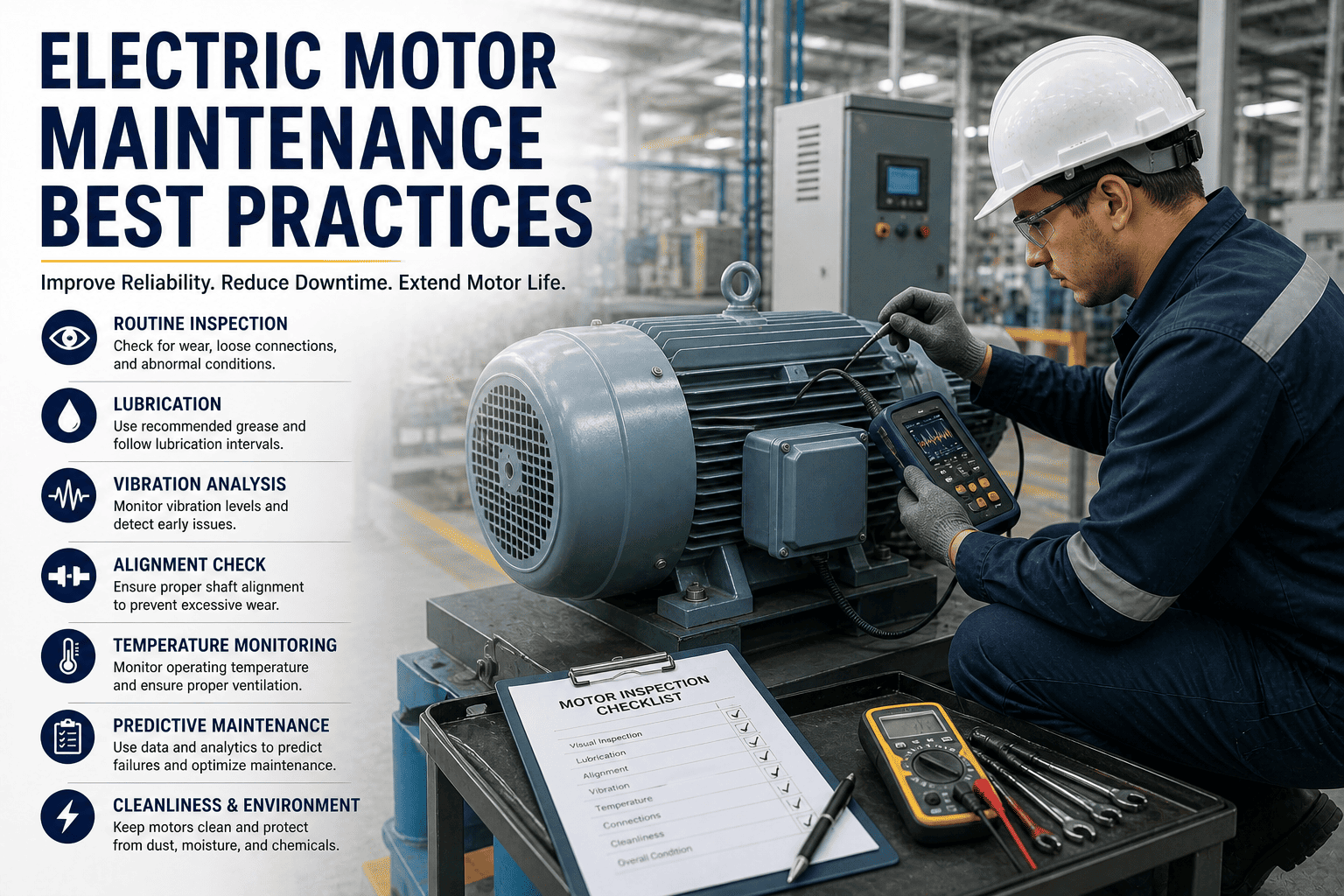
Electric motor maintenance best practices combine four core disciplines: mechanical alignment (coupling and bearing alignment within 0.05mm tolerance), lubrication management (correct lubricant type and regreasing intervals specific to bearing size and speed), vibration condition monitoring (ISO 10816 vibration limits detecting bearing wear and misalignment), and thermal imaging (detecting winding hot spots and bearing overheating). Predictive maintenance integrating all four techniques prevents 70 to 85 percent of unplanned motor failures by detecting degradation 4 to 8 weeks before failure threshold. Manufacturing plants implementing comprehensive motor maintenance best practices achieve 35 to 50 percent reduction in motor failure incidents, $800,000 to $2.1M annual downtime cost avoidance, and 15 to 20 percent improvement in motor lifespan through optimized operating conditions.
Five Electric Motor Failure Modes and Prevention Strategies
Electric motors fail through predictable degradation patterns. Understanding each failure mode and detection method enables maintenance teams to intervene before failure occurs.
Ball and roller bearing surfaces gradually degrade from cyclic loading, developing micro-cracks that propagate into spalls (surface pits). Spalling accelerates catastrophically once initiated. Early detection through vibration analysis (broadband increase 5-10 dB above baseline, high-frequency spectral peaks) enables bearing replacement during planned maintenance. Late detection (after spall is large enough to generate audible noise) often coincides with bearing cage failure, resulting in bearing seizure and motor stall. Prevention: continuous vibration monitoring, quarterly thermal imaging, oil analysis if bearing is lubricated via gearbox, regreasing on proper intervals (typically 500-2000 operating hours for standard industrial bearings).
Motor-to-load coupling misalignment creates excessive bearing loads and accelerates failure. Angular misalignment (shafts not parallel) concentrates load on bearing outer edge. Parallel offset (shafts parallel but displaced) creates radial bearing load. Combined misalignment is common when equipment settling occurs or when coupling wear increases clearances. Vibration signature of misalignment: 1x and 2x running speed peaks in radial direction, often with elevated temperatures at bearing outboard (non-drive) side. Prevention: alignment check at installation and annually thereafter (target tolerance 0.05mm), thermal imaging to detect bearing hot spots indicating misalignment loads, vibration monitoring to identify 1x/2x peaks indicating misalignment progression.
Motor winding insulation gradually degrades from thermal cycling, moisture ingress, and electrical stress. Insulation breakdown creates phase-to-ground faults that can generate lethal arc flash and motor fire. Failure is often catastrophic—little warning before winding short occurs. Detection: megohm testing (insulation resistance testing with high-voltage resistance meter) every 6 months identifies insulation degradation trend before failure. Thermography detects localized hot spots in winding if partial phase fault develops. Protective relays detect ground faults if present. Prevention: environmental control (dehumidification in humid climates), thermal management (ensure motor cooling airflow), operating temperature limits (avoid continuous full-load operation above OEM rating).
Bearing failure from lubrication breakdown occurs when lubricant film thickness drops below minimum, or when lubricant oxidizes and loses viscosity, or when moisture contamination causes corrosion. Regreasing too frequently (over-greasing) generates excess heat and accelerates degradation. Regreasing too infrequently allows oxidation and water ingress. Vibration signature of lubrication failure: broadband elevation across spectrum (5-20 dB increase), possibly with elevated 2x running speed from bearing slipping. Thermal signature: bearing temperature increase 15-30°C above normal. Prevention: establish regreasing interval specific to bearing type and speed (consult bearing manufacturer tables), use correct lubricant grade and type (synthetic vs mineral, EP additives where required), capture bearing temperature baseline at installation and monitor for deviations.
Rotor mass imbalance develops from material loss (corrosion), buildup (dirt accumulation on fan blade), or manufacturing variability. Imbalance creates 1x running speed vibration peaks that accelerate bearing wear and can destabilize alignment. Vibration signature: dominant 1x peak in radial direction, proportional to severity and rotor speed. Prevention: verify rotor balance at installation, monitor 1x vibration trend (increase indicates developing imbalance), inspect rotor visually for material loss or buildup, consider dynamic balancing if 1x vibration exceeds ISO 10816 limits.
Motors driven by Variable Frequency Drives (VFDs) experience additional stressors: high dV/dT voltage transitions create insulation stress, PWM switching creates bearing currents that cause spalling and failure. VFD-driven motor bearing life can be 50 percent shorter than line-voltage motors if not properly protected. Prevention: install dV/dT filters or sine-wave output filters on VFD to reduce voltage stress, use shaft grounding brushes to divert bearing currents to ground, specify VFD-rated motors with reinforced insulation for new installations.
Detect Motor Failures Before They Happen
Book a 30-minute consultation showing motor condition monitoring, vibration analysis, and predictive failure prevention configured for your facility's critical motors.
Motor Maintenance Best Practices: The Four Pillar Approach
Industrial best practices for electric motor maintenance integrate four complementary techniques, each detecting different failure modes and degradation patterns.
Objective: Ensure motor shaft and load shaft are concentric and parallel, minimizing bearing loads from misalignment. Target tolerance: Coupling concentricity 0.05mm, angular alignment within 0.03 degrees. Measurement: Dial indicator or laser alignment tools. Frequency: At installation, after any coupling or bearing replacement, annually for critical motors. Impact: Proper alignment reduces bearing loads 30 to 50 percent and extends motor lifespan 20 to 40 percent. Misalignment causes 20 to 30 percent of bearing failures in manufacturing environments.
Objective: Maintain proper lubricant film between bearing surfaces, preventing direct metal-to-metal contact. Regreasing intervals: Calculate from bearing speed number (bore diameter in mm × RPM). Typical ranges: 500 to 2000 operating hours for standard industrial motors. Correct lubricant: Specify by bearing type (deep groove ball, tapered roller, cylindrical roller) and speed—consult OEM tables. Use synthetic lubricants for high-speed applications (>10,000 RPM). Over-greasing prevention: Use calculated volume, not "until grease comes out other side"—excess grease generates heat and accelerates oxidation. Frequency audit: Review lubrication records annually; adjust intervals based on actual bearing temperature trends.
Objective: Detect bearing degradation, misalignment, and imbalance through vibration signature analysis. Measurements: Collect tri-axial (vertical, horizontal, axial) vibration spectra at bearing housings (non-drive side and drive side). Baseline: Establish baseline spectra within 100 operating hours of motor startup. Alert thresholds: Use ISO 10816-3 standards for rigid machines (motors typically: Zone A <2.3mm/s RMS, Zone B 2.3-4.5mm/s, Zone C 4.5-7.1mm/s, Zone D >7.1mm/s). Increase Zone C alert to inspect for misalignment or imbalance; reach Zone D triggers immediate maintenance. Frequency: Monthly for critical motors, quarterly for standard motors. Trend analysis: 5 to 10 dB gradual increase indicates bearing degradation; higher rate suggests developing imbalance or misalignment.
Objective: Detect bearing overheating (indicating lubrication failure), winding hot spots (indicating electrical fault), and cooling airflow blockage. Temperature measurement: Infrared thermometer or thermal camera on bearing housing and motor frame. Baseline: Establish baseline bearing temperature under normal load and ambient conditions (typically 40-70°C for standard bearings, 50-80°C for high-speed bearings). Alert threshold: Temperature increase 15-20°C above baseline triggers inspection for misalignment or lubrication issues. Temperature gradient (one bearing 30°C hotter than other) indicates misalignment. Frequency: Weekly for critical motors, monthly for standard motors. VFD consideration: VFD-driven motors often run 5-10°C hotter than line-voltage motors due to reduced cooling at low speeds—adjust baselines accordingly.
Motor Maintenance Schedule: Preventive vs Predictive Framework
Effective motor maintenance balances preventive activities (lubrication, alignment, inspection) with predictive interventions (vibration and thermal alerts). A structured schedule prevents failure while avoiding unnecessary maintenance.
Implementation Roadmap: From Assessment to Predictive Maintenance
Manufacturing plants typically transition from fixed-interval reactive maintenance to predictive condition-based maintenance through a structured phased approach.
Document all motors (>5 HP) with nameplate data (HP, RPM, voltage, bearing type), identify critical motors whose failure stops production (pump motors, fan motors, main drive motors). For each motor, calculate bearing speed number and establish regreasing intervals. Identify VFD-driven motors requiring additional protection measures. Output: prioritized list of motors for condition monitoring deployment.
Collect tri-axial vibration spectra on all critical motors, record bearing temperatures, document alignment status, establish baseline megohm insulation resistance. Collect data under normal load conditions and ambient temperature. For critical motors, collect weekly data for first 4 weeks to establish variability and normal operating range. Output: baseline vibration signatures, temperature profiles, and alert thresholds specific to each motor.
Deploy permanent or portable vibration monitoring equipment on critical motors. Install data collection gateways feeding to centralized condition monitoring software. Configure alert thresholds based on baseline data. Train maintenance technicians on vibration signature interpretation and alert response procedures. Establish monthly thermal imaging schedule. Output: active condition monitoring generating alerts on threshold breach, enabling maintenance team to respond to degradation before failure.
Integrate condition monitoring alerts into maintenance work order system. Automatically generate predictive maintenance work orders when vibration or temperature thresholds exceeded. Establish protocols for maintenance team response (schedule bearing replacement during next planned downtime, order replacement parts in advance). Establish escalation procedures for critical alerts (Zone D vibration, extreme temperature). Output: automatic work order generation from condition data, enabling predictive maintenance response 4 to 8 weeks before failure threshold.
Monitor success metrics: reduction in unplanned motor failures, extension of motor lifespan, downtime cost avoidance. Expand condition monitoring to additional motors. Refine alert thresholds based on actual failure cases (when bearing failed, what were the vibration and temperature signals 4 weeks prior?). Integrate alignment and lubrication optimization based on condition data insights. Output: mature predictive maintenance program preventing 70 to 85 percent of unplanned motor failures.
ROI: Electric Motor Maintenance Best Practices
Manufacturing plants implementing comprehensive motor maintenance best practices achieve measurable return on investment through prevented failures, extended motor lifespan, and reduced maintenance costs.
Mid-size manufacturing facility: 35 to 50 unplanned motor failures annually. Cost per event: $15,000 to $80,000 (replacement bearing $500-$5,000, labor $5,000-$20,000, emergency parts premium $5,000-$10,000, production downtime loss $5,000-$45,000). Annual failure cost: $525,000 to $4M depending on motor criticality and downtime duration.
Condition monitoring implementation: $30,000 to $80,000 initial deployment (equipment, software, training). Annual maintenance effort (vibration collection, thermal imaging, alignment, lubrication): 200 to 400 labor hours = $15,000 to $30,000 annually. Total first-year cost: $45,000 to $110,000.
Predictive maintenance prevents 70 to 85 percent of unplanned failures. 35 failures → 5 to 10 unplanned failures annually (75 percent reduction typical). Cost avoidance: $390,000 to $3.5M annually depending on baseline scenario. Net annual benefit: $360,000 to $3.47M after deducting maintenance costs. Payback period: 1.5 to 4 months in most cases.
Motor lifespan extension: 15 to 20 percent longer life through optimized operating conditions (proper alignment, lubrication, cooling). Typical motor 20-year lifespan extended to 23-24 years = $1,000 to $10,000 deferred capital cost per motor. Energy efficiency improvement: properly aligned and lubricated motors consume 2 to 5 percent less energy = $50,000 to $200,000 annual energy savings at typical facility scale.
Implement Motor Maintenance Best Practices
Manufacturing plants deploying comprehensive motor maintenance achieve 70 to 85 percent reduction in unplanned failures, $360,000 to $3.47M annual cost avoidance, and 1.5 to 4 month ROI payback. Schedule a consultation to assess your facility's motor maintenance maturity and identify quick-win optimization opportunities.
Frequently Asked Questions: Electric Motor Maintenance
Motor Maintenance Best Practices Checklist
Use this comprehensive checklist to assess your facility's motor maintenance maturity and identify improvement opportunities.
| Best Practice Element | Current Status | Target Implementation |
|---|---|---|
| Motor inventory documented (nameplate data, bearing type, speed) | □ Not done □ Partial □ Complete | Complete inventory with regreasing intervals calculated |
| Regreasing intervals established per bearing speed number | □ Not done □ Calendar-based □ Condition-based | Condition-based intervals per manufacturer specifications |
| Vibration baseline data collected on critical motors | □ Not done □ Partial □ Complete | Tri-axial baseline spectra established for all motors >5HP |
| Thermal imaging program established | □ Not done □ Annual only □ Monthly | Monthly thermal imaging on critical motors, quarterly on others |
| Alignment verification on schedule | □ Not done □ At installation only □ Annual | Annual alignment verification with <0.05mm tolerance tolerance |
| Megohm insulation resistance testing | □ Not done □ Annual □ Quarterly | Quarterly megohm testing trending on critical motors |
| VFD motor protection measures implemented | □ Not done □ Filters only □ Complete | dV/dT filters + shaft grounding brushes on all VFD motors |
| Condition monitoring alerts drive work orders | □ Not done □ Manual process □ Automated | Automatic work order generation from condition thresholds |
Transform Motor Maintenance Into Predictive Operations
Manufacturing plants implementing electric motor maintenance best practices prevent 70 to 85 percent of unplanned failures, achieve 1.5 to 4 month ROI payback, and extend motor lifespan 15 to 20 percent. Begin with a facility assessment to identify your current maturity level and quick-win optimization opportunities.