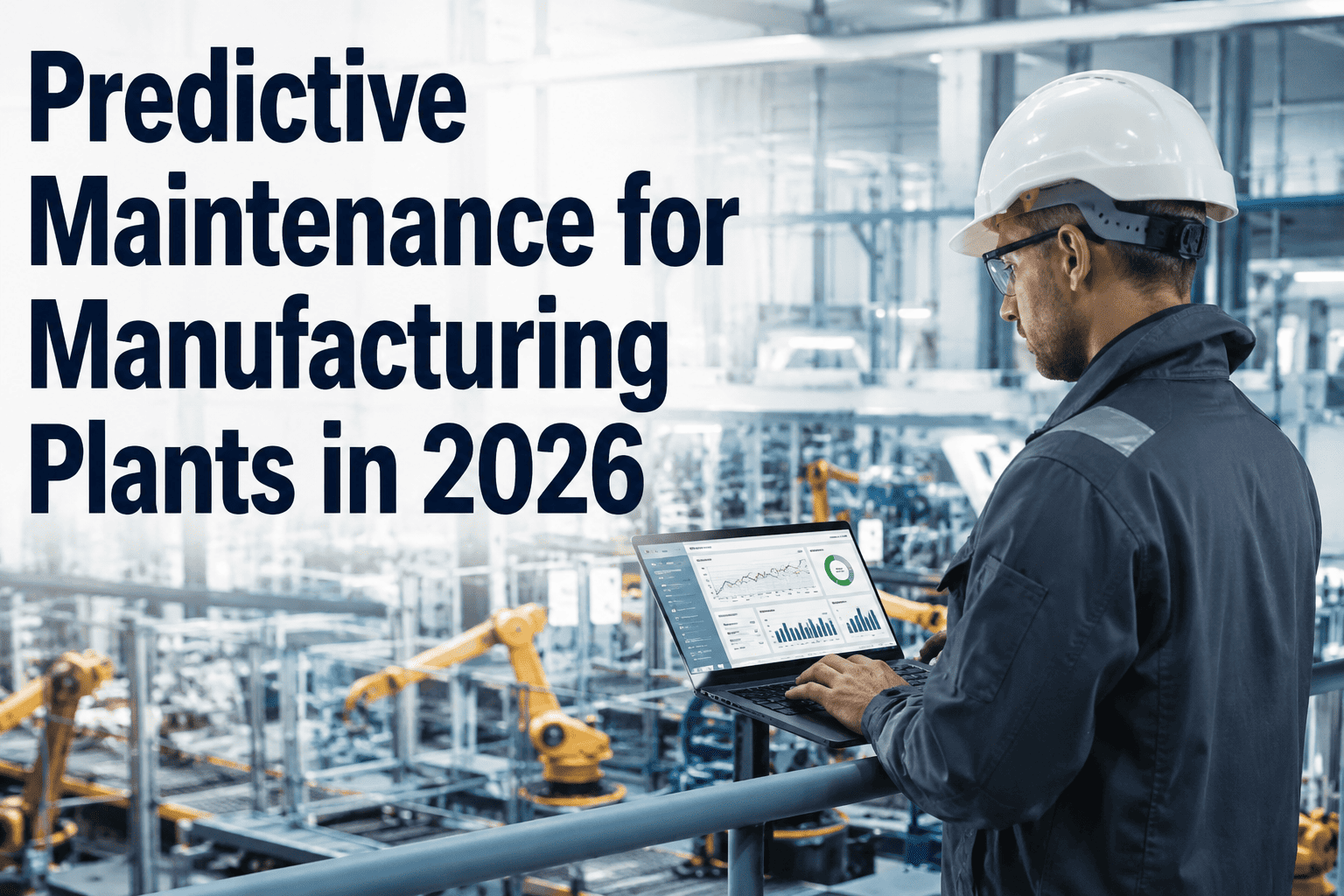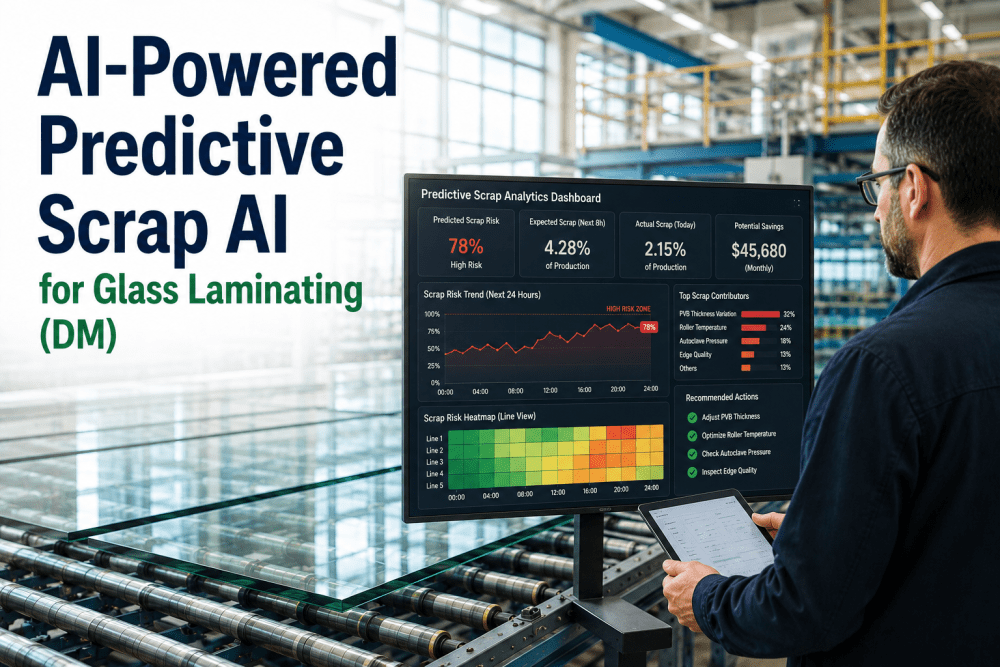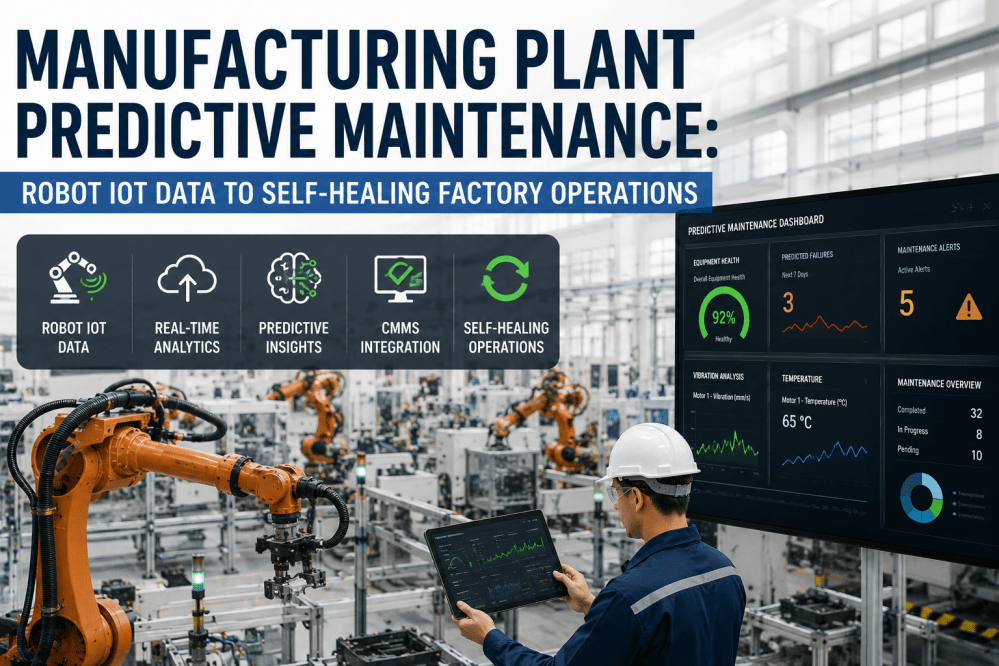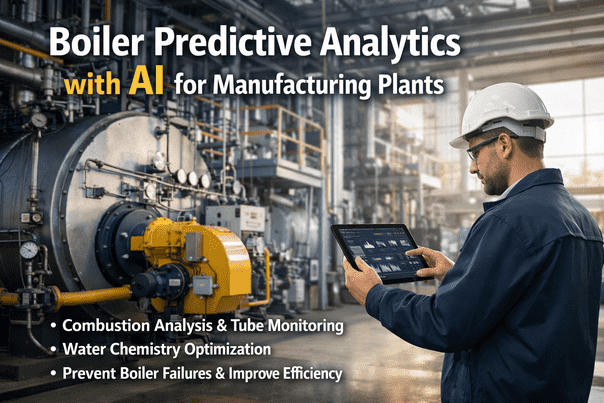
Manufacturing plants generate enormous volumes of operational data every second—vibration readings, temperature curves, motor current signatures, belt tension measurements—yet most facilities make maintenance decisions based on calendars and gut instinct. A bearing doesn't fail because it reached 90 days on the inspection schedule; it fails because accumulated stress, misalignment, and lubrication breakdown reached a critical threshold at 73 days. Predictive analytics for manufacturing plants closes that gap, converting raw sensor streams into failure warnings that arrive 7-14 days before production stops. The result: unplanned downtime drops 50-70%, emergency repair costs collapse, and maintenance teams shift from firefighting to engineering. iFactory is The Complete AI Platform for Manufacturing Operations, delivering the only end-to-end predictive analytics solution purpose-built for plant-floor realities. One Platform for Smart Manufacturing with AI-Powered Maintenance, OEE, and Operations. Want to predict equipment failures before they halt production and reduce unplanned downtime by 50-70%? Book a demo today or explore implementation with our team.
Predict Equipment Failures 7-14 Days Before They Stop Production
IoT sensors, AI analytics, and real-time condition monitoring for every critical asset in your facility.
What Is Predictive Analytics for Manufacturing?
Predictive analytics for manufacturing is the discipline of using continuous sensor data, machine learning models, and historical failure records to forecast equipment degradation before it triggers a production stop. Unlike preventive maintenance—which replaces parts on a fixed calendar—predictive analytics acts on actual condition data. A motor running cooler than expected gets its maintenance window extended. A gearbox vibrating at an anomalous frequency gets flagged for inspection three weeks before seizure. The system learns what normal looks like for every asset in your facility and alerts operations the moment deviation patterns match known failure signatures. Predictive analytics eliminates the two most expensive failure modes in manufacturing: the unplanned emergency stop that halts an entire line, and the premature replacement that wastes serviceable components. Both cost real money. Both are avoidable with the right platform.
If your plant is still running on calendar-based maintenance or waiting for alarms to fire, you're likely absorbing $1M+ in preventable downtime costs each year. Book a 30-minute demo to see exactly how much iFactory predictive analytics could save your facility — with numbers specific to your asset count and production rate.
The Four Data Pillars of Manufacturing Predictive Analytics
Every predictive analytics deployment rests on four sensor categories. Miss any one of them and failure prediction accuracy drops sharply. iFactory captures all four simultaneously, fusing them into a unified asset health score updated in real time.
Vibration Analysis
High-frequency accelerometers sample at 25 kHz, capturing the spectral fingerprints of bearing defects, gear mesh anomalies, rotor imbalance, and structural looseness. AI models compare live spectra against baseline signatures to detect early-stage damage 2-4 weeks before catastrophic failure. Vibration analysis identifies 65-70% of all mechanical failure modes across rotating equipment.
Thermal Monitoring
Infrared sensors and contact thermocouples track temperature trends across motors, drives, bearings, and electrical panels. A bearing running 8°C above its rolling average signals lubrication breakdown; a drive cabinet rising 15°C signals impending insulation failure. Thermal trending detects failures that vibration analysis misses, particularly in electrical and hydraulic systems.
Motor Current Signature Analysis
Current sensors clip onto existing motor leads with zero production interruption. AI analyzes harmonic patterns in the current waveform to detect rotor bar degradation, winding insulation breakdown, eccentric air gaps, and mechanical load anomalies. MCSA can identify 80% of motor failure modes without physical access to the motor itself—critical for equipment in difficult-to-reach locations.
Process Parameter Integration
SCADA and PLC historian data—pressure, flow rate, cycle time, throughput rate—feeds directly into the predictive model. Process deviations that don't appear in vibration or thermal data often show up in cycle time drift or output variance weeks before mechanical symptoms emerge. Cross-correlating process data with sensor data produces failure predictions that neither dataset could generate alone.
How iFactory Delivers Predictive Analytics at Plant Scale
iFactory's predictive analytics platform connects to existing equipment through wireless IoT sensors and SCADA integration, capturing continuous asset health data across every production line. AI algorithms trained on 200,000+ equipment operating hours detect failure signatures in real time, generating automated work orders before degradation reaches critical thresholds.
Real-Time Anomaly Detection
Machine learning models establish dynamic baselines for every monitored asset. Anomaly scoring updates every 30 seconds, comparing current readings against learned normal ranges adjusted for production speed, ambient temperature, and load. Alerts fire when deviation patterns match the early-stage signatures of specific failure modes—not just when readings cross static thresholds.
Failure Mode Classification
Every alert includes the specific failure mode detected—not just "anomaly detected." Bearing outer race defect. Rotor bar degradation. Belt tension exceedance. Gear tooth wear. Technicians arrive knowing what failed and what parts to bring. Diagnostic time drops from hours to minutes. First-time fix rates improve 35-45% compared to reactive maintenance response.
Automated Work Order Generation
When predictive thresholds are breached, work orders generate automatically in your CMMS with failure mode, urgency level, recommended action, and required parts list. Integration with SAP, IBM Maximo, Fiix, and other platforms ensures maintenance scheduling happens without manual data entry. Technicians receive prioritized, data-driven assignments rather than reactive emergency calls.
Fleet-Level Pattern Intelligence
When a failure pattern is confirmed on one asset, the platform automatically scans all similar assets across the facility for the same signature. A bearing failure at 8,400 operating hours on line 3 triggers inspection of identical bearings on lines 1, 2, and 4 running similar hours. Failure clusters get addressed before they cascade into simultaneous line stoppages.
OEE Integration
Predictive alerts feed directly into OEE tracking. Asset health scores appear alongside availability, performance, and quality metrics on the same dashboard. Maintenance teams see which assets are pulling OEE down before they fail. Operations leaders see projected OEE impact of scheduled maintenance windows. Predictive analytics and OEE optimization work as one unified system.
Institutional Knowledge Capture
Every repair closes a data loop—failure symptoms, root cause, corrective action, and outcome are recorded automatically. When a similar signature appears on a different asset, historical records surface the diagnosis immediately. Technicians solve problems faster because the platform remembers every failure the facility has ever experienced. Expertise accumulates rather than retiring with senior technicians.
Why iFactory Is Different: Purpose-Built for Manufacturing Plants
Most predictive analytics platforms are built for IT teams and adapted for factory floors as an afterthought. iFactory is engineered for the plant environment from the ground up—hardened sensors rated for industrial vibration and temperature extremes, AI models trained on real manufacturing failure data, and integrations designed for SCADA/PLC historians rather than cloud-native databases.
Rapid Deployment
Wireless sensors on existing equipment—no production shutdowns for installation. SCADA integration in 2-4 weeks. First predictions within 6 weeks. No multi-month implementation project, no engineering redesign.
Manufacturing-Grade AI
Models trained on 200,000+ operating hours across automotive, food, pharma, and logistics facilities. 93% failure detection accuracy. 4% false positive rate. Understands industry-specific failure signatures, not just generic anomaly patterns.
Complete Plant Coverage
Monitor conveyors, motors, compressors, pumps, CNC machines, robotic cells, and HVAC systems on one unified platform. One dashboard for every asset KPI across the entire facility. No siloed point solutions.
Predictive Analytics Implementation Roadmap
iFactory follows a proven 8-week path from sensor installation to full-facility predictive maintenance, with first failure predictions live by week 6 and ROI measurable within 90 days.
By Week 4, baselines are established and anomaly detection begins. By Week 6, first failures are detected before they reach the floor. By Week 8, every critical asset in the facility runs with predictive analytics coverage. ROI typically evident within 90 days. Full payback within 18 months.
Real Results: Predictive Analytics Success Cases
Automotive Tier-1 Supplier: CNC Machining Center Fleet
Result: 54% reduction in unplanned stops, $2.3M annual savings, 15-month payback. Facility running 28 CNC machining centers producing precision engine components. Spindle failures were averaging twice monthly, each causing 6-8 hour stoppages and $45,000 in emergency tooling costs. iFactory deployed vibration and current monitoring across all spindles. Within 8 weeks, bearing defect signatures were detected on four spindles showing inner race fatigue patterns at different stages. All four were replaced during a single planned weekend shutdown. Subsequent monitoring identified a systematic lubrication interval problem—changing regreasing frequency from 500 to 380 hours eliminated the failure mode entirely. Year one: 21 unplanned stops became 4. Emergency tooling costs dropped 78%. Spindle availability rose from 89% to 97%.
Pharmaceutical Packaging Facility: Filling Line Reliability
Result: 61% downtime reduction, $1.7M cost prevention, 11-month payback. High-speed blister pack and bottle filling lines running GMP-regulated products. Any unplanned stop triggered a batch discard and revalidation process costing $80,000-$120,000 per event beyond equipment repair. iFactory monitoring was deployed with specific GMP documentation integration. Thermal analysis identified a sealing jaw temperature drift pattern that correlated with film weld failures 10 days before quality defects manifested. Process parameter monitoring caught conveyor speed deviations that preceded jam events by 6 days. Year one: 14 quality-related production stops reduced to 3. Batch discard costs dropped $1.2M. Regulatory audit preparation time fell 40% due to automated maintenance documentation.
Steel Processing Plant: Rolling Mill Uptime
Result: 47% conveyor and mill downtime reduction, $3.1M cost prevention, 16-month payback. Hot and cold rolling mill with extreme vibration and thermal environments challenging conventional monitoring. Motor current signature analysis proved most effective under high-load conditions where vibration sensors were masked by background noise. MCSA detected rotor bar degradation on three main drive motors at 12%, 18%, and 24% progression—all replaced in sequence during planned outages before any reached failure threshold. Gearbox vibration trending identified tooth wear patterns 3 weeks ahead across the rolling stands. Year one: catastrophic gearbox failure eliminated (would have caused 72-hour minimum stoppage). Motor emergency replacements dropped from 6 to 1 per year.
These results aren't outliers — they're the standard outcome when predictive analytics replaces reactive maintenance. Talk to an iFactory expert and get a facility-specific projection of downtime reduction and savings based on your current asset mix and maintenance history.
Comparison: iFactory Predictive Analytics vs. Industry Approaches
| Capability | iFactory PdM | Manual Inspection | Time-Based PM | Reactive Maintenance |
|---|---|---|---|---|
| Warning Window | 7-14 days before failure | Inspection interval only | Calendar-scheduled only | After failure occurs |
| Detection Accuracy | 93% (multi-signal AI) | 62% (visual/tactile) | N/A (not condition-based) | 0% (no prevention) |
| False Positive Rate | 4% (tunable) | 12-18% (subjective) | 30-40% (over-maintained) | 0% (no alerts) |
| Cost per Failure Event | $9,000 (planned intervention) | $52,000 (emergency repair) | $38,000 (avoidable PM + failures) | $240,000 (full impact) |
| Maintenance Scheduling | Condition-driven, optimized | Walk-around triggered | Calendar-based fixed | Emergency-driven |
The gap between reactive maintenance and AI-powered predictive analytics isn't just operational — it's a $200,000+ per failure cost difference. Book a demo to see how iFactory closes that gap across your specific production lines.
Predictive Analytics Across Manufacturing Regions
| Region | Primary PdM Challenges | iFactory Solution Focus |
|---|---|---|
| US (Automotive & Aerospace) | Zero-tolerance downtime, high asset density, complex multi-line dependencies | Fleet-level pattern intelligence, cascading failure prevention, OEE integration |
| Europe (Mixed & Precision Manufacturing) | Energy efficiency mandates, aging equipment, strict compliance documentation | Energy consumption analytics, lifecycle optimization, automated compliance records |
| UK (Pharma & Logistics) | GMP validation requirements, 24/7 operations, limited maintenance access windows | Validation-ready documentation, uptime maximization, narrow window scheduling |
| UAE (Food & Process Industry) | Extreme ambient temperatures, hygiene compliance, dust and contamination ingress | Temperature-adjusted baselines, sanitation verification, environmental-adjusted intervals |
| India (Rapid Manufacturing Growth) | Capacity scaling pressure, technician skill development needs, cost optimization focus | Guided diagnostics, cost-efficient deployment models, rapid technician upskilling through data |
What Manufacturing Leaders Are Saying
"Before iFactory, our maintenance team was permanently in crisis mode—two or three emergency calls a week, technicians pulled off planned work constantly. The first month after deployment, the system flagged a rotor bar degradation pattern on our main press drive motor. We pulled it during a planned Saturday window and found 30% bar degradation that would have caused a catastrophic failure within two weeks. That one catch paid for the entire year's subscription. We haven't had an unplanned motor failure in eight months."
Maintenance Manager, Tier-1 Automotive Stamping Facility
"The difference between predictive analytics and what we were doing before isn't just about catching failures earlier. It's about having data that actually explains why things fail. We changed a lubrication interval based on iFactory trending data and eliminated an entire class of bearing failures that had been costing us two stoppages a quarter for three years. That's institutional knowledge the system built for us automatically."
Plant Engineering Director, Food and Beverage Processing Facility
Results like these happen when maintenance teams stop reacting and start predicting. If you want to see how iFactory would perform against your current downtime numbers, schedule a 30-minute demo — our engineers will walk through your specific asset environment and model the expected impact.
Frequently Asked Questions
Stop Discovering Equipment Problems After Production Stops
Start predicting failures 7-14 days in advance with AI-powered condition monitoring. iFactory detects 93% of failure modes before they reach the production floor.
The Complete AI Platform for Manufacturing Operations
iFactory predictive analytics is part of a complete manufacturing operations platform. Eliminate Manual Logs with AI Digital Shift Logbooks. Real-Time Visibility Into Every Production Line. Connects to Your Existing SCADA/PLC Systems. Predictive analytics runs continuously, integrated with OEE tracking, automated maintenance scheduling, and compliance documentation. Every component of manufacturing operations works together on one unified platform.
Predictive Maintenance Excellence
AI predicts failures 7-14 days early across all asset classes. Work orders generate automatically. Maintenance is scheduled during optimal production windows, not triggered by emergencies that halt the line.
OEE Optimization
Asset health scores feed directly into OEE dashboards. Identify which equipment is pulling availability down before it fails. Prioritize maintenance investment for maximum OEE impact across all production lines.
Root Cause Documentation
Every repair closes a data loop. Failure symptoms, root cause, and resolution are permanently recorded. Technicians diagnose similar failures faster. Institutional knowledge accumulates in the platform rather than leaving when experienced staff do.
Compliance Automation
All maintenance records are automatically timestamped, classified, and audit-ready. Regulatory compliance becomes part of normal operations, not a separate administrative burden consuming engineering time before every audit.
Predict and Prevent Equipment Failures Before They Cost Thousands
Talk to an iFactory specialist about implementing predictive analytics across your facility. Detect failures 7-14 days early. Prevent production stops. Reduce maintenance costs 50-70%.