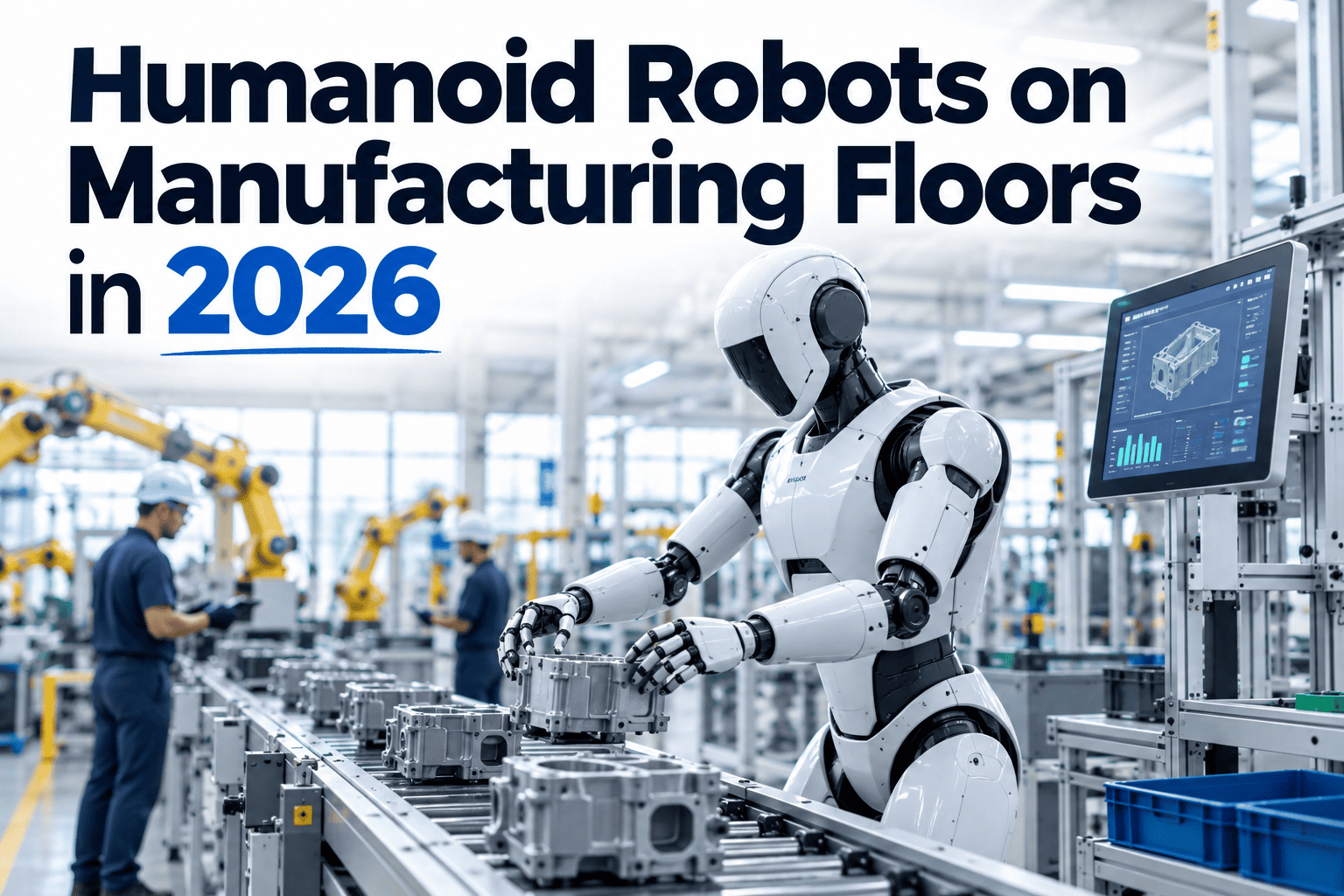
China's humanoid robotics ecosystem just crossed a line nobody in U.S. manufacturing can afford to ignore. In December 2025, AgiBot rolled its 5,000th humanoid robot off a Shanghai production line — and hit unit number 10,000 just three months later, in March 2026. UBTECH's Walker S2 plants in Liuzhou are pushing toward 5,000 industrial humanoids per year, with confirmed order books above $195 million. XPeng's IRON is heading for end-of-2026 mass production with 82 degrees of freedom and three onboard Turing AI chips. Walker S2 units are already moving across the factory floors of BYD, Geely, FAW-Volkswagen, Dongfeng, Audi FAW, BAIC, Foxconn, and SF Express — and Airbus signed on in January 2026 to bring them into aviation manufacturing. While Tesla's Optimus is still ramping in the hundreds, Chinese makers are shipping in the thousands. For U.S. plant operators evaluating where humanoid automation actually works in production, the answer is increasingly: on Chinese assembly lines, today. iFactory AI helps manufacturers integrate humanoid robotics, AI vision, and digital twin orchestration into their existing MES and CMMS stack — without ripping out what already works. Book a Demo to see how humanoid deployment fits into your operations.
10,000
AgiBot humanoid robots produced by March 2026
99.9%
AgiBot Genie G2 task success rate on production lines
5,000
UBTECH Walker S2 annual production target for 2026
310/hr
units processed per hour by AgiBot G2 in cramped workstations
Why Chinese Humanoid Manufacturing Is Outpacing the West
The numbers tell the story before any commentary does. Shanghai-based AgiBot delivered over 5,100 humanoid units in 2025 — nearly 40% of the global market. Unitree Robotics shipped around 4,200. UBTECH delivered close to 1,000 Walker S2 units, focused on industrial and commercial use. Meanwhile, U.S. players Figure AI, Agility Robotics, and Tesla Optimus are still measuring annual output in the hundreds. This isn't a forecast — it's a current production gap that determines which factories get humanoid labor in 2026 and which wait until 2028. For U.S. manufacturing leaders evaluating automation roadmaps, understanding the Chinese ecosystem isn't optional anymore. The vendors deploying first are also the ones learning fastest, refining cost curves, and writing the integration playbooks that everyone else will eventually adopt.
BYD, Geely, FAW-Volkswagen, Foxconn, Airbus, SF Express
XPeng (Guangzhou)
IRON (2nd Gen)
Mass production by end of 2026
XPeng auto plants, tour guide and assistant roles
Unitree (Hangzhou)
H1, G1, As2
4,200+ units delivered in 2025
Research, performance, light industrial tasks
BYD (Shenzhen)
Internal program + UBTECH integration
In-house pilot scale
BYD auto plants — handling, sorting, AMR coordination
Foxconn (cross-border)
UBTECH Walker S deployment
Volume deployment in Zhengzhou
iPhone assembly support, smart factory operations
The Five Vendors Reshaping Factory Automation in 2026
Five Chinese humanoid programs are doing the heavy lifting in real production environments right now. Each takes a different approach — full-size industrial humanoids, mixed-fleet generalists, lightweight wheeled assistants, or carmaker-integrated platforms — and each is teaching the rest of the industry something different about what works on a real factory floor.
01
AgiBot — The Mass-Production Leader
Founded in 2023 by former Huawei "Genius Youth" engineers, AgiBot took less than three years to reach 10,000 units. Its Genie G2 hits 310 units/hour with 99.9% success on real assembly lines, adapting to positional deviations within 1 cm and changing over to new product models in under four hours.
5,000th unit Dec 202510,000th unit Mar 2026Shanghai Lingang facility
02
UBTECH Walker S2 — The Industrial Workhorse
The world's first industrial humanoid with autonomous battery swap, enabling 24-hour operation. Combines binocular stereo vision with the BrainNet reasoning platform and integrates Co-Agent capabilities. Already deployed across BYD, Geely, FAW-Volkswagen, Dongfeng Liuzhou, Audi FAW, BAIC, Foxconn, and now Airbus.
1.4B yuan orders500+ deliveredLiuzhou factory
03
XPeng IRON — The Anthropomorphic Bet
82 degrees of freedom including 22 in the hands, three onboard Turing AI chips delivering 3,000 TOPS, solid-state battery, and a distinctly human-like gait. Designed as the centerpiece of XPeng's Physical AI strategy, with mass production targeted for end of 2026 and customizable design options.
82 DOF3,000 TOPS computeSolid-state battery
04
Unitree — The Agility Specialist
The H1 "Fuxi" platform demonstrates 360 Nm peak joint torque with 360° panoramic depth perception. Unitree's viral Spring Festival Gala performance pulled Chinese humanoid robotics into mainstream consciousness and accelerated investment across the entire sector. Strong in research, demonstration, and lightweight industrial roles.
4,200+ units in 2025Hangzhou HQResearch & light industry
05
BYD & Automaker In-House Programs
BYD, GAC (GoMate), Xiaomi, and other Chinese automakers are running internal humanoid programs alongside their UBTECH and AgiBot integrations. The strategy mirrors Tesla — own the robot stack, transfer EV manufacturing IP to robotics, and use the auto plant as the first proving ground for general-purpose deployment.
Multi-vendor strategyEV-IP transferInternal pilot scale
06
Foxconn — The Cross-Border Integrator
Foxconn formalized its humanoid partnership with UBTECH in January 2025 to integrate Walker S units into intelligent manufacturing. With deployment underway at the Zhengzhou iPhone assembly complex and warehouse automation across its smart-factory network, Foxconn is proving the cross-border template: Chinese humanoid hardware running inside the world's largest contract manufacturing footprint.
Evaluating which humanoid platform makes sense for your manufacturing operation? Book a Demo with iFactory AI's robotics integration team for a vendor-agnostic assessment.
Inside the Chinese Humanoid Factory: How Deployment Actually Works
The real story isn't the spec sheet — it's what happens between robot delivery and stable production. Chinese factories that have absorbed humanoid robots successfully follow a recognizable pattern: pilot first in high-mobility, low-precision tasks, then move into mixed-collaboration cells where humans and humanoids share a workstation, then finally hand off entire shifts to robot teams with human supervision. iFactory AI's platform sits across all three phases — orchestrating work orders, capturing OEE data per robot, and feeding sensor telemetry into the same predictive maintenance and quality models that already run your conventional equipment.
Swipe to see full workflow
Phase 1
Use Case Selection
Identify repetitive, mobility-heavy tasks with low precision tolerance — material handling, inspection rounds, refrigerant leak detection, quality testing. These are the tasks Chinese factories selected first.
Foundation
Phase 2
Pilot Cell Deployment
Single-robot pilot in an isolated work cell. Calibration in five minutes per product model. Operator training and safety zoning. Integration with MES for work order assignment and traceability.
High leverage
Phase 3
Mixed Collaboration
Humans and humanoids share workstations. Swarm intelligence platforms (UBTECH BrainNet, AgiBot embodied AI) coordinate task handoffs. AI vision validates output. AMR/AGV coordination through unified factory orchestration.
Scaling phase
Phase 4
24-Hour Shift Handover
Autonomous battery swap (Walker S2 model) enables nonstop operation. Human supervision shifts from co-work to monitoring. Predictive maintenance models trained on robot telemetry preempt failures.
Mature operations
Phase 5
Fleet Expansion
Multi-line deployment, cross-facility orchestration, line changeover under four hours per product model. ROI compounds as the same fleet shifts across product mix and seasonal demand.
Recurring value
Plan Your Humanoid Integration With iFactory AI
Whether you're piloting a single Walker S2, evaluating AgiBot Genie G2 for sorting lines, or planning an XPeng IRON deployment, iFactory AI's Robotics AI and Digital Twin platform gives you the orchestration layer, OEE telemetry, and predictive maintenance that turn a robot pilot into a stable production capability.
The Chinese humanoid wave matters for U.S. manufacturers for four specific reasons — none of them about importing the robots themselves. The leverage is in what their deployment patterns teach about integration, the cost curves they're pulling down for the global supply chain, and the orchestration software requirements that every plant will eventually need.
A
Cost Curves Are Collapsing Fast
AgiBot's jump from 5,000 to 10,000 units in three months represents a 4× acceleration in production speed. That's the same supply-chain maturity curve that took industrial robots from $200K to $30K over a decade — compressed into 18 months for humanoids. U.S. buyers waiting for a "right time" should price that compression into their CAPEX planning.
B
Integration Patterns Are Universal
The MES handshake, OEE telemetry, AMR coordination, and quality vision validation patterns being proven in Chinese auto plants translate directly to U.S. operations. Whether you eventually buy Figure, Apptronik, or a Chinese platform, the orchestration layer matters more than the robot brand.
C
Use-Case Maturity Is Replicable
Walker S2's tasks — refrigerant leak detection, instrument testing, box lifting, component sorting — are the same hazardous-or-repetitive jobs in U.S. plants. The proof points from Foxconn, BYD, and FAW-Volkswagen give U.S. operations leaders concrete benchmarks to evaluate before committing budget.
D
Software Stack Is the Real Moat
Robots without orchestration are expensive demos. iFactory AI integrates humanoid telemetry, AI vision quality control, digital twin simulation, and predictive maintenance into one platform — so your fleet investment generates compounding ROI, not isolated point automation.
Want a side-by-side of how Chinese deployment patterns translate to U.S. plant operations? Book a Demo with iFactory AI's manufacturing solutions team.
Expert Perspective
"The U.S. conversation about humanoid robotics is still mostly forward-looking — when will Optimus ship, when will Figure scale. The Chinese conversation moved past that in 2025. AgiBot's G2 hitting 99.9% success on real production lines at 310 units per hour, Walker S2 swapping its own battery for 24-hour shifts, XPeng IRON heading to mass production by end of 2026 — these aren't roadmap items, they're operating data. The question for U.S. manufacturing leaders isn't whether humanoid automation works. It's whether your MES, CMMS, and digital twin layer is ready to absorb a humanoid fleet when the cost curve crosses your budget threshold — which on current trajectory is 18 months, not five years."
— Industrial Robotics & Embodied AI Analysis, 2026
4×
AgiBot production speed acceleration (5K to 10K units)
$112M
UBTECH 2025 confirmed order book in industrial humanoids
8
commercial scenarios where AgiBot humanoids operate today
How iFactory AI Connects Humanoid Deployment to Your Existing Stack
The humanoid itself is a hardware decision. What turns it into a production capability is the software layer that connects it to work orders, quality records, predictive maintenance, OEE dashboards, and Battery Passport-style traceability. iFactory AI's platform is built for exactly that — orchestrating heterogeneous robot fleets alongside conventional CNC, robotic arms, and human operators inside a single MES and digital twin environment.
01
Robotics AI Integration
Unified orchestration across humanoid fleets, AMRs, AGVs, and robotic arms. Vendor-neutral integration — Walker S2, AgiBot Genie, Unitree, XPeng IRON, or your existing Fanuc and ABB cells, all in one work order pipeline.
Multi-vendor supportUnified work ordersReal-time telemetry
02
Digital Twin Simulation
Model your humanoid deployment before purchase. Validate line balancing, calibration cycles, and safety zoning in simulation. Train operator protocols and AI quality models against synthetic data before the first robot lands on the floor.
Real-time quality validation of every humanoid action. Cross-check pick accuracy, placement positioning, defect identification, and assembly correctness. Closed-loop feedback to robot control systems for continuous accuracy improvement.
Treat your humanoid fleet like any other piece of capital equipment. Joint torque drift, battery cycle degradation, motor temperature anomalies — all flowing into the same predictive maintenance models that protect your CNC and conveyor uptime.
Joint health monitoringBattery lifecycleFailure prevention
05
OEE Analytics for Robots
Per-robot OEE metrics — availability, performance, quality — fed into the same dashboards your plant manager already reads. Robot utilization becomes a tracked KPI alongside CNC and assembly cell performance, not a separate black box.
Robot-level OEEFleet utilizationROI tracking
06
EHS & Safety Compliance
Safety zoning around mixed human-humanoid workstations. Incident reporting integrated with humanoid telemetry. Automated compliance documentation for OSHA, ANSI/RIA R15.06, and ISO 10218 collaborative robot standards.
Ready to architect a humanoid-ready manufacturing stack before your competitors do? Book a Demo to walk through iFactory AI's Robotics AI, Digital Twin, and predictive maintenance capabilities against your plant blueprint.
Conclusion: The Decision Window Is Now
The Chinese humanoid manufacturing story isn't a curiosity piece for U.S. operations leaders — it's a forward indicator of what every globally competitive plant will look like by 2028. AgiBot, UBTECH, XPeng, Unitree, and BYD aren't just building robots. They're proving out the integration patterns, cost curves, and orchestration software requirements that will define the next decade of factory automation. The plants that absorb humanoid robotics fastest in the U.S. won't necessarily be the ones with the biggest CAPEX budgets — they'll be the ones whose MES, CMMS, and digital twin layer was already built to handle a heterogeneous fleet of human operators, conventional robots, and humanoid platforms inside one operational picture. iFactory AI exists for exactly that integration challenge — keeping your existing investments productive while making your plant ready for what's arriving in 18 months, not five years.
Get Humanoid-Ready Without Ripping Out Your Stack
iFactory AI's Robotics AI, Digital Twin, AI Vision Camera, and predictive maintenance platform integrates with your existing MES, ERP, and CMMS — so your humanoid pilot becomes operational data, not a stranded experiment. Get a 30-minute walkthrough with our team.
Which Chinese humanoid robot is most deployed in real factories today?
UBTECH's Walker S2 is the most widely deployed industrial humanoid in automotive factories globally as of early 2026. Confirmed deployments span BYD, Geely Auto, FAW-Volkswagen Qingdao, Dongfeng Liuzhou Motor, Audi FAW, BAIC, Foxconn, SF Express, and Airbus aviation manufacturing. UBTECH crossed 1,000 Walker S2 units produced at its Liuzhou facility by end of December 2025 and reported approximately $195 million in orders. AgiBot's mixed fleet — Lingxi X2, Expedition A, and Genie G2 — leads on total units produced with 10,000 by March 2026, but its deployment is more diversified across logistics, retail, and hospitality alongside manufacturing.
How is XPeng IRON different from UBTECH Walker S2 and AgiBot platforms?
XPeng IRON is the most anthropomorphic of the major Chinese platforms — 82 degrees of freedom including 22 in the hands, three onboard Turing AI chips delivering 3,000 TOPS, a solid-state battery, and a deliberately human-like gait. It's positioned as a Physical AI platform rather than a pure industrial workhorse, with end-of-2026 mass production and initial deployments planned as tour guides and assistants before broader industrial roles. UBTECH Walker S2 is built specifically for industrial endurance with autonomous battery swap and BrainNet reasoning. AgiBot runs a mixed-fleet strategy — different robot types for different commercial environments. The right choice depends on whether the use case prioritizes anthropomorphism, industrial endurance, or task diversity.
Can U.S. manufacturers actually buy and deploy Chinese humanoid robots?
It depends on the vendor, the use case, and current trade and export-control conditions. Some Chinese humanoid platforms are available for international purchase — Unitree sells globally and UBTECH has international partnerships including with Airbus. Others are currently focused on the domestic Chinese market or face regulatory friction for U.S. industrial deployment. The more strategic question for U.S. operations leaders isn't which Chinese robot to buy, but how to architect your MES, CMMS, and digital twin stack so it can absorb whatever humanoid platform — Chinese, U.S., or otherwise — proves out for your specific use cases over the next 18 months. iFactory AI is built vendor-agnostic for that reason.
What tasks are Chinese humanoid robots actually doing in production today?
Real production tasks span four main categories. First, material handling and logistics: Walker S2 units coordinate with AMRs and AGVs at BYD to handle parts movement across assembly cells. Second, quality inspection: Walker S Lite performs quality testing at FAW-Volkswagen Qingdao, including refrigerant leak detection in air conditioning systems — a task with significant human health risk. Third, precision picking and sorting: AgiBot Genie G2 hits 310 units per hour with 99.9% success on conveyor lines, adapting to 1 cm positional deviations. Fourth, assembly support: Walker S has performed final assembly and quality inspection at NIO's F2 manufacturing base — the world's first instance of a humanoid robot collaborating with humans on automotive assembly. These are not staged demos — they are live production deployments with measurable OEE contribution.
How should U.S. manufacturers prepare for humanoid robotics over the next 18 months?
Three priorities matter most. First, get your data architecture humanoid-ready: MES, CMMS, OEE dashboards, and predictive maintenance models should be able to ingest robot-level telemetry without bolt-on integration projects. Second, pilot the orchestration layer before you pilot the robot — running a digital twin of a humanoid workstation tells you 80% of what you need to know about real deployment risk. Third, choose use cases the Chinese playbook has already validated: mobility-heavy material handling, hazardous inspection tasks, and sorting/picking workstations with high cycle time and low precision tolerance. iFactory AI's Robotics AI, Digital Twin, and AI Vision Camera platform is built specifically to compress that 18-month preparation window — so when humanoid cost curves cross your budget threshold, you're integrating a robot, not rebuilding your factory software stack.



.png)