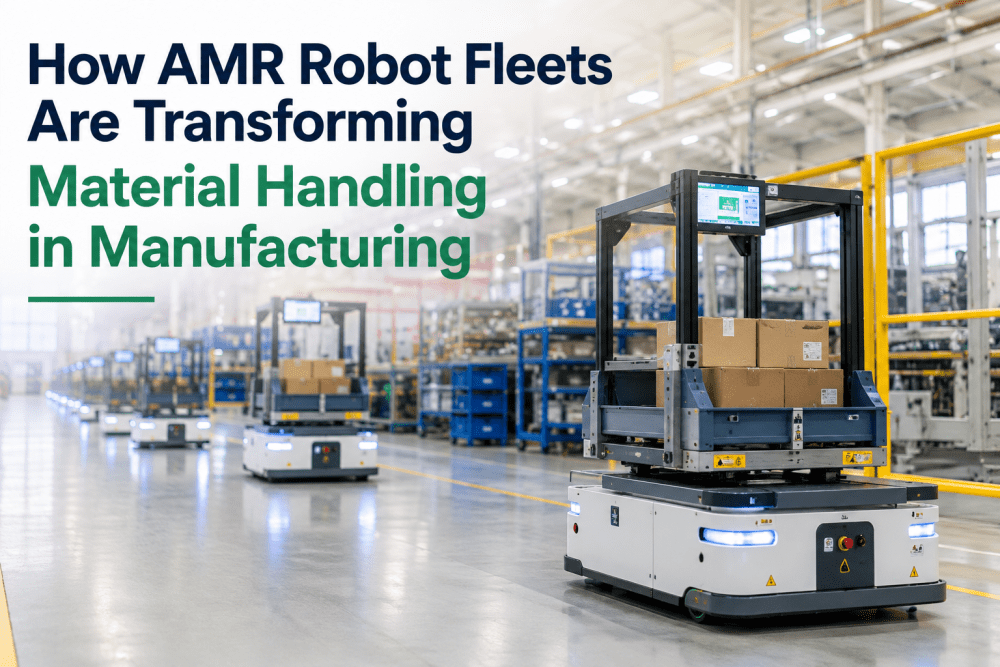
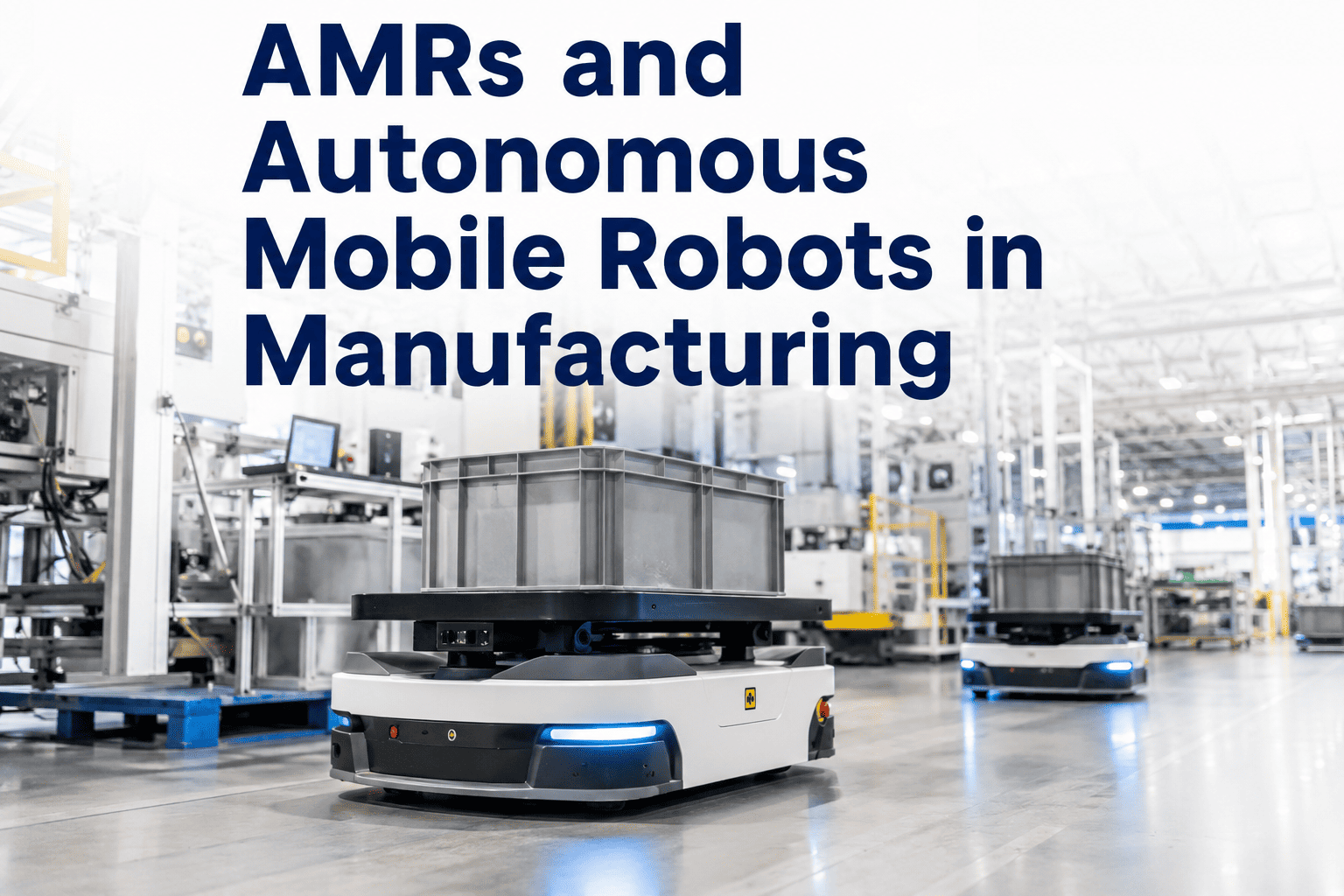
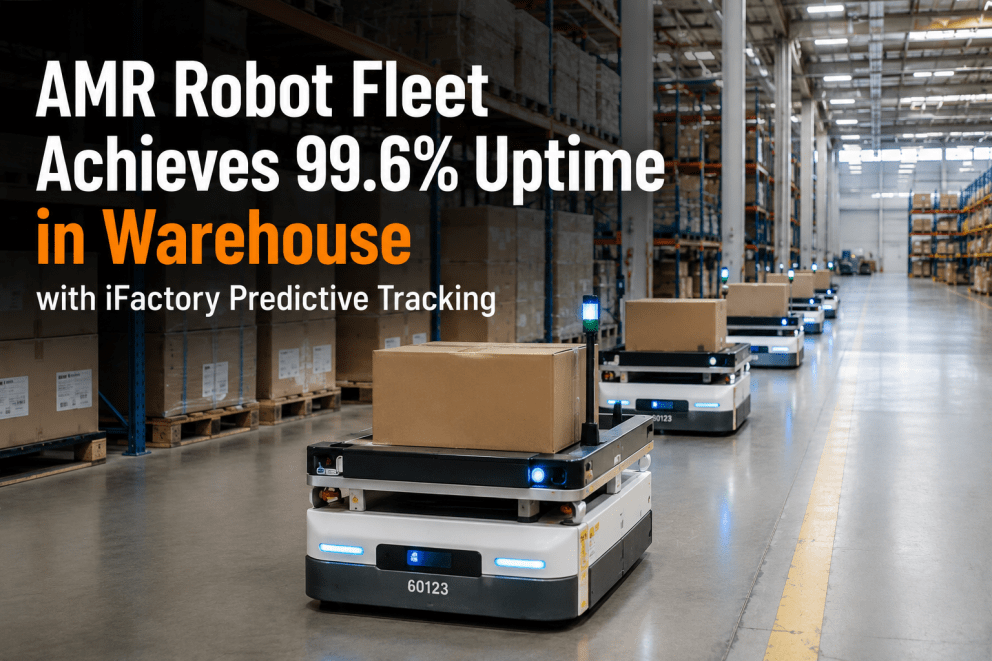
How AMR Robot Fleets Are Transforming Material Handling in Manufacturing
By Daniel Brooks on May 26, 2026
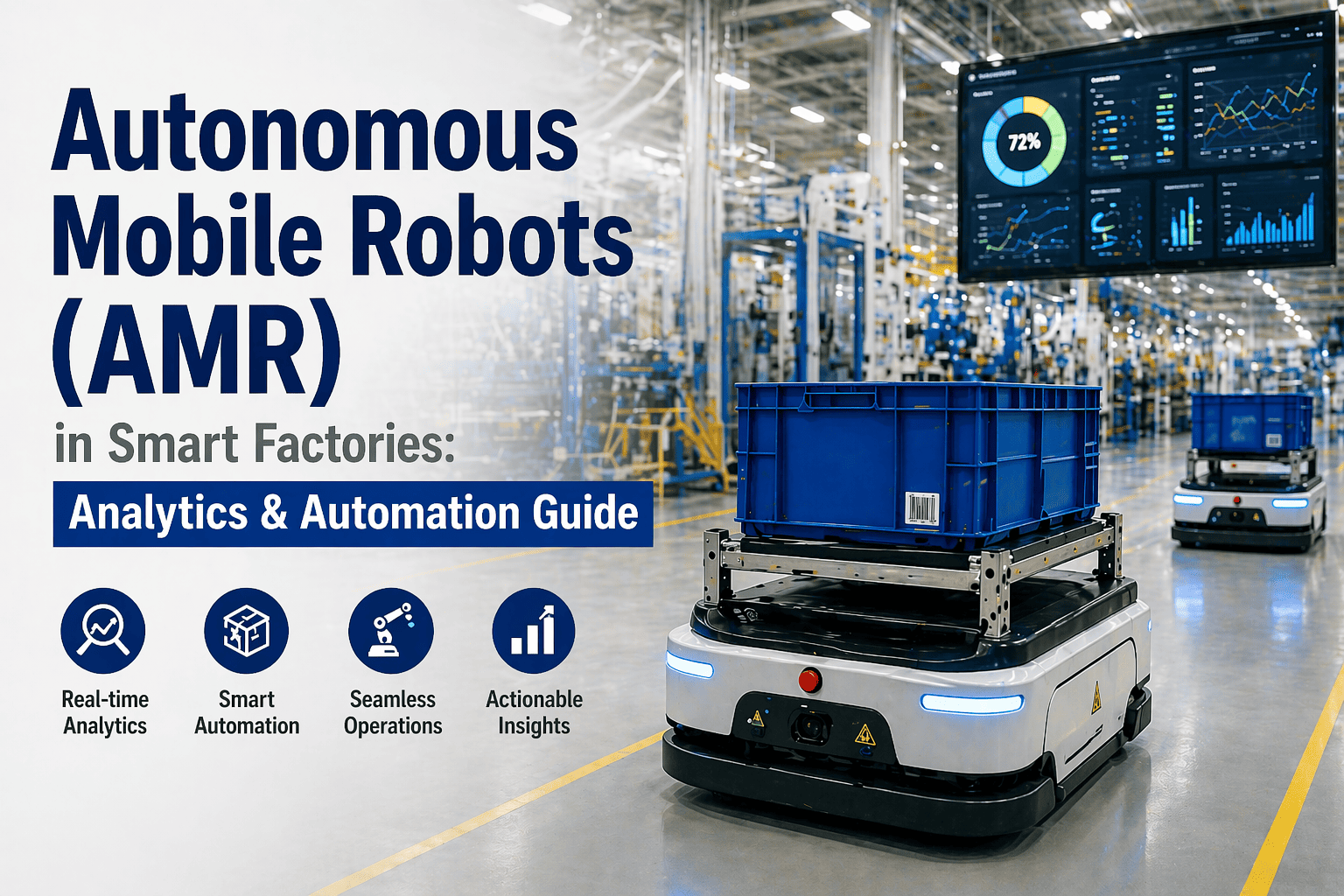
Material handling has quietly become the most expensive bottleneck in modern manufacturing — and the least understood. While factory leaders invest aggressively in CNC automation, robotic welding cells, and high-throughput assembly lines, the movement of materials between those stations still consumes 25–55% of total production time in most U.S. discrete manufacturing facilities. Forklifts wait. Operators chase parts. Line-side bins run dry. Internal logistics fragmentation costs the average mid-size plant between $1.8M and $4.2M annually in unproductive labor, line stoppages and inventory positioning errors. Autonomous Mobile Robot (AMR) fleets are rewriting this equation — but only when they're deployed as managed, intelligence-driven systems rather than isolated machines. iFactory AI Robotics & Cobot Analytics Platform transforms AMR deployments from standalone automation projects into orchestrated, predictive fleet operations: real-time routing optimization, predictive maintenance for every robot in service, fleet health analytics, and seamless integration with MES, WMS, and ERP layers — without the hidden coordination cost that sinks most multi-robot programs. Book a Demo to see how iFactory orchestrates AMR fleets across your manufacturing operations within 6 weeks.
38%
Average reduction in internal material handling cycle time post AMR fleet deployment
$2.4M
Annual labor and downtime savings per mid-size manufacturing facility
96%
Fleet uptime achieved through predictive maintenance vs. 71% reactive baseline
6 wks
Full deployment from site audit to live AMR fleet orchestration go-live
Why Traditional Material Handling Is Breaking Modern Manufacturing
For decades, U.S. manufacturers have relied on forklifts, manual tuggers, conveyor systems, and Automated Guided Vehicles (AGVs) to move work-in-progress between stations. Each of these approaches carries structural limitations that compound as production complexity increases — limitations that AMR fleet intelligence directly addresses.
Forklift Dependency Creates Labor and Safety Risk
Forklift operations account for approximately 35,000 serious injuries annually in U.S. industrial settings. Beyond safety, forklift labor cost — including operator wages, certification, and benefits — typically ranges $55K–$85K per operator per year, with utilization rates rarely exceeding 60%. AMR fleets eliminate operator dependency while delivering near-continuous duty cycles.
AGV Inflexibility Locks Down Plant Layout
Traditional AGVs follow fixed guide paths embedded in flooring or magnetic tape. Any layout change — line rebalance, new product introduction, or cell reconfiguration — requires costly path redesign and physical reinstallation. AMRs navigate dynamically using SLAM and LiDAR, adapting to plant changes in software rather than concrete.
Conveyor Systems Are Capital-Heavy and Fragile
Fixed conveyor infrastructure consumes significant capital ($800–$2,500 per linear foot installed) and creates single points of failure. A conveyor breakdown halts entire production segments. AMR fleets provide distributed, resilient material flow where individual robot downtime never stops the line.
Standalone Robots Without Fleet Intelligence Underperform
Even modern AMRs deployed without fleet orchestration deliver only 40–55% of their theoretical throughput. Without centralized task allocation, traffic management, and predictive analytics, robots collide for resources, idle unnecessarily, and fail to coordinate with production schedules. Fleet intelligence is what separates a robot purchase from an operational transformation.
No Predictive Visibility into Robot Health
AMRs accumulate wear on drive wheels, battery cells, sensors, and lift mechanisms with every shift. Without continuous health monitoring, degradation manifests as in-shift breakdowns that disrupt material flow and require emergency recovery. Predictive analytics identifies component fatigue weeks before failure conditions.
Integration Gaps Between Robots and Plant Systems
AMRs disconnected from MES, WMS, and ERP layers operate blind — moving materials without awareness of production priorities, inventory positioning, or order urgency. The result is technically functional but strategically misaligned automation. True ROI requires bidirectional integration that aligns robot tasks with manufacturing intent.
The AMR Fleet Transformation Journey: From Pilot to Plant-Wide Intelligence
Manufacturers that successfully scale AMR fleets follow a recognizable progression — and those that stall typically do so at the same transition points. Understanding this journey helps operations leaders avoid the most common deployment pitfalls.
Stage 1 — Pilot Deployment
Single-Robot Validation
A single AMR is deployed on one repetitive material handling route — typically raw material delivery to a single line or finished goods removal from a packaging cell. ROI is measured in labor hours saved. Most pilots succeed at this stage; few translate the learning into scale.
iFactory provides pilot baseline analytics from day one
Stage 2 — Multi-Robot Scaling
Fleet Coordination Complexity Emerges
Three to ten robots are added. Coordination challenges surface immediately: traffic conflicts at intersections, charging queue contention, mismatched task priorities, and idle time as robots wait for upstream completion. Vendor-supplied fleet managers handle basic routing but lack production context.
iFactory orchestration layer resolves coordination at scale
Stage 3 — Production System Integration
MES, WMS, and ERP Alignment
Robot tasks must align with production schedules, inventory positioning, and order priorities. Without integration, robots move materials efficiently but not strategically. Many deployments stall here — robot vendors do not provide enterprise system integration, and IT teams lack robotics expertise.
iFactory provides pre-built MES, WMS, ERP, and SAP connectors
Stage 4 — Predictive Fleet Operations
Continuous Optimization and Health Intelligence
Mature deployments shift from reactive fleet management to predictive operations: battery health forecasting, drive component fatigue detection, route optimization based on historical congestion patterns, and condition-based maintenance scheduling. This is where AMR fleets deliver compounding ROI year over year.
iFactory's predictive analytics is the destination architecture
Most AMR Deployments Stall at Stage 2. iFactory Takes You to Stage 4 in 6 Weeks.
iFactory's AMR fleet orchestration platform combines real-time routing intelligence, predictive maintenance analytics, and pre-built enterprise integration — eliminating the coordination, integration, and optimization gaps that cause most multi-robot programs to underperform.
iFactory AI AMR Fleet Platform: Six Capabilities That Define Modern Material Handling
iFactory's Robotics & Cobot Analytics platform is engineered specifically for the operational reality of multi-vendor AMR fleets in manufacturing environments — where robots from different OEMs must coordinate, integrate with legacy production systems, and operate reliably across multi-shift operations. The platform delivers six integrated capabilities that transform AMR purchases into orchestrated material handling operations.
01
Real-Time Fleet Routing and Traffic Optimization
iFactory's routing engine continuously evaluates plant traffic patterns, intersection congestion, and task urgency to assign optimal routes for every active robot. The system updates route decisions every 5 seconds, dynamically rerouting around bottlenecks before they impact throughput. Compared to vendor-supplied routing, manufacturers report 22–34% reduction in mean task completion time and elimination of deadlock conditions that cause manual recovery intervention.
02
Predictive Maintenance for Every Robot in Service
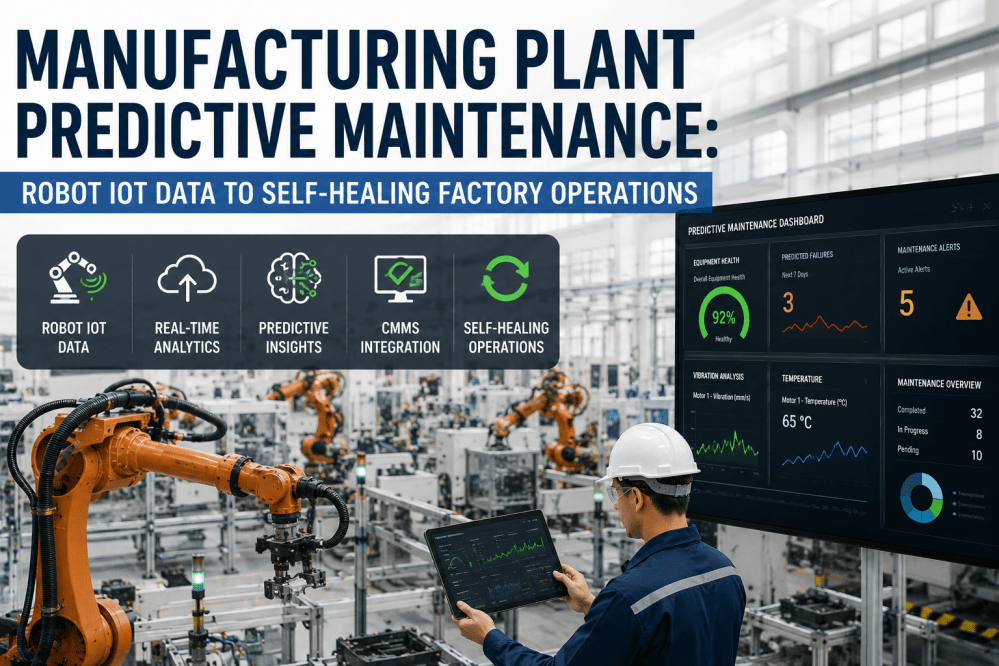
iFactory ingests telemetry from drive motors, wheel encoders, lift actuators, and sensor arrays — building component-level fatigue models that detect degradation 14–45 days before failure conditions. Maintenance work orders are auto-generated through your CMMS with specific component recommendations, parts requirements, and recommended service windows. Fleet-wide unplanned downtime typically drops 60–75% within the first 6 months of deployment.
03
Battery Health Forecasting and Charge Scheduling
Lithium-ion battery degradation is the single largest driver of AMR fleet performance decline. iFactory tracks state-of-charge cycles, depth-of-discharge patterns, thermal exposure, and capacity fade curves for each battery in the fleet — predicting end-of-life 60–90 days in advance. The platform optimizes charging schedules to extend battery service life by 18–28% while ensuring fleet availability aligns with production peak demand.
04
Native MES, WMS, and ERP Integration
iFactory connects to SAP S/4HANA, Oracle EBS, Microsoft Dynamics, Rockwell FactoryTalk, Siemens Opcenter, and major WMS platforms via pre-built connectors using OPC-UA, REST APIs, and SQL bridges. Robot task lists are generated automatically from production schedules and inventory positions — eliminating manual dispatch coordination. Integration is completed in under 10 days with no ERP configuration changes required.
05
Multi-Vendor and Mixed-Fleet Orchestration
Most manufacturers operate AMRs from multiple OEMs — Mobile Industrial Robots, OTTO Motors, Locus Robotics, Geek+, and others — each with proprietary fleet managers. iFactory provides a unified orchestration layer that coordinates across vendors, enabling cross-fleet task allocation, unified traffic management, and consolidated performance reporting. This eliminates the vendor lock-in that limits future fleet expansion options.
06
Fleet Performance Analytics and ROI Dashboards
Operations leaders receive real-time visibility into fleet utilization, task throughput, mean cycle time, exception rates, and labor displacement metrics. ROI dashboards quantify avoided labor cost, downtime prevention, and throughput gains in dollars — making the financial case for fleet expansion data-driven rather than anecdotal. Executive reports are auto-generated weekly with no manual compilation required.
Comparison: Standalone AMR Deployment vs. iFactory Fleet Orchestration
The difference between an AMR purchase and an operational transformation lies in the orchestration layer. The table below compares typical vendor-supplied AMR deployments with iFactory's managed fleet platform.
Capability
Standalone AMR Deployment
iFactory Fleet Orchestration
Routing Intelligence
Vendor-supplied basic path planning. No production context. Static priority handling.
Dynamic routing updated every 5 seconds based on real-time traffic, task urgency, and production schedule alignment.
Maintenance Approach
Reactive or calendar-based service. In-shift breakdowns common. Manual fault diagnosis.
Predictive maintenance with 14–45 day fault forecasting. Auto-generated CMMS work orders with component-level recommendations.
Battery Management
Opportunity charging based on state-of-charge thresholds. No degradation tracking.
Battery health forecasting with 60–90 day end-of-life prediction. Charge optimization extends battery life by 18–28%.
Enterprise Integration
Limited or manual integration with MES, WMS, ERP. Task lists managed in vendor portal.
Native pre-built connectors for SAP, Oracle, Rockwell, Siemens, major WMS platforms. Bidirectional sync in under 10 days.
Multi-Vendor Support
Single vendor fleet manager only. Cannot orchestrate across OEMs.
Unified orchestration across MiR, OTTO, Locus, Geek+, and others. Cross-fleet task allocation and reporting.
Performance Visibility
Basic utilization stats from vendor dashboard. No financial ROI quantification.
Real-time fleet KPI dashboards with quantified labor savings, downtime prevention, and throughput gains in dollar terms.
Deployment Timeline
Pilot to production typically 4–9 months including integration challenges.
6-week structured deployment: audit, integration, pilot, scale, optimize — with measurable ROI starting week 4.
Real-World Outcomes: AMR Fleet Deployments in U.S. Manufacturing
The following outcomes are drawn from iFactory AMR fleet deployments across three manufacturing configurations. Each use case reflects 6-month post-deployment performance data.
A Tier-1 automotive component manufacturer operating an 18-AMR fleet across three production halls experienced persistent fleet coordination issues — robots from two different OEMs operated through separate fleet managers, causing traffic conflicts at shared intersections and idle time waiting for cross-fleet task handoffs. iFactory deployed a unified orchestration layer integrating both robot fleets, MES production schedules, and the facility's SAP WMS. Cross-vendor task allocation eliminated traffic conflicts within 14 days. Mean task completion time dropped 31%, freeing 22% additional fleet capacity for new automation use cases without adding robots.
31%
Reduction in mean task completion time across multi-vendor fleet
22%
Additional fleet capacity unlocked without adding robots
$680K
Annual labor and throughput gain quantified in ROI dashboard
Unify Multi-Vendor AMR Fleets Into a Single Orchestrated Operation
"Multi-vendor fleets are the norm in mature manufacturing. Unified orchestration is what turns them from coordination problem into competitive advantage."
A consumer electronics contract manufacturer operating a 12-robot AMR fleet across two shifts experienced an average of 6.4 unplanned in-shift breakdowns per month — primarily drive motor failures and lift mechanism wear. Each breakdown caused 35–90 minutes of material flow disruption to assembly lines. iFactory deployed predictive maintenance analytics with component-level fatigue modeling and CMMS integration. Within 4 months, unplanned breakdowns dropped to 1.2 per month, with most maintenance now performed during planned shift transitions. Annual labor and downtime avoidance was quantified at $310K.
81%
Reduction in unplanned in-shift AMR breakdowns within 4 months
38 days
Average advance warning before drive motor failure conditions
$310K
Annual avoided downtime and emergency maintenance cost
Eliminate In-Shift AMR Breakdowns With Predictive Component Analytics
An industrial equipment manufacturer with an 8-AMR fleet handling line-side material delivery operated robots through manual task dispatch — a production coordinator would assign tasks based on visual line observation and operator radio calls. Task latency averaged 11 minutes from line-side material need to AMR arrival. iFactory integrated the AMR fleet manager with the facility's Siemens Opcenter MES, enabling automatic task generation from production schedule events. Task latency dropped to under 90 seconds. Line stoppages attributable to material delays decreased 76%, and the production coordinator role was redeployed to higher-value scheduling work.
87%
Reduction in line-side material delivery task latency
76%
Decrease in line stoppages caused by material delivery delays
$245K
Annual labor redeployment and throughput improvement value
Integrate Your AMR Fleet With MES for Automatic Task Dispatch
"Manual AMR dispatch is the most common ROI leak in fleet deployments. MES integration recovers it immediately."
Expert Review: Why Fleet Orchestration Is the Real Differentiator in AMR Investment
Director of Smart Manufacturing & Robotics
Independent review — U.S. discrete manufacturing sector, 17 years operational experience
The most common mistake I see in AMR deployments is treating them as equipment purchases rather than operational system implementations. A robot vendor will happily sell you ten units and a basic fleet manager. What they will not deliver is the orchestration intelligence that makes those ten robots actually behave like a fleet — coordinating tasks, avoiding traffic deadlocks, aligning with production priority, and predicting component failure before it disrupts material flow.
The economic reality is straightforward. A well-orchestrated 10-robot AMR fleet delivers two to three times the throughput of the same robots operating through vendor-supplied tooling. The hardware cost is identical. The orchestration layer is where the productivity multiplier lives, and where the ROI gap between average deployments and best-in-class deployments emerges.
The other underappreciated factor is multi-vendor flexibility. Most manufacturers that scale AMR fleets eventually need robots from multiple OEMs — different payload capacities, different navigation environments, different price points. Without a vendor-neutral orchestration platform, every new robot type means a new fleet manager, new integration project, and new operational silo. That fragmentation kills the long-term scaling case.
For manufacturers evaluating AMR investments today, the question is not which robot to buy first. It is what orchestration platform will manage the fleet as it grows from one to fifty robots over the next five years. That decision determines whether the AMR program becomes a competitive capability or a stranded automation experiment.
Assessment
A vendor-neutral fleet orchestration platform with predictive maintenance and native enterprise integration is the highest-leverage investment a manufacturer can make in its material handling automation roadmap — typically delivering 2–3x the operational ROI of comparable robot hardware deployed in isolation.
6-Week Deployment Plan: From AMR Fleet Audit to Live Orchestration
Integration architecture for MES, WMS, ERP, and CMMS systems
Weeks 3–4
Pilot Orchestration Deployment
Deploy unified fleet orchestration layer with traffic management and routing optimization
Activate predictive maintenance analytics for all robots in pilot scope
Bidirectional integration with MES and CMMS goes live — ROI evidence begins here
Weeks 5–6
Full Fleet Scale and Optimization
Expand orchestration to full plant AMR fleet across all production zones and shifts
Battery health forecasting and charge scheduling optimization activated
Fleet performance and ROI dashboards delivered to operations leadership
ROI IN 4 WEEKS: MEASURABLE RESULTS FROM WEEK 4
Facilities completing the 6-week program report an average of $165,000 in quantified material handling productivity gains and avoided downtime within the first 4 weeks of orchestration go-live — with fleet utilization improvements of 24–38% identified by week 5 pilot validation.
$165K
Avg. quantified gain in first 4 weeks
24–38%
Fleet utilization gain by week 5
96%
Fleet uptime post optimization
Frequently Asked Questions
iFactory is vendor-neutral and supports AMRs from all major OEMs including Mobile Industrial Robots (MiR), OTTO Motors, Locus Robotics, Geek+, Fetch Robotics, Seegrid, and others. The platform connects through standard fleet manager APIs and VDA 5050 protocol where supported. Mixed-fleet orchestration across multiple vendors is a core platform capability, not a custom integration project. New robot types added to the fleet inherit existing orchestration policies automatically.
iFactory provides pre-built connectors for SAP S/4HANA, Oracle EBS, Microsoft Dynamics, Rockwell FactoryTalk, Siemens Opcenter, and major WMS platforms using OPC-UA, REST APIs, SQL bridges, and message queue patterns. Integration is read-and-write in both directions and is configured during weeks 1–2 of deployment without requiring ERP configuration changes, schema modifications, or production system downtime. Typical integration completion is under 10 days.
iFactory builds component-level fatigue models for drive motors, wheel encoders, lift actuators, LiDAR sensors, safety bumpers, and battery cells. Each component has a remaining useful life prediction updated continuously based on operational telemetry. Maintenance alerts include the affected component, predicted time-to-failure, recommended service action, required parts, and optimal service window — all auto-generated as CMMS work orders through your existing maintenance system.
Yes. iFactory is designed for fleet scaling from initial pilot deployments through multi-hundred robot operations across distributed manufacturing sites. The platform supports incremental robot additions, new vendor introductions, additional production zones, and multi-site rollouts without architectural changes. Many customers begin with 3–8 robot pilots and expand to 25+ robot fleets within 12–18 months without re-platforming.
Typical iFactory AMR fleet deployments deliver measurable returns in three categories: 24–38% improvement in fleet utilization and task throughput, 60–75% reduction in unplanned in-shift robot downtime, and 18–28% extension of battery service life. In dollar terms, mid-size manufacturing facilities (10–25 robot fleets) report annual quantified ROI between $400K and $1.2M depending on baseline labor costs, downtime impact, and integration complexity. ROI dashboards within the platform quantify these gains continuously.
Conclusion: AMR Fleet Intelligence Is the Material Handling Standard of the Next Decade
Material handling automation is no longer a question of whether — it is a question of how well. U.S. manufacturers that successfully deploy AMR fleets are not the ones with the largest robot counts. They are the ones whose fleets are orchestrated as intelligent operational systems: routed dynamically, maintained predictively, integrated bidirectionally with production planning, and scaled across vendors without lock-in.
The economic gap between standalone AMR deployments and orchestrated fleet operations is significant and growing. Standalone robots deliver labor displacement. Orchestrated fleets deliver throughput acceleration, downtime elimination, and the operational flexibility to absorb production changes that would have required physical reinstallation in the AGV era.
For manufacturers building AMR roadmaps today, the platform decision matters more than the robot decision. The orchestration architecture chosen for a 5-robot pilot will determine the capability ceiling of a 50-robot operation five years from now. Vendor-neutral, integration-rich, predictively intelligent platforms are the foundation that compounding ROI requires.
iFactory deploys in 6 weeks, integrates with existing fleet managers and enterprise systems without configuration changes, and delivers quantified ROI evidence beginning in week 4. The path from fragmented AMR deployment to orchestrated material handling intelligence is a defined process — not an open-ended transformation.
Stop Operating AMRs as Isolated Robots. Orchestrate Your Fleet in 6 Weeks. ROI in Week 4.
iFactory gives manufacturing operations teams unified AMR fleet orchestration, predictive maintenance analytics, native MES and ERP integration, multi-vendor support, and quantified ROI dashboards — fully deployed in 6 weeks, with measurable results starting from week 4.