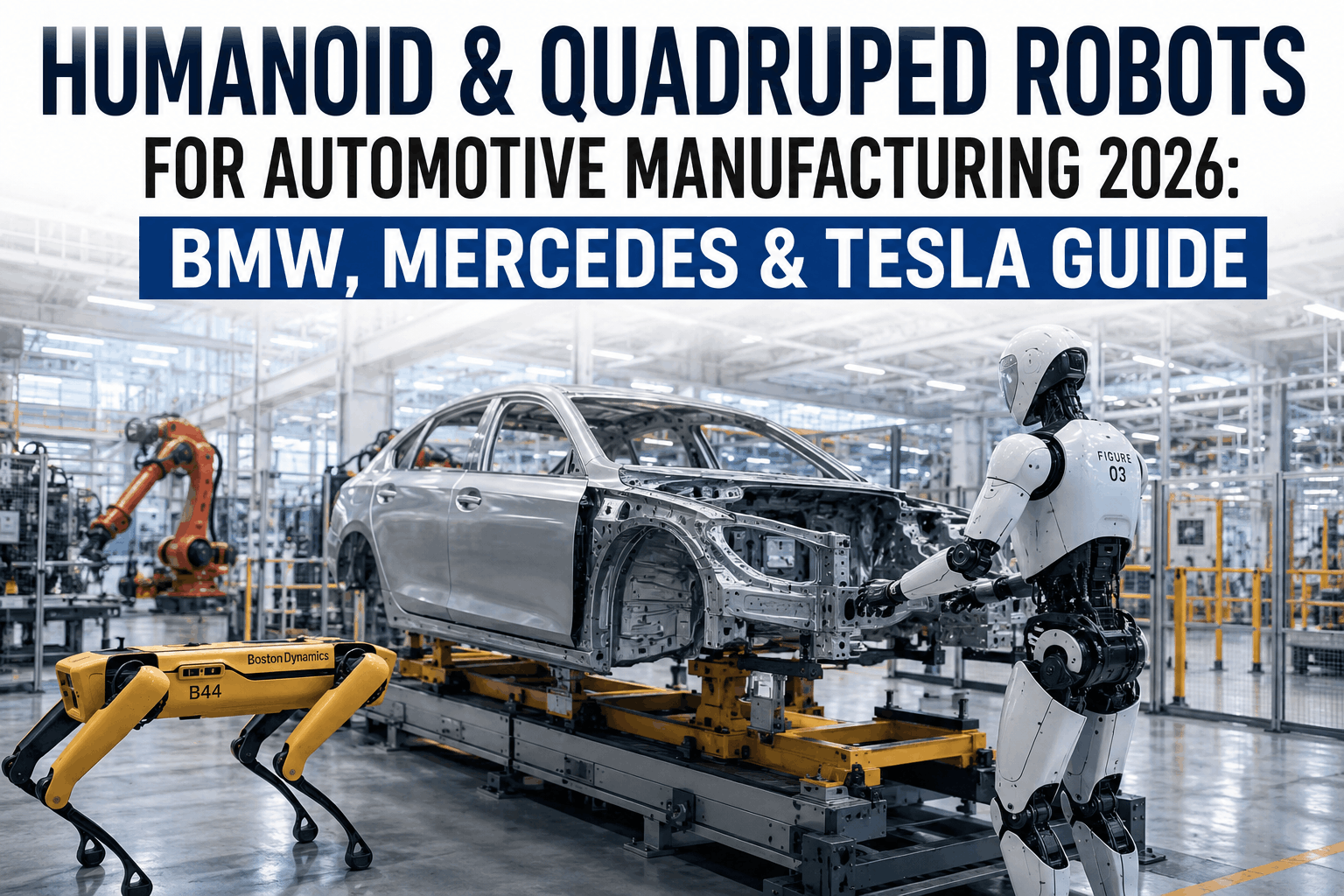
The humanoid robot is no longer a concept vehicle for the factory floor — it is a production reality. Figure 02 robots are permanently deployed at BMW Spartanburg. Apptronik's Apollo is in pilot at Mercedes-Benz Berlin-Marienfelde and Kecskemét. Tesla Optimus is running tasks inside Fremont. Unitree H1 completed automotive assembly tests at Geely in 2023. For automotive manufacturing leaders evaluating which platform to pilot, the question has shifted from "will humanoid robots work in our plant?" to "which one works best for our specific use case — and how do we orchestrate them alongside our MES, CMMS, and ERP?" This buyer comparison answers both. Talk to an iFactory expert about humanoid orchestration for your plant — book a demo.
2026 Automotive Humanoid Buyer Guide
Figure 02 vs Tesla Optimus
vs Apollo vs Unitree H1
Payload, dexterity, deployment status, OEM partnerships, and iFactory orchestration — the technical buyer comparison for automotive manufacturing leaders.
Why Automotive Leads the Humanoid Robot Race
Automotive plants are the ideal proving ground for humanoid robots: structured environments, repeatable tasks, existing robot-safe zones, and OEMs with capital to pilot unproven technology. Automotive saw the deepest AI and robotics penetration in 2025, driven by OEM mandates pushing quality and traceability requirements down through the supply chain. Three task categories drive the first wave of humanoid deployments: intralogistics (moving parts to the line), repetitive assembly assistance, and quality inspection support. These are not the most complex tasks in the plant — they are the ones with sufficient volume, safety margin, and business case to justify humanoid ROI today.
The 4 Platforms: At a Glance
Head-to-Head Comparison Matrix
Best / Strong
Moderate
Limited / Uncertain
Automotive Use Case Match: Which Platform for Which Task?
Intralogistics — Parts Delivery to Line
Apollo (Mercedes) + Unitree H1
Apollo's 25kg payload and Mercedes multi-plant deployment make it the proven choice for carrying heavy component sets. Unitree H1's 30kg payload and open SDK make it the fastest to deploy for logistics integration via iFactory.
Fine Assembly Assistance
Figure 02/03
Helix 02's fine manipulation capability and the BMW deployment track record make Figure the strongest platform for tasks requiring precise hand dexterity — connector insertion, component placement, torque application to spec.
Quality Inspection Support
Apollo + Figure 02
Apollo is already performing initial quality checks at Mercedes-Benz. Figure's OpenAI integration enables natural language quality reporting. Both benefit from iFactory's AI quality data pipeline that connects robot observations to SAP QM automatically.
Research + Pilot Programme
Unitree H1 / H1-2
Available today at $99,900–$128,900 with an open SDK. The fastest path to a working humanoid pilot integrated with your MES through iFactory's orchestration layer, without enterprise negotiation timelines.
Long-Term Fleet Scaling
Apollo (Jabil) + Tesla Optimus
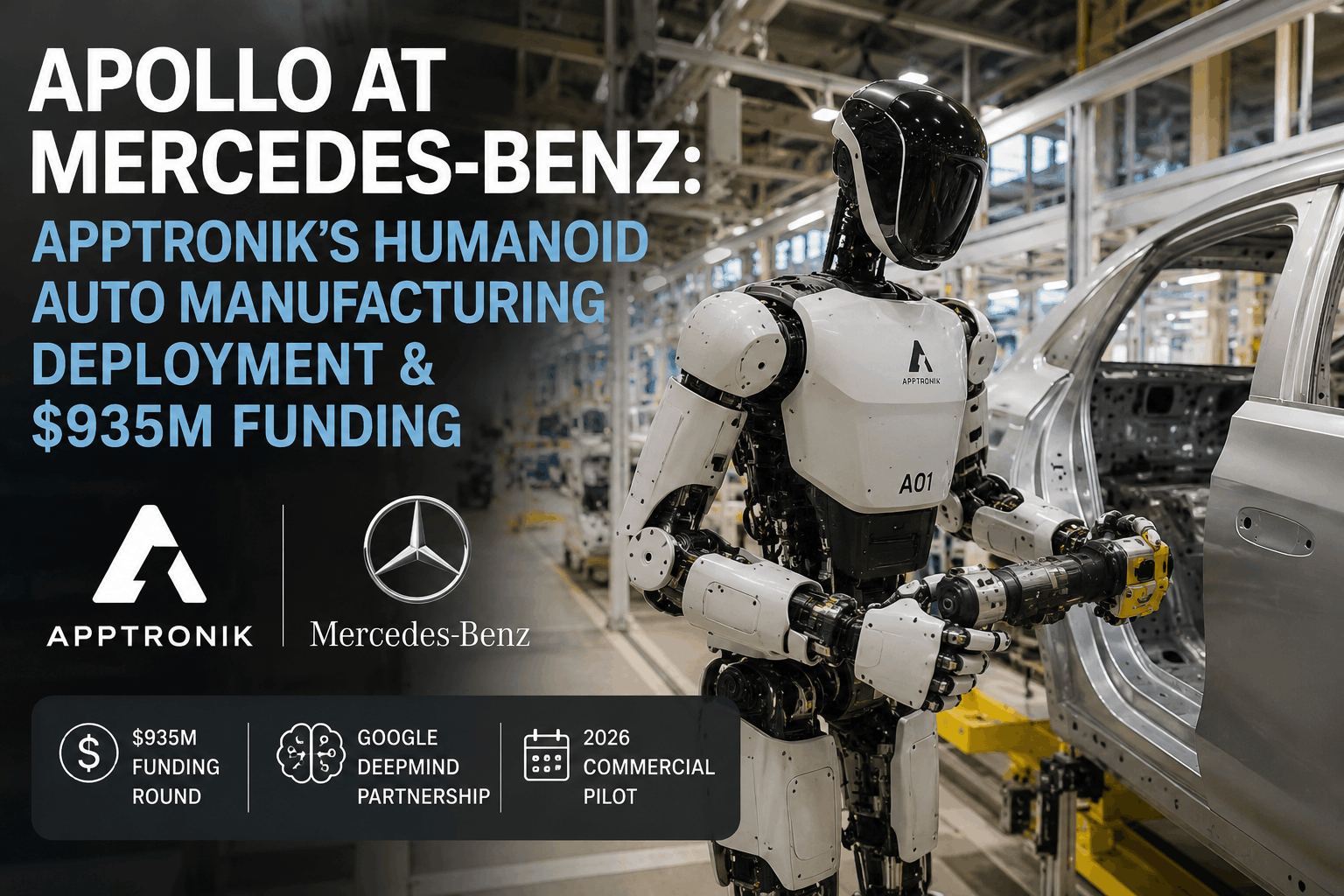
Apptronik's Jabil manufacturing partnership and $935M funding position Apollo for commercial fleet delivery by 2027. Tesla's supply chain advantage is the strongest long-term cost reduction path — if 3rd-party commercial availability opens.
Hazardous / Ergonomic Tasks
Apollo
Apollo was specifically selected by Mercedes-Benz for physically demanding and repetitive tasks that are less suitable for human workers — heat exposure, heavy lifting, awkward postures. Its 25kg payload and modular architecture are purpose-matched.
The Missing Layer: Why Hardware Alone Is Not Enough
Every platform in this comparison has impressive hardware specifications. None of them ship with production system integration. Talk to an iFactory expert about integrating humanoid robots into your MES and ERP — book a demo. A humanoid robot operating without production system integration is generating no structured data, receiving no production context from your ERP, and creating no traceable quality record for IATF 16949 compliance. The hardware is the body. iFactory provides the intelligence layer that makes it productive in an automotive manufacturing environment.
iFactory Humanoid Orchestration Layer
What Humanoid Robots Generate
Task completion events
Visual inspection observations
Component handling logs
Exception and anomaly signals
Movement and sensor telemetry
→
iFactory AI Orchestration
On-Premise or Cloud
What Production Systems Receive
MES: task completions linked to production orders
SAP QM: quality observations as inspection records
CMMS: maintenance alerts from robot telemetry
SAP PP: real-time task status for schedule actuals
ERP: cost centre data per robot per shift
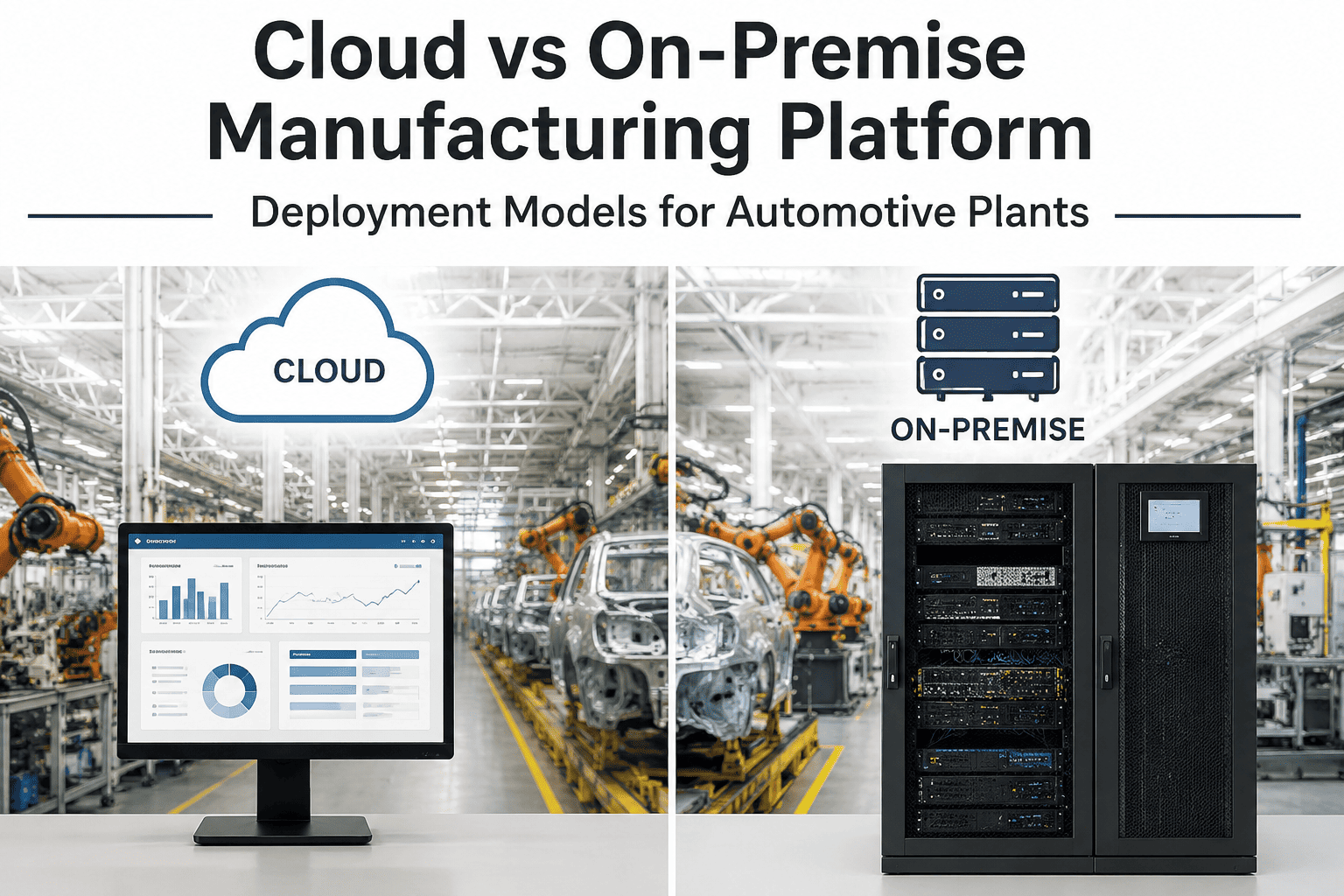
iFactory Deployment Options: On-Premise and Cloud
Automotive plants have different data requirements. Tier 1 suppliers and OEMs with strict data sovereignty policies need on-premise deployment — every byte of production data stays inside the plant network, with no dependency on external connectivity. Global OEMs running multi-plant operations need cloud-based analytics — fleet performance dashboards, cross-plant benchmarking, and enterprise-level quality reporting accessible from headquarters. iFactory provides both. Ask our team about the deployment model that fits your data governance requirements.
On-Premise Deployment
All data processed and stored inside the plant network
No external connectivity required for operation
Meets OEM data sovereignty and ITAR requirements
Edge AI inference — sub-20ms response for real-time control
Ideal for: Tier 1 suppliers, OEMs with strict IT policies
Discuss On-Premise Setup
Cloud-Based Deployment
Enterprise-level fleet management across multiple plants
Cross-plant OEE, quality, and humanoid performance benchmarking
Continuous AI model improvement from fleet-wide data
Accessible from headquarters, operations centers, and mobile
Ideal for: Global OEMs, multi-plant production networks
Discuss Cloud Setup
FAQ: Humanoid Robots in Automotive Manufacturing
Which humanoid robot platform is most proven in automotive manufacturing today?
As of mid-2026, Figure 02 at BMW Spartanburg and Apptronik Apollo at Mercedes-Benz Berlin-Marienfelde and Kecskemét represent the two most validated automotive deployments by independent OEMs. Figure's second BMW use case deployed in 30 days (versus 12 months for the first), signaling rapid deployment learning. Apollo's Mercedes deployment is the most ambitious in scope — designed as a multi-task, multi-plant programme from the outset, rather than a single-task pilot. Tesla Optimus deployments are real but limited to Tesla's internal Fremont factory, with no confirmed 3rd-party commercial availability as of this writing.
How long does it take to deploy a humanoid robot in an automotive plant?
Figure AI's first BMW use case took 12 months from deployment start to production task completion. Their second use case took 30 days — reflecting the steep learning curve in deployment tooling and AI training. Apollo's Mercedes deployment is structured as a 2025–2026 pilot with 2027 commercial fleet scale-up planned. For Unitree H1, with its open SDK and iFactory orchestration, a pilot programme in logistics or inspection can be operational in 4–8 weeks. The integration of the humanoid into MES and ERP via iFactory typically adds 1–2 weeks to the deployment timeline.
What is the ROI case for humanoid robots in automotive manufacturing?
The ROI case for the first wave of automotive humanoid deployments is built on three foundations: labor substitution for physically demanding or hazardous tasks (intralogistics, heavy part delivery, ergonomically problematic assembly positions); consistent quality data generation (robots generate structured observations that feed quality systems without human data entry variation); and 24/7 operational availability in tasks where shift patterns create coverage gaps. The hardware cost must be amortized over useful task hours — at $50,000–$100,000 per unit and 3–4 years of productive life, the hourly cost competes with specialized skilled labor when 2-shift or 3-shift utilization is achieved.
How does iFactory integrate with humanoid robots from different manufacturers?
iFactory provides a platform-agnostic orchestration layer that connects to humanoid robot data streams through open APIs and standard industrial protocols. The integration architecture captures task completion events, quality observations, sensor telemetry, and exception signals from humanoid robots regardless of manufacturer — Figure, Apollo, Unitree, or future platforms — and routes this data to MES, SAP QM, CMMS, and ERP using the same connector framework used for conventional machine integration. iFactory is available in both on-premise deployment (for data sovereignty requirements) and cloud-based deployment (for multi-plant enterprise visibility).
Is Tesla Optimus available for external automotive manufacturers to deploy?
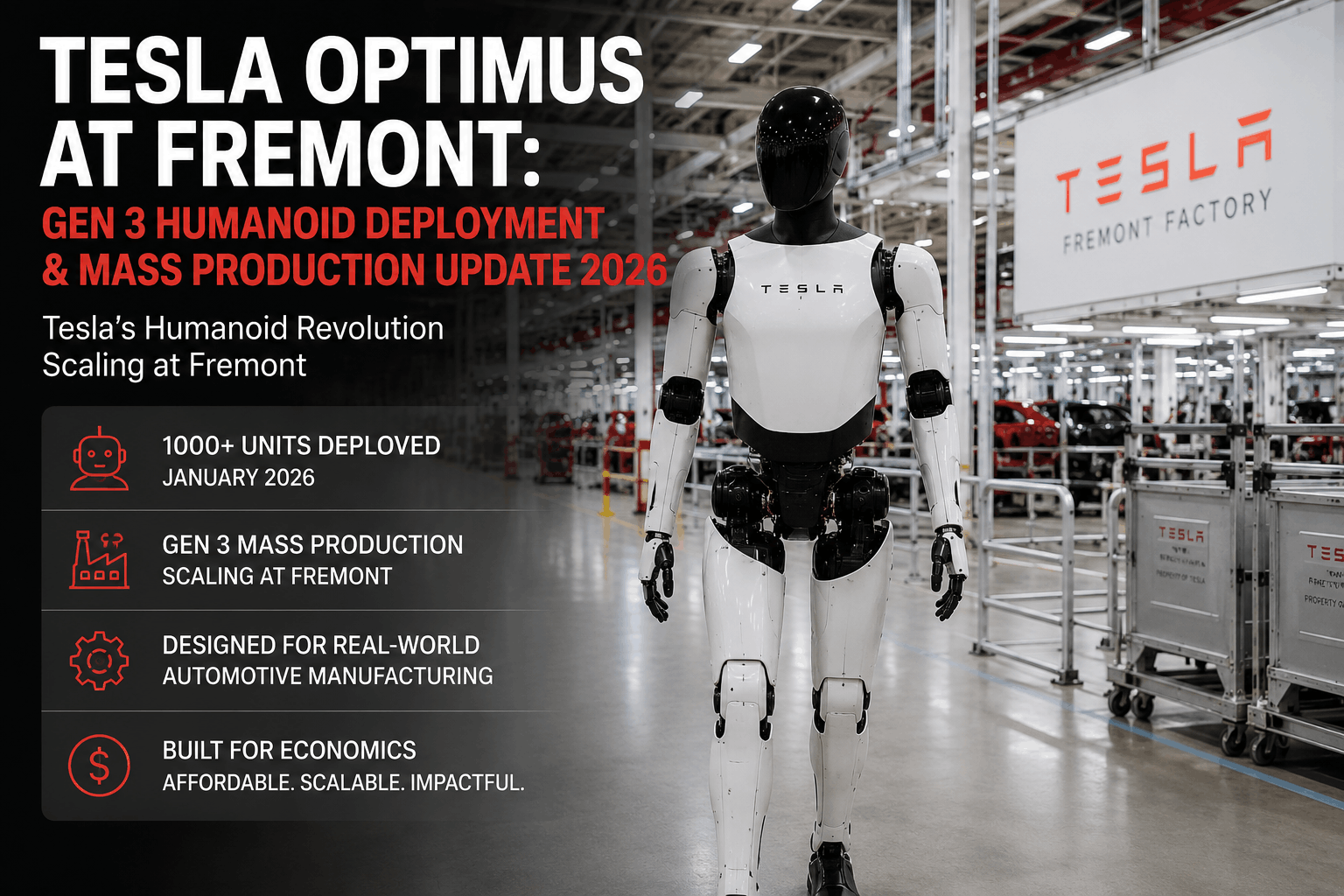
As of mid-2026, Tesla Optimus is not confirmed as externally commercially available. Tesla's current deployments are internal — at its Fremont factory and Gigafactory facilities. Tesla's stated target price of $20,000–$30,000 and plans for 5,000 units in internal deployment make it the most compelling long-term cost case. However, the closed ecosystem (Tesla-specific AI stack, limited 3rd-party integration documentation) and the controversy around public demonstration autonomy create procurement risk for external OEMs planning deployments on a 2025–2027 timeline. For automotive manufacturers who cannot wait, Figure 02/03 and Apollo represent the only current options with proven 3rd-party OEM deployment.
What tasks should NOT be given to humanoid robots in automotive manufacturing today?
Current humanoid platforms are not yet suited for: high-precision torque assembly to spec (cycle time, positional accuracy, and force feedback are not yet at production-grade reliability for safety-critical fasteners); tasks requiring sustained high-speed throughput over full shifts (battery life and thermal management limit continuous operation); any task with significant variation in incoming material positioning without structured fixtures; and tasks where a hardware fault could cause injury or major line disruption. The first-wave deployment focus on intralogistics, parts delivery, and inspection assistance reflects these constraints — these tasks tolerate more variability and have lower consequence of error than core assembly.
Humanoid + AI Orchestration
Hardware Is Just the Start.
Orchestration Is the Value.
iFactory connects humanoid robots to your MES, SAP, CMMS, and ERP — on-premise or cloud — turning robot task data into production intelligence from day one of deployment.
Figure AI Integration
Apollo Orchestration
On-Premise & Cloud
SAP QM + MES Routing
IATF 16949 Traceability