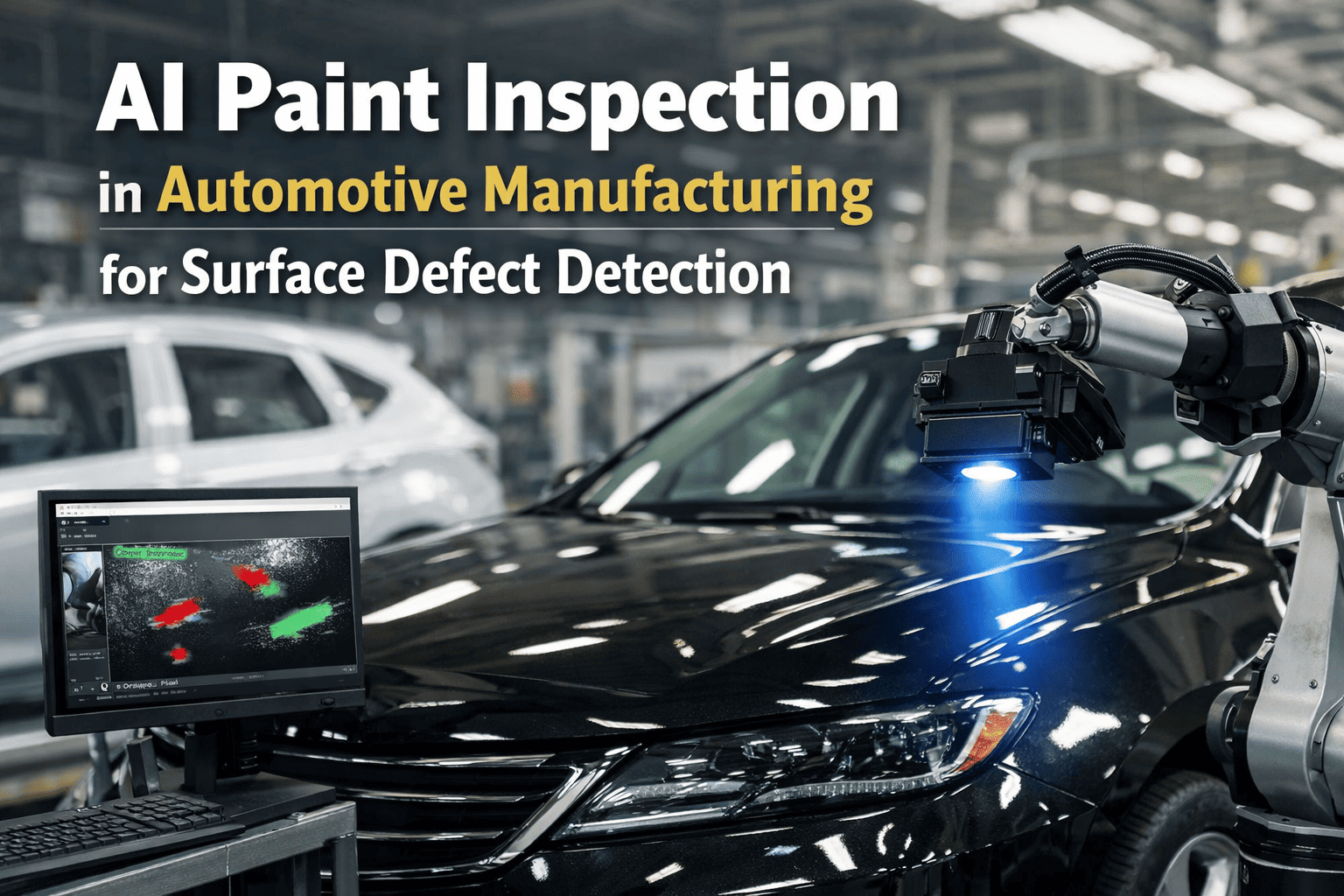
At 350 frames per second, the human eye sees nothing. AI sees everything. Modern automotive production lines run at speeds that make manual quality inspection physically impossible stamping presses cycling every 3 seconds, robotic welding stations firing in sub-second intervals, paint booths processing an entire vehicle body in under two minutes. A single missed defect reaching final assembly costs 10 to 100 times more to fix than catching it inline. iFactory AI Inspection systems close this gap completely, embedding machine vision intelligence directly into your production flow at every critical checkpoint from body-in-white through final audit.
How Automotive Production Lines Actually Work
Understanding where AI inspection creates value requires understanding the speed and complexity of modern automotive manufacturing. Every stage runs continuously, interdependently, and at mechanical tolerances measured in microns.
Steel coils feed into progressive die stamping presses producing hood panels, doors, quarter panels, and structural components at 8 to 20 strokes per minute. Surface defects, edge cracks, and dimensional variations introduced here propagate through every downstream stage. Traditional end-of-press sampling inspects 1 in 200 parts. AI vision inspects all of them.
Robotic welding cells join up to 400 individual stampings into the vehicle body structure using MIG, spot, and laser welding. Weld spatter, missed spots, and geometric distortions are invisible to cameras running at standard frame rates. High-speed AI vision systems capture weld quality at 200 to 500 fps, classifying anomalies in under 50 milliseconds.
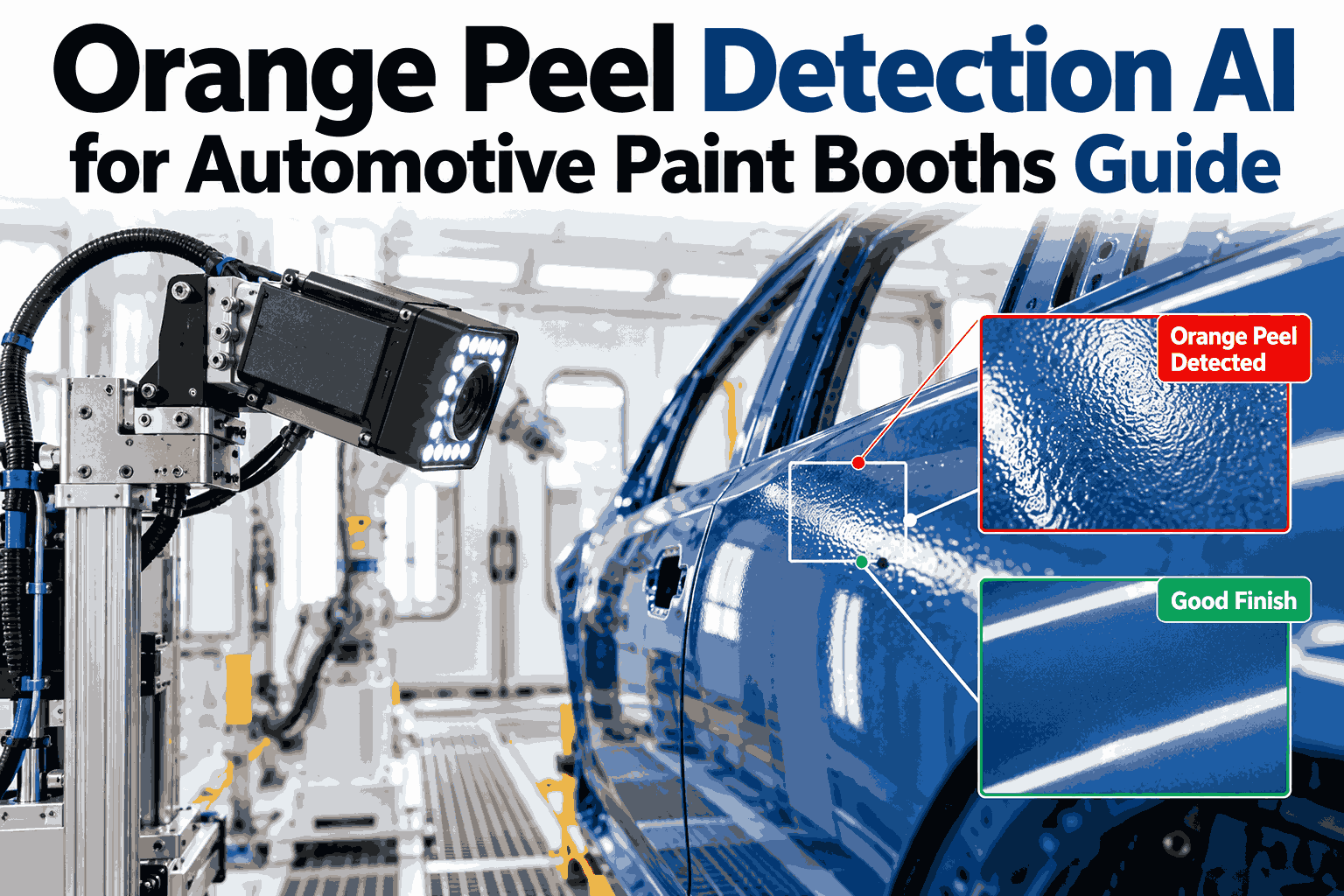
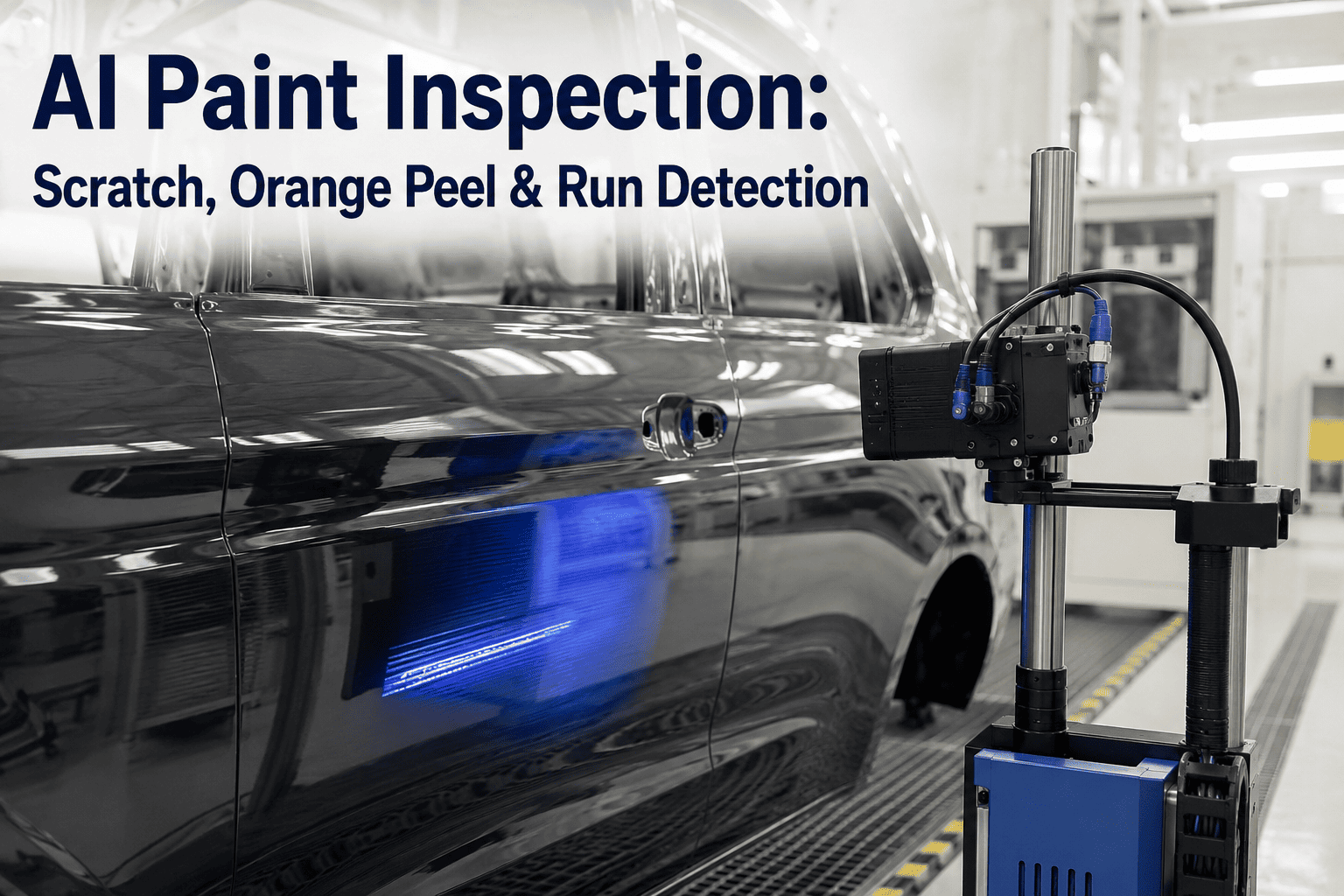
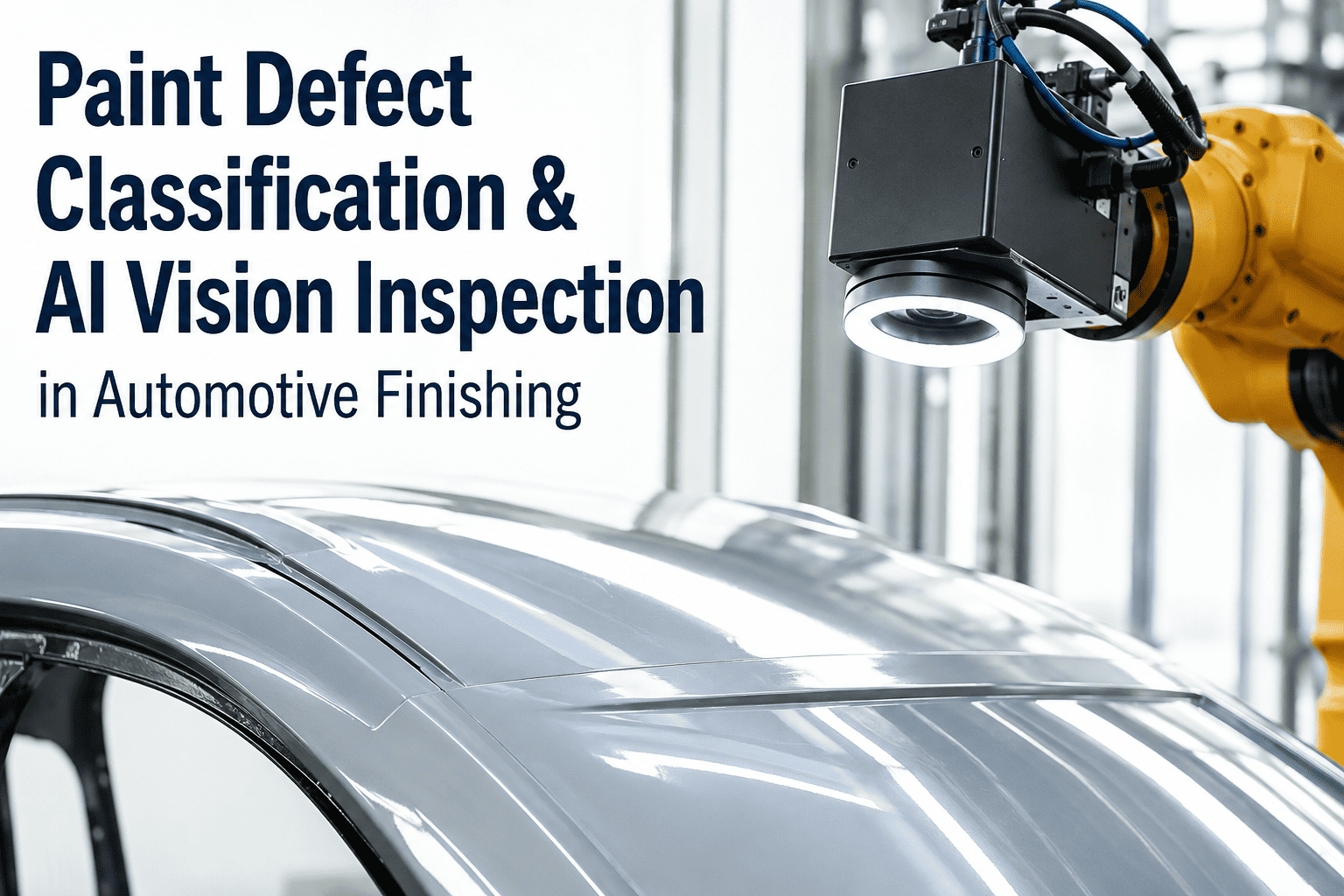
Electrophoretic deposition, primer, basecoat, and clearcoat application must be defect-free before the next layer is applied. Orange peel texture, runs, inclusions, and thin film zones are difficult to detect optically at line speed. AI multi-spectral imaging identifies coating anomalies across the full body surface as vehicles exit each paint zone.
Engine dress, trim installation, glass sealing, and hundreds of torque-critical fastener operations happen across 400 to 600 assembly stations. Every missed clip, reversed part, and under-torqued fastener is a potential warranty claim or recall trigger. AI vision verifies part presence, orientation, and torque marker position at each station in real time.
Cell-to-module assembly, busbar welding, and battery pack sealing require inspection tolerances 10 to 50 times tighter than conventional auto parts. Electrode coating consistency, separator alignment, electrolyte fill level, and weld penetration on battery tabs all require AI-level inspection speed and precision. A single failing cell in a 400V pack creates field safety risk.
Traditional final audit relies on trained human inspectors walking 100 to 150 vehicles per shift, spending 4 to 6 minutes per unit. AI inspection replaces or augments this with 360-degree robotic camera arrays that complete a full-vehicle audit in under 90 seconds, generating a digital defect record automatically attached to the vehicle VIN.
The Real Cost of Defect Escape in Automotive Manufacturing
Downtime costs in automotive manufacturing rose 113% since 2019 as line speeds, complexity, and labor rates increased.
Warranty claims, recalls, and scrap from defect escape account for an estimated 5 to 8 percent of total vehicle revenue globally.
Equipment failures driven by missed inspection findings and undetected tooling wear account for the majority of unscheduled stops.
Every defect that escapes the production line multiplies remediation cost by a factor of 10 to 14 compared to catching it at the point of origin.
What Modern Automotive Plants Need From Inspection Systems
Every part inspected, every cycle, not statistical samples. Defect detection at the point of origin before downstream assembly locks in cost.
Inspection cannot slow the line. AI inference must complete within the part transfer window, typically 30 to 80 milliseconds, without buffering production flow.
Vision systems must connect to robot controllers, PLC reject gates, and SCADA process historians without manual data bridging or inspection data silos.
Battery cell inspection requires micron-level dimensional verification, coating density measurement, and weld penetration confirmation at production throughput rates.
Defect rate data must feed directly into OEE Quality calculations, giving production managers real-time visibility into how inspection performance affects Overall Equipment Effectiveness.
AI inspection trend data should predict press tool wear before it causes defects, triggering predictive maintenance work orders before quality deviation occurs.
How iFactory AI Inspection Works at 350 Frames Per Second
High-Speed AI Vision: Defect Detection at Line Speed
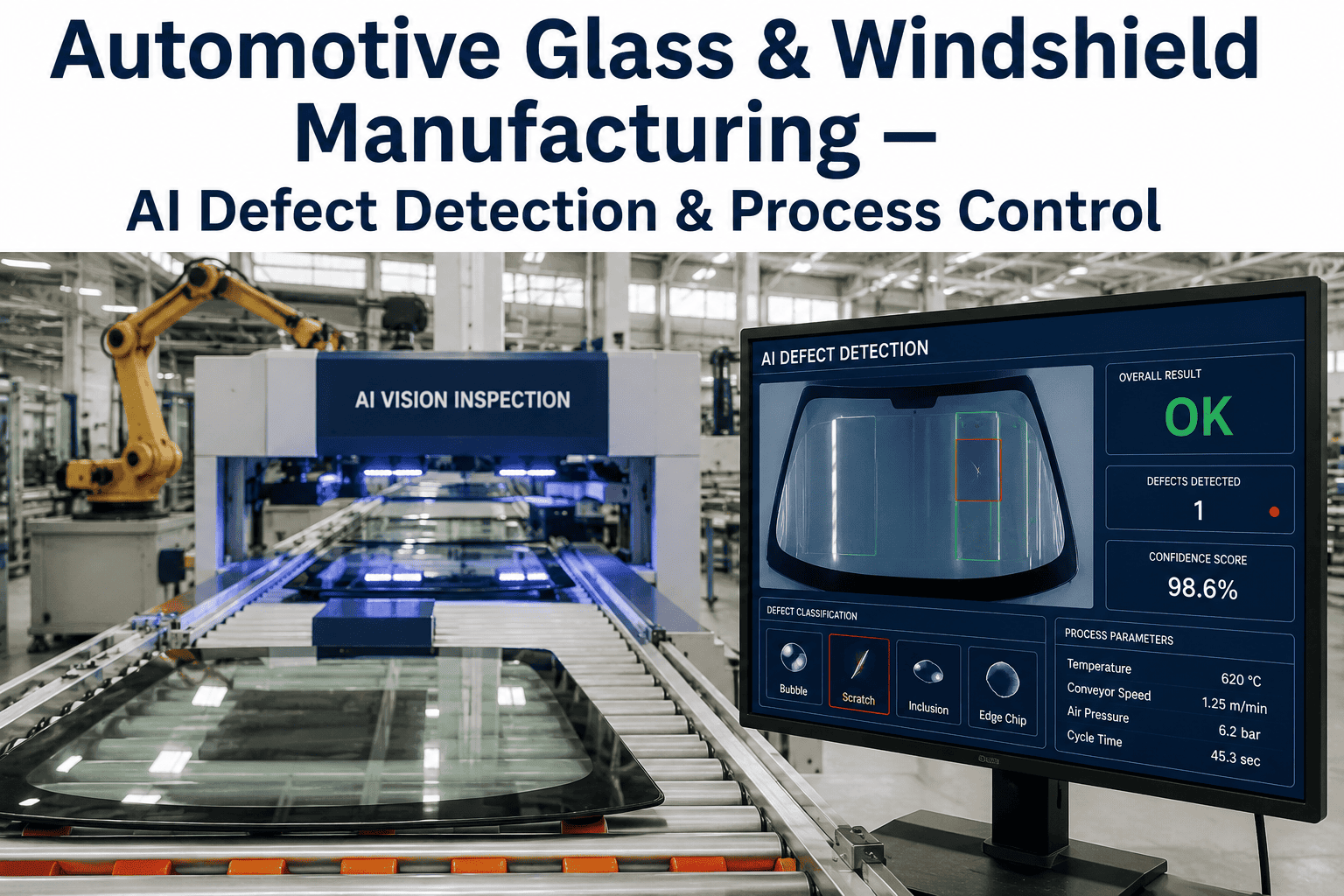
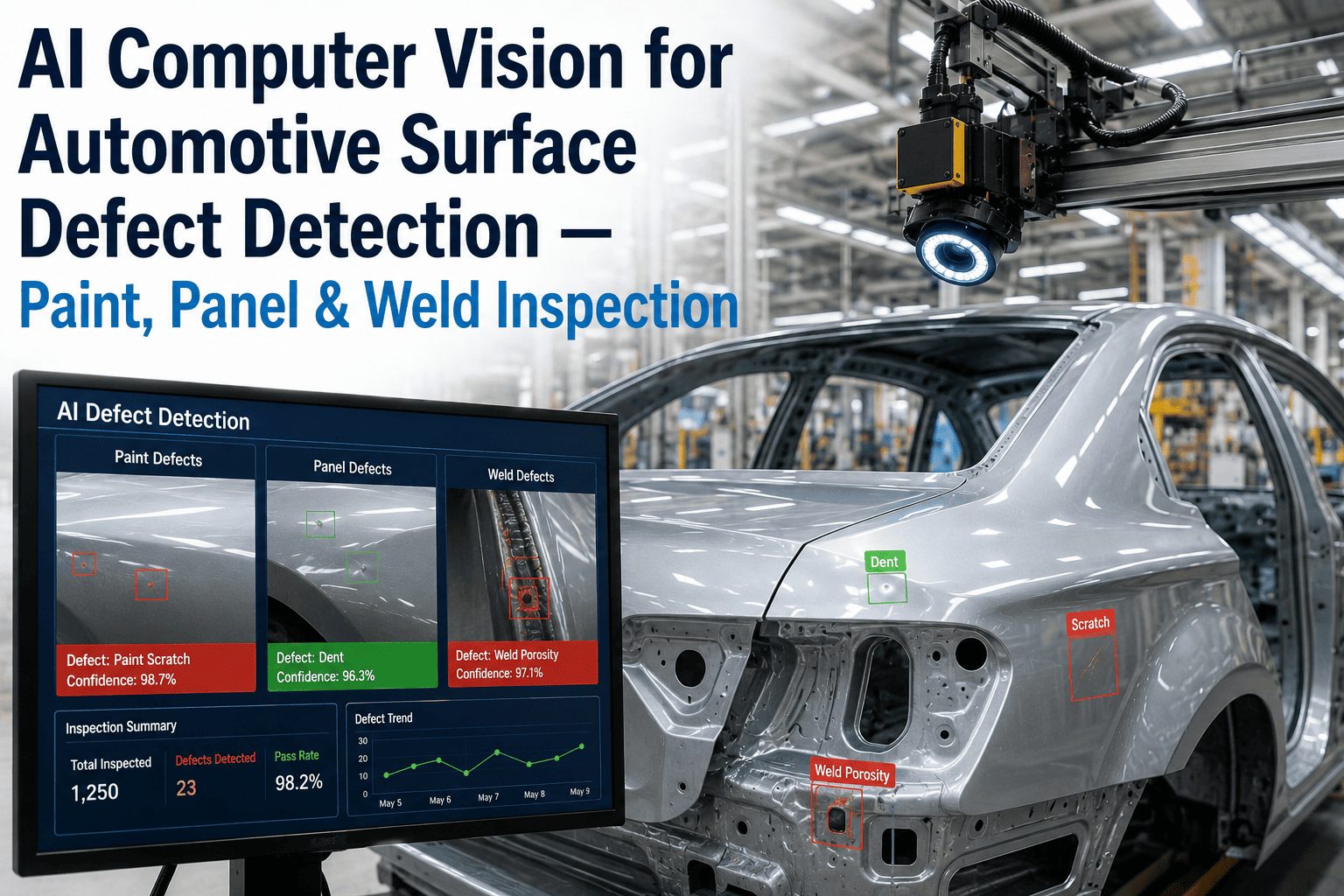
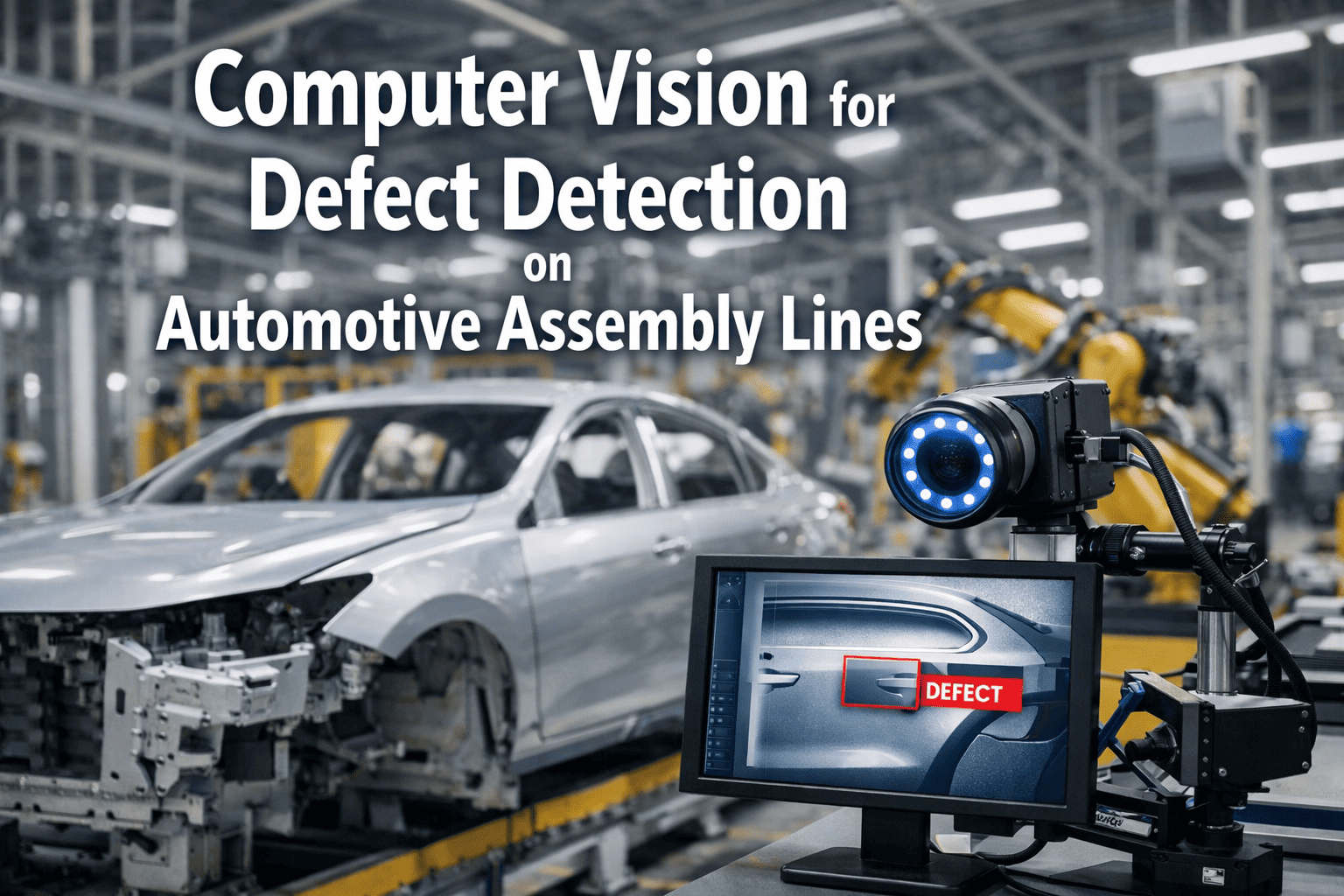
iFactory deploys high-speed industrial cameras paired with edge AI inference hardware directly on the production line. Vision models trained on your specific defect library — dents, scratches, weld anomalies, dimensional deviations, missing components — run inference on every frame at up to 350 fps without introducing latency into the production cycle.
- Processes 350 frames per second with sub-50ms classification latency on edge hardware
- Defect models trained on customer-specific part geometry and defect taxonomy
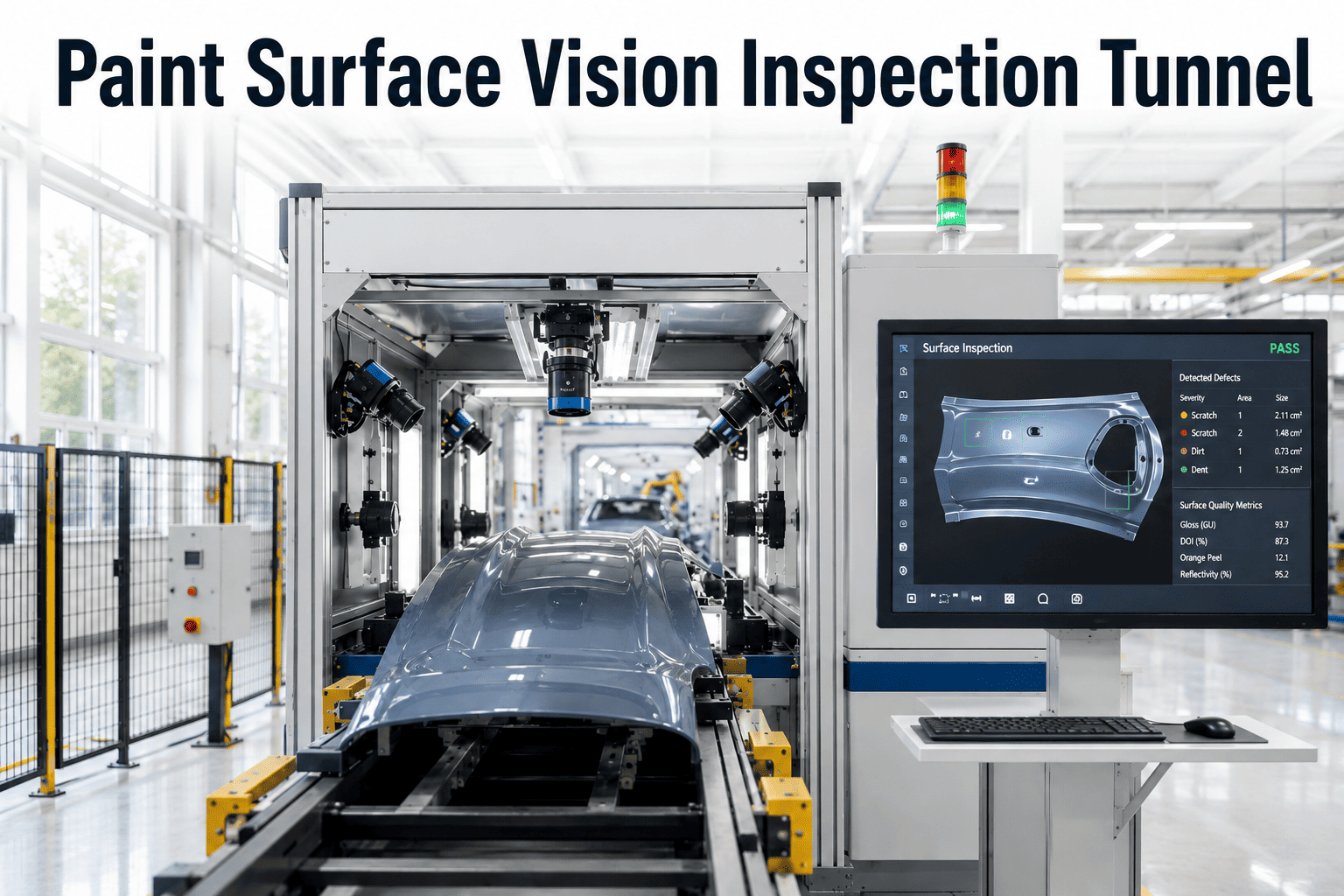
- Multi-camera station arrays provide full 360-degree part surface coverage
- Automated reject gate triggering sends non-conforming parts to rework without operator intervention
- Defect images and classification data stored per part, per VIN, per batch automatically
AI Predictive Maintenance: Inspection Data That Prevents the Next Defect
iFactory connects inspection defect trend data directly to predictive maintenance models. When defect rates on a stamping press begin trending upward, the AI correlates this with press force sensor data, stroke count, and tool service history to calculate remaining tool life and schedule preventive replacement before quality deviation hits acceptable limits.
- Defect rate trending per station linked to equipment health signatures
- Tool wear prediction with remaining useful life (RUL) calculation per die and cutter
- Automated predictive maintenance work orders generated from inspection trend triggers
- Reduces unplanned tooling failures by 35 to 50 percent across press and stamping operations
- Maintenance scheduling integrated with production plan to minimize impact on takt time
Real-Time OEE Optimization: Quality Losses Visible Immediately
iFactory calculates OEE Quality in real time from AI inspection pass/fail data, feeds this into the live OEE dashboard alongside Availability and Performance metrics, and alerts production supervisors the moment Quality drops below target. Every inspection failure is tagged with station, shift, operator, tooling state, and root cause classification.
- Real-time OEE Quality metric updated on every inspection event across all stations
- Pareto analysis of defect types, stations, and shifts updated live throughout the shift
- OEE alert thresholds trigger immediate supervisor notification and corrective action workflow
- Shift-by-shift quality trending supports IATF 16949 statistical process control requirements
PLC, SCADA & MES Integration: No Data Islands
iFactory AI inspection connects directly to your existing plant control and manufacturing execution systems. Inspection results are written back to the MES part traveler in real time, defect events trigger PLC reject gates and SCADA alarms, and inspection data is linked to process historian timestamps for full traceability.
- OPC-UA and OPC-DA connectivity to all major PLC platforms including Siemens, Allen-Bradley, Mitsubishi, and Fanuc
- MES integration with SAP ME, Siemens Opcenter, Apriso, and custom MES platforms
- SCADA alarm integration routes defect events to control room operator displays
- Historian data linkage enables process-to-quality correlation analysis for root cause investigation
Automated Work Order Generation: From Defect Alert to Corrective Action
When iFactory detects a recurring defect pattern or inspection station anomaly, it automatically generates a prioritized work order including the defect image evidence, affected part numbers, production volume impacted, and recommended corrective action. Quality engineers and maintenance teams receive actionable work packages, not raw alarm data.
- Work orders auto-generated from defect threshold breaches, tool wear predictions, and station anomalies
- Priority scoring based on defect severity, production volume at risk, and downstream impact
- Full defect image and classification data attached automatically to every work order
- Mobile technician app enables field execution with photo documentation and sign-off
EV & Battery Inspection: Precision at Production Speed
iFactory deploys specialized AI models for EV battery production inspection, where tolerances are 10 to 50 times tighter than conventional automotive components. Electrode coating uniformity, separator alignment, cell dimensional verification, busbar weld penetration, and pack sealing integrity are all verified inline at production throughput rates.
- Electrode coating density and uniformity measurement at cell production line speed
- Busbar and battery tab weld inspection using thermographic and optical AI fusion
- Cell-level dimensional verification against battery module design tolerances
- Pack sealing integrity verification linked to VIN traceability for field safety compliance
Compliance & Traceability: IATF 16949 and Customer-Specific Requirements
iFactory maintains a complete, tamper-proof inspection record for every part produced, linked to VIN, batch, shift, station, and process conditions. This provides the audit trail required for IATF 16949 compliance, customer-specific quality requirements from OEMs, and regulatory submissions for EV battery safety certifications.
- Full part-level traceability with defect images, classification results, and disposition records
- IATF 16949 SPC, FMEA, and control plan documentation generated from inspection data
- OEM customer-specific requirement compliance reports built automatically
- EV battery safety certification data packages with inspection evidence per regulatory standard
AI Inspection vs Traditional Quality Methods
| Factor | iFactory AI Inspection | Manual Inspection | Traditional Machine Vision |
|---|---|---|---|
| Coverage Rate | 100% of parts, every cycle | 1 to 5% sample-based | 50 to 80% (fixed defect types) |
| Inspection Speed | 350 fps, sub-50ms classification | 4 to 6 min per vehicle | 10 to 30 fps, limited throughput |
| Defect Types Detected | Open-ended, model trainable | Trained human judgment | Pre-programmed rules only |
| New Defect Adaptation | Retrain in hours with new images | Retraining takes weeks | Reprogramming takes days to weeks |
| Data Output | Structured, per-part, VIN-linked | Paper or manual entry | Pass/fail only, limited metadata |
| OEE Integration | Live feed into OEE Quality metric | End-of-shift data entry | Partial, requires middleware |
| Predictive Maintenance Link | Defect trends trigger PM work orders | No connection to maintenance | No predictive capability |
| PLC / MES Integration | Native, real-time, bidirectional | Manual process | Limited, often one-directional |
| Cost Per Inspection Event | Reduces to near-zero at scale | High, labor-intensive | Fixed hardware cost, limited scope |
| Operator Required | Monitoring only, exception-based | Full-time per station | Setup and calibration staff required |
Competitor Comparison: AI Inspection & Automotive Manufacturing Platforms
| Feature | iFactory AI | QAD Redzone | Evocon | Mingo Smart Factory | L2L CW | MaintainX | Limble CMMS | IBM Maximo | SAP EAM | Oracle EAM |
|---|---|---|---|---|---|---|---|---|---|---|
| AI Inline Inspection | Advanced, 350fps | No | No | No | No | No | No | Limited | No | No |
| AI Capability | Full ML + Computer Vision | Basic Analytics | OEE Only | Basic Analytics | Partial | No | No | Partial AI | Partial AI | Partial AI |
| Predictive Maintenance | Advanced, Defect-Linked | Limited | No | Basic | Basic | Basic | Basic | Partial | Partial | Partial |
| PLC / SCADA / MES Integration | Native, Real-Time | Partial | OPC-UA only | Partial | Limited | No | No | Partial | Partial | Partial |
| Work Order Automation | AI-Automated, Defect-Triggered | Manual | No | Basic | Partial | Partial | Partial | Manual | Manual | Manual |
| Ease of Use | High, Mobile-First | High | High | High | High | High | High | Low | Low | Low |
| Automotive Fit | Purpose-Built | General Mfg | General Mfg | General Mfg | General Mfg | General MRO | General MRO | General EAM | General EAM | General EAM |
| OEE Real-Time Tracking | Full, Inspection-Linked | Full | Full | Full | Partial | No | No | Partial | Partial | Partial |
| EV Battery Inspection | Dedicated Module | No | No | No | No | No | No | No | No | No |
| Compliance Traceability | IATF 16949, OEM CSR Ready | Partial | Limited | Limited | Partial | Basic | Basic | Partial | Partial | Partial |
Region-Wise Automotive Inspection Challenges & iFactory Fit
| Region | Key Manufacturing Challenges | Compliance Requirements | How iFactory Solves |
|---|---|---|---|
| United States ★ | High labor cost pressure, Big Three OEM quality gate requirements, EV transition in legacy ICE plants, OSHA safety compliance on inspection lines, aging press equipment | IATF 16949, OSHA 1910, EPA Clean Air Act for paint shops, NHTSA recall reporting obligations, OEM Customer Specific Requirements (Ford, GM, Stellantis) | AI inspection reduces headcount-dependent quality cost, OEM CSR report automation, NHTSA traceability data per VIN, predictive press maintenance aligned to OSHA equipment safety rules |
| UAE ★ | Heat and dust impact on automated inspection camera systems, growing EV assembly operations, ADNOC and industrial zone quality mandates, expatriate workforce training requirements | UAE ESMA industrial quality standards, ADNOC supply chain quality requirements, Dubai Industrial Strategy 2030 compliance, ISO 9001 and IATF alignment for export-bound vehicles | Edge AI hardware rated for high-ambient-temperature environments, Arabic-language operator interface, OEM export traceability documentation, rapid workforce training through mobile-first app |
| United Kingdom | Post-Brexit supply chain complexity adding inspection burden, strict HSE safety standards on automated equipment, JLR and Stellantis UK quality tier requirements | IATF 16949, HSE PUWER regulations for inspection equipment, UK REACH for coating processes, MHRA and DVSA traceability requirements for EV systems | HSE-compliant automated inspection reduces manual inspection safety risk, UK OEM quality documentation automation, EV battery certification traceability, Brexit supply disruption early warning through defect trend analysis |
| Canada | Cold climate effects on stamping die performance and material properties, remote plant connectivity challenges, Stellantis and Toyota Canada quality requirements | Transport Canada vehicle safety regulations, Ontario OHSA workplace safety, CSA standards for electrical inspection equipment, Environment Canada for paint VOC compliance | Temperature-compensated AI defect models for cold-weather material behavior, satellite-connected edge AI for remote plant sites, CSA-compliant inspection hardware, VOC emission-linked quality reporting |
| Europe | EU7 emissions regulation increasing production complexity, CSRD ESG reporting adding documentation burden, multi-OEM supply chain quality requirements, EV transition requiring retooled inspection capabilities | IATF 16949, EU REACH and RoHS for material compliance, CSRD mandatory sustainability reporting, EU type approval traceability for EV battery systems, Seveso III for paint and chemical processes | CSRD-automated quality and sustainability reporting, RoHS material traceability per part, EU type approval inspection evidence packages, EV battery system certification data per cell and module |
Implementation Roadmap: iFactory AI Inspection Deployment
iFactory engineers audit target inspection stations, map existing PLC, SCADA, and MES connectivity, identify camera mounting positions, and define the defect taxonomy for AI model training. No production changes required.
Edge AI inference hardware is installed at each inspection station. Computer vision models are trained on customer-supplied defect image libraries and validated against production parts before go-live.
Inspection results are connected to PLC reject gates, MES part travelers, SCADA historian, and OEE dashboards. Automated work order triggers are configured with your maintenance team's threshold preferences.
Full production go-live with AI inspection running at line speed. Operator and quality engineer training completed. False-positive and sensitivity tuning finalized based on first-week production data.
Deployment extended to additional production lines and plants. AI models continuously improve on accumulated defect data. Quarterly model retraining and compliance report package updates provided by iFactory team.
Measurable Results: What Automotive Plants Achieve with iFactory
100% inline AI coverage versus sample-based inspection catches defects at origin rather than in assembly or field.
Predictive maintenance triggered by defect trend analysis prevents tooling and press failures before line stoppage occurs.
Real-time inspection data closes the OEE Quality measurement gap from end-of-shift reporting to continuous live tracking.
AI-generated work orders with image evidence and process correlation data cut root cause investigation from days to hours.
AI handles 100% of routine inspection. Human inspectors shift to exception review and process improvement roles.
Every inspection result linked to VIN, batch, process conditions, and shift data. Zero manual traceability compilation for audits.