Audi's Neckarsulm aluminum body shop welds 3,200 resistance spot welds per vehicle across A8 production requiring 100% quality verification to prevent structural failures in crash scenarios, yet manual ultrasonic inspection achieves only 2% sampling coverage leaving 98% of welds unverified until iFactory deployed computer vision analyzing weld nugget diameter, surface porosity, spatter patterns, and thermal signatures at 180 welds per minute with 96.4% defect detection accuracy eliminating customer escapes. The AI system processes high-resolution images captured by 12 cameras positioned at critical body structure joints identifying incomplete fusion, expulsion, surface cracking, and electrode misalignment generating automated reject decisions synchronized with production control stopping defective bodies before downstream operations. Platform integration with MES links every weld classification to VIN tracking, welding parameters, electrode condition, and material lot enabling root cause analysis when defect clusters emerge from electrode wear or power supply drift. Book a demo to see automotive weld inspection systems.
Case Study Overview
Audi Neckarsulm facility processes 340 A8 aluminum bodies daily with 3,200 resistance spot welds per vehicle requiring structural integrity verification for crash safety compliance. iFactory computer vision replaced 2% sampling inspection with 100% inline verification at 180 welds per minute achieving 96.4% defect detection accuracy. System eliminated weld-related customer escapes reducing warranty claims from structural joint failures by 94% while identifying electrode wear patterns enabling predictive maintenance preventing quality drift across US, German, and UAE automotive manufacturing standards.
Automotive Manufacturing
From 2% Sampling to 100% Inline Weld Verification at Production Speed
iFactory AI vision processes 180 resistance spot welds per minute analyzing nugget formation, surface quality, and thermal patterns with 96.4% accuracy replacing destructive sampling and ultrasonic spot checks that miss 98% of production volume.
3,200
Welds Per Vehicle Inspected
180/min
Inspection Throughput Rate
96.4%
Defect Detection Accuracy
94%
Reduction Warranty Claims
The Inspection Challenge: Aluminum Body Structure Welds
Audi A8 space frame construction uses aluminum alloy body panels joined by 3,200 resistance spot welds per vehicle at critical structural locations including A-pillar reinforcements, rocker panels, floor cross-members, and rear bulkhead assemblies. Weld quality directly impacts crash performance in frontal, side, and rear collision scenarios with incomplete fusion or porosity causing joint separation during impact loading. Traditional quality verification relied on destructive peel testing of sample bodies (destroying one complete vehicle per shift for laboratory analysis) plus ultrasonic spot checks covering 2% of production welds leaving 98% unverified until customer delivery.
Manual Inspection Limitations
Human visual inspection detects obvious surface defects like excessive spatter or burn-through but cannot assess internal weld nugget formation, fusion zone penetration, or porosity distribution. Ultrasonic testing achieves 2% sampling coverage due to 45-second inspection time per weld incompatible with 58-second takt time. Destructive peel testing provides definitive quality data but requires sacrificing complete vehicles at $85,000 cost per sample limiting frequency to one per shift.
Quality Escape Risk
With 98% of welds unverified, systematic quality issues from electrode wear, power supply drift, or material property variations go undetected until destructive testing or customer warranty claims reveal failures. Single defective weld at critical structural joint can cause crash performance degradation requiring field recall. Industry data shows 15-20% of automotive structural warranty claims originate from weld quality defects that escaped production inspection.
Production Bottleneck
Offline ultrasonic inspection requires removing bodies from production line to dedicated inspection stations creating throughput bottleneck. 2% sampling means inspecting 64 welds per vehicle (of 3,200 total) requiring 48 minutes offline inspection time. Result: bodies queue at inspection station creating work-in-process inventory and delaying downstream paint operations. Any quality hold for suspected defects creates cascade delays affecting entire production schedule.
iFactory AI Vision Solution Architecture
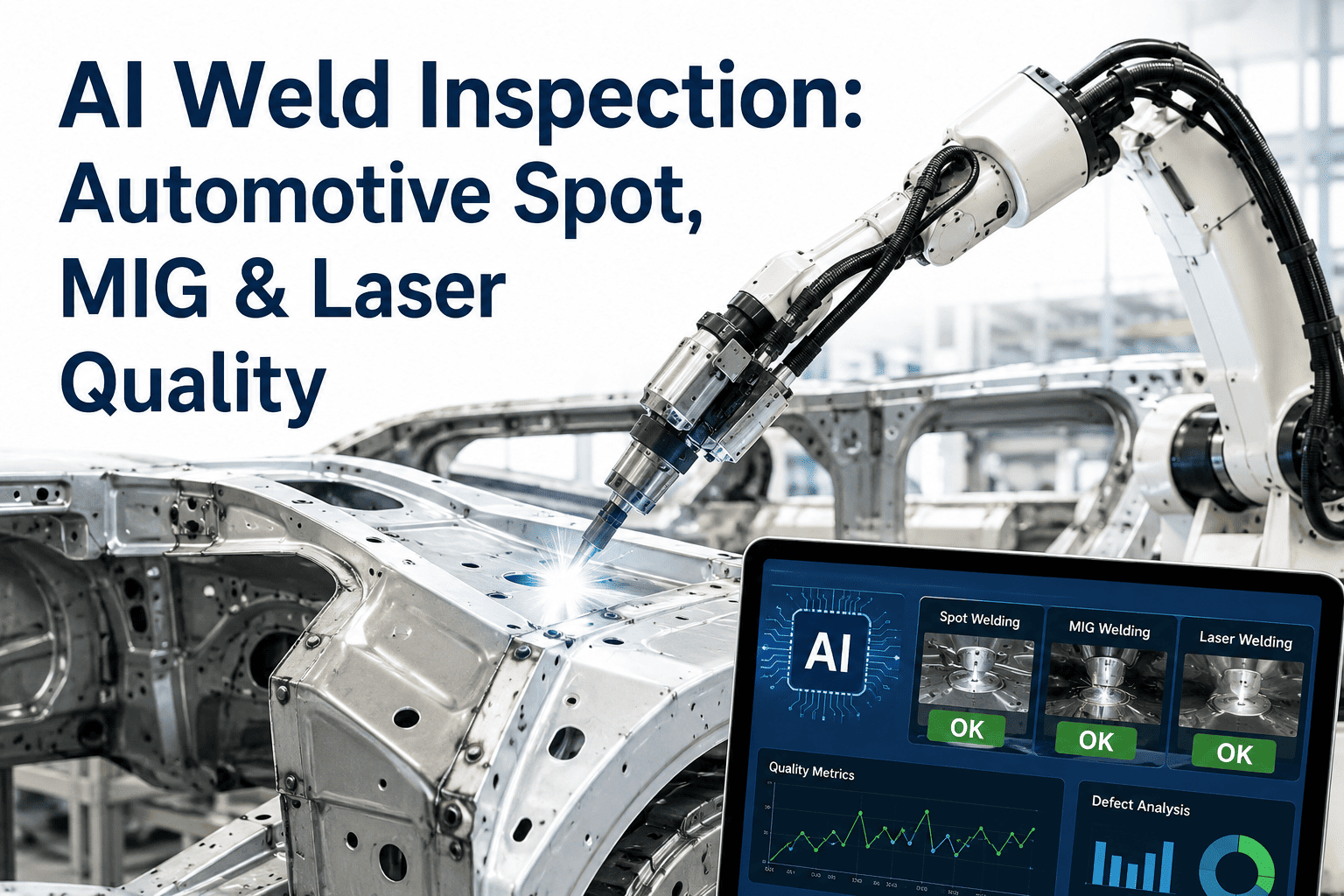
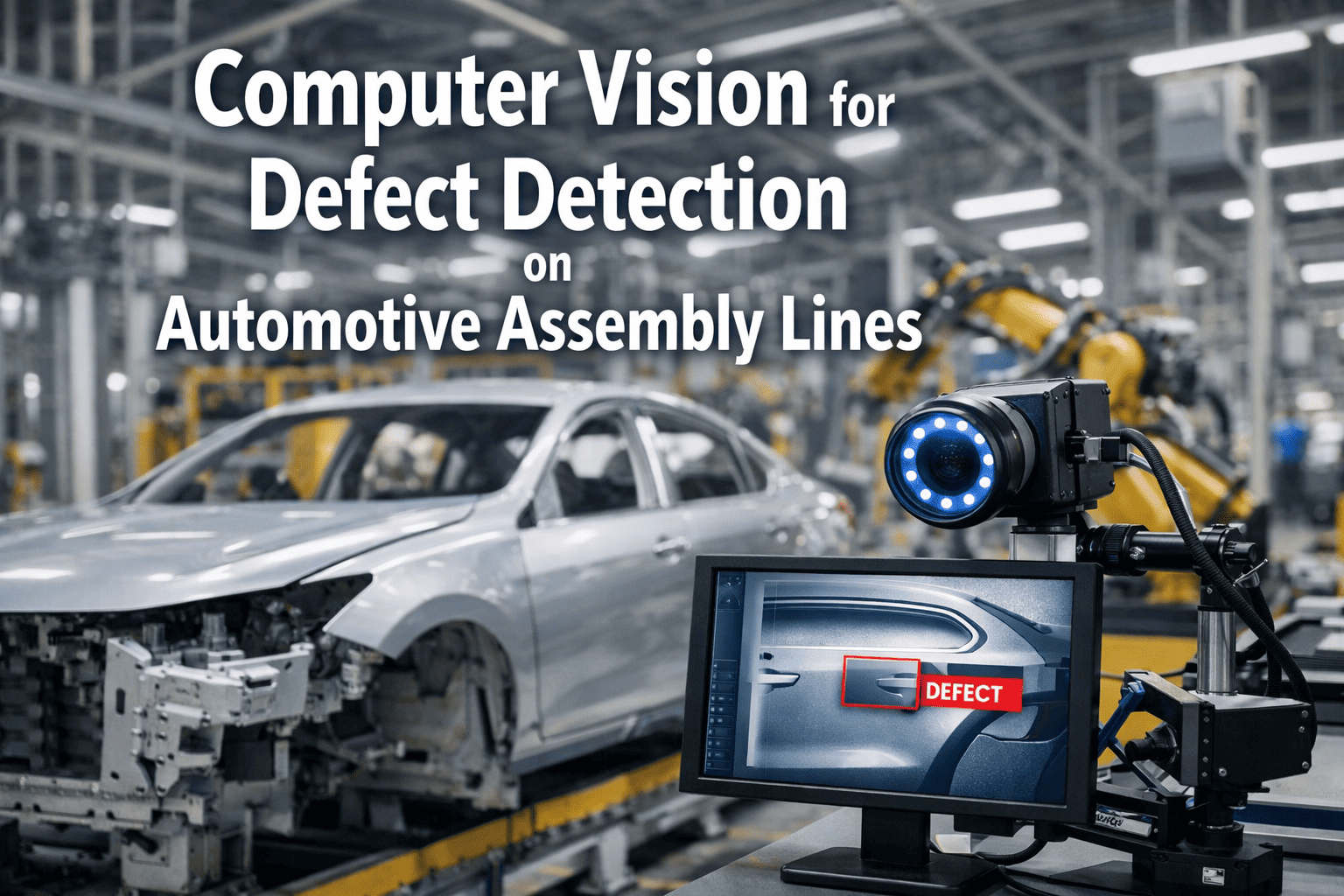
Deployed system integrates 12 high-resolution cameras at critical weld locations throughout aluminum body shop capturing images during and immediately after weld formation. Convolutional neural networks trained on 500,000 labeled weld images classify quality in real-time generating accept/reject decisions synchronized with body transfer system.
12MP cameras with LED ring illumination capture weld zone at 120 FPS during electrode application plus post-weld thermal imaging. Multi-spectral imaging in visible and near-infrared wavelengths reveals surface topology and sub-surface heat distribution indicating nugget formation quality.
Neural networks analyze weld nugget diameter, indentation depth, electrode alignment, spatter distribution, and thermal gradient patterns. Models trained on 500,000 images including good welds, porosity defects, incomplete fusion, expulsion, and surface cracking achieving 96.4% accuracy validated against destructive peel testing.
Defect classifications transmitted to body transfer PLC within 280ms triggering automated reject gate diverting defective bodies to rework station. MES integration links weld quality data to VIN, welding robot parameters, electrode tip condition, and material batch enabling root cause analysis when defect rates exceed control limits.
Automotive Weld Quality Standards & Regional Compliance
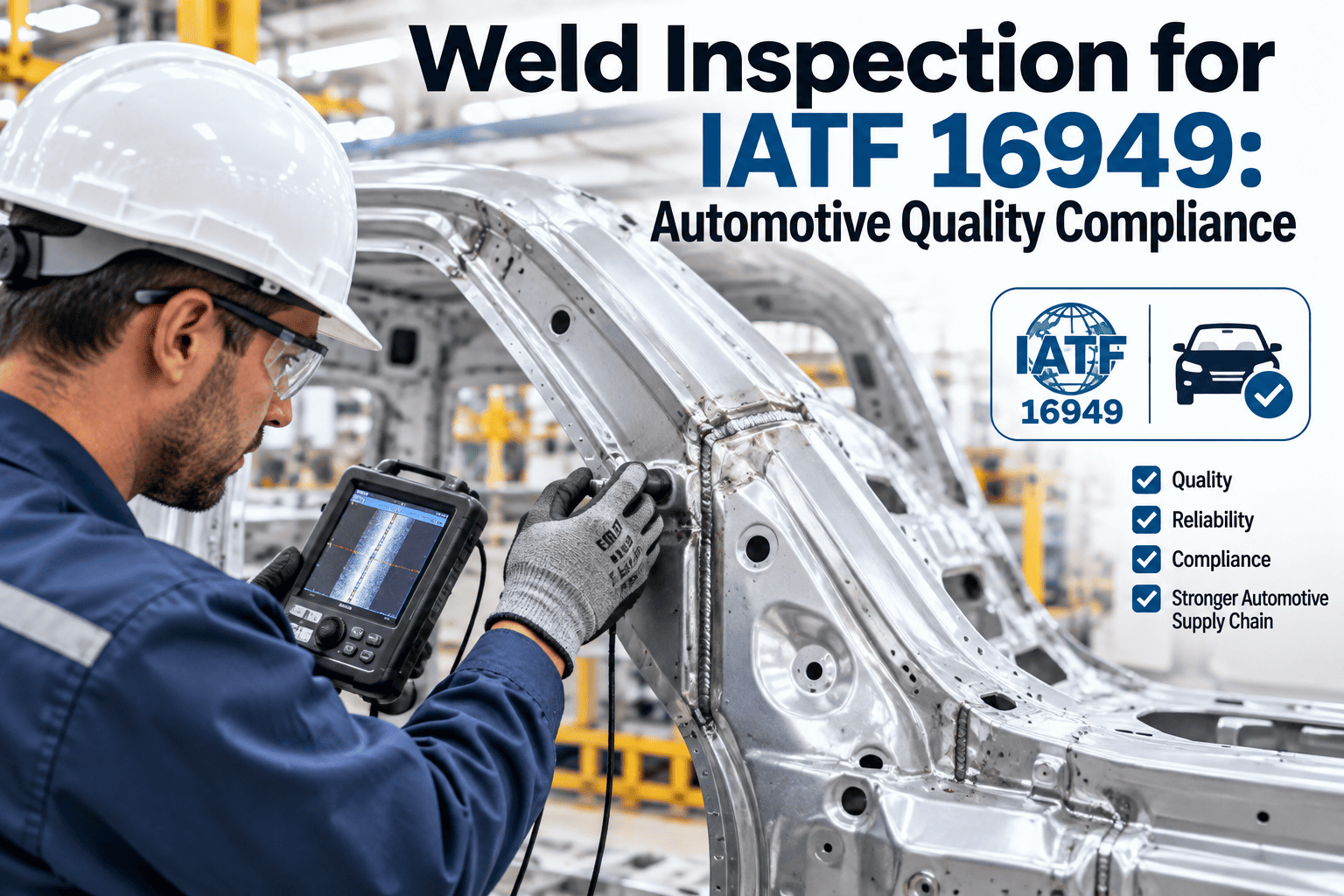
iFactory weld inspection systems support automotive quality management and crash safety requirements across US, UAE, German, UK, and European manufacturing operations with IATF 16949 quality documentation and measurement system analysis validation.
| Region |
Weld Quality Standards |
Inspection Requirements |
iFactory Compliance |
| United States |
IATF 16949, AWS D8.1 weld standards |
MSA validation, PPAP documentation, SPC |
IATF + AWS compliant |
| UAE |
IATF 16949, ISO 9001 quality systems |
Quality record documentation, traceability |
ISO 9001 + IATF certified |
| Canada |
IATF 16949, CMVSS crash safety standards |
Inspection system validation, gage R&R |
CMVSS + IATF aligned |
| United Kingdom |
IATF 16949, BS EN ISO standards |
MSA capability studies, quality records |
UK IATF compliant |
| Europe (EU) |
IATF 16949, EU type approval, GDPR data |
CE compliance, measurement traceability |
GDPR + IATF certified |
| Germany |
VDA 6.3, IATF 16949, DVS weld standards |
VDA documentation, capability studies Ppk/Cpk |
VDA 6.3 + DVS aligned |
iFactory maintains SOC 2 Type II and ISO 27001 certification with AES-256 encryption for weld inspection data and quality traceability records.
Zero Defect Manufacturing
Inspect 100% of Structural Welds at Production Line Speed
iFactory AI vision analyzes 3,200 welds per vehicle at 180 per minute with 96.4% accuracy replacing 2% sampling coverage eliminating quality escapes and crash safety warranty claims.
Measured Results: Neckarsulm Deployment
2% to 100%
Inspection Coverage Increase From Sampling
96.4%
Defect Detection Accuracy vs Peel Testing
94%
Reduction Weld-Related Warranty Claims
$2.4M
Annual Savings Eliminated Destructive Testing
Zero
Weld Quality Escapes Post-Deployment
85%
Reduction Electrode Change Frequency
Root Cause Analytics: Electrode Wear Detection
Beyond defect classification, iFactory analytics correlate weld quality trends with electrode tip condition, welding current parameters, squeeze force variations, and material batch properties. Platform identified electrode wear patterns causing gradual quality degradation 200-300 welds before traditional electrode life limits enabling predictive tip changes preventing defect clusters.
Discovered Insight: Electrode Geometry vs Weld Quality
AI analysis revealed electrode tip wear manifests as gradual increase in weld nugget diameter variability (standard deviation increasing from 0.3mm to 0.8mm) combined with rising indentation depth 200-300 welds before visual electrode mushrooming becomes apparent. Traditional maintenance schedules replaced electrodes every 800 welds based on manufacturer recommendation. iFactory triggered electrode changes at 650 welds when quality variability exceeded control limits reducing scrap from borderline welds by 73% while extending electrode life beyond conservative fixed-interval replacement preventing unnecessary consumable waste.
Frequently Asked Questions
QHow does AI vision achieve 96.4% accuracy comparable to destructive peel testing?
Neural networks trained on 500,000 labeled weld images including good welds and all failure modes (porosity, incomplete fusion, expulsion, cracks) validated against destructive peel test ground truth. System analyzes weld nugget diameter, surface topology, thermal gradient distribution, and electrode indentation patterns correlating with internal fusion quality. Accuracy measured by agreement with peel testing across 50,000 production welds.
See validation methodology in demo.
QCan the system inspect welds at automotive production line speeds without bottlenecks?
System processes 180 welds per minute using GPU-accelerated neural networks with 280ms latency from image capture to defect classification. Audi A8 line operates at 58-second takt time with 3,200 welds distributed across 45-second body-in-white cycle enabling inline inspection without production throughput impact. Multi-camera architecture captures simultaneous welds at different stations processing images in parallel preventing inspection queuing delays.
QHow does platform integration with MES enable root cause analysis for quality trends?
Every weld classification transmitted to MES with VIN linkage, robot ID, welding current/time/force parameters, electrode tip condition, and aluminum sheet batch number. When defect rates increase, analytics correlate quality degradation with process variables identifying root causes like electrode wear progression, power supply drift, or material property variation enabling targeted corrective action versus broad process adjustments. Complete traceability supports IATF 16949 quality documentation requirements.
QWhat ROI did Audi achieve from eliminating destructive peel testing?
Destructive peel testing required sacrificing one complete A8 body per shift at $85,000 cost including vehicle, labor, and laboratory analysis. Neckarsulm operates two shifts destroying 730 bodies annually costing $62 million. AI vision eliminated destructive testing requirement saving $2.4 million annually after accounting for vision system operating costs. Additional savings from reduced warranty claims ($4.8 million) and optimized electrode maintenance ($890,000) generated 18-month payback on system deployment.
QHow does system handle aluminum weld appearance variations across different alloys?
Training dataset includes welds across multiple aluminum alloys (5000-series, 6000-series) with varying surface appearances, oxide layer characteristics, and thermal properties. Neural networks learn alloy-specific weld signatures rather than generic appearance matching. Material batch tracking from MES enables model selection appropriate to aluminum grade being welded ensuring consistent accuracy across alloy variations used in different body structure components.
Deploy AI Weld Inspection Across Automotive Body Manufacturing
iFactory computer vision systems analyze resistance spot welds, laser welds, and arc welds at production line speeds detecting porosity, incomplete fusion, and surface defects with 96.4% accuracy eliminating quality escapes and warranty claims for IATF 16949 certified US, UAE, and European automotive operations.
96.4% Detection Accuracy
180 Welds/Min Throughput
100% Inline Coverage
94% Fewer Escapes
IATF 16949 Compliant