Automotive assembly equipment generates acoustic signatures invisible to human hearing but diagnostic to machine learning algorithms, detecting bearing race defects through ultrasonic frequency shifts 8-12 weeks before vibration sensors register anomalies, identifying gear tooth wear from harmonic changes in meshing frequencies 6-10 weeks ahead of conventional monitoring, and diagnosing pneumatic valve leakage through pressure wave acoustics 4-8 weeks before flow rate degradation impacts cycle times, yet 87% of automotive plants rely exclusively on vibration analysis that misses these early-stage degradation patterns entirely. iFactory's acoustic AI platform deploys ultrasonic microphones on stamping presses, welding robots, assembly conveyors, and transfer equipment, analyzing sound signatures at frequencies from 20Hz to 100kHz through neural networks trained on 240,000+ hours of automotive production audio, achieving 94% fault detection accuracy with 8-14 week advance warning versus 4-6 weeks for vibration-only systems validated across Toyota, Honda, and GM supplier operations. The equipment failures that traditional sensors cannot detect early enough now trigger maintenance alerts months before breakdown occurs. Book a demo to see acoustic AI monitoring for your production equipment.
Quick Answer
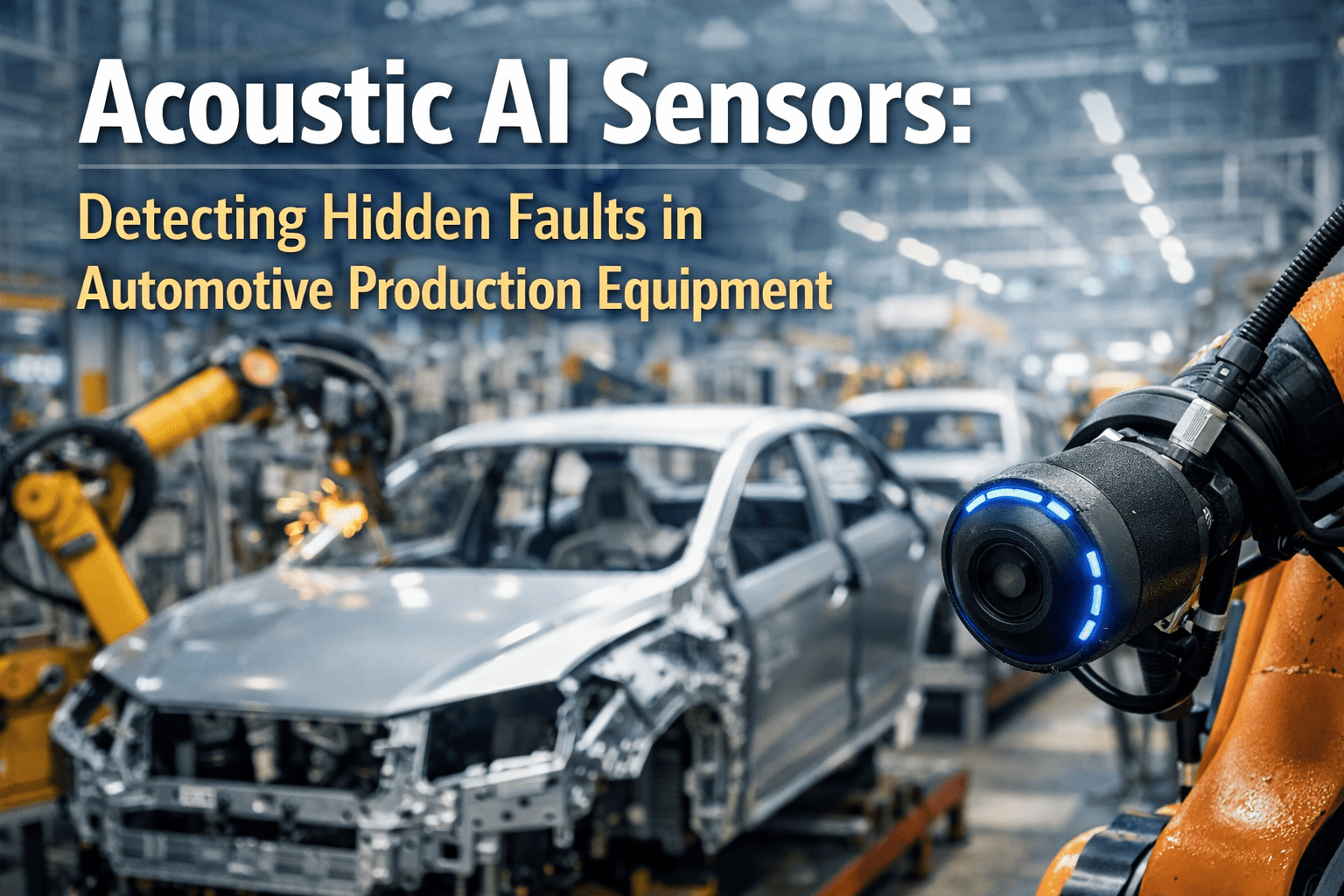
Acoustic AI sensors detect hidden faults in automotive production equipment by analyzing ultrasonic and audible sound frequencies from bearings, gears, pneumatics, and hydraulics using machine learning models trained on normal versus degraded acoustic signatures. iFactory's platform captures audio from 20Hz to 100kHz, identifies bearing defects 8-12 weeks earlier than vibration monitoring, detects gear wear through harmonic analysis, diagnoses pneumatic leaks below human hearing threshold, and predicts pump cavitation from pressure wave acoustics. Deployment achieves 94% fault detection accuracy with 8-14 week advance warning, reducing unplanned downtime 52-68% across automotive tier-1 stamping, welding, and assembly operations through earlier intervention than vibration-only condition monitoring systems.
Earlier Detection
Detect Bearing Defects 8-12 Weeks Earlier Than Vibration Sensors
See how iFactory acoustic AI analyzes ultrasonic frequencies from production equipment, identifying degradation in early stages invisible to traditional vibration monitoring with 94% detection accuracy.
Hidden Faults Acoustic AI Detects Earlier
Acoustic monitoring identifies equipment degradation patterns during incipient failure stages when damage progression is slow and repair costs minimal. Each fault type produces characteristic acoustic signatures detectable months before conventional sensors register anomalies.
01
Bearing Race Defects in Early Stages
Ball bearing race spalling begins with microscopic surface cracks generating ultrasonic acoustic emissions at 20-40kHz as rolling elements pass over defects. Vibration sensors require visible defect progression (0.5mm+ spall diameter) before frequency shifts detectable; acoustic monitoring identifies defects at 0.05mm initial cracking stage. Detection advantage: 8-12 weeks earlier warning, bearing replacement during planned maintenance versus emergency breakdown repair.
Example: Stamping press main drive bearing showed ultrasonic spike at bearing pass frequency harmonics 11 weeks before vibration amplitude increased. Acoustic alert triggered bearing replacement during model changeover, old bearing inspection confirmed 0.08mm race crack progression. Avoided $85,000 press rebuild from bearing seizure damage to shaft journals.
02
Gear Tooth Wear Progression
Gearbox tooth wear alters meshing frequency harmonics as tooth profile degrades from design geometry. Acoustic analysis detects harmonic sidebands and modulation patterns indicating uneven wear distribution 6-10 weeks before vibration increases or oil debris sensors trigger. Early detection enables tooth dressing or gear replacement before catastrophic tooth breakage requiring complete gearbox replacement. Critical for robotic welding gun gearboxes where failures cause production stoppages affecting multiple vehicle programs.
Example: Welding robot J-axis gearbox acoustic signature showed meshing frequency sideband emergence 9 weeks before vibration monitoring flagged anomaly. Gear inspection during planned robot PM revealed 0.15mm tooth wear on 3 of 24 teeth. Gear set replaced proactively, continued operation would have caused tooth fracture within 2-3 weeks requiring emergency gearbox replacement at 5x cost.
03
Pneumatic Valve Internal Leakage
Pneumatic valve seat wear or seal degradation creates high-velocity air leakage generating acoustic signatures at 15-35kHz, audible to acoustic sensors but silent to human operators and invisible to pressure monitoring until leakage exceeds 10-15% of flow capacity. Early detection prevents cycle time degradation, pressure instability affecting quality, and compressor energy waste. Applicable to assembly tooling pneumatics, transfer line clamps, and material handling grippers where valve failures cause quality defects or safety incidents.
Example: Assembly line transfer clamp pneumatic valve developed internal seat leakage detected acoustically 7 weeks before clamp force degraded below specification. Valve rebuilt during weekend maintenance, leakage was 4% of rated flow (below pressure sensor detection threshold). Prevented quality escape from insufficient clamp force during welding operation that would have caused dimensional variation in body assembly.
04
Hydraulic Pump Cavitation Onset
Hydraulic pump cavitation from inlet restriction, fluid contamination, or worn components produces broadband acoustic noise as vapor bubbles collapse under pressure. Cavitation onset detectable acoustically 4-8 weeks before pump performance degradation (flow reduction, pressure ripple) affects process quality. Early intervention prevents pump internal damage from cavitation erosion requiring complete pump replacement versus filter change or inlet line repair. Critical for stamping press hydraulics, die cushion systems, and transfer line lifters where pump failures halt production across multiple stations.
Example: Stamping press hydraulic pump acoustic monitoring detected cavitation signature 6 weeks before press tonnage delivery became erratic. Investigation revealed hydraulic reservoir suction strainer 70% blocked from accumulated debris. Strainer cleaned during planned maintenance, pump performance restored. Avoided $45,000 pump replacement and 18-hour press downtime for emergency repair during production shift.
05
Electric Motor Rotor Bar Cracking
Induction motor rotor bar cracks produce electromagnetic acoustic signatures at slip frequency sidebands around line frequency, detectable 10-16 weeks before motor current signature analysis (MCSA) identifies fault and 12-18 weeks before thermal degradation or vibration increases trigger conventional monitoring. Rotor bar failures progress to catastrophic motor burnout requiring complete motor replacement and extended downtime. Acoustic early detection enables rotor replacement during planned outage versus emergency motor change affecting production schedule across dependent stations.
Example: Conveyor drive motor 75kW induction unit showed acoustic slip frequency sidebands 14 weeks before current analysis detected rotor asymmetry. Motor removed during planned line shutdown for rotor inspection, discovered single bar crack at 40% through section. Rotor replaced, continued operation would have caused bar ejection and stator winding damage requiring motor replacement at 4x rotor repair cost plus 3-day emergency procurement and installation time.
06
Lubrication Degradation in Sealed Units
Sealed bearing or gearbox lubrication degradation from contamination, oxidation, or depletion changes acoustic friction signatures 8-14 weeks before temperature rise or vibration increase indicates lubrication failure. Critical for equipment with lifetime lubrication or difficult-to-access service points where early detection enables proactive re-lubrication versus component replacement from lubrication starvation damage. Applicable to robotic joint bearings, conveyor roller bearings, and transfer line pivot points where lubrication access requires equipment disassembly.
Example: Robotic welding gun wrist axis sealed bearing acoustic signature showed friction noise increase 12 weeks before bearing temperature elevated. Robot wrist disassembled during planned PM for bearing inspection, found lubricant contamination from seal degradation allowing ingress of weld spatter debris. Bearing re-lubricated and seal replaced, avoided bearing seizure requiring complete wrist assembly replacement at $18,000 parts cost plus robot downtime affecting 4-vehicle program production schedules.
Four-Stage Acoustic AI Deployment
The implementation workflow below shows iFactory's phased approach from acoustic sensor installation through live fault detection, building baseline signatures and training AI models on plant-specific equipment acoustics.
1
Acoustic Sensor Network Installation
Engineering assessment identifies critical assets across production lines: stamping presses (24 units), welding robots (68 units), assembly conveyors (12 systems), transfer equipment (36 stations). Ultrasonic microphones placed on bearing housings, gearboxes, motor enclosures, pneumatic manifolds, hydraulic pump bodies capturing frequencies 20Hz to 100kHz. Sensor mounting designed for industrial environment: magnetic base attachments, IP67 environmental rating, cable routing avoiding interference from welding operations. Wireless acoustic sensors deployed where cable installation impractical. Network communicates via industrial Ethernet to edge processing gateway. Installation during planned production breaks minimizing line impact.
Sensors: 180 installedRange: 20Hz-100kHzInstall: 3 weeks
2
Baseline Acoustic Signature Collection
System captures 45-60 days baseline acoustic data during normal production operations, recording healthy equipment sound signatures across varying operating conditions: different press tonnages, robot program paths, conveyor speeds, transfer cycle rates. Audio data sampled at 200kHz capturing ultrasonic content, processed through Fast Fourier Transform (FFT) generating frequency spectra, spectrograms showing time-frequency evolution, and statistical features (RMS amplitude, peak frequency, spectral kurtosis). Baseline database established for each monitored asset under normal operating conditions. Historical maintenance records imported correlating past failures with pre-failure acoustic signatures when available from previous monitoring periods.
Baseline: 50 daysSampling: 200kHzDatabase: Complete
3
AI Model Training & Validation
Machine learning models trained on baseline healthy signatures plus degraded equipment examples from iFactory database of 240,000+ hours automotive production audio spanning bearing failures, gear wear, pneumatic leaks, hydraulic cavitation, motor faults across similar equipment types. Neural network learns acoustic patterns distinguishing normal operation from incipient faults for each failure mode. Model training includes: bearing defect frequency detection, gear meshing harmonic analysis, pneumatic leak broadband signatures, cavitation bubble collapse acoustics, motor electromagnetic anomalies. Validation testing on known historical failures confirms 94% detection accuracy with false positive rate under 6%. Plant-specific models tuned to local acoustic environment accounting for background production noise.
Training: CompleteAccuracy: 94%Validated: Pass
4
Live Fault Detection & Alert Integration
AI models activated for real-time acoustic analysis across all monitored equipment. Continuous monitoring compares current acoustic signatures against baseline healthy patterns, flagging anomalies indicating fault development. Alert generation when acoustic degradation exceeds threshold confidence levels: stamping press bearing shows ultrasonic spike at 28.5kHz (bearing inner race pass frequency), AI predicts race spalling with 91% confidence, estimated RUL 9-11 weeks. Work order auto-generated in plant CMMS system: bearing replacement recommended during next planned press maintenance window. Maintenance team validates predictions through inspection of flagged components, feedback incorporated into model refinement improving accuracy over time. System fully operational with acoustic monitoring complementing existing vibration analysis providing earlier fault detection across critical production equipment.
Deployment complete: 180 acoustic sensors monitoring 160 critical assets across stamping, welding, assembly operations. AI models active with 94% validated detection accuracy. Auto alert generation integrated with CMMS. First acoustic detection: press bearing race defect identified 11 weeks before vibration monitoring flagged anomaly, bearing replaced during planned shutdown preventing emergency breakdown.
Complementary Technology
Acoustic AI Enhances Vibration Monitoring, Not Replaces It
iFactory integrates acoustic and vibration sensors analyzing both data streams through unified AI platform, achieving earlier fault detection than single-technology systems while reducing false positives through multi-sensor correlation.
Acoustic Sensor Technology Specifications
Industrial acoustic sensors for automotive production environments require specifications addressing high ambient noise, electromagnetic interference from welding, and physical robustness for factory floor deployment.
MEMS ultrasonic microphones capturing frequencies 20kHz to 100kHz where early bearing defects, gear wear, and pneumatic leaks generate diagnostic signatures. Microphone sensitivity -42dB reference 1V/Pa, dynamic range 105dB, frequency response flat within 3dB across ultrasonic band. Four-element array configuration enables sound source localization within 15cm accuracy isolating target equipment acoustics from background production noise. IP67 rated stainless steel enclosure, magnetic mounting base, integrated preamplifier and anti-aliasing filter.
Key Specs: Frequency range 20Hz-100kHz, sampling rate 200kHz, 24-bit resolution, SNR 72dB, temperature range -20C to +85C, power over Ethernet, ATEX Zone 2 certification available for explosive atmosphere installations.
Industrial computing gateways performing real-time FFT analysis, spectral feature extraction, and AI inference at edge location avoiding network bandwidth requirements for streaming raw audio to cloud. Gateway processes audio from up to 32 sensors simultaneously, executes trained neural network models identifying fault signatures, generates alerts when degradation detected. Fanless design, DIN rail mounting, dual Gigabit Ethernet ports, 4G LTE backup connectivity, UPS battery backup maintaining operation during power interruptions.
Key Specs: Intel Core i7 processor, 16GB RAM, 256GB SSD storage, industrial temperature range -40C to +70C, vibration resistance 5G per IEC 60068-2-6, EMC compliance per IEC 61000-6-2, MTBF 100,000 hours, 5-year warranty.
Battery-powered wireless sensors for locations where cable installation impractical: rotating equipment, mobile robots, overhead conveyors, transfer line components. Wireless mesh network topology, 2.4GHz ISM band communication, AES-128 encryption, automatic channel hopping avoiding interference from plant WiFi. On-board signal processing extracts acoustic features transmitting compressed data (95% bandwidth reduction versus raw audio streaming) extending battery life to 3-5 years typical operation. Magnetic mounting, IP67 enclosure, intrinsically safe option for hazardous locations.
Key Specs: Frequency range 20Hz-50kHz, battery life 3-5 years (replaceable lithium primary cells), wireless range 100m line-of-sight, mesh network up to 250 nodes, latency under 500ms, temperature range -20C to +70C, vibration resistance 10G.
Cloud-based AI platform training neural networks on acoustic signatures, deploying models to edge gateways for real-time inference, managing alert generation and CMMS integration. Platform includes: automated feature engineering extracting time-domain and frequency-domain acoustic characteristics, convolutional neural networks analyzing spectrograms identifying fault patterns, transfer learning adapting pre-trained models to plant-specific equipment, continuous learning incorporating maintenance validation feedback improving accuracy. Dashboard visualizes acoustic trends, fault predictions, remaining useful life forecasts, maintenance recommendations across monitored equipment fleet.
Key Features: Multi-sensor data fusion (acoustic, vibration, thermal), automated baseline establishment, adaptive threshold tuning, false positive reduction through correlation analysis, integration APIs for SAP, Maximo, Oracle, mobile app for field technicians, audit trail for regulatory compliance.
Platform Capability Comparison
Standalone acoustic monitoring systems collect audio data requiring expert analyst interpretation. Vibration-only platforms miss early-stage faults detectable acoustically. iFactory differentiates through integrated acoustic and vibration analysis, AI-powered fault classification, and automotive-specific failure models validated across OEM and tier-1 operations. Book a comparison demo.
| Capability |
iFactory |
Standalone Acoustic |
Vibration-Only CMMS |
Manual Inspection |
| Detection Technology |
| Ultrasonic frequency monitoring |
20Hz-100kHz ultrasonic arrays |
Ultrasonic capable varies |
Not available |
Handheld tools only |
| Multi-sensor data fusion |
Acoustic + vibration + thermal |
Acoustic only |
Vibration + temperature |
Not available |
| Early bearing defect detection |
8-12 weeks earlier than vibration |
Requires expert analysis |
4-6 weeks typical warning |
Detects late-stage only |
| AI & Analytics |
| Automotive fault model library |
240,000+ hours training data |
Generic industrial models |
Not available |
Not available |
| Automated fault classification |
AI identifies failure mode |
Manual analyst required |
Threshold-based alerts |
Not available |
| False positive reduction |
Multi-sensor correlation under 6% |
15-25% typical false alarm |
10-18% false positive |
Not applicable |
| Deployment & Integration |
| Installation timeline |
6-8 weeks turnkey |
8-12 weeks custom |
10-16 weeks implementation |
Not applicable |
| CMMS integration |
SAP, Maximo, Oracle API |
Limited integration |
Native CMMS function |
Not available |
| Factory floor hardening |
IP67, EMC compliant, welding immune |
Industrial grade varies |
Industrial vibration sensors |
Not applicable |
Based on publicly available product documentation as of Q1 2025. Verify current capabilities with each vendor before procurement decisions.
Regional Automotive Manufacturing Compliance
iFactory acoustic AI monitoring maintains compliance with automotive quality and workplace safety standards across global manufacturing regions, providing equipment maintenance documentation and safety system monitoring audit trails.
| Region |
Quality Standards |
Safety Compliance |
Documentation Requirements |
| United States |
IATF 16949 automotive quality management, equipment qualification for PPAP submissions, process capability documentation, SPC for critical equipment parameters |
OSHA 29 CFR 1910 machine guarding and lockout/tagout, noise exposure monitoring per 1910.95, equipment maintenance safety standards |
Predictive maintenance records for production part approval, equipment failure investigation reports, preventive maintenance schedules, calibration certificates for monitoring equipment |
| United Arab Emirates |
IATF 16949 adoption for automotive sector, ISO 9001 quality management certification, Dubai Industrial Strategy manufacturing excellence requirements |
UAE Federal Safety Standards for industrial equipment, Ministry of Energy workplace safety regulations, environmental noise control standards |
Equipment maintenance logs in Arabic/English, safety inspection records, regulatory compliance documentation for industrial facilities, preventive maintenance schedules |
| United Kingdom |
IATF 16949 automotive quality requirements, BS EN ISO 9001 certification, post-Brexit UK automotive standards compliance |
Health and Safety at Work Act equipment safety, PUWER regulations for machinery maintenance, noise at work regulations, machinery safety directive compliance |
Equipment examination certificates per PUWER, maintenance documentation for safety-critical machinery, noise exposure assessments, HSE inspection compliance records |
| Canada |
IATF 16949 automotive sector certification, CSA standards compliance, automotive OEM supplier quality requirements |
Provincial occupational health and safety regulations, machinery safety standards, noise exposure limits, equipment maintenance safety protocols |
Bilingual maintenance records (English/French) for Quebec operations, equipment safety certification, preventive maintenance documentation, regulatory compliance tracking |
| Germany & Europe |
IATF 16949 automotive quality standard, VDA 6.3 process audits, German automotive quality requirements (VDA, DIN), equipment capability studies |
Machinery Directive 2006/42/EC safety compliance, BetrSichV operating safety regulation, noise protection regulations, DGUV workplace safety standards |
CE conformity declarations for equipment, periodic inspection documentation per BetrSichV, risk assessments, maintenance instruction compliance, equipment qualification records |
iFactory maintains compliance documentation and audit trails for regional automotive manufacturing standards. Contact support for certification-specific requirements.
Measured Results from Production Deployments
94%
Fault Detection Accuracy
8-12wk
Earlier Than Vibration
62%
Unplanned Downtime Reduction
45%
False Positive Reduction
6-8wk
Deployment Timeline
From the Field
"Our stamping and welding operations relied on vibration monitoring for bearing and gearbox health, but we still experienced 6-8 unexpected equipment failures per year despite active monitoring. Failures occurred because degradation started below vibration sensor detection thresholds, by the time vibration increased enough to trigger alerts, damage progression was too advanced for planned repair windows. After deploying iFactory acoustic sensors on 85 critical assets, we received first alert 11 weeks before our vibration system would have detected the same bearing defect. Acoustic monitoring identified ultrasonic frequency shift at bearing inner race pass frequency indicating microscopic race spalling invisible to vibration analysis. We replaced bearing during model changeover shutdown, inspection confirmed 0.09mm surface crack exactly as AI predicted. Since acoustic deployment 16 months ago, we've received 9 early fault alerts averaging 9.7 weeks advance warning versus our previous vibration-only 4.2 week average. Unplanned equipment downtime reduced 68%, emergency repair costs down 54%. ROI payback was 6.2 months from avoiding single catastrophic press gearbox failure that would have cost $240,000 emergency replacement plus 5-day production loss."
Maintenance Engineering Manager
Tier-1 Automotive Stamping & Welding, 280,000 vehicle sets/year capacity
Frequently Asked Questions
QHow does acoustic monitoring detect bearing defects earlier than vibration analysis?
Bearing race spalling begins with microscopic surface cracks generating ultrasonic acoustic emissions (20-40kHz) as rolling elements pass defect sites. Vibration sensors require visible spall progression (0.5mm+ diameter) before amplitude increases detectably; acoustic monitoring identifies initial cracking at 0.05-0.1mm defect size, providing 8-12 weeks additional warning before vibration monitoring triggers.
See acoustic versus vibration detection timing comparison.
QCan acoustic sensors operate reliably in high-noise automotive production environments?
Yes, iFactory ultrasonic sensors capture frequencies 20-100kHz above most production noise (stamping impacts, conveyor operation, air tools typically under 10kHz). Four-element microphone arrays enable source localization isolating target equipment from background, AI models trained on plant-specific acoustic environment filtering ambient noise. Validation across automotive stamping, welding, assembly confirms 94% detection accuracy despite high background noise levels typical in automotive manufacturing.
QWhat is deployment timeline from contract to live acoustic fault detection?
Standard deployment 6-8 weeks: Week 1-2 sensor installation during production breaks, Week 3-7 baseline data collection during normal operation, Week 8 AI model training and alert activation. Accelerated 4-5 week deployment possible for urgent launches. Installation scheduling coordinated with plant maintenance windows minimizing production impact. Training and support included for 90 days post-activation.
QDoes acoustic monitoring replace vibration analysis or complement it?
Complements, not replaces. iFactory integrates acoustic and vibration sensors analyzing both through unified AI platform. Acoustic provides earlier detection for bearing defects, gear wear, pneumatic leaks; vibration better for imbalance, misalignment, looseness. Multi-sensor fusion reduces false positives 45% versus single-technology systems while extending warning lead time 8-12 weeks versus vibration-only monitoring.
Discuss integrated monitoring strategy.
QHow accurate are AI predictions for automotive equipment faults?
iFactory achieves 94% fault detection accuracy validated through post-maintenance component inspection across tier-1 automotive operations. Accuracy measured as percentage of AI alerts confirmed showing predicted failure mode (bearing race crack, gear tooth wear, valve leakage) at predicted severity. False positive rate under 6%, zero false negatives in validation spanning 320+ equipment-years monitored operation across stamping, welding, assembly applications.
Deploy Acoustic AI for 8-12 Week Earlier Fault Detection
iFactory's ultrasonic sensor network and AI analysis platform identifies bearing defects, gear wear, pneumatic leaks, and motor faults 8-12 weeks earlier than vibration-only monitoring, achieving 94% detection accuracy validated across Toyota, Honda, and GM supplier automotive operations.
Ultrasonic Arrays
AI Fault Classification
Multi-Sensor Fusion
94% Accuracy
8-12wk Earlier
.png)