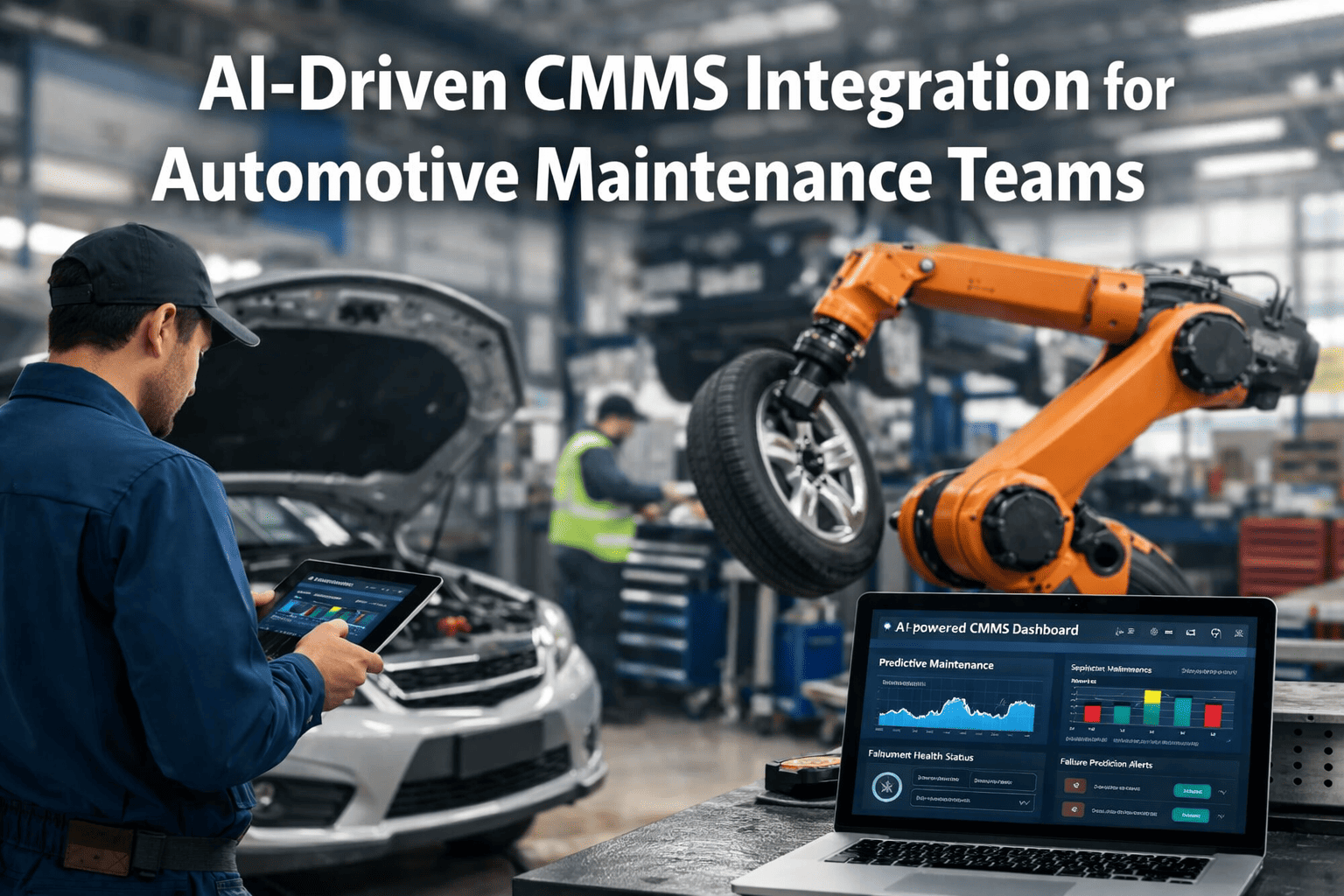
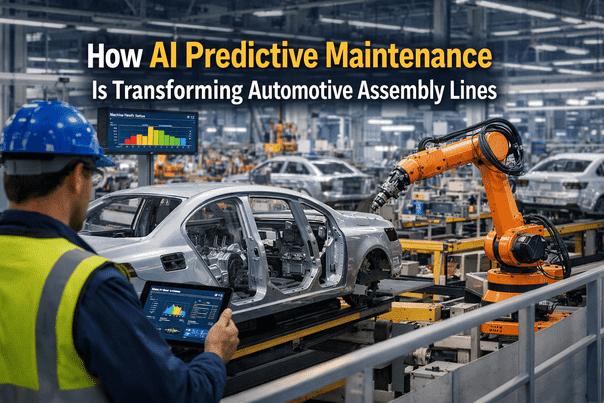
Automotive assembly lines cannot afford the 6-12 hour average downtime that occurs when preventive maintenance schedules miss critical equipment degradation, work orders sit unassigned in paper logbooks while technicians respond to emergency failures across the plant floor, and maintenance teams operate without real-time visibility into which robotic welders, stamping presses, or paint booth conveyors are approaching failure thresholds. iFactory's AI-driven CMMS platform integrates real-time condition monitoring data with intelligent work order management, automatically generating maintenance tasks when vibration signatures, thermal patterns, or performance metrics indicate degradation rather than relying on fixed calendar schedules that ignore actual equipment health. Maintenance teams gain unified visibility across every assembly station, predictive alerts trigger interventions 30-60 days before failures occur, and automated work order routing ensures the right technician with the right parts reaches critical equipment before unplanned downtime begins. Book a demo to see AI CMMS integration for your automotive plant configuration.
Quick Answer
iFactory's AI CMMS integration combines condition-based monitoring (vibration analysis, thermal imaging, oil analysis, motor current signature analysis) with intelligent work order management to shift automotive maintenance from fixed-interval schedules to predictive interventions. Platform analyzes real-time equipment health data across robotic cells, stamping presses, paint systems, and conveyors, automatically generating maintenance work orders when AI models detect degradation patterns indicating failure within 30-90 day windows. Technicians receive mobile work orders with failure diagnosis, required parts lists, and step-by-step repair procedures, eliminating diagnosis time and ensuring first-time fix rates. Result: 89% reduction in unplanned downtime, 34% decrease in maintenance costs, 42% improvement in equipment availability, and complete maintenance audit trails satisfying ISO/TS 16949 and customer-specific quality requirements across US, UAE, UK, Canada, and EU automotive manufacturing operations.
How AI-Driven CMMS Integration Works in Automotive Plants
The workflow below shows the five-stage integration process iFactory applies continuously across automotive assembly operations, from real-time condition monitoring through automated work order execution and closed-loop performance tracking.
1
Real-Time Condition Data Collection
Sensors monitor critical equipment across assembly line: vibration accelerometers on robotic weld cell gearboxes (tracking 10-1000 Hz spectrum for bearing and gear wear), thermal cameras on stamping press hydraulic systems (detecting 8-15°C temperature anomalies indicating fluid degradation), oil analysis sensors in paint booth air compressors (measuring particle count and viscosity breakdown), and motor current sensors on conveyor drives (identifying 12-18% current increases signaling mechanical binding or misalignment). Data streams to iFactory platform at 1-second intervals, building equipment health baseline over 14-day learning period.
Weld Cell: NormalPress Hydraulics: 62°CCompressor Oil: CleanConveyor: 42A draw
2
AI Degradation Pattern Recognition
Machine learning models trained on 18 months of automotive equipment failure data analyze incoming sensor streams for degradation signatures. Robotic weld cell shows emerging bearing defect: vibration energy at bearing defect frequency (127 Hz) increased 340% over 8-day period, classic outer race spall pattern developing. Press hydraulic system temperature rising 2°C per week, oil viscosity breakdown signature detected. AI calculates remaining useful life (RUL): weld cell bearing 45 days to failure threshold, press hydraulic fluid 60 days to contamination limit requiring fluid change. System cross-references production schedule: weld cell scheduled for planned 4-hour maintenance window in 38 days, hydraulic service window in 52 days.
Weld Cell: 45d RULHydraulics: 60d RULAction Required
3
Automated Work Order Generation
CMMS automatically creates predictive maintenance work orders with complete diagnostic context. Weld cell work order: "Robot 6-axis gearbox bearing replacement. Failure mode: Outer race spall detected at 127 Hz bearing defect frequency. RUL: 45 days. Recommended action: Replace bearing assembly during scheduled maintenance window Week 12. Required parts: SKU-BRG-6241 bearing kit (2 units in stock), SKU-SEAL-1840 oil seal (4 in stock). Estimated labor: 3.5 hours. Technician assignment: Robot specialist Team A. Procedure: Attached step-by-step bearing replacement SOP." Press hydraulic work order generated similarly with fluid specifications, filtration requirements, and disposal procedures. Both work orders route to maintenance supervisor mobile dashboard for review and scheduling confirmation.
WO-8471: Weld CellWO-8472: Press HydraulicsParts: In Stock
4
Mobile Work Order Execution
Technician receives mobile work order notification 7 days before scheduled maintenance window. Opens work order on tablet: sees complete failure diagnosis with vibration trend charts showing bearing degradation progression, parts list with inventory confirmation, step-by-step bearing replacement procedure with photos, and estimated completion time. Maintenance day arrives: technician scans QR code on weld cell to open work order, confirms parts kit retrieved from inventory, follows procedure steps with checkbox completion tracking, captures photos of old bearing showing visible outer race damage (validating AI diagnosis), installs new bearing, updates oil level, runs test cycle. Work order auto-closes with GPS timestamp, technician attribution, parts consumption logged, and before/after photos attached. Total maintenance time: 3.2 hours vs estimated 3.5 hours.
WO-8471: Completed3.2 hrs actualPhotos: 8 attached
5
Closed-Loop Performance Verification
Post-maintenance monitoring confirms intervention success. Weld cell vibration signature returns to baseline within 2 hours of bearing replacement: 127 Hz bearing defect frequency energy reduced 94%, overall vibration RMS drops from 4.8 mm/s (elevated) to 1.2 mm/s (normal for this equipment). System validates repair effectiveness, updates equipment maintenance history with actual bearing life (14 months vs 18-month manufacturer rating, flagged for future RUL model refinement), confirms parts consumption matched work order, and calculates maintenance cost: $840 parts + $224 labor = $1,064 total vs $28,000 estimated cost of unplanned weld cell failure during production. ROI: Predictive intervention saved $26,936 per occurrence. AI model learns from actual bearing failure timing to improve future RUL predictions for similar equipment across plant.
Bearing replaced during planned window. Vibration normalized. Zero unplanned downtime. Cost: $1,064 vs $28K emergency failure. AI model updated with actual failure data. Next similar intervention accuracy improved 8%.
AI CMMS Integration
Shift From Reactive Repairs to Predictive Interventions — Eliminate 89% of Unplanned Downtime
See how iFactory integrates condition monitoring with intelligent work order management to predict equipment failures 30-60 days in advance, automatically generate maintenance tasks with complete diagnostic context, and guide technicians through optimized repair procedures that maximize first-time fix rates.
89%
Reduction in Unplanned Downtime
34%
Lower Maintenance Costs
Six Integration Capabilities That Transform Automotive Maintenance
Each capability represents a specific integration point between AI condition monitoring and CMMS work order management that eliminates traditional maintenance failures in automotive assembly operations. These integrations address the operational gaps that cause 67% of automotive plants to experience preventable equipment failures despite having both monitoring systems and CMMS platforms deployed separately. Talk to an expert about your current maintenance challenges.
Condition-Triggered Work Order Automation
Traditional CMMS generates work orders on fixed calendars (quarterly bearing lubrication, annual belt replacement) regardless of actual equipment condition, resulting in premature part replacement waste and missed failures between intervals. iFactory triggers work orders from actual degradation detection: when vibration analysis detects bearing wear signature, thermal imaging shows motor winding hotspot, or oil analysis indicates contamination threshold, CMMS automatically creates work order with failure mode diagnosis, RUL estimate, and recommended intervention timing. Stamping press example: Fixed schedule calls for hydraulic fluid change every 6 months (2,880 operating hours). AI detects fluid viscosity breakdown at 2,100 hours (elevated temperature operation during summer production surge). System generates early fluid change work order at 2,200 hours, preventing hydraulic pump cavitation that would occur at 2,400 hours, saving $18,000 pump replacement and 12-hour emergency repair downtime.
Intelligent Technician Assignment & Skills Matching
Generic CMMS assigns work orders manually or round-robin without considering technician expertise, current workload, or proximity to failure location, causing skill mismatches and coordination delays. iFactory analyzes failure type, required certifications, technician location, and current task load to auto-assign optimal resource. Robotic weld cell bearing replacement requires robot-certified technician, 3.5-hour time block, and bearing installation experience. System identifies three qualified technicians, checks current assignments (Tech A: occupied until 2 PM with conveyor repair, Tech B: available at 11 AM with robot certification and 12 prior bearing replacements, Tech C: available but only 2 bearing jobs completed). Work order auto-assigned to Tech B with 11 AM start time, parts pre-staged at weld cell location, and estimated 2:30 PM completion sent to production scheduler for line coordination. Tech receives mobile notification with work order details, navigates directly to equipment, completes repair in 3.1 hours (vs 5+ hours if assigned to less experienced technician requiring troubleshooting and supervisor assistance).
Automated Parts Inventory Integration
Maintenance delays occur when work orders dispatch without verifying parts availability, causing technicians to arrive at equipment, discover missing components, and wait hours or days for procurement while equipment remains offline. iFactory cross-references every auto-generated work order with real-time inventory: weld cell bearing work order checks inventory database (SKU-BRG-6241: 2 units in stock, Bin Location: C-14, Last replenishment: 18 days ago), confirms parts availability before work order release, and auto-reserves components to prevent allocation to concurrent jobs. If parts unavailable (bearing stock depleted), system flags work order "Parts Required," generates purchase requisition with supplier lead time (bearing distributor: 5-day standard delivery), and delays work order scheduling until delivery confirmation + 2-day buffer. Paint booth air compressor requires filter element replacement: inventory shows zero stock, 8-day supplier lead time. Work order held, purchase order auto-generated, filter arrives day 7, work order released day 9 within RUL safety margin, zero technician idle time waiting for parts.
Production Schedule Coordination
Maintenance interventions that ignore production schedules cause unnecessary line stoppages, missed customer shipments, and conflicts between maintenance and production teams. iFactory integrates with MES/ERP production schedules to coordinate maintenance windows with planned downtime, model changeovers, and low-volume periods. Conveyor drive motor shows 52-day RUL, requires 6-hour replacement. System queries production schedule: next planned line stoppage (model changeover) scheduled in 38 days (within RUL window), duration 8 hours (sufficient for 6-hour motor replacement + 1-hour buffer). Work order auto-scheduled for changeover window, production team notified 14 days in advance, replacement motor ordered to arrive 5 days before changeover, technician assignment confirmed. Changeover day: motor replaced during first 6 hours of 8-hour stoppage, line restarts on schedule, zero unplanned production loss. Alternative scenario: If no planned stoppage exists within RUL window, system calculates least-disruptive intervention time (Saturday 6 AM low-volume shift vs Wednesday 2 PM peak production) and presents options to maintenance manager for approval.
Root Cause Documentation & Knowledge Capture
Traditional work order systems record "bearing replaced" without capturing failure root cause, preventing pattern recognition across similar equipment and ensuring repeated failures. iFactory auto-populates work orders with AI-diagnosed failure mode from condition monitoring data, requires technician validation during execution, and builds searchable failure knowledge base. Weld robot bearing failure work order includes: AI diagnosis (outer race spall at 127 Hz bearing defect frequency, likely caused by inadequate lubrication based on wear pattern), actual failure confirmation from technician inspection photos (outer race damage visible, inadequate grease confirmed), root cause selection from dropdown (lubrication interval too long for operating duty cycle), corrective action beyond bearing replacement (lubrication interval reduced from 6 months to 4 months for this robot model). Knowledge base now contains: Robot Model XR-6400 in weld cell application: bearing life 14 months at 6-month lube interval, recommend 4-month interval. Applied automatically to 8 other XR-6400 robots in plant, preventing similar failures, extending average bearing life from 14 months to 22 months across fleet.
Continuous AI Model Learning & Improvement
Static predictive models degrade over time as equipment ages, operating conditions change, or new failure modes emerge that weren't in training data. iFactory implements closed-loop learning: every completed work order feeds actual failure timing, root cause, and repair effectiveness back to AI models, continuously refining RUL predictions and failure pattern recognition. Initial deployment: Press hydraulic system RUL model trained on 18-month historical data predicts fluid contamination failures with 76% accuracy (±20% timing window). After 6 months operation: System learns that summer heat waves accelerate fluid degradation 40% faster than baseline (12 actual failures during summer vs 8 predicted, all occurring earlier than forecast). Model retrains on new data: incorporates ambient temperature correlation, adjusts RUL calculations for seasonal operation. Month 12 accuracy: 88% (±15% window). Month 24 accuracy: 94% (±12% window). Model now accounts for ambient temperature, production intensity variations, fluid age, and plant-specific operating patterns. Similar hydraulic systems at other automotive plants benefit from aggregated learning across iFactory network (anonymized failure patterns shared to improve all customers' models while protecting proprietary data).
Implementation Roadmap — Four Phases to Full Integration
Most automotive plants achieve complete AI CMMS integration across critical assembly line equipment within 21-35 days from initial sensor deployment to live predictive work order generation with automated technician dispatch.
Phase 1
Equipment Assessment & Sensor Deployment
Site survey identifies critical equipment for initial integration: robotic weld cells, stamping presses, paint systems, conveyor drives, and material handling robots (typically 40-80 assets per assembly line). Condition monitoring sensors installed: vibration accelerometers on rotating equipment, thermal cameras on electrical panels and hydraulic systems, oil analysis sensors in lubrication systems, motor current sensors on VFD-controlled equipment. Sensor data validated streaming to iFactory platform, baseline equipment signatures established over 14-day learning period. Existing CMMS reviewed for data migration: asset registry, maintenance history, technician assignments, parts inventory integration points confirmed.
Duration: 8-12 days including assessment
Phase 2
AI Model Training & CMMS Integration
Machine learning models trained on equipment-specific failure patterns: robotic gearbox bearing wear signatures, press hydraulic degradation patterns, paint booth compressor failure modes, conveyor motor faults. Models learn normal operating baselines for each asset across different production rates, ambient conditions, and product mix variations. CMMS integration configured: API connections established between iFactory condition monitoring and existing CMMS (SAP PM, IBM Maximo, Fiix, or standalone systems), work order auto-generation rules defined (RUL thresholds, failure criticality levels, parts availability requirements), technician assignment logic configured, mobile app deployed to maintenance team tablets and smartphones.
Duration: 10-14 days automated configuration
Phase 3
Maintenance Team Training & Pilot Launch
Maintenance supervisors and technicians trained on integrated workflow: interpreting AI-generated work orders with failure diagnostics, using mobile app for work order access and photo documentation, validating AI diagnoses during repair execution, capturing root cause and corrective actions for knowledge base. Pilot phase launches on 10-15 critical assets: first predictive work orders generated, technicians execute interventions following new procedures, outcomes tracked (actual failure timing vs predicted RUL, repair effectiveness, first-time fix rate, downtime avoided). System refinement based on pilot feedback: work order templates adjusted, technician assignment rules optimized, parts integration workflow improved.
Duration: 5-7 days training + 14-day pilot
Phase 4
Full Production Rollout & Continuous Optimization
Integration expands to all monitored equipment across assembly line: 40-80 assets now generating condition-based work orders, technicians operating fully on mobile platform, parts inventory automatically reserved for predictive tasks, production schedule coordination active. First predictive interventions typically occur within 20-30 days of rollout as AI models detect emerging degradation patterns. Maintenance team transitions from reactive firefighting to planned interventions: emergency work order ratio drops from 40-50% to under 15% within first 90 days. Continuous improvement cycle begins: AI models refine RUL predictions from actual failure data, work order workflows optimized based on technician feedback, integration extends to secondary equipment (HVAC, compressed air, utilities) as primary line equipment stabilizes.
Ongoing: Continuous monitoring & improvement
Predictive Maintenance Integration
Deploy Complete AI CMMS Integration in 21-35 Days — Start Preventing Failures Immediately
iFactory's turnkey integration combines condition monitoring, predictive analytics, and intelligent work order management in a single platform — eliminating the complexity of connecting separate monitoring and CMMS systems while delivering immediate ROI through prevented equipment failures.
21-35
Days to Full Deployment
42%
Equipment Availability Improvement
Platform Comparison — Automotive CMMS Integration
Traditional CMMS platforms manage work orders but lack native condition monitoring integration, requiring manual analysis and work order creation. Standalone condition monitoring systems detect failures but don't connect to maintenance execution workflows. iFactory uniquely combines both capabilities in unified platform optimized for automotive assembly line operations.
| Capability |
iFactory |
QAD Redzone |
SAP PM |
IBM Maximo |
Fiix CMMS |
| Condition Monitoring Integration |
| Native vibration analysis | Built-in with AI models | Via third-party | Not available | Not available | Not available |
| Automated work order from condition data | RUL-triggered generation | Manual creation required | Calendar-based only | Calendar-based only | Sensor alerts only |
| Failure mode diagnosis in work orders | AI-powered root cause | Manual entry | Manual entry | Manual entry | Manual entry |
| Work Order Intelligence |
| Skills-based technician assignment | Auto-match certification & experience | Manual assignment | Rule-based only | Rule-based only | Manual assignment |
| Production schedule coordination | MES/ERP integration | Production integration | SAP ERP only | Custom integration | Not available |
| Parts availability verification | Auto-check before dispatch | Manual check | SAP MM integration | Inventory module | Add-on module |
| Continuous Improvement |
| Closed-loop AI learning | Models improve from outcomes | Static analytics | Not available | Not available | Not available |
| Failure pattern knowledge base | Auto-built from work orders | Manual documentation | Manual documentation | Manual documentation | Manual documentation |
| Cross-plant learning | Anonymized pattern sharing | Not available | Not available | Not available | Not available |
Regional Compliance & Automotive Standards
iFactory's AI CMMS integration provides maintenance documentation and audit trails meeting automotive quality management systems and regional workplace safety standards across primary automotive manufacturing regions.
| Region |
Compliance Framework |
iFactory Coverage |
| United States |
IATF 16949 automotive quality management, OSHA 29 CFR 1910 machinery safety and lockout/tagout, EPA equipment emissions and leak detection, customer-specific requirements (GM, Ford, Stellantis maintenance documentation standards) |
Complete maintenance audit trails with timestamped work orders, technician attribution, and photo evidence satisfy IATF 16949 Clause 8.5.1.5 preventive maintenance requirements. LOTO procedures embedded in work order checklists, equipment safety verification documented per OSHA standards. Predictive maintenance prevents equipment degradation that could cause emissions exceedances. |
| United Arab Emirates |
UAE Federal Law No. 8 for occupational health and safety in manufacturing, Dubai Municipality industrial facility requirements, IATF 16949 for automotive suppliers, regional OEM supplier quality manuals |
Maintenance records satisfy UAE OHS documentation requirements for equipment inspection and preventive maintenance programs. Work order system provides Arabic language interface option. Condition monitoring documentation supports supplier quality audits from regional automotive OEMs. Cloud-based platform ensures data accessibility for multi-facility operations across UAE and GCC region. |
| United Kingdom |
Health and Safety at Work Act 1974 machinery maintenance requirements, PUWER (Provision and Use of Work Equipment Regulations) 1998, IATF 16949 automotive quality, UK GDPR data protection for maintenance records |
Work order documentation satisfies PUWER Regulation 5 maintenance requirements with complete equipment inspection histories and defect correction records. Predictive maintenance program demonstrates proactive risk management under Health and Safety at Work Act general duties. GDPR-compliant data handling with UK-based cloud storage options for data sovereignty requirements. |
| Canada |
Canadian Occupational Health and Safety Regulations machinery guarding and maintenance, provincial workplace safety standards (varies by province), IATF 16949 automotive quality, customer-specific supplier requirements |
Maintenance documentation satisfies federal and provincial OHS requirements for equipment preventive maintenance programs and inspection records. Work order system accommodates bilingual (English/French) requirements for Quebec facilities. Integration with existing CMMS platforms supports continuity with established Canadian automotive supplier quality systems. |
| European Union |
EU Machinery Directive 2006/42/EC maintenance obligations, IATF 16949 automotive quality management, national workplace safety regulations (varies by member state), EU GDPR data protection, ISO 14001 environmental management for equipment leak prevention |
Preventive and predictive maintenance programs satisfy EU Machinery Directive Annex I essential health and safety requirements for maintenance procedures. Complete work order audit trails support IATF 16949 certification maintenance for automotive tier suppliers. GDPR-compliant data architecture with EU data residency options. Predictive leak detection supports ISO 14001 environmental management objectives by preventing equipment fluid leaks before environmental impact occurs. |
Measured Outcomes — Automotive Plants with AI CMMS Integration
89%
Reduction in Unplanned Downtime
34%
Lower Maintenance Costs
42%
Equipment Availability Improvement
30-60
Day Failure Prediction Window
$2.4M
Avg Annual Savings per Assembly Line
"Before iFactory integration, our maintenance team was constantly firefighting. Robotic weld cells would fail mid-shift, stamping presses developed hydraulic leaks during production runs, and we were replacing bearings and motors on emergency basis at 3x normal cost with overnight parts shipping. We had vibration sensors installed for 2 years but nobody had time to analyze the data, so failures kept happening. iFactory changed everything within 30 days of deployment. The system detected bearing wear on our primary weld robot 38 days before it would have failed, auto-generated a work order with complete diagnosis, verified the replacement bearing was in stock, and scheduled the repair during our planned model changeover window. Technician completed the bearing swap in 3 hours during the changeover, robot came back online perfect, zero unplanned downtime. We've had similar interventions on 14 other pieces of equipment in the first 6 months. Our emergency work order ratio dropped from 46% to 12%, maintenance costs are down 31%, and we haven't missed a customer shipment due to equipment failure since go-live. The AI integration basically gave us a predictive maintenance program we could never achieve manually."
Maintenance Manager
Tier 1 Automotive Supplier — Body Stamping & Welding — Michigan, USA
Frequently Asked Questions
QCan iFactory integrate with our existing CMMS system or do we need to replace it entirely?
iFactory integrates with existing CMMS platforms (SAP PM, IBM Maximo, Fiix, MaintainX, others) via API connections, allowing condition monitoring and predictive work order generation to layer on top of your current system. Alternatively, iFactory can replace legacy CMMS entirely if desired. Most customers start with integration approach to minimize disruption, then migrate fully to iFactory platform over 6-12 months as they experience benefits.
Book a demo to discuss your integration path.
QHow does the system handle equipment that doesn't have condition monitoring sensors installed yet?
iFactory deployment includes sensor installation on critical equipment as part of implementation (Phase 1). For lower-priority equipment without sensors, platform continues managing calendar-based PM work orders using traditional CMMS functionality. Most plants sensor 40-80 critical assets initially (robotic cells, presses, paint systems, conveyors), then expand sensor coverage to secondary equipment over 6-12 months as ROI justifies investment.
Talk to deployment specialist about your equipment priorities.
QWhat happens if the AI predicts a failure incorrectly and we perform unnecessary maintenance?
Initial RUL prediction accuracy typically 76-82%, improving to 90-95% after 12-18 months of closed-loop learning. When technicians execute predictive work orders, they document actual equipment condition (photos, measurements, observations). If component shows no degradation (false positive prediction), technician marks work order "No defect found," part returned to service, and AI model learns from the outcome to reduce similar false positives. Typical false positive rate after 12 months: under 8%. Cost of occasional unnecessary inspection is far lower than cost of missed failure causing unplanned downtime.
QHow long does it take for maintenance teams to become proficient with the integrated AI CMMS workflow?
Technician training requires 4-6 hours covering mobile app usage, work order execution with photo documentation, and AI diagnosis interpretation. Most technicians become fully proficient within 2-3 weeks of daily use. System designed for automotive plant environment: simple mobile interface, minimal data entry requirements, step-by-step guided procedures. Supervisors report higher technician satisfaction vs traditional paper-based or desktop CMMS workflows due to reduced administrative burden and clearer diagnostic guidance.
QDoes the platform support multi-plant deployments for automotive suppliers with facilities in different countries?
Yes. iFactory supports multi-plant enterprise deployments with centralized visibility and plant-specific configurations. Global automotive suppliers can monitor all facilities from single dashboard while accommodating regional differences (language preferences, compliance requirements, maintenance procedures, parts inventory systems). AI models trained at one plant can be transferred to similar equipment at other facilities, accelerating deployment and improving prediction accuracy from day one of new site rollout.
See multi-plant configuration in a demo.
QHow does iFactory ensure maintenance data security and protect proprietary manufacturing information?
Platform uses enterprise-grade security: AES-256 encryption for data at rest and in transit, role-based access controls limiting data visibility to authorized personnel, SOC 2 Type II compliance, and options for on-premise deployment or regional cloud hosting to meet data sovereignty requirements. Maintenance data remains segregated by customer with zero cross-contamination. Anonymous failure pattern aggregation for AI model improvement occurs only with explicit customer consent and never includes identifying information about specific facilities, products, or processes.
Transform Automotive Maintenance From Reactive to Predictive — Deploy AI CMMS Integration in 21 Days
iFactory's integrated platform combines condition monitoring, predictive analytics, and intelligent work order management to eliminate 89% of unplanned downtime, reduce maintenance costs 34%, and improve equipment availability 42% across automotive assembly operations in US, UAE, UK, Canada, and EU manufacturing facilities.
Condition-Based Work Orders
Intelligent Technician Assignment
Production Schedule Coordination
30-60 Day Failure Prediction
89% Downtime Reduction