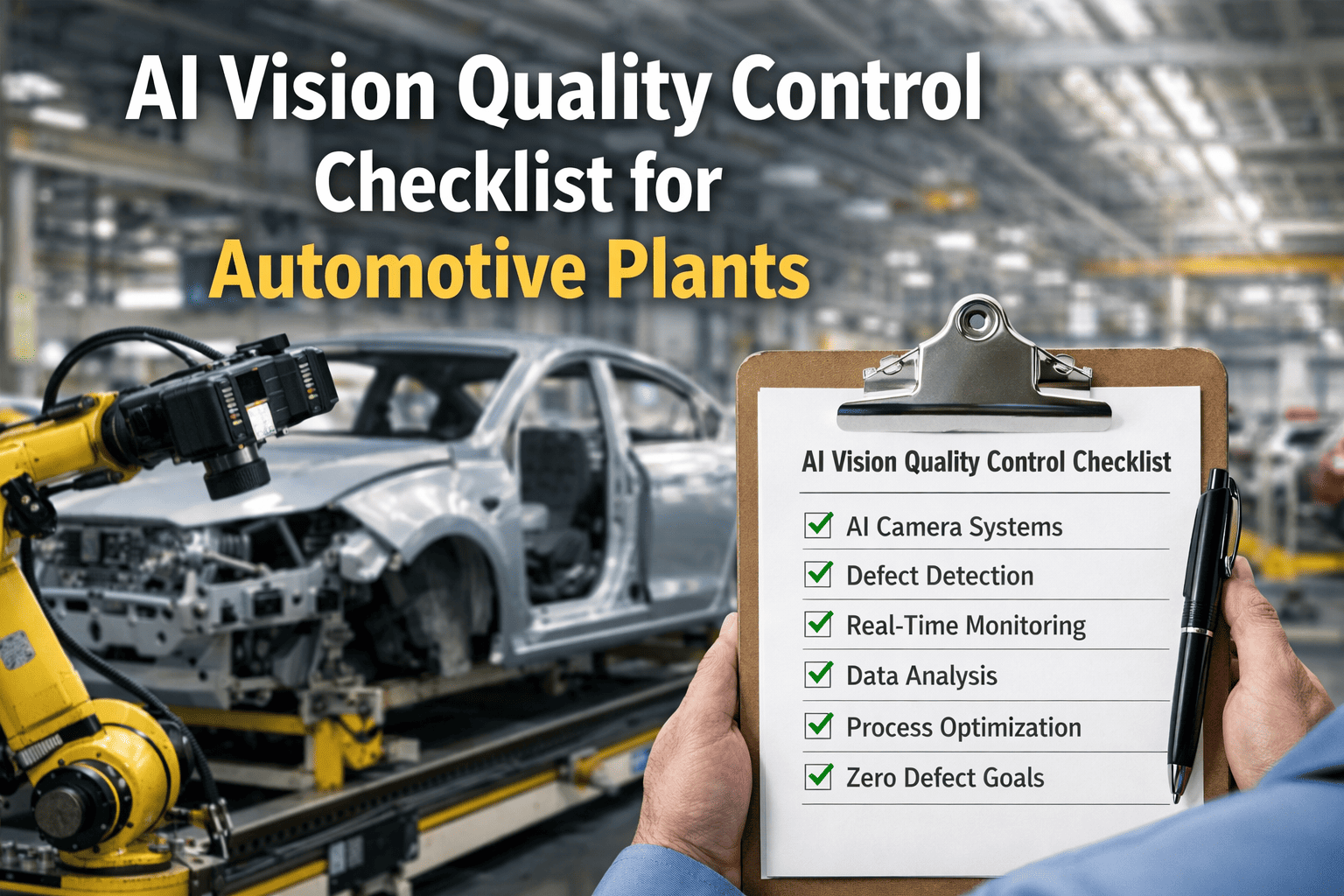
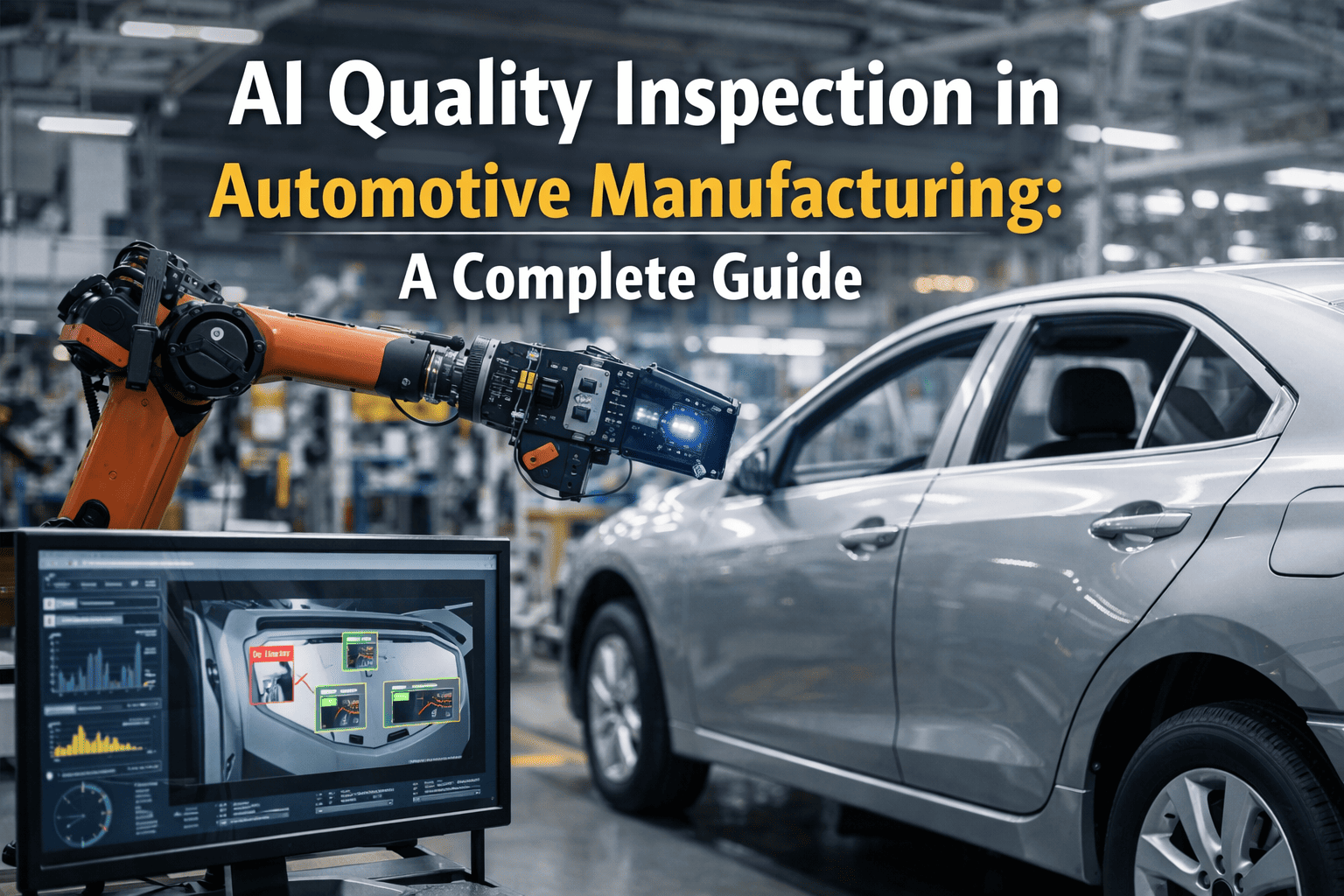
AI Vision Quality Control Checklist for Automotive Plants
By John Polus on April 16, 2026
Automotive plants lose an average of $2.3 million per hour to unplanned production downtime, and defect-related rework accounts for up to 12% of total manufacturing cost across global OEM facilities. Traditional end-of-line quality inspection catches defects after value has already been added at every preceding station, making rework exponentially more expensive than prevention. AI vision quality control deployed inline across stamping, body-in-white, paint, and final assembly stations detects surface defects, dimensional deviations, and assembly errors in real time at machine speed, before they propagate downstream. The shift from manual inspection to AI-powered zero-defect manufacturing is no longer a competitive advantage; it is a production survival requirement in a sector where downtime costs rose 113% since 2019. This checklist gives quality engineers, plant managers, and automation leads a structured implementation path from camera selection through live AI inspection deployment. Book a demo to see how iFactory AI Vision is configured for your specific automotive production lines and quality gates.
$2.3M
Per-hour cost of unplanned automotive line stoppage — defect escapes are the leading hidden cause
113%
Increase in automotive downtime costs since 2019 — AI inspection is now a production survival requirement
99.7%
Defect detection accuracy achievable with properly deployed AI vision versus 87% average for human inspectors
6
Checklist phases covering camera selection, lighting, AI model training, integration, alerting, and continuous improvement
Lighting is the most underestimated variable in AI vision quality control. The same surface defect that is clearly visible under correct illumination becomes invisible under incorrect lighting — no AI model compensates for fundamentally inadequate image contrast. Lighting design must be completed and locked before any training images are collected.
Lighting Type Selection by Defect Category
Ambient Light Exclusion and Enclosure
Phase 3 — AI Model Training and Defect Classification
Phase 4 — MES, PLC, and Production System Integration
AI vision quality control creates its highest value when inspection results are linked to production data — part serial number, build record, operator, shift, tooling set, and material batch. Without system integration, AI inspection results are isolated quality data that cannot drive work order generation, traceability, or process improvement. Book a demo to see how iFactory AI Vision integrates with your MES, PLC, and quality management systems.
MES and Traceability Integration
PLC and Production Line Control Integration
iFactory Platform and Work Order Integration
Phase 5 — Alert Logic, Rejection Thresholds, and Operator Interface
Alert configuration determines whether AI vision quality control drives action or generates ignored notifications. Threshold settings that are too sensitive flood the production floor with false alarms that erode operator trust within days. Thresholds that are too permissive allow defect escapes that negate the entire business case for deployment.
Defect Severity Classification and Threshold Setting
Operator Interface and Andon Integration
Phase 6 — Continuous Improvement, Model Maintenance, and Compliance
IATF 16949, IATF 16949, and Customer Audit Compliance
Implementation Phase Summary and Milestone Tracker
Checklist Phase
Pre-Production
Pilot Run
Go-Live
Ongoing Ops
Critical Items
Total
Phase 1 — Camera and Hardware
Full phase
Repeatability test
Sign-off
Lens cleaning
3
13
Phase 2 — Lighting and Environment
Design and install
Intensity verify
Lock-in
Quarterly calibration
4
11
Phase 3 — AI Model Training
Data collection
Acceptance test
QE sign-off
Active learning
6
14
Phase 4 — MES and PLC Integration
Tag mapping
Latency test
PLC approval
Annual audit
5
12
Phase 5 — Alerts and Operator Interface
Threshold design
End-to-end test
Operator training
FP rate review
4
10
Phase 6 — Continuous Improvement
Audit plan setup
MSA baseline
First report
Monthly review
2
9
Total Checklist Items
Phases 1-3
All 69
Full 69
Ongoing
24
69
Region-Wise Deployment: Compliance and Fit by Market
Region
Key Automotive QC Challenges
Compliance Requirements
How iFactory Solves
United States
IATF 16949 customer-specific requirements from Big 3, aging line equipment creating false positive drift, high labor cost driving full automation pressure, OSHA 1910.217 press guarding compliance for inspection stations
IATF 16949, AIAG FMEA, AIAG MSA 4th Ed, OSHA 1910 Subpart O, EPA reporting for paint VOC
Pre-validated AIAG MSA-compliant inspection records, automated IATF change control documentation, OSHA-compliant station enclosure specifications, OEE quality rate integration for Big 3 supplier scorecard reporting
United Arab Emirates
Extreme heat and dust ingress degrading camera and lighting performance, rapid assembly plant expansion outpacing quality system maturity, ADNOC and Emirates Authority standards for industrial AI systems, limited trained quality engineering workforce for manual inspection fallback
ESMA industrial standards, UAE Cabinet Resolution on AI governance, ISO 9001:2015, IATF 16949 for export-oriented plants
Dust-rated IP67 enclosure specifications for desert environments, edge AI processing for remote locations with limited connectivity, Arabic-language operator interface option, rapid deployment templates for greenfield plant commissioning
United Kingdom
Post-Brexit supply chain traceability requirements, strict HSE workplace regulations for automated inspection equipment, UKCA marking requirements for vision system hardware, EV transition pressure creating new battery module inspection requirements
UKCA / CE marking, BS EN ISO 9001, IATF 16949, UK HSE Machinery Directive equivalent, SECR ESG reporting
Pre-configured battery module AI inspection models for EV production, SECR-compliant quality and energy data integration, HSE-documented station safety risk assessments for automated inspection zones, UKCA-compatible hardware specifications
Canada
Remote plant locations with limited specialist support, extreme cold affecting camera and lighting calibration stability, CAW/Unifor union requirements for technology introduction consultation, cross-border traceability with US OEM customers
CSA Group standards, Transport Canada automotive safety regs, IATF 16949, Provincial OHS Acts, Environment and Climate Change Canada reporting
Temperature-compensated AI baselines for cold climate plants, remote monitoring and model management without on-site specialist presence, US MES and IATF traceability compatibility for cross-border supply chain, bilingual English/French operator interface
Europe
EU AI Act compliance for industrial AI systems deployed in manufacturing, GDPR implications for operator-monitoring vision systems, strict EU Machinery Regulation 2023 requirements for automated inspection equipment, carbon reduction mandates impacting production energy and scrap targets
EU AI Act (Annex II high-risk systems), EU Machinery Regulation 2023/1230, GDPR, IATF 16949, EU CSRD, ISO 14001
EU AI Act conformity documentation built into model registry, GDPR-compliant vision system configuration with no operator biometric capture, CSRD-linked scrap and rework carbon footprint reporting, CE-marked hardware specifications for all EU deployment configurations
iFactory AI Vision vs Competitor Platform Comparison
Platform
iFactory AI
IBM Maximo
SAP EAM
Oracle EAM
QAD Redzone
Evocon
Mingo Smart Factory
L2L Connected
MaintainX
Limble CMMS
AI Vision Inspection
Dedicated Module
None
None
None
None
None
None
None
None
None
AI Predictive Maintenance
Advanced
Partial
Partial
Limited
Limited
None
Limited
Limited
Limited
None
PLC/SCADA/MES Integration
Native
Add-on
Add-on
Add-on
Partial
Limited
Partial
Partial
None
None
Work Order Automation
AI-Driven
Manual
Manual
Manual
Semi-Auto
None
Semi-Auto
Semi-Auto
Semi-Auto
Semi-Auto
OEE Real-time Tracking
Full Integration
Partial
Partial
Partial
Full
Full
Full
Partial
None
None
IATF 16949 Compliance Support
Built-in
Add-on
Add-on
Add-on
Partial
None
None
None
None
None
Automotive Industry Fit
Purpose-Built
General
General
General
Manufacturing
Manufacturing
Manufacturing
Manufacturing
General
General
Ease of Deployment
4-6 Weeks
6-18 Months
6-24 Months
6-18 Months
4-8 Weeks
2-4 Weeks
4-8 Weeks
4-8 Weeks
2-4 Weeks
2-4 Weeks
Battery / EV Production Support
Dedicated Module
None
None
None
None
None
None
None
None
None
iFactory AI Vision Results at Automotive Plants
99.7%
Defect Detection Accuracy
Achieved at body-in-white and stamping inspection stations after 30-day model stabilization period versus 87% average for human visual inspection
68%
Reduction in Defect Escapes
Average reduction in customer-facing defect escapes at plants with iFactory AI Vision deployed inline at all critical quality gates versus prior manual inspection
42%
Rework Cost Reduction
Reduction in rework labor and material cost from earlier defect detection preventing downstream value-add on parts that will ultimately be rejected
5 wks
Average Deployment Time
From hardware installation through model acceptance test to live inline AI inspection with full MES and PLC integration across a multi-station deployment
Deploy This Checklist as a Live AI Vision Program Across Your Production Lines
iFactory converts this six-phase checklist into a configured, running AI vision quality control program — cameras installed, models trained to your defect specifications, MES integrated, and work orders automated from defect detection to corrective action. No generic AI platform. Built for automotive production.
QDoes iFactory AI Vision integrate with our existing MES and PLC systems without requiring hardware replacement?
iFactory integrates with existing MES platforms via standard API, OPC-UA, or database connector, and with PLCs via PROFINET, EtherNet/IP, or Modbus without requiring PLC hardware replacement. The vision controller adds to your existing automation stack rather than replacing it. Book a demo to review the integration architecture for your specific MES and PLC platforms.
QHow does iFactory handle AI model degradation as tooling wears and material sources change over time?
iFactory monitors detection rate and false positive rate weekly per station and alerts quality engineering when performance drops more than 1.5% from acceptance baseline. An active learning pipeline automatically flags low-confidence predictions for review and adds confirmed labels to the retraining queue. Quarterly model reviews with iFactory's automotive AI team ensure sustained performance across the production lifecycle. Book a demo to see the model lifecycle management workflow.
QIs iFactory AI Vision suitable for EV battery module production inspection?
Yes. iFactory includes a dedicated EV and battery module inspection module covering cell gap verification, tab weld quality, busbar connection inspection, foreign object detection, and module housing integrity checks. Battery module inspection operates on a 100% inspection basis with no sampling, satisfying zero-tolerance defect requirements for EV safety-critical components. Start free or contact iFactory to review EV-specific inspection configurations.
Ready to Deploy AI Vision Quality Control Across Your Automotive Plant?
Six phases. 69 checklist items. One iFactory AI platform that handles cameras, models, MES integration, work order automation, and IATF compliance documentation across your full production line quality gates.