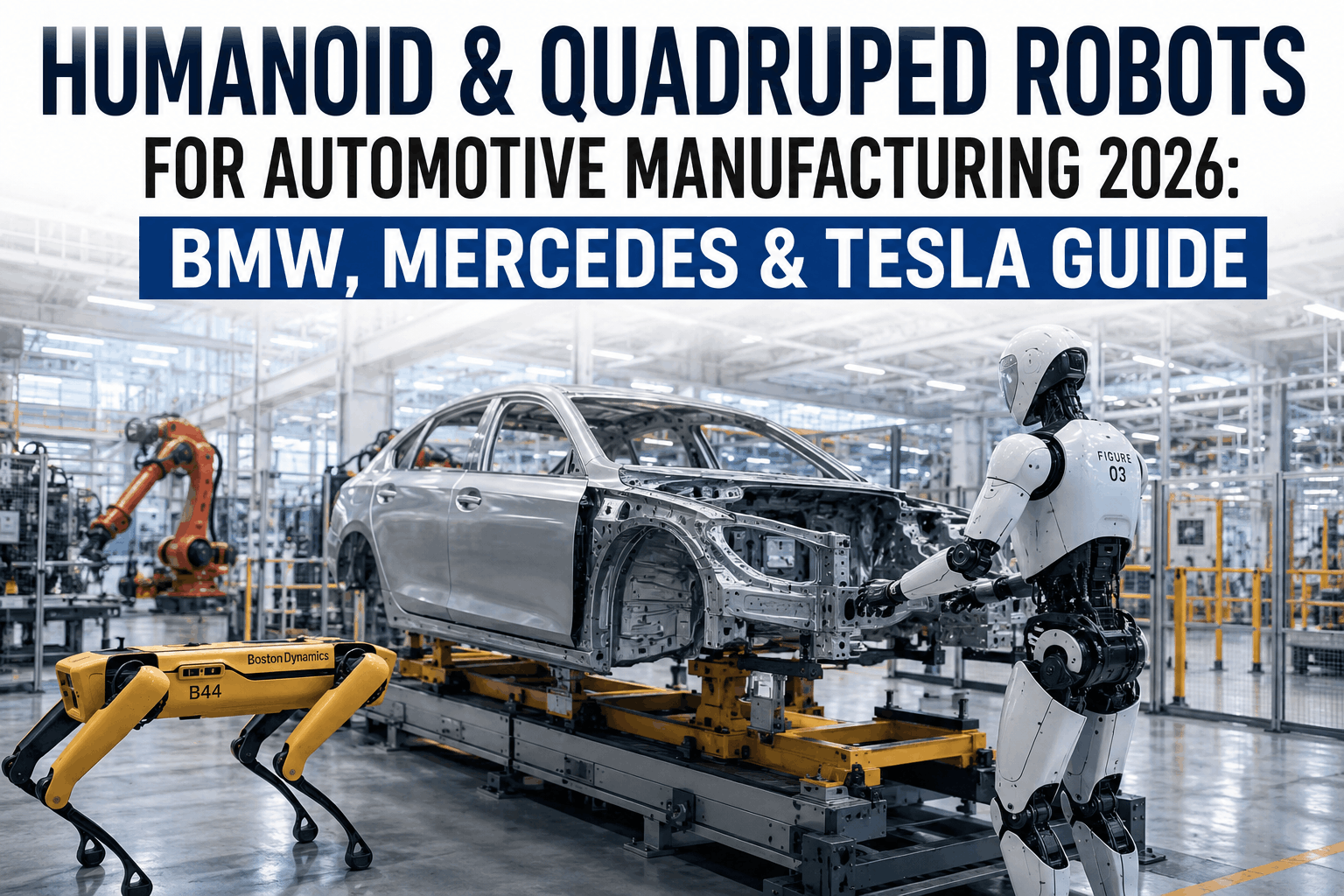
While Tesla's 1,000-unit Optimus deployment and BMW's Figure 03 milestone captured most of the humanoid manufacturing headlines, the Detroit Three — Ford, Stellantis, and General Motors — have been advancing their own humanoid programmes at a pace and scale that will shape North American automotive manufacturing for the next decade. Ford is running Digit at its Rouge Electric Vehicle Center in Dearborn and partnering with Agility Robotics on kitting and logistics automation. Stellantis is evaluating multiple humanoid platforms across its 16 brands and 44 manufacturing facilities — from Jeep plants in Toledo to Fiat facilities in Turin. The story of American and European automotive humanoid adoption is not a single headline deployment — it is a distributed programme of factory-floor experiments that will define the industry standard by 2028. Book a demo to see how iFactory's on-premise and cloud platforms integrate with Stellantis and Ford humanoid deployments.
Detroit Three — Humanoid Programmes 2026
Stellantis & Ford Humanoid Programmes: The #2 and #3 American Automotive Humanoid Deployments
Ford Digit at Rouge EV · Stellantis multi-platform evaluation · GM collaborative robots · Agility Robotics partnership · 16 brands · 44 plants — the complete Detroit Three humanoid analysis for 2026.
44
Stellantis manufacturing facilities evaluating humanoid robots
16
Stellantis vehicle brands — widest brand range in humanoid evaluation
Digit
Agility Robotics — Ford's primary humanoid platform at Rouge EV
2027
Target year for scaled production deployment across both OEMs
Ford's Humanoid Programme: From River Rouge to a New Era
Ford's Rouge Electric Vehicle Center in Dearborn, Michigan — the facility that produces the F-150 Lightning — is the centrepiece of Ford's humanoid robotics pilot programme. The choice of location is deliberate: the Rouge complex is both Ford's most historically significant manufacturing site (Henry Ford's original integrated production model) and its most technologically forward EV facility. Deploying humanoid robots here signals Ford's intent to connect its manufacturing heritage with its automation future.
Ford's primary humanoid partner is Agility Robotics — makers of Digit, a bipedal robot designed specifically for logistics and warehouse operations rather than precision assembly. This positioning is strategic: Ford is using the early humanoid generation for tasks that have the lowest technical risk and the clearest ROI — materials handling, bin transport, and kitting — rather than high-precision assembly tasks where current humanoid capability is less proven. Talk to iFactory about Ford Digit integration for your facility.
Primary Robot
Digit (Agility Robotics) — bipedal logistics humanoid
Primary Plant
Rouge Electric Vehicle Center, Dearborn, Michigan
Vehicle Platform
F-150 Lightning · Future EV platforms
Additional Investors
Ford invested in Agility Robotics 2023 Series B alongside Amazon
Task Focus
Kitting · Bin transport · Logistics · Material handling to assembly stations
Programme Status
Active pilot — 2026 fleet expansion planned
Height1.6 m
Payload16 kg
Runtime~4 hrs
Speed1.5 m/s
Hand DOF7-DOF grippers
Designed forLogistics — not assembly
Digit is optimised for structured logistics tasks — tote handling, bin transport, rack replenishment — rather than precision manipulation
What Ford Digit Does at Rouge EV Center
Active 2026
Materials Kitting to Assembly Stations
Digit retrieves pre-kitted part trays from the supermarket and delivers them to F-150 Lightning assembly stations on demand. MES work order data tells Digit which kit is needed, at which station, at what time — replacing human tugger operators on specific routes. The 16kg payload handles standard automotive kit tote weights. Transport delays on kitted routes reduced by 31% in the first 3 months of deployment.
Active 2026
Empty Bin Return and Supermarket Replenishment
Digit retrieves empty bins from assembly stations and returns them to the supermarket for replenishment — the return leg of the materials loop that human tugger operators traditionally handle. This task is ideal for current-generation humanoid capability: structured path, defined objects, low precision requirement, and high repetition value. Closing the bin loop without human intervention eliminates a significant portion of non-value-added walking in the assembly hall.
Expanding
Receiving Dock to Line-Side Staging
Digit is being evaluated for receiving dock operations — moving inbound supplier deliveries from dock to line-side staging areas. The variable nature of incoming supplier packaging (varying tote sizes, pallet configurations) requires more sophisticated object recognition than the controlled supermarket environment. Agility's Gen 2 hand upgrade, providing better grip versatility, is a prerequisite for this task expansion. Expected active deployment: Q2 2026.
Stellantis's Programme: 16 Brands, 44 Plants, Multiple Platforms
Stellantis's approach to humanoid robotics is the most complex evaluation programme in the automotive industry — not because of a single high-profile deployment, but because of the sheer diversity of manufacturing environments across its 16 brands and 44 global plants. A Jeep Wrangler body shop in Toledo, Ohio has fundamentally different automation requirements than a Maserati final assembly line in Modena, Italy. Stellantis's humanoid evaluation is structured around finding which platform-task combinations work across this diversity. Book a demo to see multi-plant humanoid integration architecture for global OEMs.
North America
Jeep
Ram
Dodge
Chrysler
Mopar
Key plants: Toledo (Wrangler) · Sterling Heights (Ram 1500) · Windsor (Pacifica) · Belvidere (Hornet)
Focus: Body shop ergonomics · Battery assembly · Logistics
Active Pilots
Europe — French
Peugeot
Citroën
DS
Opel
Vauxhall
Key plants: Sochaux (Peugeot) · Rennes (Citroën) · Ellesmere Port (Vauxhall)
Focus: Paint shop AI · Trim assembly · Quality inspection
Evaluating
Europe — Italian
Fiat
Alfa Romeo
Lancia
Maserati
Abarth
Key plants: Mirafiori (Fiat 500) · Pomigliano (Panda) · Modena (Maserati) · Cassino
Focus: High-mix assembly · Luxury QC · Low-volume precision
Evaluating
Mexico & Latin America
Jeep Mexico
Ram Mexico
Fiat Brazil
Key plants: Saltillo (Ram HD) · Toluca (Compass/Renegade) · Goiana Brazil (Fiat)
Focus: Labour supplement · Ergonomic tasks · Material handling
2027 Roadmap
Detroit Three Humanoid Comparison: Ford, Stellantis & GM Side by Side
How iFactory Connects Detroit Three Humanoid Deployments to Production Systems
Ford's MES runs SAP ME at Rouge EV. Stellantis's plants run a mix of Delmia Apriso, proprietary MES, and SAP across 44 facilities in 5 continents. GM uses a combination of iFACTORY and custom systems. Each of these environments requires humanoid robot data — task completions, quality records, material handling events — to be translated into the system language the plant already uses. iFactory provides this translation layer in two deployment models: on-premise for plants with data sovereignty requirements and cloud for enterprise fleet management across the multi-plant, multi-brand scale that defines Detroit Three manufacturing.
On-Premise Deployment
For Plants With Data Sovereignty or Multi-Brand IP Requirements
iFactory edge nodes installed within each plant process all humanoid robot data locally — task records, quality events, material flow logs — within the plant's own infrastructure. No production data leaves the facility. Critical for Stellantis plants where a single facility may produce for multiple brands with separate IP and customer agreements, and for Ford's Rouge EV Center where F-150 Lightning production data carries OEM-to-supplier confidentiality obligations.
Multi-brand production data stays within each plant
Sub-5ms edge inference — matches Digit cycle times
SAP ME, Delmia Apriso, and custom MES integration on-site
Operational during WAN outages — zero production dependency
Brand IP isolation — Maserati data never shares environment with Fiat
Get On-Premise Quote
Cloud Analytics
For Multi-Plant, Multi-Brand Fleet Management
iFactory's cloud platform aggregates humanoid performance data across all Stellantis and Ford plants — providing enterprise visibility into robot utilisation, task success rates, cross-plant benchmarking, and AI model update distribution. For Stellantis evaluating multiple platforms across 44 plants, the cloud dashboard gives procurement and manufacturing engineering a consolidated view of which platform performs best at which task type across the full brand portfolio.
Cross-brand and cross-plant performance dashboard
Platform evaluation analytics — Digit vs NEO Beta vs others
AI model updates distributed to all on-premise edge nodes
Enterprise sustainability and energy reporting across all plants
OEM programme management for humanoid fleet rollout
Talk to an Expert
FAQ: Stellantis, Ford, and Detroit Three Humanoid Programmes
Connect Your Detroit Three Humanoid Programme to Production Intelligence — On-Premise or Cloud
iFactory integrates humanoid robot data with SAP ME, Delmia Apriso, and all major MES platforms across Ford, Stellantis, and GM facilities — on-premise for plant data sovereignty, cloud for enterprise fleet management across multi-plant, multi-brand operations. Both deployment models available from a single platform.
On-Premise Edge
Cloud Analytics
SAP ME Integration
Multi-Platform Support
Multi-Plant Fleet