The Toyota Production System is the most studied, most replicated, and most influential manufacturing methodology in the world. Every lean transformation, every Six Sigma programme, every kaizen initiative traces its intellectual lineage back to Taiichi Ohno's work on the Toyota factory floor. Now Toyota faces the most consequential question in its manufacturing history: how does the world's most human-centred production philosophy integrate workers who are not human? Humanoid robots do not get tired, do not cause muri (overburden), cannot participate in morning kaizen meetings — but they also never vary, never call in sick, and never pull the andon cord for the wrong reason. The integration of humanoid robots into TPS is not a technology question. It is a philosophy question with technology consequences. Book a demo to see how iFactory connects humanoid robots to TPS-aligned production systems.
Toyota Production System — Humanoid Integration 2026
TPS Meets Humanoid Robotics: How Jidoka, Andon, and Kaizen Work With Robotic Workers
The definitive analysis of humanoid robot integration into the Toyota Production System — jidoka redefined, andon cord protocols for robots, kaizen with non-human participants, and the TPS principles that survive and evolve in the age of humanoid manufacturing.
1950s
TPS origin — Taiichi Ohno's Toyota factory floor
2026
Toyota humanoid pilot — Georgetown & San Antonio plants
Jidoka
Autonomation — the TPS principle humanoids change most
14
Toyota Way principles — all require reinterpretation for robotic workers
The Toyota Production System: A Foundation Built for Humans
TPS was designed around a central assumption that no one questioned in 1950 and almost no one questions today: the worker is human. Every TPS element — jidoka's authority to stop the line, heijunka's respect for human capacity limits, kaizen's reliance on worker insight, andon's communication protocol — was designed for a biological worker with cognitive capabilities, physical limits, and social participation. Humanoid robots challenge every one of these assumptions simultaneously — not by rejecting TPS, but by forcing a rethink of what each principle means when the worker is a machine that behaves like a person.
Toyota's response to this challenge is characteristically deliberate. Rather than deploying humanoid robots at scale immediately, Toyota Motor Manufacturing (TMM) is running structured pilot programmes at Georgetown, Kentucky and San Antonio, Texas — studying exactly how humanoid workers integrate with TPS workflows before committing to fleet-scale deployment. Talk to iFactory about TPS-aligned humanoid integration architecture.
The TPS House: How Humanoid Robots Interact With Each Element
Goal: Highest Quality · Lowest Cost · Shortest Lead Time
Just-in-Time
Right part, right amount, right time
Humanoid impact
Robots receive kanban signals digitally via MES — no physical card handling. Pull system logic unchanged; execution method changes.
High compatibility
Jidoka
Autonomation — stop at abnormality
Humanoid impact
Robots can stop the line autonomously via AI quality detection — extending jidoka beyond human observation to continuous machine intelligence.
Enhanced by robots
Heijunka
Level production scheduling — robots extend the production window beyond human shift limits
Enhanced
Standardised Work
Robots execute standard work with perfect consistency — zero deviation from documented process
Ideal execution
Kaizen
Robots generate improvement data but cannot participate in kaizen meetings — human-led, robot-data-informed
Requires adaptation
Jidoka Reimagined: When the Robot Stops the Line
Jidoka — the principle that every worker has the authority and obligation to stop the production line when an abnormality is detected — is often described as "autonomation with a human touch." The human touch was the key qualifier: a human worker observes, judges, and decides. A humanoid robot equipped with AI quality inspection changes this equation fundamentally. The robot does not observe and judge in the same way as a human — it detects patterns, compares against trained models, and executes pre-defined responses. But the outcome is the same: the line stops when quality falls below specification. See how iFactory implements jidoka-compatible AI quality detection in a live demo.
Human Worker Jidoka
Observes: Visual, tactile, auditory
Detection speed: Seconds to minutes
Consistency: Variable — fatigue, distraction
Coverage: Sampled — not every unit
Response: Pull andon cord, call team leader
Learning: Participates in problem-solving
Judgement: Contextual, experience-based
Humanoid Robot Jidoka
Observes: Multi-sensor continuous streams
Detection speed: Milliseconds
Consistency: Perfect — no degradation
Coverage: 100% — every unit, every cycle
Response: Digital signal to MES and andon system
Learning: Model retrained from outcomes
Judgement: Pattern-based, model-defined
TPS evolution: Robot jidoka extends detection capability but requires human team leaders for problem-solving — a hybrid model where robots detect and humans respond.
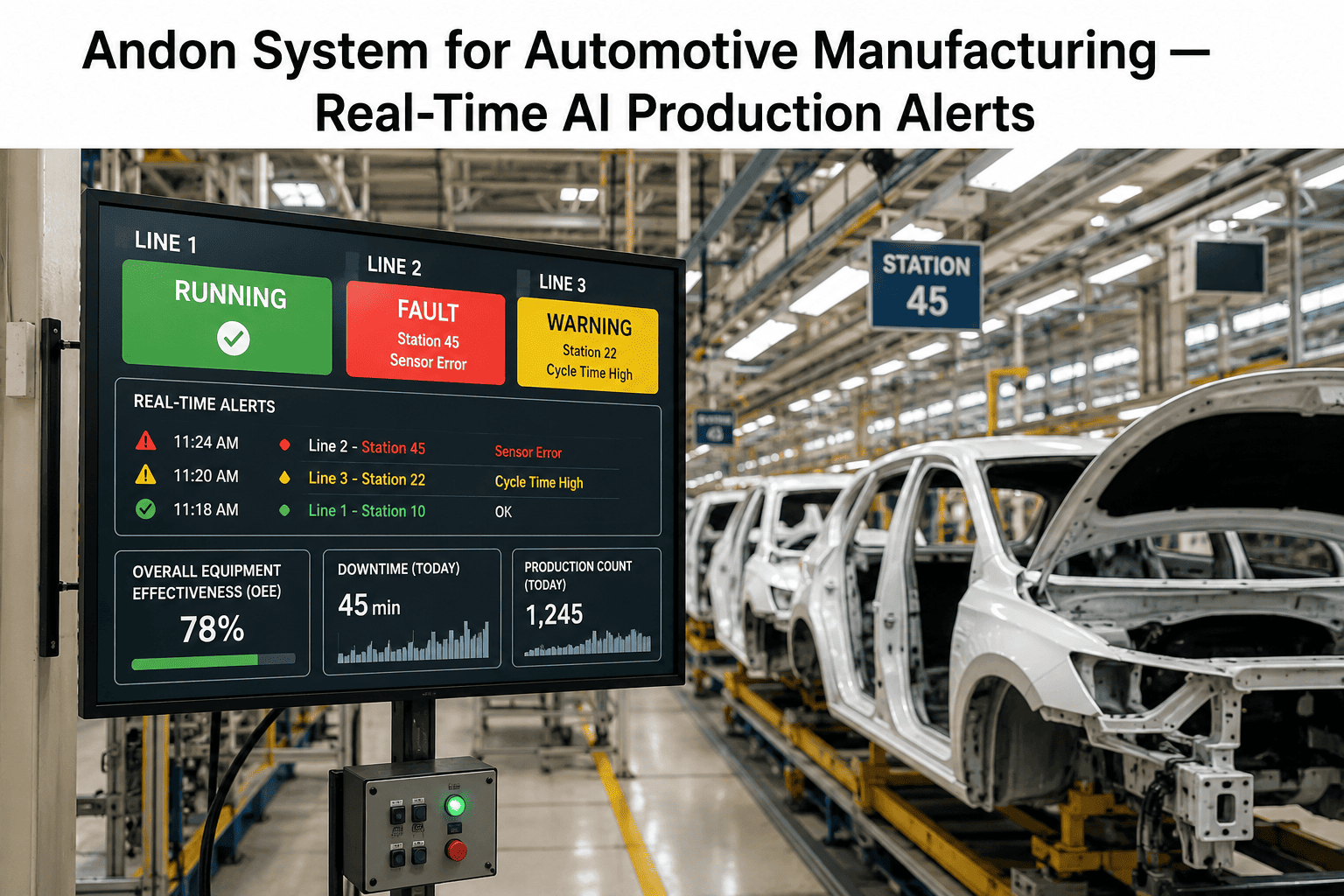
The Andon Cord Problem: How Humanoid Robots Integrate With Toyota's Alert System
The andon cord — or modern andon button — is TPS's most visible quality mechanism. A worker pulls the cord, a light activates above the station, music plays, and the team leader has until the line reaches the next fixed position to assess and respond. If unresolved, the line stops. This 60-year-old protocol was designed for a human hand pulling a physical cord. How does a humanoid robot participate?
Andon Integration Architecture for Humanoid Workers
AI
Robot Detects Abnormality
Humanoid's onboard AI or iFactory edge node detects quality deviation, process abnormality, or task failure during cycle execution
MES
Digital Andon Signal
iFactory platform sends a digital andon signal to the plant's MES and andon board system — identical to a human cord pull in the production control system
LED
Andon Board Activates
The physical andon board above the station illuminates — same visual signal the team leader responds to, regardless of whether a human or robot triggered it
TL
Team Leader Responds
Human team leader assesses the robot's flagged abnormality. Robot provides structured data: fault type, sensor reading, image evidence — reducing diagnosis time vs verbal human description
OK
Resolution & Countermeasure
Team leader resolves the issue. iFactory logs the event with full robot sensor data for root cause analysis — richer data than a human verbal andon event report
Kaizen With Robots: What Changes and What Stays Human
Kaizen — continuous improvement through small, incremental changes driven by the workers closest to the process — is arguably the most human element of TPS. It depends on worker observation, intuition, creativity, and willingness to question the status quo. Humanoid robots do not have opinions. They cannot sit in a kaizen circle, observe a process critically, and suggest a better way. But they generate data that no human kaizen team has ever had access to: continuous, structured, quantified process observation at every station, every cycle, every shift.
Stays Human
What Robots Cannot Do in Kaizen
Identify the root cause of a process problem through experience and intuition
Propose creative solutions to workflow inefficiencies
Participate in kaizen circles with cross-functional judgement
Recognize that a standard work document is wrong, not just that it wasn't followed
Motivate other workers through kaizen success stories
Robot Contribution
What Robots Add to Kaizen
Continuous quantified process data — cycle time variation, force profiles, defect location
Objective before/after measurement — kaizen impact is immediately quantifiable
Muda identification from data patterns that human observation would miss
Standardised work verification — robots execute the current standard exactly, making deviation visible
Shift-consistent baseline — no operator variation obscuring process signal
Toyota's Humanoid Deployment Strategy: Deliberate, Zone-by-Zone
Toyota's approach to humanoid integration reflects the Toyota Way's Principle 13: "Make decisions slowly by consensus, implement rapidly." The Georgetown, Kentucky and San Antonio, Texas pilots are studying specific tasks — ergonomic-risk assembly, parts kitting, and under-vehicle access — before any decision is made about broader deployment. This is precisely the opposite of Tesla's approach, and it is consistent with TPS philosophy. Book a demo to see how iFactory's on-premise and cloud platforms support phased humanoid deployment.
How iFactory Connects Humanoid Robots to TPS Production Systems
TPS production systems — MES, andon boards, kanban management, standardised work documentation, and quality records — were built for human workers. Connecting humanoid robots to these systems requires an integration layer that translates robot data, events, and actions into the language that TPS systems understand. iFactory provides this integration layer in two deployment models, designed to meet Toyota's data sovereignty requirements and TPS data governance principles.
On-Premise Deployment
For TPS Plants With Data Sovereignty and Gemba-First Requirements
iFactory edge nodes installed within each Toyota plant process all humanoid robot data, andon events, quality records, and jidoka signals locally. No raw production data, standardised work data, or kaizen improvement data leaves the facility. Critical for Toyota's IP protection requirements and consistent with TPS's gemba (actual place) principle — all intelligence lives on the shop floor, not in a remote cloud.
Andon signals processed at edge — sub-millisecond response
Standardised work data and kaizen records stay on-site
TPS production data sovereignty — aligned with Toyota IP policy
Operational during WAN outages — production never depends on cloud
MES, andon system, and CMMS integration on-site
Get On-Premise Quote
Cloud Analytics
For Multi-Plant TPS Fleet Management and Kaizen Intelligence
iFactory's cloud platform aggregates humanoid robot performance data across all Toyota plants — enabling enterprise-level kaizen intelligence: which plants achieve highest robot jidoka detection rates, which tasks have highest success rate variance, and where standardised work needs updating based on robot execution data. AI model updates distribute from cloud to all on-premise edge nodes, improving humanoid performance across the entire Toyota manufacturing network simultaneously.
Cross-plant kaizen intelligence dashboard
Standardised work compliance analytics across all plants
Robot jidoka detection rate benchmarking
AI model updates to all on-premise edge nodes
Enterprise sustainability and quality reporting
Talk to an Expert
FAQ: Toyota Production System and Humanoid Robot Integration
Connect Humanoid Robots to TPS Production Systems — On-Premise, Cloud, or Both
iFactory provides the integration layer connecting humanoid workers to Toyota's MES, andon systems, kanban management, and quality records — on-premise for gemba-level data sovereignty, cloud for enterprise kaizen intelligence, or both. TPS-aligned architecture designed for Toyota Manufacturing and TPS-model plants worldwide.
On-Premise Edge
Cloud Analytics
Andon Integration
Jidoka AI Detection
Kanban + MES