A shift supervisor at a Tier-1 automotive assembly plant in Ohio watches the morning dashboard: 18 seconds of unplanned downtime on Line 3, a b-pillar weld that's 2.1 mm out of spec, and a part shortage that the ERP won't flag for another 37 minutes. The plant runs three shifts, 500 robots, and a MES that was installed before most of those robots were built. The supervisor's job is to keep the line moving, but the data flows are manual, the alerts are late, and the decisions are reactive. Humanoid robots are on the plant floor now, and they bring their own data streams — but no one has connected them to the systems that actually schedule, inspect, and maintain production. That's the gap this page closes.
Your plant has humanoids. Your MES can't talk to them. iFactory bridges the gap — on-prem, in weeks.
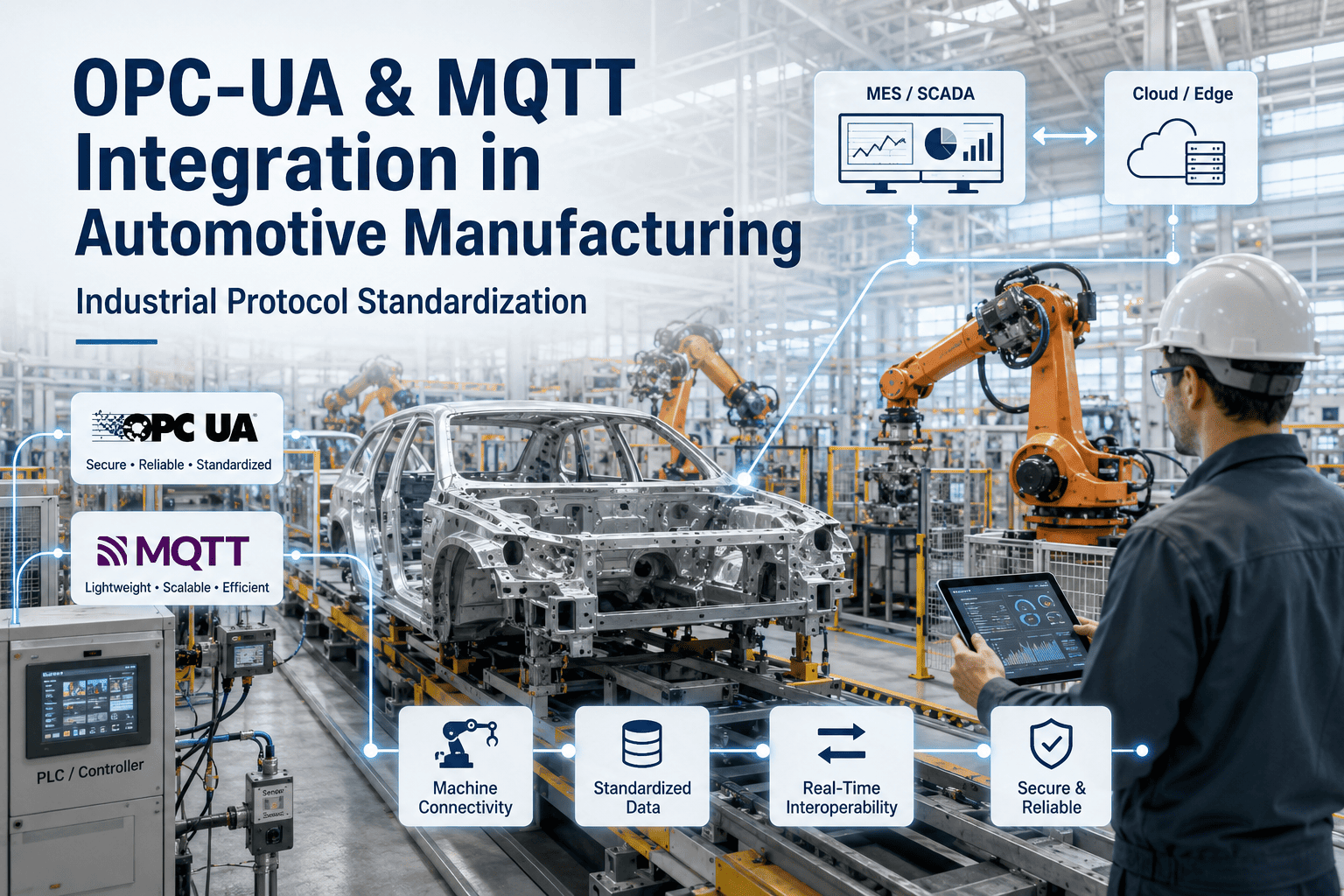
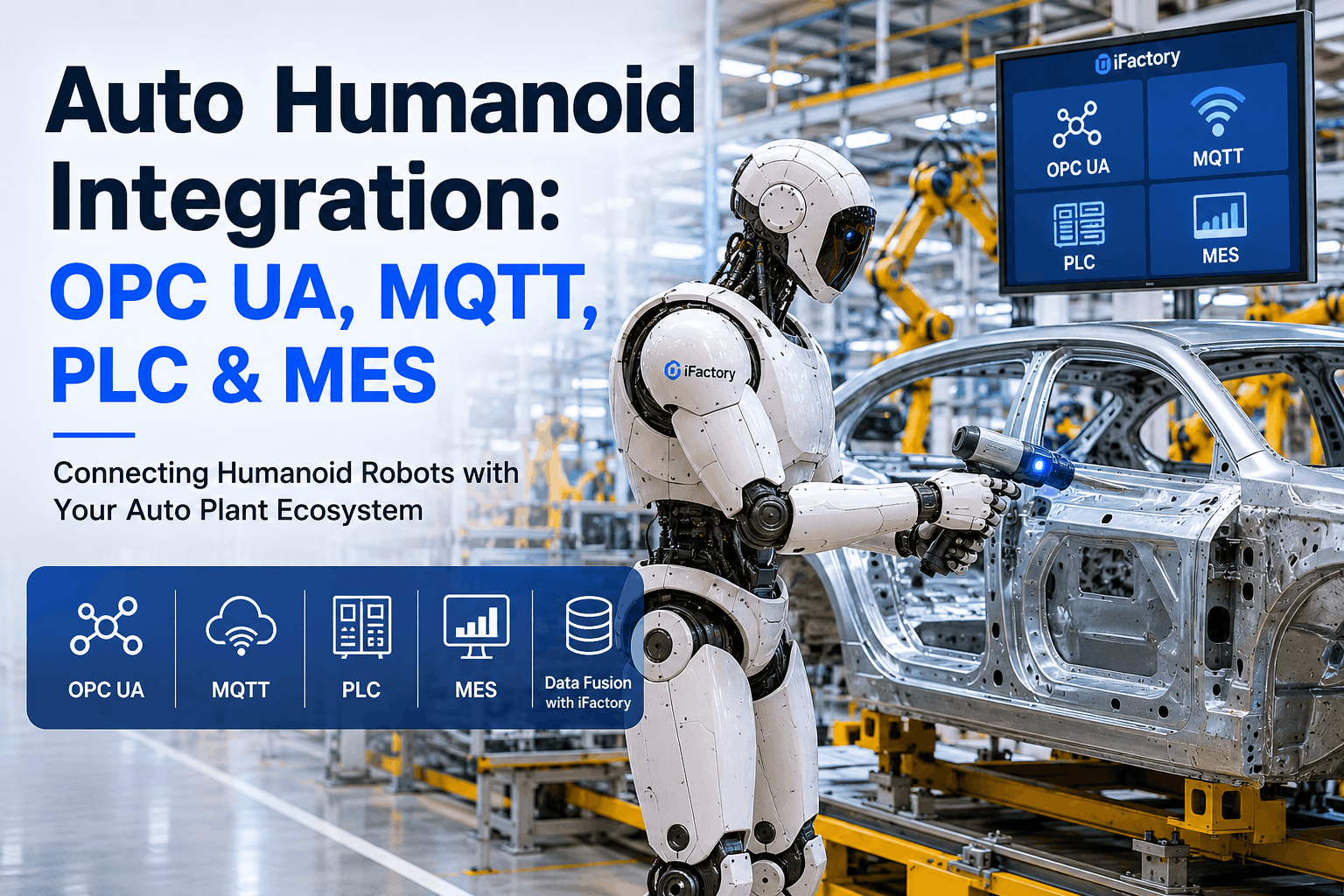
Stop managing humanoid robots as standalone islands. iFactory connects OPC UA, ROS2, and MQTT streams from humanoids directly to your MES, ERP, and CMMS — without cloud dependency, without custom middleware, and without waiting for your IT team to build adapters.
Your humanoid robots are data-rich and system-poor
Humanoid robots in automotive plants generate thousands of signals per second — joint angles, torque, vision streams, force feedback, battery state, ROS2 topics, OPC UA nodes. But your existing MES was built for fixed automation. Your ERP sees finished counts, not real-time humanoid health. Your CMMS gets maintenance alerts from PLCs, not from walking robots that can self-diagnose a failing actuator. The result: humanoids operate in a data silo, and the plant floor loses the very advantage they were bought to deliver — adaptive, real-time, autonomous production.
No protocol bridge between humanoids and MES
Your humanoid runs on ROS2 and OPC UA. Your MES speaks SQL and proprietary PLC protocols. There is no native translator. Engineers spend weeks building custom middleware that breaks with every firmware update. A single integration failure costs 45 minutes of downtime on a line that runs at $35,000 per minute.
ERP is blind to humanoid production data
Your ERP schedules work orders based on historical cycle times, not real-time humanoid capability. When a humanoid slows down due to battery degradation or a software glitch, the ERP doesn't know — so it pushes more work into a bottleneck. The result: WIP builds, overtime spikes, and a 12% miss on OEE targets.
CMMS gets no signals from walking robots
Humanoids have complex mechanical systems — 40+ actuators, vision cameras, force-torque sensors, batteries. They generate predictive maintenance signals that no CMMS currently ingests. A failing hip joint on a humanoid can go undetected until it causes a hard stop. Unplanned maintenance on a humanoid costs $18,000 per hour in lost production and repair labor.
AI inspection data stays in the camera, not the system
Humanoids carry vision systems that can detect defects in real time. But that data — pass/fail, defect type, location, image — is stored locally or in a separate cloud. It never reaches the MES for SPC, the ERP for yield tracking, or the QMS for traceability. Quality engineers manually reconcile reports at end of shift. Defective parts slip through for 2.3 hours on average.
Every humanoid fleet is a custom integration project
No two humanoid vendors expose data the same way. Some use OPC UA, some use ROS2, some use MQTT, some use proprietary APIs. Your plant might have two different humanoid models from two vendors. Each requires a separate integration, separate middleware, separate maintenance. IT spends 40% of their automation budget on custom adapters that deliver no business value.
You don't need more middleware. You need a platform that speaks OPC UA, ROS2, and MQTT natively — and connects to your MES, ERP, and CMMS out of the box. Book a 30-min walkthrough and we'll show you how iFactory does it in a single deployment.
iFactory: the universal data plane for humanoid manufacturing
iFactory is an AI-native platform that runs on an NVIDIA appliance in your plant network. It ingests data from any humanoid — regardless of vendor or protocol — and maps it in real time to your existing MES, ERP, CMMS, and QMS. No cloud, no custom code, no months-long integration projects. Here's how it works.
Connect any humanoid, any protocol
iFactory's native connectors ingest OPC UA nodes, ROS2 topics, and MQTT streams from any humanoid fleet — no middleware, no adapters. Add a new humanoid model in minutes, not weeks.
Map data to your MES, ERP, and CMMS
The platform's semantic layer translates humanoid signals into the schemas your plant systems already understand — work orders, production counts, SPC data, maintenance triggers, quality events. No schema changes required on your side.
AI processes every signal in real time
iFactory's AI models detect anomalies in humanoid performance — torque drift, battery degradation, vision quality shifts — and trigger actions in your MES or CMMS before a failure occurs. The inference runs on-prem, on the NVIDIA appliance, with zero latency.
Deliver a working pilot in 6–12 weeks
iFactory is turnkey. You hand over data-source access; we deploy the appliance, configure the connectors, and map the data. In one quarter, you have a live, production-grade integration with measurable ROI.
What iFactory delivers for humanoid-equipped automotive plants
These are the specific capabilities that make humanoid integration practical, scalable, and valuable — not just possible.
Native OPC UA & ROS2 ingestion
Ingest all OPC UA nodes (data access, alarms, historical) and all ROS2 topics (tf, joint states, sensor messages) from any humanoid. No custom parsers. No protocol gateways. iFactory handles the translation natively.
MES, ERP, CMMS out of the box
Pre-built connectors for SAP MES, Siemens Opcenter, Rockwell FTIS, Oracle ERP, SAP S/4HANA, and leading CMMS platforms like SAP EAM and Infor EAM. Humanoid data maps directly to work orders, production records, and maintenance notifications.
On-prem AI for anomaly detection
AI models that detect joint torque degradation, battery capacity fade, vision system drift, and force-torque sensor anomalies — all running on the NVIDIA appliance in your plant network. No data leaves the plant. No cloud dependency.
Real-time AI inspection integration
Ingest pass/fail, defect type, location, and image data from humanoid vision systems. Feed it to your MES for SPC charts, your QMS for traceability, and your ERP for yield reporting. Quality data is live, not end-of-shift.
Predictive maintenance for humanoids
iFactory monitors 40+ actuator signals per humanoid, plus battery, vision, and force sensors. When a signal drifts outside normal bounds, it creates a CMMS notification with the specific component, severity, and recommended action. No more surprise failures.
Multi-vendor fleet management
Run humanoids from different vendors on the same platform. iFactory normalizes data from each model into a common schema. Your MES sees one unified fleet, not separate integration projects.
What automotive plants achieve with iFactory humanoid integration
These metrics come from iFactory deployments in automotive plants running mixed fleets of fixed and humanoid robots. Your results will vary, but the pattern is consistent.
iFactory is turnkey, on-prem, and managed for you
You don't hire integrators. You don't build custom software. iFactory delivers a complete, production-ready platform in one deployment.
End-to-end, turnkey delivery
From data-source access to a working pilot in 6–12 weeks. We handle the connectors, the data mapping, the AI models, and the integration with your MES, ERP, and CMMS. You get a live system, not a proof of concept.
On-prem NVIDIA appliance — zero cloud
Every connector, AI model, and data pipeline runs on an NVIDIA appliance in your plant network. No data egress. No cloud dependency. No security review delays. Your humanoid data stays where it belongs.
Pilot to ROI in one quarter
We don't ask for a year-long rollout. In 6–12 weeks, you have a live integration with measurable metrics — downtime reduction, OEE gain, quality improvement. You see ROI before the second quarter ends.
24x7 managed service
iFactory runs as a managed service. We monitor the platform, update connectors when humanoid firmware changes, retrain AI models, and ensure uptime. Your plant operations team focuses on production, not integration maintenance.
Multi-protocol, multi-vendor by design
OPC UA, ROS2, MQTT — iFactory speaks all three natively. Add any humanoid model from any vendor without custom work. The platform normalizes every signal into a common schema that your plant systems understand.
Scales from one humanoid to a fleet
Start with a single humanoid on a single line. iFactory scales to hundreds of humanoids across multiple lines, plants, and vendors — without re-architecting the integration. The same platform, the same connectors, the same AI models.
Common questions about humanoid integration in automotive plants
Your humanoids are ready. Your plant systems are waiting. The bridge exists.
Stop building custom middleware. Stop managing humanoid data in silos. iFactory connects your humanoid fleet to your MES, ERP, and CMMS in 6–12 weeks — on-prem, turnkey, and managed for you. Book a 30-minute walkthrough. We'll show you a live integration with your humanoid model and your plant systems.