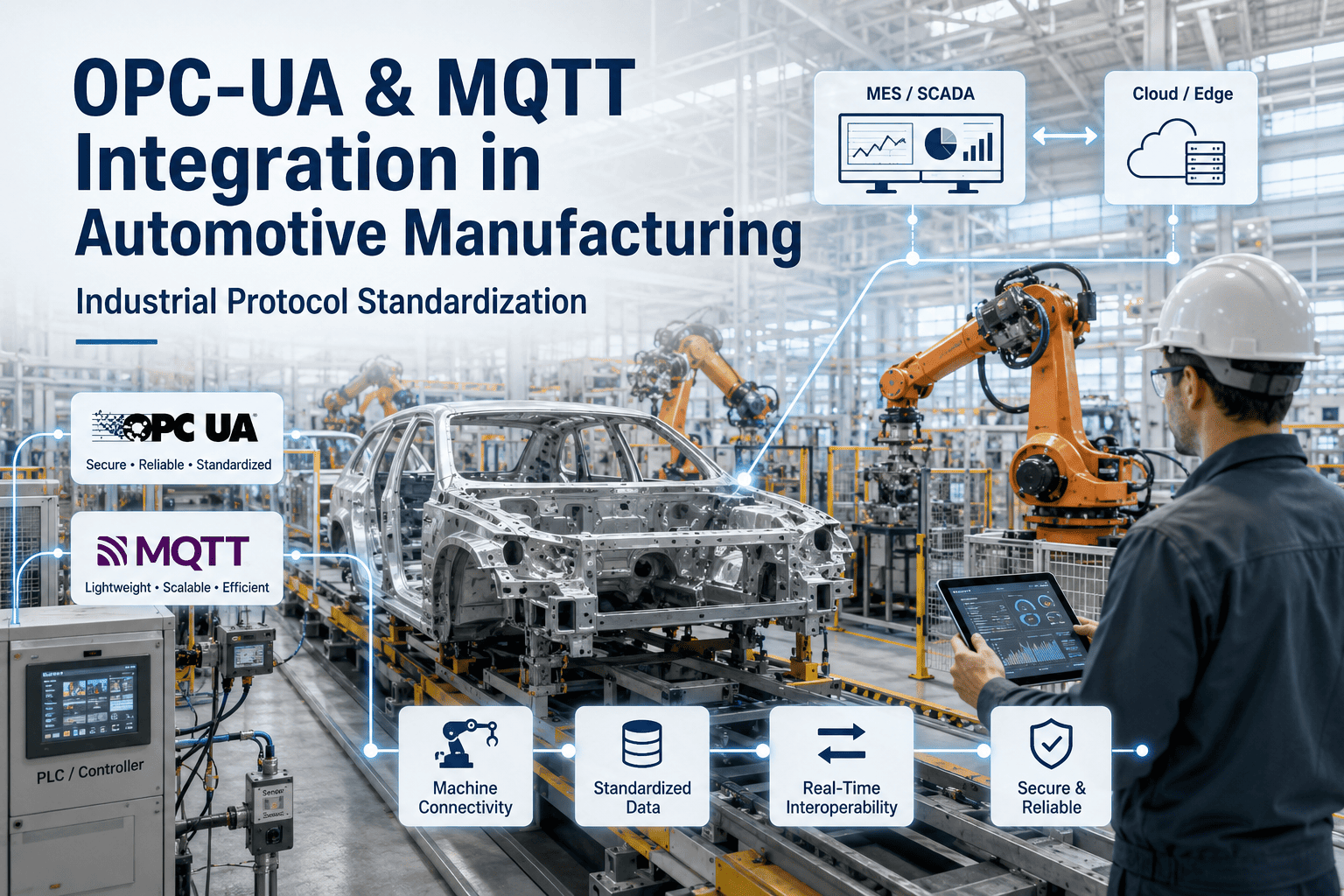
Walk the floor of most automotive plants built up over twenty or thirty years and you will find PLCs, sensors, and legacy equipment speaking a dozen different industrial protocols, none of which were designed to talk to each other. Standardizing on OPC-UA and MQTT does not mean ripping out working equipment, it means building a translation layer that lets every asset, old and new, feed the same data architecture. That single architecture is what actually makes plant-wide AI analytics possible, since models need consistent, structured data flowing up through clearly defined layers to work from. Process engineers mapping their own protocol landscape can book a demo to see how it comes together.
PROCESS ENGINEER GUIDE · INDUSTRIAL PROTOCOLS · 2026
One Data Language for Every Machine on the Floor
OPC-UA and MQTT standardization connects legacy PLCs, modern sensors, and everything in between into a single architecture ready for AI analytics.
Field Devices & Legacy Equipment
PLCs, CNC machines, sensors, and older serial or Modbus equipment already running on the floor.
Gateway & Protocol Translation
Devices without native standard support are bridged into the common architecture without hardware replacement.
OPC-UA & MQTT Standardized Layer
A single, consistent data language every connected system reads from and writes to, regardless of source.
AI Analytics & Dashboards
Models and live dashboards consume clean, structured data without per-source cleanup work.
OPC-UA
Structured, Secure, Descriptive
Carries rich, self-describing data models with built-in security, making it well suited for connecting PLCs and complex industrial equipment directly.
MQTT
Lightweight, Efficient, Scalable
A publish-subscribe messaging protocol built for high-volume sensor data over constrained networks, ideal for IoT-scale deployments across a plant.
Why Standardization Beats Point-to-Point Integration
Many plants connect systems one pair at a time, a custom link between this PLC and that dashboard, another between a different sensor and a separate reporting tool. Every new connection multiplies the maintenance burden, and each point-to-point link tends to break quietly whenever either system on either end gets updated.
Standardizing on OPC-UA for structured equipment data and MQTT for high-volume sensor streams replaces that tangle with a single layered architecture, shown above. New equipment connects to the same standard interface as everything already on the floor, and legacy assets without native protocol support connect through a gateway rather than a one-off custom bridge.
The layered structure also means each part of the system can evolve independently. A new sensor type at the field device layer does not require rebuilding the analytics layer, and a new analytics tool does not require touching how field devices connect, because the standardized middle layer absorbs the change on both sides.
| Protocol | Best Suited For | Typical Data Volume | Security Model |
|---|---|---|---|
| OPC-UA | PLCs, CNC machines, robotics | Moderate, structured | Built-in encryption and authentication |
| MQTT | Sensors, edge devices, IoT | High-frequency, lightweight | Broker-managed, TLS supported |
| Legacy Serial / Modbus | Older equipment without native support | Low to moderate | Requires gateway-level security |
UNIFIED PROTOCOL ARCHITECTURE
Connect Every Asset to One Data Backbone
See how OPC-UA and MQTT standardization brings legacy and modern equipment onto the same architecture.
Getting to a Standardized Architecture
1
Inventory the Floor
Catalogue every PLC, sensor, and legacy device with its native protocol.
2
Assign the Right Protocol
Structured data routes through OPC-UA, high-volume streams through MQTT.
3
Bridge the Legacy Gaps
Assets without native support connect through a shared gateway layer.
4
Feed the Analytics Layer
Consistent, structured data becomes available for AI models directly.
What Process Engineers Are Saying
We had a different custom integration for almost every machine on the floor, and every firmware update from a vendor risked breaking one of them. Standardizing on OPC-UA and MQTT meant new equipment just plugs into the same architecture instead of becoming another one-off project.
Process Engineer, Automotive Component Plant
Frequently Asked Questions
Do we need to replace legacy equipment to standardize on these protocols?
No, legacy equipment without native OPC-UA or MQTT support typically connects through a gateway device that translates its existing protocol, whether that is Modbus, a proprietary serial link, or something else, into the standardized architecture. This lets older assets participate in the same unified data layer as newer equipment without requiring a capital replacement project just to get their data flowing.
Why use both OPC-UA and MQTT instead of just one protocol?
The two protocols solve different problems well. OPC-UA carries rich, structured, self-describing data and is well suited to complex equipment like PLCs and CNC machines where data context matters as much as the values themselves. MQTT is lighter weight and built for high-frequency publish-subscribe messaging, making it the better fit for large numbers of simple sensors streaming data continuously across a plant network.
How disruptive is a protocol standardization project to ongoing production?
A well-planned rollout typically connects equipment in phases, starting with a pilot area, so production is not disrupted all at once across the plant. Gateway devices for legacy equipment are generally installed alongside existing connections rather than replacing them outright during the transition, which keeps the current system operational while the new architecture is validated. Teams can review a phased rollout plan through support before committing to a plant-wide timeline.
Does this integration work directly with AI analytics tools?
Yes, that is one of the main reasons plants pursue protocol standardization in the first place, since AI models need consistent, structured data rather than a dozen inconsistent formats pulled from different sources. Once equipment feeds into a unified OPC-UA and MQTT architecture, analytics platforms can consume that data directly without per-source cleanup. Plant teams can book a demo to see this connected to a live analytics view.
OPC-UA · MQTT · INDUSTRIAL INTEGRATION
Give Every Machine on the Floor One Data Language
See how a standardized protocol architecture connects your legacy and modern equipment alike.