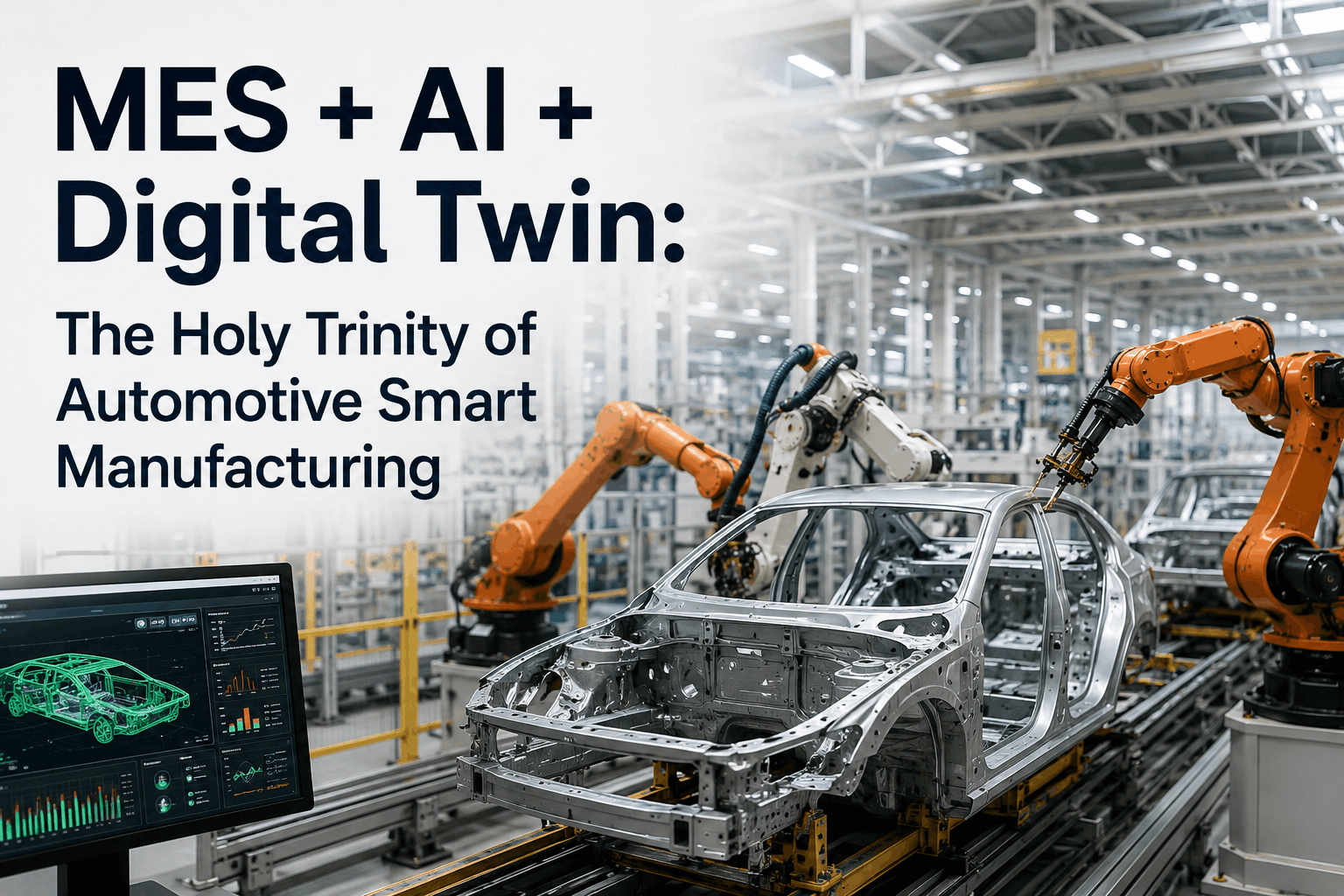
Manufacturing Execution Systems are the nervous system of an automotive plant — capturing every production order, machine event, quality result, and operator action in real time. But an MES alone is a recorder, not a decision-maker. It collects data; it cannot act on patterns it does not know how to interpret. AI MES integration in automotive manufacturing changes this: AI transforms the MES from a passive data repository into an active intelligence layer that predicts failures, optimizes schedules, flags quality risks, and feeds accurate production actuals back to ERP — automatically, in real time. See how iFactory connects AI to your MES and ERP — book a demo.
AI + MES + ERP
Your MES Records What Happens.
AI Decides What Happens Next.
iFactory AI integrates with your MES, SAP, SCADA, and ERP to turn production data into decisions — in real time, across every line.
What Is AI MES Integration — and Why Does It Matter Now?
A Manufacturing Execution System sits between the shop floor (machines, PLCs, sensors) and the business level (ERP, planning systems). It is the source of truth for what is actually happening in production. The problem: MES data is only valuable if someone — or something — is acting on it. Most automotive plants generate terabytes of MES data weekly that is reviewed in Monday morning shift reports, not acted on in real time. By then, the quality escape has shipped, the bottleneck has caused four hours of downstream starvation, and the ERP production plan is already wrong.
AI integration changes the operating model. Instead of humans reviewing MES data after the fact, AI monitors it continuously — detecting anomaly patterns, predicting failures, flagging deviations from standard work, and pushing corrective instructions back through the MES before the problem becomes a shutdown. Gartner projects that 40% of enterprise applications will feature task-specific AI agents by 2026, up from less than 5% in 2025 — and automotive MES is at the front of that adoption curve.
The Architecture: How AI Connects to MES and ERP
AI-MES-ERP Integration Stack
ERP Layer
SAP S/4HANA
Oracle
MS Dynamics
Production Planning
Production orders flow down. OEE actuals, quantities, downtime, and cost data flow back up — bidirectionally, in near real time.
Bidirectional data sync via OData, REST, BAPI
AI Intelligence Layer
iFactory AI Engine
Predictive Analytics
Anomaly Detection
Root Cause Analysis
AI reads MES data streams, identifies patterns, generates alerts and instructions, and feeds ERP with accurate production actuals — replacing manual reporting.
Real-time data streams via OPC-UA, MQTT, REST
MES + Shop Floor Layer
MES / SCADA
PLCs
IoT Sensors
Vision Systems
Real-time machine data, production events, quality results, and operator inputs feed AI continuously — no manual data entry, no batch uploads.
The integration model that works in practice is a two-layer architecture: ERP handles business process management and production planning; the AI-MES layer handles real-time OEE measurement and AI-driven improvement intelligence. ERP creates production orders and manages materials, financials, and customer deliveries — the AI layer receives those orders, runs them against machine sensor data in real time, calculates per-order and per-line OEE, and feeds actuals back.
6 Ways AI Transforms What Your MES Can Do
01
Real-Time OEE Intelligence
MES calculates OEE from machine data. AI explains it. When OEE drops 4% on Line 7 at 14:23, AI identifies the root cause — a specific machine's cycle time drift, a changeover running 18 minutes over standard — and alerts the right person with the right action, not a data dump for someone to interpret in the morning. ERP planning engines can then consume real OEE data — no more promising orders the floor cannot deliver.
Impact: OEE improvement visible within 48 hours of integration
02
Predictive Maintenance — Triggered Through MES
AI detects equipment degradation signatures in machine data streams 6–12 hours before failure. Rather than generating an alert that sits in an inbox, AI creates a maintenance work order directly in the CMMS — with machine ID, predicted failure mode, and recommended action — through the MES integration layer. AI-detected failure signals create work orders in your CMMS with zero manual handoff between systems. Studies from 2025 show AI predictive analytics can reduce unplanned downtime by up to 70%.
Impact: Up to 70% reduction in unplanned downtime
03
AI-Driven Production Scheduling
Traditional MES scheduling is deterministic — it follows the plan ERP created yesterday using assumptions that are already stale. AI scheduling reads real-time machine availability, current WIP levels, supplier delivery status, and quality hold queues, then dynamically resequences production to maximize throughput under actual conditions. Most modern MES vendors have added AI features in 2025–2026: anomaly detection on machine data, predictive scheduling, and vision-based quality — but the value multiplies when AI is connected across the full MES-ERP data stack, not siloed within one system.
Impact: 15–25% throughput improvement from dynamic resequencing
04
Quality AI: Integrated from Inspection to ERP
AI vision inspection at the line generates quality results in real time. Integrated with MES, those results are linked to the specific production order, operator, machine, and material lot — creating per-unit traceability automatically. When a quality trend emerges, AI flags the affected production batch in MES, triggers a quality hold, and surfaces the supplier lot or process parameter correlation. AI integration in quality control results in a 30% improvement in defect detection rates — and when quality data flows into ERP automatically, warranty claim processing and supplier chargebacks become data-driven rather than manual disputes.
Impact: 30% better defect detection + automatic quality traceability
05
Exception Handling Beyond MES Scope
MES handles structured, deterministic decisions well. It cannot reason about an urgent customer email requesting a sequence change, a supplier calling about a delayed shipment, or an operator's free-text note flagging an unusual vibration. An AI agent does what an MES cannot do well: reason about exceptions, integrate unstructured data (emails from customers, free-text notes from operators), and orchestrate decisions across MES, ERP, CAQ, and engineering systems. Replacing a MES is a multi-year project. Adding AI on top takes 8–12 weeks.
Impact: Exceptions resolved in minutes, not shift-change meetings
06
Bidirectional ERP Accuracy
ERP production plans are only as good as the actuals fed back into them. Most plants batch-upload MES actuals to SAP once per shift — meaning ERP is planning against data that is 8 hours old. AI MES integration feeds production actuals, OEE, downtime events, and quality results to ERP in near real time. Plants that attempt to use ERP as their MES typically find cost-of-goods discrepancies of 15–30% that are only revealed when a dedicated MES goes live — AI closes the accuracy gap continuously rather than batch-by-batch.
Impact: ERP accuracy improves from shift-end to near real-time
Integration KPIs: What Changes After AI-MES Deployment
48 hrs
Time to first live OEE data with iFactory integration
70%
Unplanned downtime reduction via AI predictive maintenance
30%
Quality defect detection improvement with AI-MES integration
5–10 days
Full connector setup: MES, SAP, SCADA, CMMS
iFactory Connector Map: What Integrates Out of the Box
ERP Systems
SAP S/4HANA
SAP PP / CO
Oracle ERP
MS Dynamics 365
SAP integration via standard OData and BAPI — no custom ABAP required
MES / SCADA
Siemens Opcenter
Rockwell Plex
Wonderware
SCADA / DCS
Real-time data via OPC-UA, MQTT, and REST APIs — no production stoppage for installation
Industrial Protocols
OPC-UA
MQTT
Modbus
PROFINET
Legacy machines from 1990s to 2024 CNC centers — no vendor-specific APIs needed
Maintenance / Quality
CMMS Systems
CAQ Platforms
Vision Inspection
IoT Sensors
AI-detected alerts create CMMS work orders automatically — zero manual handoff
Implementation: How AI-MES Integration Actually Works
Days 1–5
Connector Configuration
Native adapters configured for MES, ERP (SAP OData / BAPI), SCADA, and CMMS. No custom middleware, no point-to-point development. First live OEE data visible within 48 hours of initiating deployment.
Weeks 2–4
AI Model Calibration
AI baselines normal production signatures across all connected machines and lines. Predictive maintenance models calibrate to actual equipment behavior. Quality inspection models train on your specific part variants and defect types.
Weeks 4–8
Live Operation & Operator Adoption
AI alerts, scheduling recommendations, and quality flags delivered to operators through existing MES screens and mobile interfaces. Workforce training focuses on AI-driven insights — not system changes. Adoption is fast because AI works with tools people already use.
Month 3+
Continuous Improvement Loop
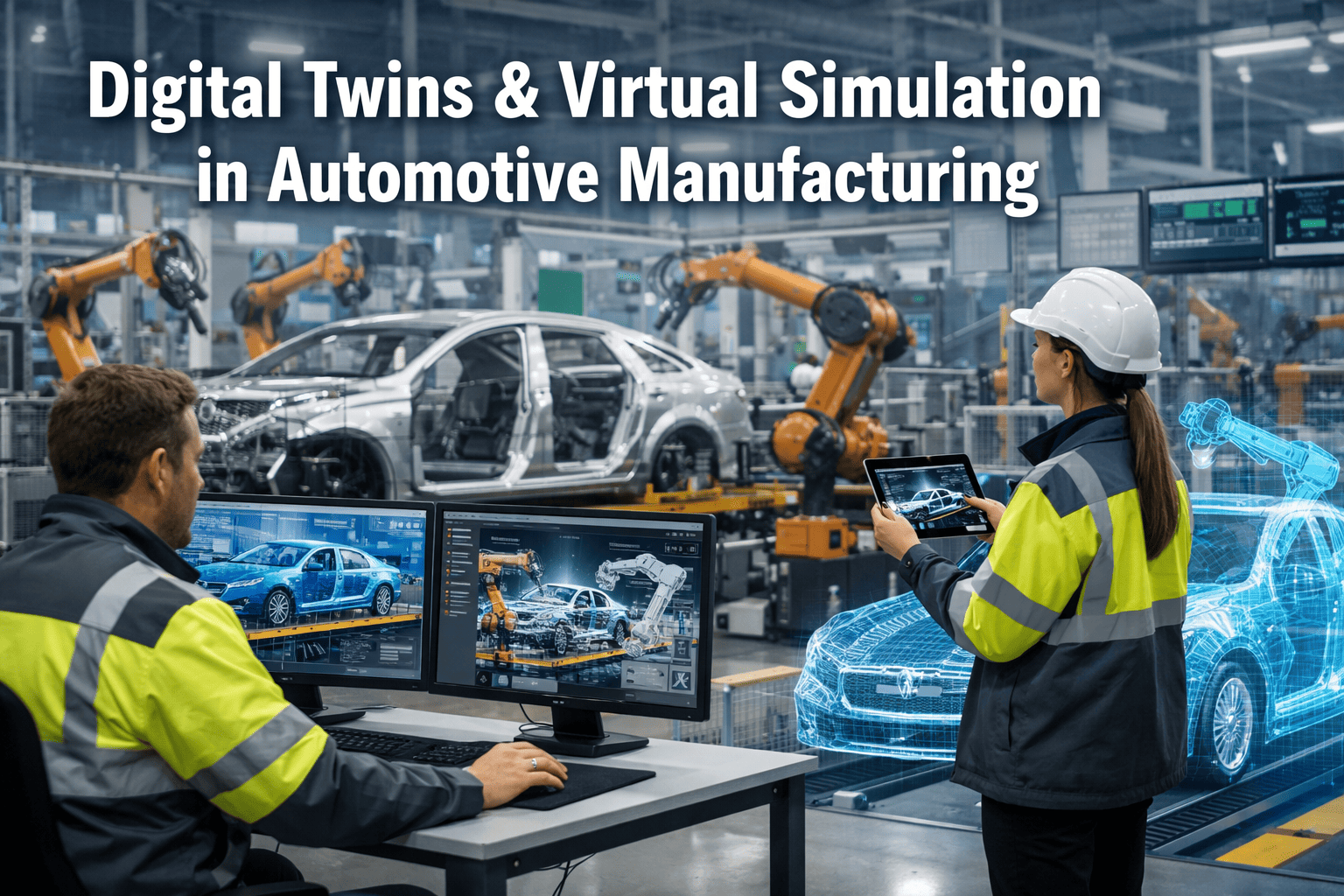
AI models improve with every production run. ERP planning accuracy improves as real-time actuals replace batch uploads. Digital twin scenarios become more accurate as the AI calibrates to actual equipment and process conditions. ROI compounds over time.
FAQ: AI MES Integration in Automotive Manufacturing
What is the difference between AI MES integration and simply adding AI features to an existing MES?
Adding AI features to an existing MES gives you AI that can only see what the MES sees — machine data and production orders within that system. AI MES integration connects AI to the full stack: MES data, ERP production context, SCADA signals, quality system records, and supplier data. This cross-system view is what enables AI to reason about why OEE dropped, predict maintenance failures before they cascade, and generate scheduling decisions that reflect actual business priorities — not just line-level machine state.
Does AI MES integration require replacing our current MES?
No — and this is one of the most common misconceptions. AI integration sits on top of your existing MES as an intelligence layer, reading data through standard protocols (OPC-UA, MQTT, REST) and pushing decisions back through the same interfaces operators already use. Replacing an MES is a multi-year project involving significant disruption. Adding AI on top takes 8–12 weeks and starts delivering value in the first 48 hours of integration. Your MES investment is preserved and made more valuable, not replaced.
How does iFactory AI integrate with SAP specifically?
iFactory uses SAP's standard OData services and BAPI interfaces — no custom ABAP development is required for standard scenarios. Production orders flow from SAP PP into iFactory for production context. OEE actuals, quantities, downtime records, and quality events flow back to SAP CO and PP modules bidirectionally in near real time. This means ERP planning engines consume real shop floor data rather than batch-uploaded estimates, and cost centre charging reflects actual production performance rather than standard cost assumptions.
How long does AI MES integration take for a typical automotive plant?
Most deployments complete the full connector setup — MES, SAP, SCADA, and CMMS — in 5 to 10 business days. First live OEE data is visible within 48 hours of initiating deployment. AI model calibration to production-grade accuracy takes 4–8 weeks of live operation. Compare this to legacy MES integrations, which routinely take 12–18 months, cost millions, and require dedicated system integrator teams. iFactory's integration model uses standard open protocols, eliminating the custom middleware that drives traditional timelines.
Can AI MES integration work with legacy equipment on the shop floor?
Yes. Legacy machines from 1990s-era equipment to modern CNC centers can be connected through non-intrusive IoT sensors communicating via WiFi, LoRaWAN, or 4G — with installation times under 30 minutes per machine. Vendor-specific APIs are not required for legacy connectivity. The AI sees machine behavior through sensor data regardless of whether the machine has a modern PLC interface, making legacy equipment a first-class data source rather than a gap in your production intelligence.
What ROI should we expect from AI MES integration in automotive manufacturing?
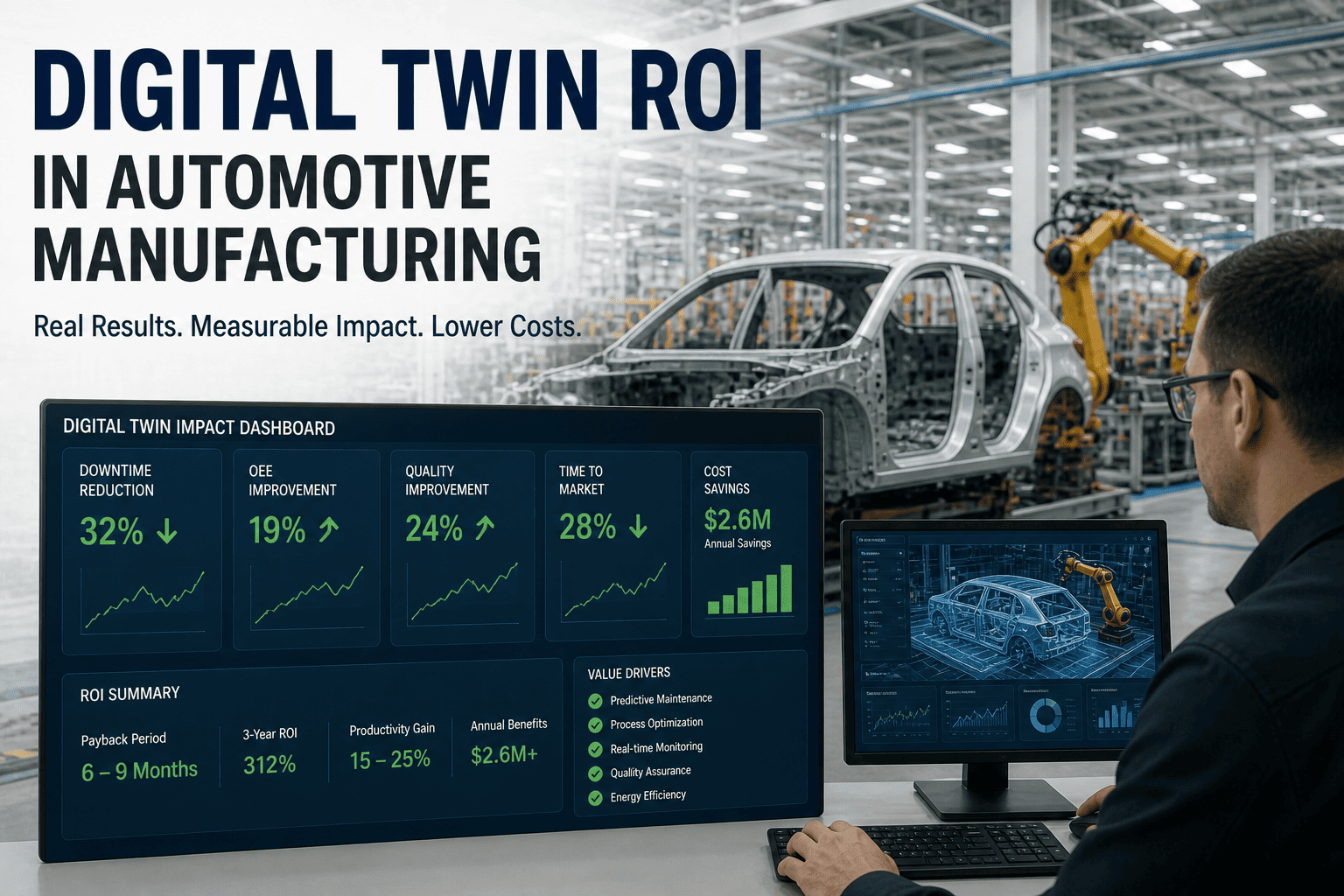
ROI comes from three primary sources: unplanned downtime reduction (up to 70%, worth $1–4M annually depending on line throughput), quality improvement (30% better defect detection, reducing warranty claims and rework costs), and ERP accuracy improvement (eliminating the 15–30% cost-of-goods discrepancies that typically emerge when MES and ERP are misaligned). Most iFactory automotive deployments achieve payback in 4–8 months. The improvement compounds — AI models improve over time, making each subsequent month more efficient than the last.
Book a demo to model the ROI for your specific plant configuration.
MES + AI + ERP
Connect Your MES to AI in Days, Not Months
iFactory AI integrates with your existing MES, SAP, SCADA, and CMMS through native connectors — no custom middleware, no production disruption. First OEE data in 48 hours. Full ROI in months.
SAP OData Integration
Real-Time OEE
Predictive Maintenance
AI Quality Inspection
5–10 Day Setup