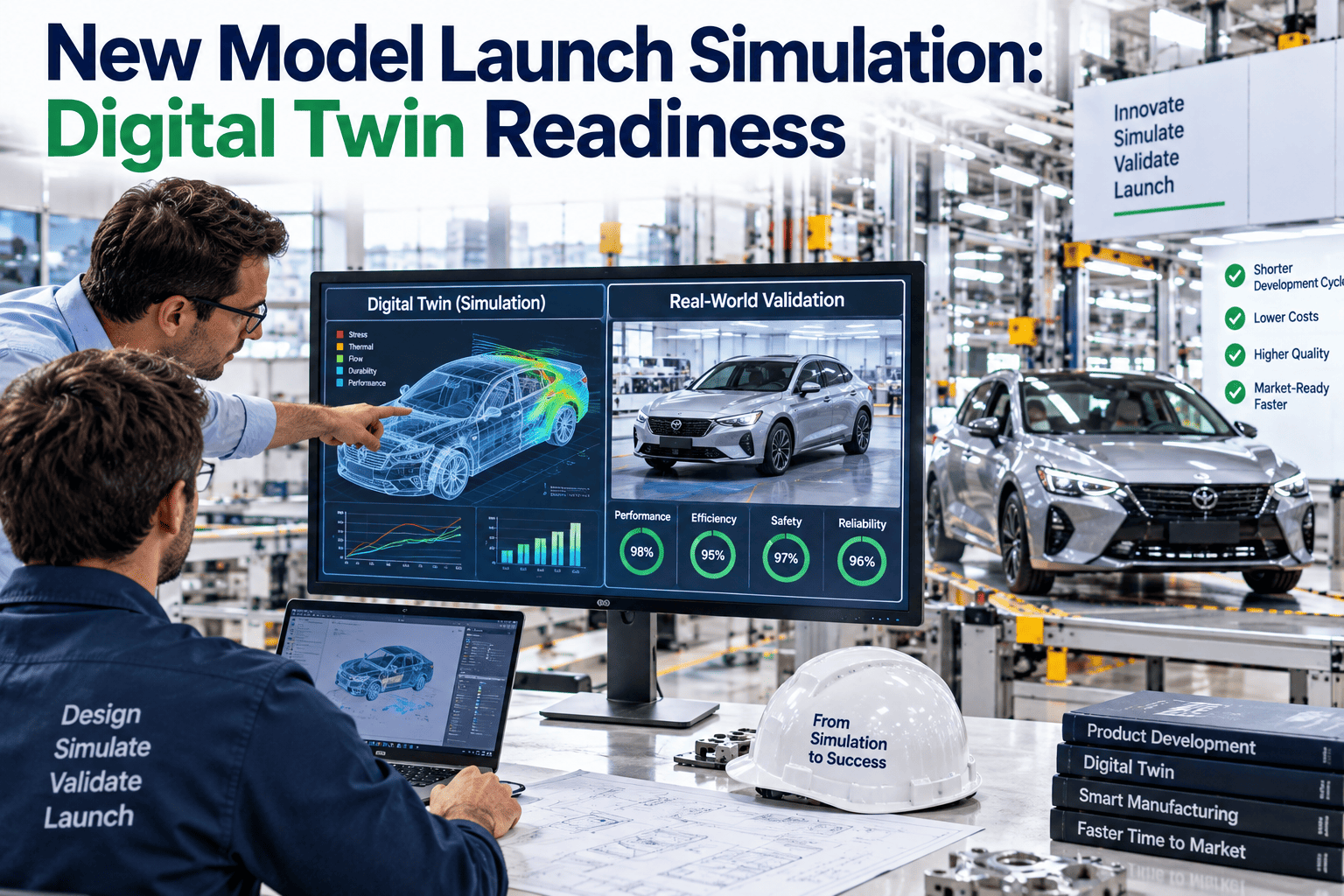
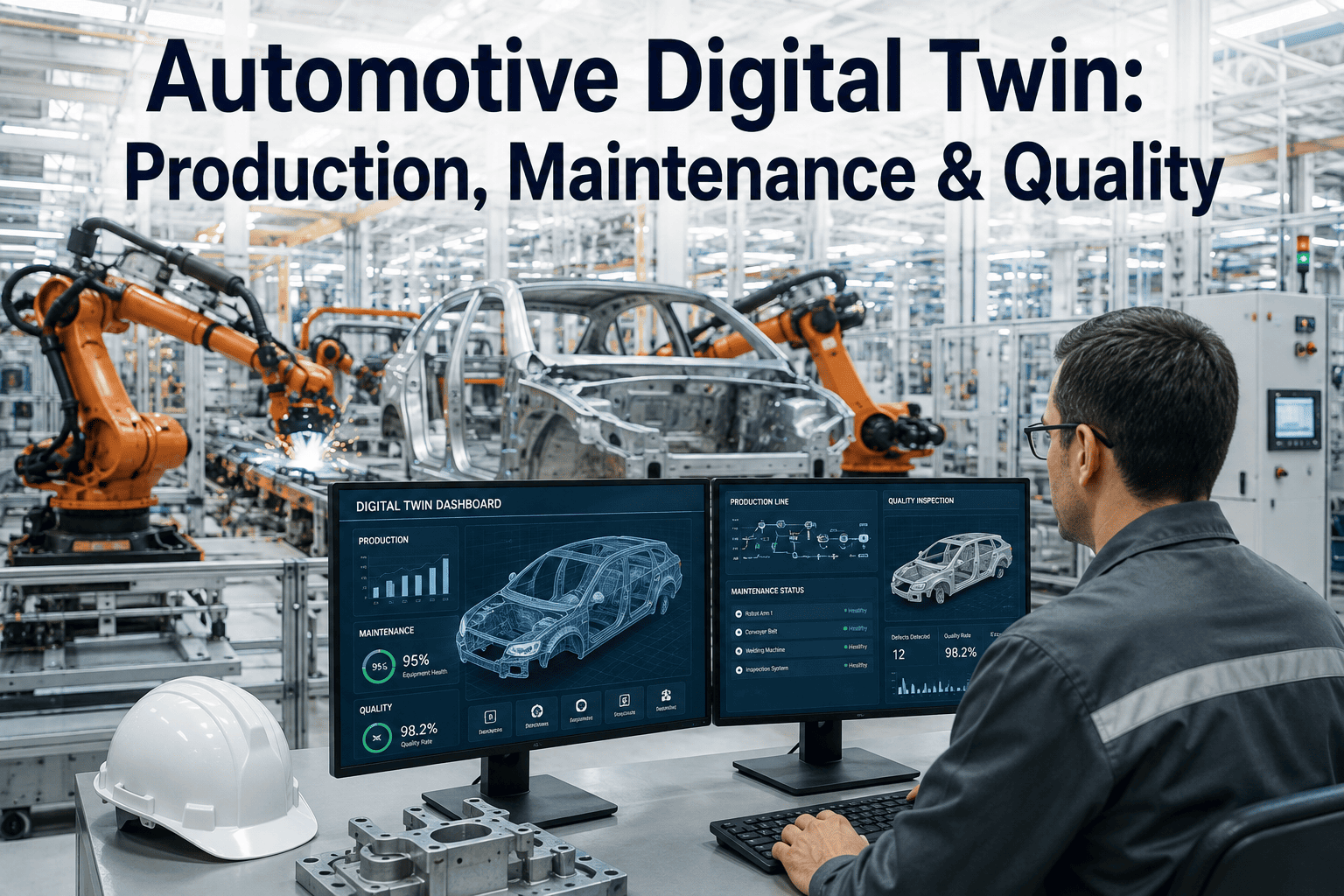
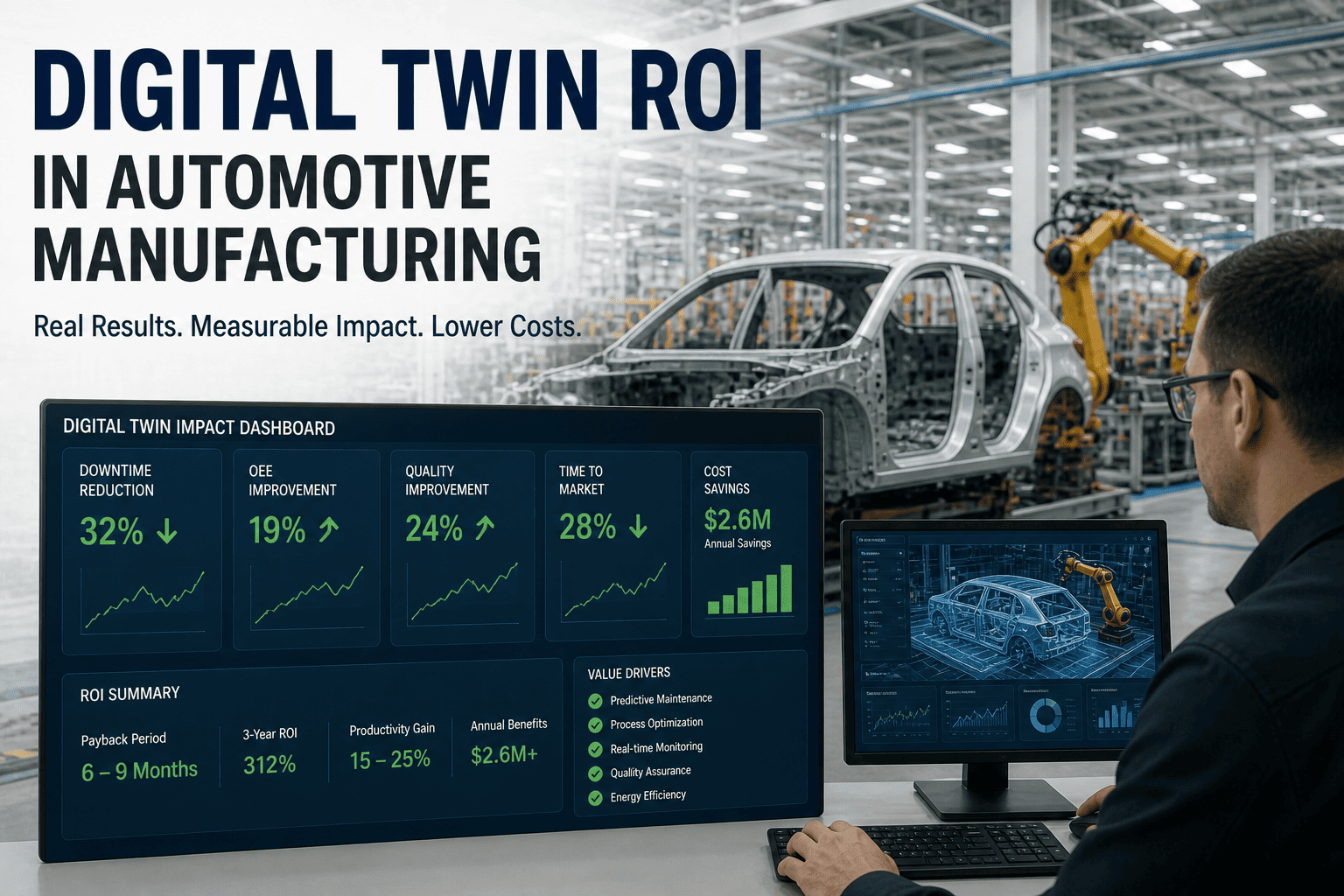
New model introduction (NMI) in automotive manufacturing is a high-stakes, compressed-timeline event where production lines transition from one vehicle platform to another in weeks, not months. A single day of unplanned downtime during NMI startup costs $2.4M in lost production capacity and threatens customer delivery commitments established months before. Digital twins reduce this risk by enabling manufacturers to validate production processes, equipment configurations, and supply chain readiness in simulation before vehicles reach the physical assembly line. Book a demo to see how iFactory digital twins accelerate NMI readiness.
What Is New Model Introduction and Why Digital Twins Matter
New model introduction is the manufacturing equivalent of a product launch in tech. An automotive OEM announces a new vehicle platform, engineering completes vehicle design, manufacturing engineering specifies production equipment and processes, suppliers validate component readiness, and operations teams prepare the physical assembly line. The actual production transition typically occurs over 4 to 12 weeks, compressed around vehicle launch announcements and customer delivery commitments that are already locked into marketing calendars.
This compressed timeline creates predictable failure patterns. Equipment arrives from suppliers configured for theoretical specifications rather than actual line conditions. Supply chain partners validate components at their facilities but not in integration with all 200+ upstream suppliers whose parts converge on the assembly line simultaneously. Operators train on theoretical processes in classrooms rather than on the actual line under actual production pressure. When production starts, the accumulated unknowns surface immediately: equipment clashes with adjacent tooling, suppliers discover last-minute component fit issues, bottleneck processes halt entire lines because upstream buffer spaces fill faster than expected.
Digital twins solve this by virtualizing the entire production system before physical startup. The OEM builds a simulation model of the assembly line incorporating equipment specifications, process parameters, and supplier component data. Production engineers stress-test the virtual line under realistic production scenarios: What happens when three suppliers are 3 days late? Does the line survive if the welding robot uptime is 95% instead of the specification 99%? How does the material handling system respond when sub-assembly delivery rates vary by 10%? These questions are answered in weeks of simulation, not in weeks of production firefighting.
The NMI Problem: Launch Delays and Unplanned Downtime Costs
Average Launch Delay: 18 Days
Unplanned delays during NMI startup average 18 days industry-wide, pushing first-customer delivery commitments by 2.5 weeks. Each day of delay costs manufacturers $2.4M in lost production capacity and supplier penalty fees.
Equipment Validation Failures: 34% of Startup Issues
One-third of unplanned downtime during NMI occurs because equipment does not function as designed in the actual line environment. Robots reach for components in wrong sequence, tool clashes block material flow, conveyor interfaces do not align with supplier part dimensions.
Supply Chain Integration Gaps: 28% of Startup Issues
Suppliers validate their components in isolation but have no visibility into how their part integrates with 200+ other supplier parts on the actual line. Buffer spaces designed for theoretical delivery windows fail when real suppliers miss dates or deliver in different sequence.
Operator Training Gaps: 24% of Startup Issues
Operators train on processes documented in engineering specs but rarely encounter the actual decision points, edge cases, and line interactions that define real production. When pressure mounts during startup, operators default to workarounds rather than documented processes.
Process Bottleneck Discovery: 14% of Startup Issues
Stations designed to independent specifications do not account for downstream effects. A sub-assembly buffer fills faster than expected because the assembly station consumes slower than supplier models predicted, halting upstream operations in waves.
Cost of NMI Startup Delays: $2.4M per Day
Each day of unplanned downtime during NMI costs approximately $2.4M in lost production. A 18-day average delay costs $43M. Digital twin validation that prevents even 5 days of startup delay pays for itself in direct production losses alone.
How Digital Twins Enable NMI Readiness
A digital twin for new model introduction virtualizes the entire production system — equipment, processes, material flows, and supplier integration — in a discrete event simulation that can be executed, stress-tested, and optimized before physical production begins. The simulation incorporates five data dimensions that define NMI success:
CAD models of all production equipment converted to functional specifications: cycle times, reliability parameters, failure modes, buffer sizes, material handling interfaces. Equipment vendors provide these specifications; the digital twin validates they work together in the actual line layout.
Manufacturing engineering defines the process flow: which operations happen at each station, what material handling sequence is required, what quality gates exist. The digital twin executes these sequences in realistic order with simulated material attributes (part variants, quality states) flowing through the system.
Each supplier part has an expected delivery window and variability profile. The digital twin simulates arrival schedules including realistic late deliveries, early arrivals, and mixed-batch scenarios. This reveals where buffer space is insufficient and which suppliers have highest impact on line stability.
New equipment is assumed to run at design reliability, but actual ramp-up typically sees 92–96% availability while operators learn and maintenance teams discover unexpected failure modes. The digital twin models equipment downtime probabilistically, revealing production impact of realistic equipment performance.
Real production includes operator decisions that are not explicitly documented: when to hold material for quality review, how to sequence variant vehicles through mixed-model lines, how to respond to upstream bottlenecks. The digital twin includes decision rules that reflect operator behavior, allowing validation that processes are resilient to realistic operator variance.
KPI Results: Plants Using Digital Twins for NMI
NMI Use Case 1: Crossover SUV Model Launch
Prevented 6 Days of Startup Delay Through Equipment Clash Detection
An OEM preparing to launch a new crossover SUV on an existing line had engineered new sub-assembly equipment to fit in the existing line footprint. The digital twin simulation revealed that the new frame welding robot could not reach components in the designed sub-assembly sequence because a newly installed material handling device blocked the robot's load/unload zone.
Without the digital twin: This clash would have been discovered on Day 3 of production startup, requiring 6 days of downtime while manufacturing engineers modified the equipment layout, re-validated interfaces, and redeployed tooling.
With the digital twin: The clash was identified in week 6 of simulation, 4 weeks before production startup. Manufacturing engineering rerouted material handling to avoid the clash and validated the new layout in simulation before purchasing adjustments. Production started with known-good equipment configuration.
NMI Use Case 2: Platform Consolidation
Supply Chain Integration Validation Prevented Material Starvation
A manufacturer consolidating two vehicle platforms onto a single line was introducing parts from 23 new suppliers alongside 47 continuing suppliers. Engineering validation ensured each supplier's component met specifications in isolation, but had no visibility into collective delivery dynamics across all 70 suppliers.
The digital twin simulated 90 days of production including realistic supplier delivery variance. Simulation revealed that supplier Group A (seats, interior trim) had a pattern of early delivery clustering (arriving days 1–3 of each week) while supplier Group B (chassis components) had late delivery clustering (arriving days 4–5). This created a buffer space mismatch: material for 1.5 days of production would arrive before material for days 6–7, causing a starvation event on day 8 when buffer space depleted faster than expected.
Without the digital twin: This starvation pattern would emerge in week 2 of production, requiring 9 days of stop-and-start production while procurement coordinated supply adjustments with all 23 new suppliers.
With the digital twin: Simulation identified the mismatch 8 weeks before startup. Procurement negotiated with supplier Group A to shift 15% of delivery to mid-week, smoothing the arrival pattern. Material control personnel configured priority sequencing rules in the MES to account for the arrival pattern. Production started with supply chain synchronized.
NMI Use Case 3: Mixed-Model Line Variant Sequencing
Digital Twin Variant Logic Prevented Production Deadlock
A plant with 8 sub-assembly parallel lines feeding a single final assembly line was introducing a new variant with 6 new sub-assemblies and a new option combination (sport suspension + AWD + performance package) that created a sub-assembly set requiring 18 seconds longer at final assembly than standard variants. Production engineering designed the line to accept this variant at 5% penetration rate.
The digital twin modeled vehicle sequencing including realistic batching patterns (customers ordered variants in clusters rather than even distribution). Simulation revealed that if sport-suspension vehicles clustered in batches (2–3 adjacent vehicles), the final assembly buffer space would overflow because 3 consecutive vehicles each taking 18 seconds longer would exceed buffer capacity designed for single variant variance.
Without the digital twin: This sequencing deadlock would emerge in week 3 of production, creating line stoppages until material control personnel learned to prevent variant clustering and implemented manual sequence enforcement.
With the digital twin: Production engineering validated variant sequencing rules that prevent more than 1 performance variant in any 5-vehicle window. MES scheduling algorithms were configured to enforce this rule before production started.
Digital Twin NMI Implementation: 12-Week Timeline
Core Features: iFactory Digital Twin for NMI
Line Design Simulation
Convert CAD equipment layouts and process flowcharts into discrete-event simulation models. Validate material flow paths, equipment interface tolerances, and buffer space adequacy before startup.
Supply Chain Integration Modeling
Model 50-200+ supplier parts with realistic delivery variance. Simulate material arrival scenarios and stress-test buffer spaces against expected supply volatility. Identify procurement coordination needs.
Equipment Reliability Scenarios
Model equipment uptime realistically. Test line performance under 92%, 95%, and 98% equipment availability scenarios. Measure sensitivity to reliability assumptions and validate maintenance strategy.
Variant Sequencing Validation
Simulate vehicle sequencing for mixed-model lines. Test variant clustering resilience. Validate that MES sequencing rules prevent buffer overflow and production deadlock scenarios.
Process Bottleneck Detection
Run 100+ production scenarios and identify where material accumulation or equipment starvation occurs. Rank bottlenecks by frequency and severity. Recommend process changes with impact forecasting.
Operator Decision Rule Validation
Model operator decision points including quality holds, material sequencing choices, and response to line pressure. Validate that process designs are resilient to operator behavior variance.
FAQ: Digital Twins for New Model Introduction
Why Digital Twins Are Essential for Compressed NMI Timelines
Traditional NMI planning uses spreadsheets, meetings, and experience to predict startup risk. Digital twins automate this prediction with mathematical rigor. When you compress NMI timelines from 24 weeks to 16 weeks (a common industry trend), the penalty for being wrong increases exponentially. A 10-day discovery-to-fix cycle that takes 2 weeks of the 24-week window is a 1.2% impact. The same 10-day cycle in a 16-week window is a 1.8% impact that could push the entire launch.
Digital twins shift risk discovery from the first week of production to the first 12 weeks of planning. This buys back the timeline compression and protects the production launch. For OEMs facing market pressure to accelerate NMI, digital twins are not a luxury optimization — they are a competitive necessity.
Validate Your Next NMI Before Production Starts
Digital twin simulation accelerates new model introduction by identifying production risks in planning rather than during startup. Prevent 5-14 days of unplanned downtime. Protect $12M-$33M in production value per NMI.