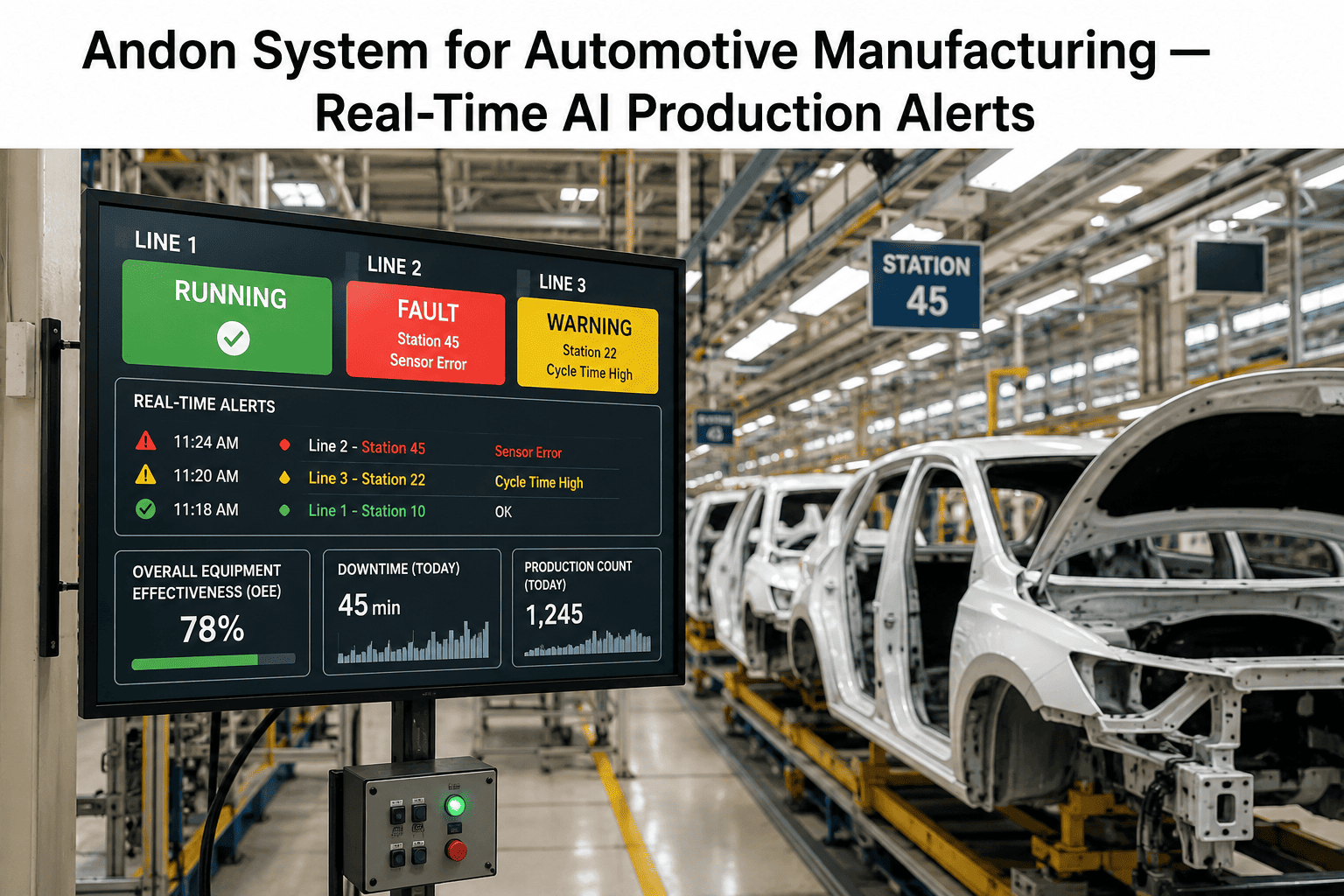
The Andon cord has been pulled by automotive line workers for decades, and the principle behind it, that any worker can stop the line the moment something looks wrong, remains one of the most important ideas the Toyota Production System ever exported to the rest of manufacturing. What has not kept pace is the escalation behind the pull. In most plants, a cord pull still triggers a light, a tone, and a hope that the right supervisor notices in time, with no intelligence about who should respond first or whether this exact pattern has caused a bigger problem before. Operations directors looking to close that gap usually start with Book a Demo of what an AI-enhanced Andon response actually looks like on the floor.
An Andon System That Knows Who to Call Before the Line Stops Longer
ifactoryApp layers AI-driven prioritization and cascade prediction onto your existing Andon infrastructure, cutting response time from minutes to seconds.
Why a Working Andon Board Still Leaves Minutes on the Table
A traditional Andon board does exactly what it was designed to do: it makes a problem visible the instant it happens. Where most plants lose time is in everything that happens after the light turns on. A cord pull at a torque station gets treated with the same urgency as a minor material shortage three stations away, because the board itself has no concept of priority. The right responder, whether that is a team lead, a quality technician, or a maintenance electrician, has to be identified and reached manually, often after the alert has already been visible for several minutes.
The deeper cost is that most Andon systems treat every alert as an isolated event. They do not connect today's cord pull to the twelve similar pulls that happened at the same station over the past month, which means the same root cause keeps triggering the same alert without anyone noticing the pattern until a much bigger failure forces the issue. An intelligent escalation layer changes both of these dynamics at once: it routes the right responder immediately, and it flags when today's alert is part of a recurring signature worth investigating properly.
How an Alert Moves Through an AI-Prioritized Andon Cascade
Rather than broadcasting every alert at the same volume, ifactoryApp scores each event on severity and pattern history the moment it fires, then routes it through an escalation ladder built around actual response urgency.
Safety & Quality-Critical Stops
Routed instantly to the nearest team lead and safety coordinator simultaneously, with no queuing delay regardless of what else is happening on the board.
Equipment Faults With Known Fix
Routed to the specific technician whose history shows fastest resolution time for this failure signature, along with the recommended fix already attached.
Material & Minor Process Alerts
Queued for the next available material handler without interrupting a technician mid-repair on a higher priority issue elsewhere on the line.
Recurring Signature Detected
Surfaced to the plant manager's weekly review when the same alert type has repeated beyond a set threshold at the same station, regardless of individual severity.
Response Time, Before and After Intelligent Routing
The comparison below reflects the shift operations directors typically see once alert prioritization and routing replace a flat, unweighted Andon board.
| Alert Category | Traditional Andon Board | AI-Prioritized Andon |
|---|---|---|
| Safety-critical stop | Visible on board, manual notification | Instant simultaneous push to two responders |
| Equipment fault, known cause | Queued with all other alerts | Routed to fastest-resolving technician |
| Recurring failure signature | Invisible until manually reviewed | Flagged automatically after threshold |
| Average time to first response | 4 to 7 minutes | Under 45 seconds for Tier 1 alerts |
Watch a Live Alert Cascade Through Your Own Line
Bring a recent Andon incident log. ifactoryApp's team will show how the same event would have been prioritized, routed, and resolved under an AI-driven escalation model.
What Plants Track After Deploying Intelligent Escalation
These are the operational indicators operations directors monitor most closely after layering AI-driven prioritization onto an existing Andon system.
Average time to first responder acknowledgment
Total line-down minutes per shift from alerts
Repeat alerts from the same unresolved root cause
Technician response accuracy on first dispatch
Adding Intelligence Without Replacing Your Existing Andon Hardware
Most plants already have Andon cords, light stacks, and board infrastructure that works mechanically fine. ifactoryApp's role is not to rip that out, it is to add a prioritization and routing layer on top of the signals that infrastructure already generates. Integration typically connects to the existing Andon controller or PLC output, meaning the physical experience for line workers pulling a cord does not change at all. What changes is everything that happens in the seconds after the pull, from who gets notified, to how the alert is weighted against everything else currently open on the board, to whether the pattern gets flagged for a deeper investigation rather than resolved and forgotten.
AI-Enhanced Andon Systems — Common Questions
Do we need to replace our existing Andon cords and light stacks?
No. ifactoryApp is designed to integrate with the Andon hardware your plant already has installed, reading the same signals your current board relies on. The prioritization and routing intelligence is added as a layer on top, so line workers continue pulling the same cord they always have while the response behind it becomes significantly faster and better targeted.
How does the system decide which alerts are highest priority?
Each alert is scored using a combination of factors including the station's safety and quality classification, historical resolution time for similar events, and whether the alert matches a recurring failure signature. Safety-critical alerts are always routed with immediate priority regardless of any other scoring factor, consistent with standard Andon philosophy.
Can this route alerts to specific technicians based on their skill or history?
Yes, the routing engine can weight technician assignment based on documented fastest resolution history for a given failure type, while still respecting your plant's existing shift assignments and escalation hierarchy. This is configured during onboarding with input from your maintenance and quality leadership.
What happens if the same alert keeps recurring at one station?
Recurring alerts at the same station are automatically flagged once they cross a configurable frequency threshold, surfacing the pattern to plant management even if each individual occurrence was resolved quickly. This is often how a low-grade recurring issue gets caught and permanently fixed before it escalates into a major stop.
How long does integration with our existing system typically take?
Most plants complete integration with existing Andon controllers and escalation contact lists within two to three weeks, with the prioritization model becoming more accurate over the following month as it learns your station-specific severity patterns. Our support team manages the full integration process alongside your maintenance and IT staff.
Give Your Andon Board a Brain, Not Just a Light
Talk to ifactoryApp about layering intelligent prioritization and escalation onto the Andon infrastructure you already run.