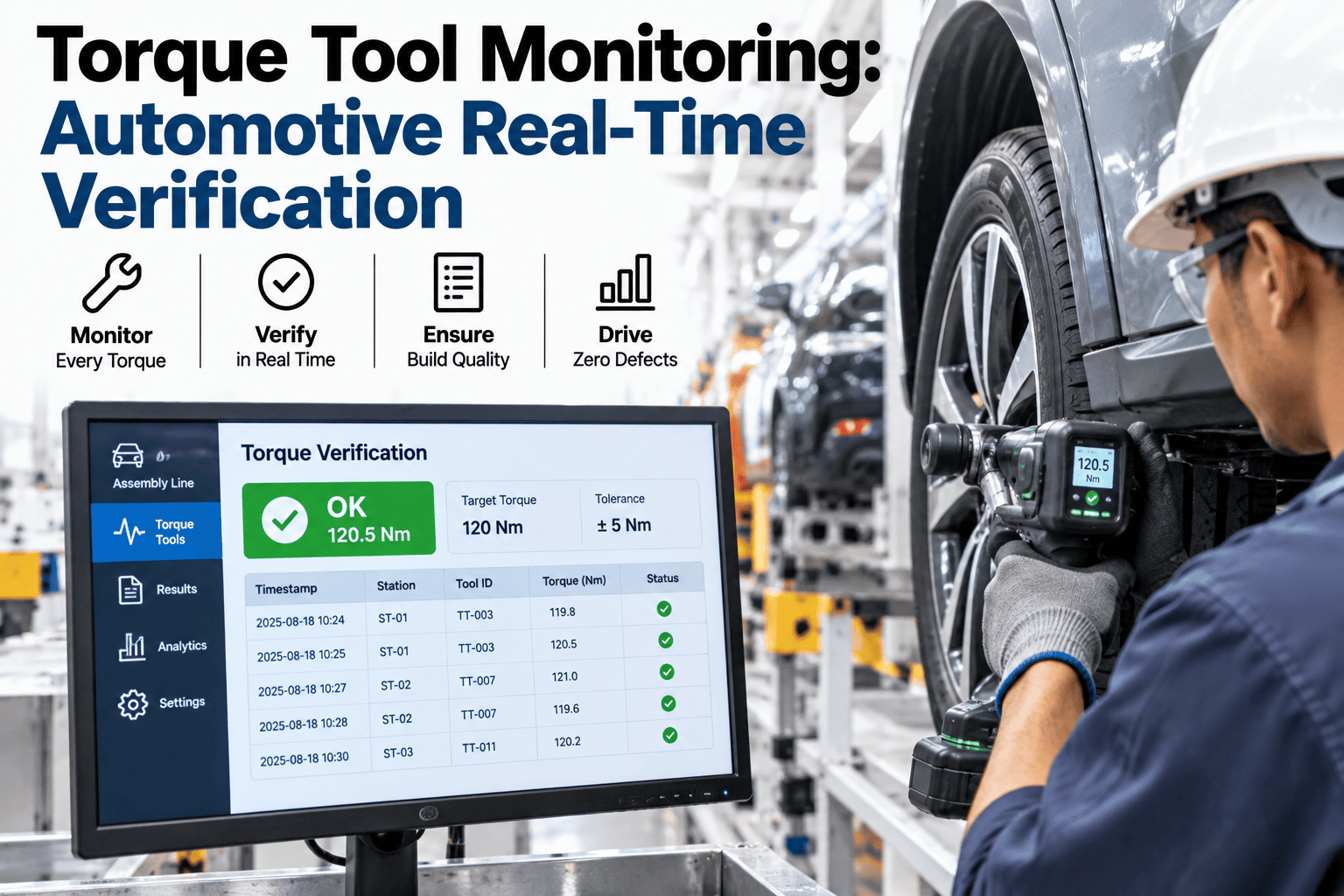
A torque wrench clicking at the right final number tells you almost nothing about whether the fastening operation actually happened correctly. The same click can occur after a smooth, controlled tightening sequence or after a tool that slipped and re-engaged partway through, and both end up looking identical on a simple pass/fail torque check. Safety-critical fastening — the bolts holding a suspension component, a seatbelt anchor, or a steering assembly together — needs more than a final torque value; it needs the angle of rotation and the cycle pattern verified too, since either one deviating is exactly the kind of failure a single torque reading alone will miss entirely. See what full torque, angle, and cycle verification looks like on your safety-critical joints.
A Correct Final Torque Number Doesn't Mean a Correct Fastening Operation
Torque, angle, and cycle all need to be verified together on every safety-critical fastening event, not just the final click value a simple torque check relies on.
torque, angle, and cycle — the full verification set needed to confirm a fastening operation genuinely happened correctly
of safety-critical fastening operations that need real-time verification, not a sampled spot-check
the window in which a slip-and-reengage event happens, invisible to a technician but fully captured by continuous tool monitoring
What a Verified Fastening Event Actually Records
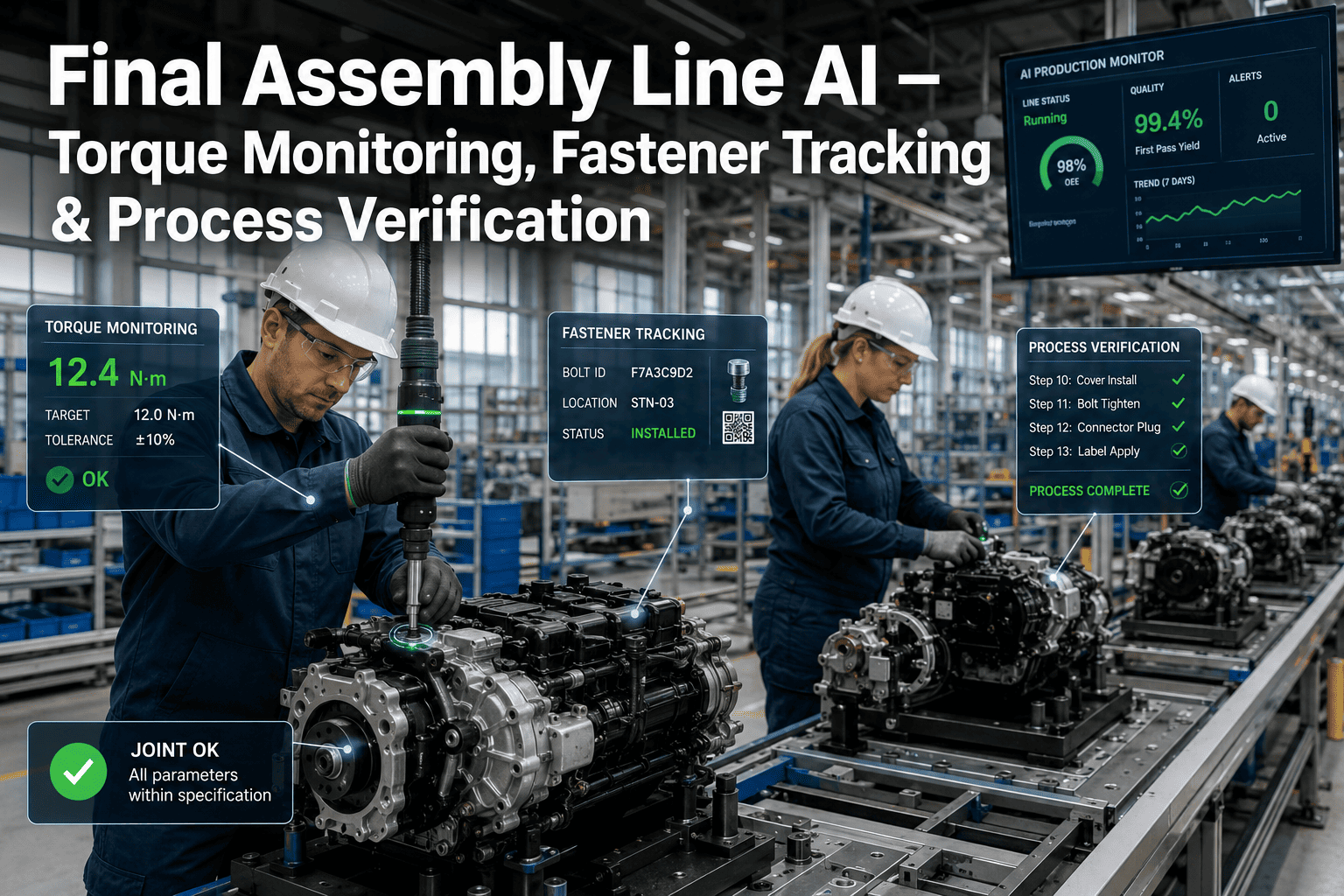
Every safety-critical fastening operation generates its own verification record, capturing all three parameters together rather than a single pass/fail torque check.
Fastener ID: SUS-047 · Station 12
Torque
94.2 Nm
Angle
62.4°
Cycle Pattern
Single, continuous
Verify Every Safety-Critical Fastening Event, Not Just a Sample
iFactory reviews your current torque verification coverage to show exactly which safety-critical joints need full torque, angle, and cycle monitoring.
Why All Three Parameters Matter Together
Each parameter catches a failure mode the others miss, which is exactly why verifying only one leaves real risk unaddressed.
Torque Value
Confirms the fastener reached the correct final clamping force, but says nothing about how it got there or whether the rotation pattern was actually correct.
Rotation Angle
Catches a cross-threaded or improperly seated fastener that might still reach the correct final torque reading despite a fundamentally wrong installation.
Cycle Pattern
Reveals a slip-and-reengage event or an interrupted tightening sequence, either of which can still produce a passing final torque number despite the operation not happening cleanly.
Verification Method Compared
The gap between a basic torque check and full three-parameter verification is exactly where undetected fastening failures tend to hide.
What Full Verification Coverage Requires
Deploying complete torque verification is a matter of connecting existing torque tools to a continuous monitoring layer rather than replacing them.
Classify every fastening point by safety criticality
Not every fastener needs the same verification depth, so classifying each joint by its safety consequence determines where full three-parameter monitoring is genuinely required.
Connect tools to continuous data capture
Torque, angle, and cycle data from every fastening event streams into a monitoring system in real time, rather than being sampled or checked only periodically.
Link every event to a specific vehicle and fastener record
Each verification event ties back to a specific vehicle identification number and fastener location, building the traceability record needed if a field issue ever needs investigation.
What Changes When Verification Covers All Three Parameters
Figures reflect typical outcomes within the first year after expanding from torque-only checks to full torque, angle, and cycle monitoring on safety-critical fasteners.
A Process Engineer's View on Full-Parameter Verification
We had a torque check in place for years that passed every single audit, and it still didn't catch a slip-reengage event on one suspension bolt that only showed up because we happened to add angle and cycle monitoring right before it occurred. That single catch justified the entire monitoring investment on its own, and it made clear how much a torque-only check had actually been missing the whole time.
The Bottom Line on Torque Tool Monitoring
A final torque reading is necessary but not sufficient for confirming a safety-critical fastening operation happened correctly, since it can't distinguish a clean tightening sequence from a slip-reengage event or a cross-threaded fastener that happened to still land on the right number. Verifying torque, angle, and cycle together on every safety-critical joint closes that gap, catching failure modes a torque-only check was never built to see.
Frequently Asked Questions
How is a slip-and-reengage event actually detected in the torque data?
The torque curve shows a distinct discontinuity — a drop and recovery pattern — during a slip-reengage event that a final torque value alone would never reveal, since the fastener can still ultimately reach the correct final reading despite the interruption. Continuous cycle monitoring captures the full curve shape, not just the endpoint. Book a review to see how this applies to your specific torque tools.
Does every fastener on a vehicle need full three-parameter verification?
No — full verification is generally reserved for safety-critical fasteners where a failure could affect structural integrity or occupant safety, while non-critical fasteners often rely on a lighter torque-only check, which is why classifying fasteners by safety consequence is an important first step before deploying monitoring broadly.
Can existing torque tools be upgraded, or does this require entirely new equipment?
Many existing electric torque tools already generate the underlying torque and angle data needed, meaning the gap is often in capturing and continuously monitoring that data rather than replacing the tools themselves, though older pneumatic or manual tools may need to be upgraded to support full data capture.
How does this connect to a vehicle's build record for future traceability?
Each verified fastening event is typically linked to the specific vehicle identification number and fastener location, building a permanent record that can be referenced if a field issue related to that specific joint ever needs investigation, well after the vehicle has left the plant.
What happens on the line when a verification event fails one of the three parameters?
A failed parameter typically halts the station or flags the specific fastener for immediate operator attention before the vehicle can proceed, ensuring the correction happens at the point of assembly rather than being caught later or missed entirely. Talk to a specialist about configuring this response for your specific line layout.
Close the Gap a Torque-Only Check Can't See
Book a 30-minute assessment. iFactory reviews your safety-critical fastening points and shows exactly where full torque, angle, and cycle verification is needed.
.png)
