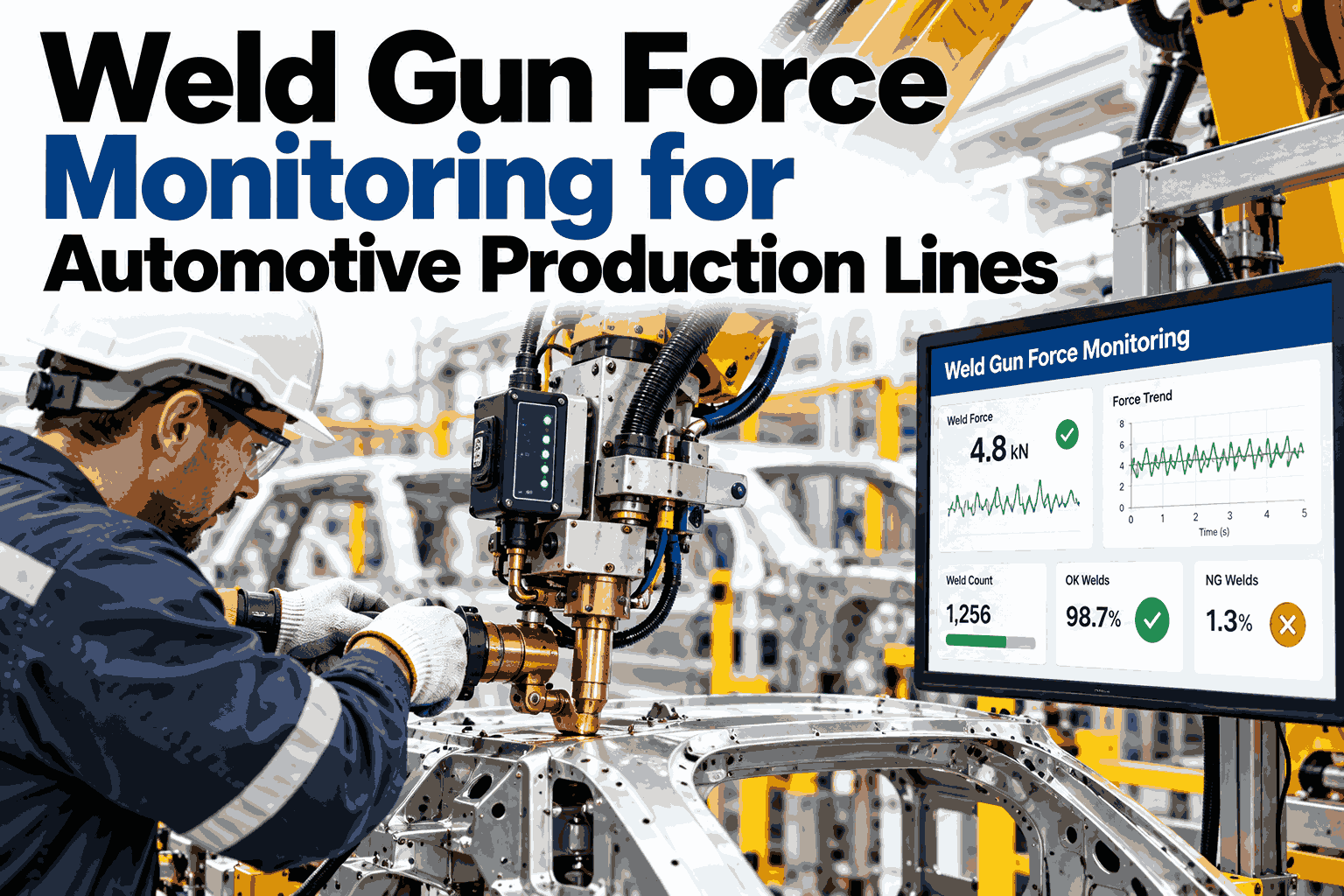
Every resistance spot weld on a body or frame line depends on one quiet number, which is the force the electrodes apply while current flows. When that force drifts, nugget size, surface finish and joint strength all drift with it, often without any obvious sign at the gun. Most plants find out only when a peel test fails or a shift ends with an unusual amount of scrap and rework. This guide shows how force sensing, closed-loop control and drift alarming keep that number steady across every gun and every shift, and you can preview how the monitoring would look across your own gun fleet.
AUTOMOTIVE WELD QUALITY PREDICTION
Weld Gun Force Monitoring for Automotive Production Lines
iFactory tracks electrode force on every gun, holds it to setpoint and alarms on drift early, so spot weld quality stays stable from the first shift to the last.
FORCE IN THE WELD CYCLE
Where Force Acts During a Single Spot Weld
A spot weld is a short sequence, and force matters in every stage of it, not only at the moment current flows.
Squeeze
Force builds so the sheets are pressed into firm contact before current starts.
Weld
Current flows while force holds the joint together and contains the molten nugget.
Hold
Force continues as the nugget cools and solidifies under pressure.
Release
Electrodes open and the gun moves to the next spot on the frame.
The bars illustrate the idea that force must be present and stable across squeeze, weld and hold, rather than measured at one instant.
THE FORCE WINDOW
Too Low, Too High and Just Right
Electrode force has a working window, and leaving it in either direction causes a different kind of failure.
Too lowWorking windowToo high
Force too low
Contact resistance rises, heat concentrates and the weld may expel molten metal, leaving spatter, burn marks and a weakened nugget.
Force in window
Heat forms a consistent nugget, the surface stays clean and indentation remains within the drawing limit.
Force too high
Contact resistance falls, the nugget can come out small, and deeper indentation adds electrode wear.
WHY FORCE DRIFTS
Six Sources of Drift on a Real Line
Force rarely fails suddenly, and the cause usually sits in one of a handful of places that can be watched.
Air pressure regulation
Pneumatic guns follow supply pressure, so regulator drift or plant air swings change force directly.
Cylinder and seal wear
Friction and leakage slowly reduce the force delivered for the same command.
Arm deflection and play
Loose joints and flexing arms change how much force reaches the tips.
Tip wear and mushrooming
As tip faces widen, the same force spreads over more area and pressure at the joint falls.
Misalignment
Offset or angled tips create uneven contact, so force is not applied squarely.
Servo and sensor calibration
Servo guns estimate force, and if the reference drifts, the controller chases a wrong number.
Bar lengths show how often each source tends to contribute in practice, and the mix will differ from plant to plant.
Find out which drift sources affect your guns
iFactory can review force records from a sample of guns and show where drift starts, how fast it moves and how it links to weld results.
SENSOR CALIBRATION
Trust the Number Before You Control It
Monitoring is only as good as the sensor, so calibration is the foundation for everything that follows.
| Gun type |
How force is known |
Calibration focus |
Typical risk |
| Pneumatic |
Air pressure through a regulator, sometimes a load cell |
Regulator accuracy and force at the tips |
Pressure reading no longer matches actual force |
| Servo |
Estimated from motor torque and gun stiffness |
Force reference and stiffness data per gun |
Estimate drifts as the gun wears |
| Fixed load cell |
Direct sensor in the force path |
Zero, span and cable condition |
Sensor damage or offset after collisions |
The reference is a calibrated force gauge placed between the electrodes, and readings are compared with what the gun reports at several force levels.
CLOSED-LOOP CONTROL
Holding Force to Setpoint Automatically
Closed-loop control replaces hoping the force is right with measuring it and correcting it on every weld.
1
Setpoint
Target force for the joint and material stack
2
Gun action
Gun applies force through the pneumatic or servo drive
4
Correction
Controller adjusts the command to close the gap
3
Measurement
Sensor reports the actual force during the weld
The loop runs continuously, so small deviations are corrected before they can grow into a visible defect.
DRIFT ALARMING
Seeing the Slide Before It Becomes a Defect
Trend-based alarms watch the direction of force over many welds, not just a single reading that crosses a limit.
In window
Drift warning
Alarm
The drift warning arrives while force is still acceptable, which gives maintenance time to act before quality is affected.
Warning level
A steady downward slope prompts a check of regulators, tips and alignment on that gun.
Alarm level
Force leaves the window and welds are flagged for inspection or the gun is held out of service.
Fleet comparison
A gun that behaves differently from similar guns is flagged even if it stays inside limits.
SHIFT STABILITY
Keeping Force Steady From Start to End of Shift
Force changes with temperature, air supply and tip condition, so stability has to be checked across the whole shift.
| Point in shift |
What changes |
What to watch |
| Start-up |
Cold equipment and fresh tip dressing |
Force after warm-up against the reference |
| Mid-shift |
Steady production and rising tip wear |
Slow trends and tip dress interval |
| Peak demand |
Plant air draw and thermal load |
Pressure dips and force sag on pneumatic guns |
| Changeover |
New material stack and setpoints |
Correct setpoint loaded for the new joint |
CONNECTING FORCE TO QUALITY
What Force Data Tells You About the Weld
Force becomes more valuable when it is read alongside current, time and inspection results.
Force patterns
Low force with expulsion marks points toward regulator or seal trouble
Falling force with rising tip size points toward mushrooming
Force different on one gun only points toward alignment or sensor issues
Actions that follow
Adjust or replace the regulator or cylinder seals
Change the tip dress or replacement interval
Recalibrate or realign the affected gun
MATURITY PATH
Four Steps From Manual Checks to Predictive Control
Most plants climb this staircase gradually, and each step makes the next one easier.
Manual
Periodic gauge checks and paper records
Logged
Force recorded for every weld and gun
Controlled
Closed-loop force with trend alarms
Predictive
Force linked to quality with early maintenance calls
FREQUENTLY ASKED QUESTIONS
What Weld and Maintenance Engineers Ask
Do we need a load cell on every gun?
Not always, because many servo guns already report force and pneumatic guns can be checked with calibrated pressure and periodic gauge tests. Direct sensors are worth adding on critical joints or guns that drift often.
Ask our support team which option suits your fleet.
How often should force sensors be calibrated?
The interval depends on your process, gun type and how quickly force drifts, and it should follow your quality plan. Monitoring shows when a sensor starts disagreeing with its peers, which can trigger an earlier check.
See how calibration tracking works in a session.
Can closed-loop control fix a worn tip?
It can hold force at the right value, but it cannot restore a tip face that has widened, since pressure at the joint still falls. That is why tip condition is monitored alongside force.
Review the tip and force link with our team.
Will alarms create too many stoppages?
Alarms use trends and separate warning from stop levels, so most events lead to a scheduled check rather than an immediate stoppage. Limits are tuned per gun and joint to avoid noise.
Contact support to discuss alarm settings.
Can this cover a mix of gun brands and types?
Yes, since force data is normalized per gun, pneumatic and servo guns from different suppliers can be compared in one view. Integration depends on which signals each controller exposes.
Walk through your gun mix with our team.
STEADY FORCE, STEADY WELDS
Keep Every Weld Gun Inside Its Force Window
iFactory monitors electrode force, supports closed-loop control and warns of drift early, so spot weld quality holds across every shift on your line.