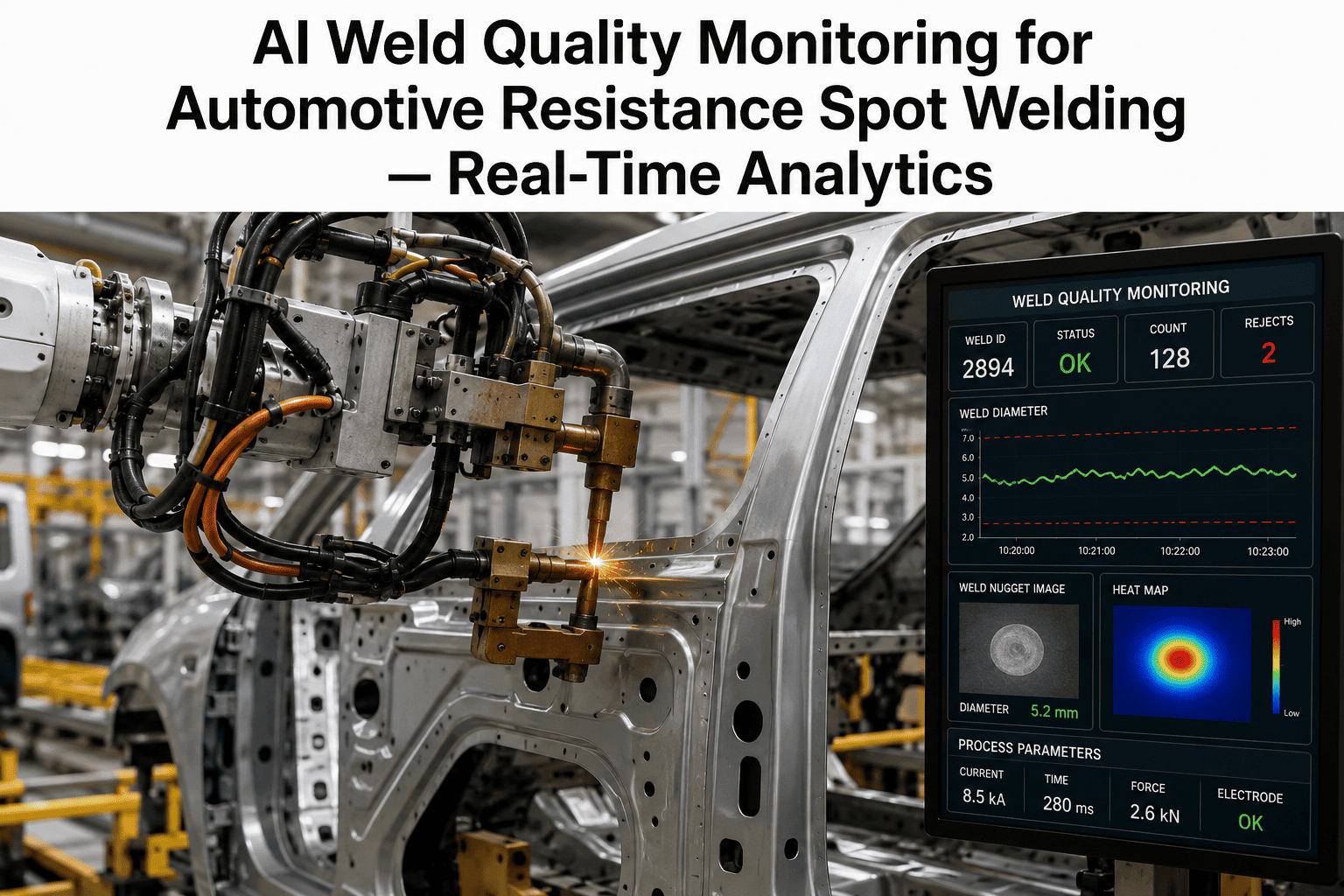
Every automotive plant has the same uncomfortable truth hiding in its body shop: a spot weld can look perfect, pass a visual check and still carry too little nugget to hold in a crash. Ultrasonic sampling and teardown tests catch only a small slice of the thousands of welds a vehicle receives, so a drifting electrode or a shunting fault can run for hours before anyone knows. The best weld quality AI software for 2026 predicts each weld while it is being made, classifies the defect risk and adjusts parameters before the next joint. To judge how that works on your own line, walk through a live weld-quality review with the iFactory team.
P1 · AUTOMOTIVE WELD QUALITY PREDICTION AND INSPECTION
The Best Automotive Weld Quality AI Software for 2026
iFactory combines real-time weld prediction, defect classification and parameter control so undetected weld defects stop reaching final assembly.
THE HIDDEN GAP
Why Sampling-Based Weld Inspection Leaves Blind Spots
Destructive and ultrasonic checks tell you how a handful of welds performed, not how the other welds on that shift behaved.
Welds tested by ultrasonic or teardown
Bar lengths are illustrative of the coverage gap, not measured plant data.
WHAT CAUSES WELD DRIFT
Four Quiet Causes Behind Most Undetected Weld Defects
Electrode Wear
Tip face growth spreads current over a larger area, shrinking the nugget without any visible change.
Shunting and Fit-Up
Neighboring welds and poor panel gaps divert current, so the same schedule produces different results.
Coating and Material Variation
Galvanized layers and new steel grades change contact resistance from coil to coil.
Cooling and Force Faults
Low water flow or drifting electrode force alters heat input while alarms stay silent.
SCORECARD
How to Rank Weld Quality AI Platforms in 2026
Five capabilities separate a platform that changes scrap and rework from one that only adds another dashboard.
Per-weld prediction
Scores every joint from signature data
Defect classification
Names the likely defect type
Parameter control
Recommends current and force changes
Controller compatibility
Works with existing weld timers
Traceability
Links weld data to VIN and station
Bar length shows suggested buying weight, not a vendor rating.
See which of your welds a model would have flagged
iFactory can review a sample of your weld signature history and show what predicted quality would have looked like.
FROM SIGNAL TO DECISION
What Happens in the Two Seconds After a Weld Fires
01
Capture
Current, voltage, force and displacement curves stream from the weld controller.
02
Predict
A model compares the signature to known good and defective welds for that joint.
03
Classify
Risky welds are labeled by likely cause, such as undersized nugget or expulsion.
04
Act
The station gets a parameter recommendation and the part is flagged for targeted inspection.
DEFECT CLASSIFICATION
Reading the Defect Types the Software Should Separate
A useful classifier does more than say good or bad, because each defect points to a different fix.
| Defect Type |
Typical Signature Clue |
Likely Root Cause |
Suggested Response |
| Undersized nugget |
Low dynamic resistance rise |
Worn tips or shunting |
Dress or change tips, review sequence |
| Expulsion |
Sudden voltage drop late in weld |
Excess current or low force |
Lower current, check force |
| Stuck or cold weld |
Flat resistance curve |
Poor contact or coating |
Inspect fit-up and surface |
| Electrode misalignment |
Uneven force and displacement |
Gun or fixture wear |
Realign gun, service fixture |
CLOSED-LOOP CONTROL
Parameter Control That Keeps the Nugget on Target
Measure the weld
then
Predict nugget size
then
Adjust current or time
then
Verify next weld
Instead of waiting for a shift-end audit, the loop nudges settings within engineering limits and logs every change for review.
BUYER CHECKLIST
Questions to Ask Every Vendor Before You Shortlist
Does it read signatures from your current weld controllers without replacing them?
Can it be trained per joint, per material stack and per station?
Does it explain why a weld was flagged, not just that it was?
Are parameter changes bounded by rules your process engineers approve?
Is weld data traceable to the vehicle for audits and recalls?
ROLLOUT PATH
How iFactory Brings Weld AI Onto Your Line
Weeks 1-2
Connect
Link weld controllers and pull historical signatures and inspection results.
Weeks 3-5
Calibrate
Train prediction and classification models against your ultrasonic and teardown data.
Weeks 6-8
Go Live
Switch on alerts, parameter guidance and dashboards with operator training.
FREQUENTLY ASKED QUESTIONS
What Quality Teams Ask Before Choosing Weld AI
Does weld AI replace ultrasonic testing?
No, it works alongside it. Ultrasonic and teardown results become the ground truth that trains the model, and the model then covers the welds you never sampled. Many teams end up targeting physical tests where risk is highest. Ask for
a walkthrough using your own weld data.
Will it work with our existing weld controllers?
iFactory is designed to read signature data from the controllers already on your line, so a full equipment swap is not the starting point. Compatibility depends on the controller brand and data access, which is confirmed during integration. Confirm controller compatibility with
the iFactory support engineers.
How does it handle different materials and coatings?
Models are calibrated per joint and material stack, because a galvanized high-strength steel joint behaves differently from an uncoated one. As new grades enter production, the model can be retrained with fresh inspection data. Review
a sample calibration for your material mix with our team.
Can the software change parameters on its own?
How long before we see useful predictions?
Timing depends on how much labeled weld data you already have. Lines with strong inspection history calibrate faster, and accuracy keeps improving as more verified results feed back in. A typical plan reaches go-live in a matter of weeks. Get
a realistic go-live estimate for your line in a short call.
STOP SHIPPING WELDS YOU CANNOT SEE
Predict, Classify and Control Every Weld With iFactory
Give your quality team a live view of weld health across stations, shifts and plants, and act before a defect becomes a recall risk.