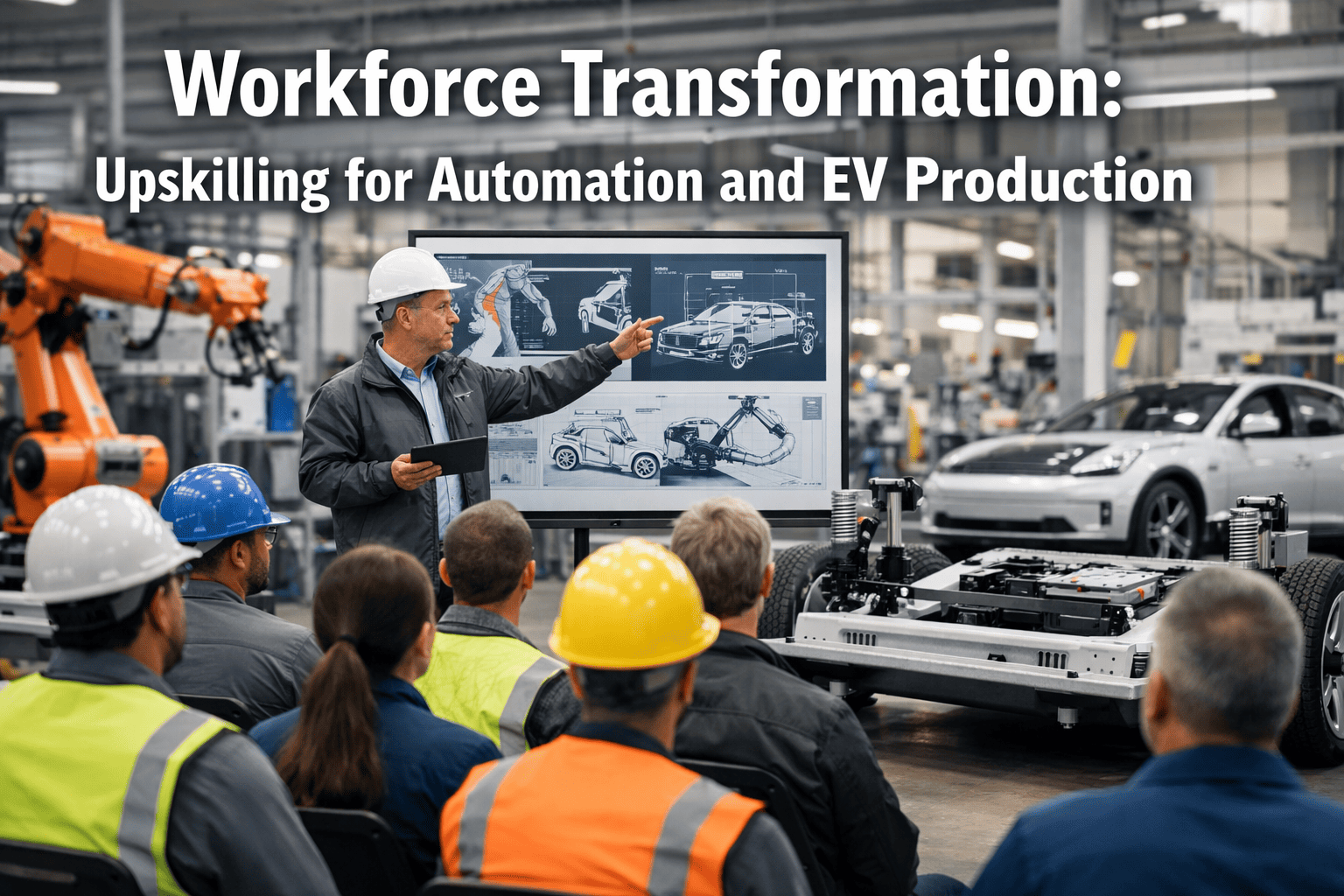
The automotive workforce is undergoing its most significant transformation since the original assembly line. As factories integrate advanced robotics, AI-driven quality systems, and electric vehicle (EV) production lines, the skills that defined automotive manufacturing for decades are being fundamentally reshaped. Plants investing in structured upskilling programs are seeing 45% faster technology adoption, 50% lower turnover among production staff, and measurably smoother transitions to EV platforms. This guide examines how forward-thinking manufacturers are building the workforce capabilities needed for automation-intensive, electrified production—and the strategies that separate successful transformations from costly false starts.
Reskilling the Factory Floor
Why Workforce Transformation Is Now a Production-Critical Priority
Workforce upskilling is no longer an HR initiative—it's a production imperative. Three converging forces are making workforce transformation the make-or-break factor for automotive manufacturers in 2026 and beyond.
The Automation Acceleration
Robotics, cobots, and AI systems are being deployed at unprecedented speed. Every new automated station requires workers who can program, supervise, troubleshoot, and maintain intelligent machines—skills that didn't exist on most factory floors five years ago. Plants that deploy automation without concurrent upskilling see 30% longer ramp-up times and 2× more unplanned downtime from operator errors.
The EV Production Pivot
Electric vehicles fundamentally change what gets assembled and how. Battery pack manufacturing, high-voltage electrical systems, thermal management, and electric motor assembly require entirely different competencies than ICE powertrain work. OEMs retooling existing plants for EV production must simultaneously retool their workforce—or face production quality and safety gaps that no amount of automation can compensate for.
The Talent Shortage Reality
Automotive manufacturing faces a projected shortage of 2.1 million skilled workers globally by 2030. Hiring alone cannot close this gap—manufacturers must develop existing talent. Plants with robust upskilling programs report 50% lower voluntary turnover, as workers who see clear career progression and skill development are far more likely to stay than those performing static, repetitive tasks.
Building your workforce transformation strategy? Book a consultation with iFactory's manufacturing workforce specialists.
The Skills Shift: What's Changing on the Factory Floor
The transition from traditional automotive assembly to automated, electrified production is creating a fundamentally different skills landscape. Understanding what's fading, what's emerging, and what's evolving is the first step to building an effective upskilling program.
5 Core Upskilling Domains for the Automated, Electrified Factory
Effective workforce transformation programs focus on five interconnected skill domains that together create the versatile, technology-literate workforce modern automotive production demands.
Robotics & Automation Literacy
Every production worker needs baseline competency in how robots, cobots, and automated systems operate—even if they don't program them. Advanced roles include cobot programming via hand-guided teaching, robot cell troubleshooting, end-of-arm tooling changeover, and integration with plant control systems.
EV & High-Voltage Systems
EV production introduces high-voltage battery packs (400V–800V+), electric drive units, thermal management systems, and power electronics that require specialized safety training and technical competence. Every worker on an EV line must understand electrical isolation procedures, PPE requirements, and emergency response for high-voltage incidents—this is non-negotiable for production safety.
Data Literacy & Digital Tools
Automated factories generate massive volumes of production data—OEE metrics, quality analytics, predictive maintenance alerts, and real-time process parameters. Workers who can read dashboards, interpret trend data, respond to AI-generated alerts, and use digital work instructions are dramatically more effective than those relying on tribal knowledge and paper-based systems.
Advanced Maintenance & Diagnostics
With more automated equipment on the line, maintenance teams must evolve from reactive repair to predictive and prescriptive maintenance. This means understanding vibration analysis, thermal imaging, motor current signatures, and AI-based anomaly detection—skills that prevent failures before they halt production and keep robotic assets running at peak performance.
Lean & Continuous Improvement in Automated Environments
Traditional lean manufacturing principles don't disappear with automation—they evolve. Workers must learn how to apply kaizen, root-cause analysis, and value-stream mapping to hybrid human-robot production systems. The most effective improvement ideas in automated plants come from operators who understand both the technology and the production process—making cross-trained workers the engine of continuous improvement.
Need a skills gap assessment for your production teams? Connect with iFactory's workforce analytics team to map current capabilities against automation and EV readiness.
Upskilling Program Models That Work
The most effective workforce transformation programs combine multiple learning approaches tailored to different skill levels and production constraints. Here are the four proven models leading automotive manufacturers are deploying.
On-Line Micro-Learning
Short, focused training modules (5–15 minutes) delivered via tablets at the workstation during natural production gaps—shift starts, scheduled breaks, or line changeovers. Covers safety procedures, digital tool tutorials, and incremental skill building without removing workers from the floor.
Dedicated Training Cells
Replica production cells equipped with actual cobots, robots, and HV training rigs where workers practice hands-on skills in a safe, off-line environment. Operators learn cobot programming, troubleshooting, and EV-specific procedures through structured exercises that mirror real production scenarios before ever working on a live line.
Digital Twin Simulation Training
Virtual replicas of production lines where workers practice robot interactions, diagnose simulated failures, and test process changes without any risk to actual equipment or production. Digital twins accelerate learning by compressing weeks of on-the-job experience into hours of scenario-based simulation—particularly valuable for rare but critical fault-response training.
Cross-Functional Rotation Programs
Structured rotations that move workers through automation, maintenance, quality, and logistics roles over 6–12 month cycles. Cross-trained workers develop systems-level understanding of how automated production lines interconnect—making them far more effective at troubleshooting, improvement, and adapting to new model launches or technology upgrades.
EV-Specific Workforce Requirements
Electric vehicle production introduces unique technical and safety requirements that demand dedicated training beyond general automation upskilling. These are the EV-specific competencies every production team needs.
High-Voltage Safety Certification
All workers on EV lines must complete certified high-voltage safety training covering lockout/tagout for 400V–800V+ systems, arc flash awareness, PPE requirements (Class 0/00 insulating gloves, face shields), and emergency de-energization procedures. This is not optional—it's a regulatory and safety-critical requirement under NFPA 70E and OSHA standards.
Battery Pack Assembly & Handling
Battery module stacking, cell-to-pack integration, torque sequences for busbar connections, thermal interface material application, and battery management system (BMS) verification. Workers must understand cell chemistry basics, thermal runaway risks, and the precision requirements that prevent field failures and warranty costs.
Electric Drive Unit Assembly
E-motor assembly, inverter integration, gear reduction unit fitting, and high-voltage harness routing require precision handling and contamination-controlled environments. Workers transitioning from ICE powertrain lines need specific training on electromagnetic interference awareness, cleanroom protocols, and the tighter tolerances that electric drivetrains demand.
Thermal Management Systems
EV battery and motor cooling circuits involve glycol loops, cold plates, chiller units, and sophisticated control logic that differ fundamentally from ICE cooling systems. Assembly workers must understand leak-testing protocols, connector integrity verification, and the critical relationship between thermal performance and battery longevity, safety, and vehicle range.
Workforce Transformation Challenges & How to Overcome Them
Even the best-designed upskilling programs face real obstacles. Here are the most common challenges and the strategies that leading manufacturers use to overcome them.
Change Resistance & Fear of Displacement
Workers who've spent years mastering manual skills may resist automation-focused training, fearing their roles will be eliminated. This creates passive resistance—slow adoption, reluctance to engage with new tools, and informal pushback that undermines technology rollouts.
Transparent communication before deployment: share specific data on how roles evolve (not disappear), showcase new career paths and pay progression tied to automation skills, and involve veteran workers as training leads and cobot champions. Workers who help lead the change become its strongest advocates.
Training Time vs. Production Pressure
Production targets don't pause for training. Plant managers face constant tension between releasing workers for upskilling and meeting daily output requirements. Programs that require extended off-line time are often deprioritized or cancelled when production runs hot.
Blend micro-learning at-station with structured off-line sessions during planned changeovers and maintenance windows. Use digital twin simulators for high-impact training without production disruption. Schedule intensive training during model changeover shutdowns when lines are already down.
Measuring Training ROI
Without clear metrics linking training investment to production outcomes, upskilling budgets are vulnerable to cuts. Many plants track training hours completed but fail to measure whether those hours actually improved throughput, quality, safety, or maintenance response times.
Connect training data to production KPIs using iFactory's analytics platform. Track the correlation between certification completion and station-level OEE, defect rates, and downtime. Build ROI cases that show dollar-for-dollar returns on training investment tied to measurable production improvements.
Inconsistent Skill Standards Across Plants
Multi-plant manufacturers often find that training quality, certification standards, and skill definitions vary widely between locations. This creates production inconsistency, complicates workforce transfers, and makes it impossible to benchmark performance accurately across the manufacturing network.
Establish a centralized skills framework with standardized certification levels, competency assessments, and digital skill passports that transfer with workers across plants. Use iFactory's platform to enforce consistent training requirements and track certification status enterprise-wide.
ROI of Workforce Transformation Investments
The financial returns on workforce upskilling are well-documented across plants that track training outcomes against production performance. Here's what the data shows.
Plants with pre-deployment training programs reach full production speed 45% faster after automation installations—saving weeks of lost output during ramp-up periods that typically cost $200K–$500K per week on high-volume lines.
Workers who receive structured upskilling with clear career progression are 50% less likely to leave. In an industry spending $15K–$25K per replacement hire, retention improvements from training programs often cover the entire upskilling budget within the first year.
Workers trained in predictive maintenance and robot diagnostics identify and resolve issues faster—reducing mean time to repair (MTTR) by 30% and preventing the cascade failures that turn a single robot fault into a full-line stoppage.
Combining faster ramp-ups, lower turnover, reduced downtime, and improved quality yields, leading manufacturers report a 3× return on workforce transformation investments within 24 months—making upskilling one of the highest-ROI investments in modern automotive manufacturing.
Workforce Transformation Roadmap
Successful workforce transformation follows a structured progression that builds capability incrementally while maintaining production continuity throughout the transition.
Skills Assessment & Gap Analysis
Month 1–2- Map current workforce skills against target-state automation and EV production requirements
- Identify high-priority skill gaps by station, shift, and role
- Establish baseline metrics (OEE, quality, safety, turnover) for ROI tracking
- Design personalized learning paths for each worker based on current skills and target roles
Foundation Training & Safety Certification
Month 3–5- Deploy mandatory HV safety certification for all EV line workers
- Launch automation literacy program for all production staff
- Establish training cells with replica cobot and robot equipment
- Begin digital tool onboarding (dashboards, digital work instructions, MES interfaces)
Advanced Skills & On-Line Application
Month 6–10- Roll out advanced robotics programming and maintenance training for technical roles
- Launch cross-functional rotation programs for high-potential workers
- Activate digital twin simulation training for complex fault scenarios
- Connect training completion to production KPIs via iFactory analytics
Continuous Development & Scaling
Month 11+- Establish continuous learning culture with ongoing micro-learning and quarterly skill assessments
- Create internal career ladders: Operator → Robot Technician → Automation Specialist → Line Engineer
- Deploy digital skill passports that transfer across plants and production lines
- Scale proven training models across the entire manufacturing network
Ready to build your workforce transformation roadmap? Schedule a strategy session with our manufacturing workforce specialists.
Expert Perspective
"The biggest risk in automotive's automation and EV transition isn't the technology—it's the assumption that the existing workforce will figure it out on the job. Plants that invest in structured upskilling before deploying new technology consistently outperform those that train reactively. The data is unambiguous: every dollar spent on pre-deployment training saves three to five dollars in lost productivity, quality failures, and turnover during ramp-up. The winners in 2027's automotive landscape won't be the plants with the most advanced robots—they'll be the plants with the most capable people operating those robots."
Conclusion
The automotive industry's simultaneous shift to advanced automation and electric vehicle production represents the largest workforce transformation since mass production began. Success requires more than deploying robots and retooling lines—it demands a deliberate, structured investment in the people who operate, maintain, and continuously improve these systems. From robotics and automation literacy to high-voltage EV safety, from data-driven maintenance to digital twin simulation training, the skills portfolio of the automotive worker is expanding dramatically. Manufacturers who build these capabilities proactively—before new technology hits the floor—will achieve faster ramp-ups, lower turnover, fewer quality escapes, and a workforce that sees automation as an opportunity rather than a threat. The technology will keep advancing. The question is whether your workforce will advance with it.
Schedule your iFactory demo to see how workforce analytics connects training data to production performance, or talk to our team about building your workforce transformation strategy.
Upskill Smarter. Produce Better. Retain Longer.
Join leading automotive manufacturers using iFactory to connect workforce capability data, automate skills tracking, and prove the ROI of every training dollar invested.