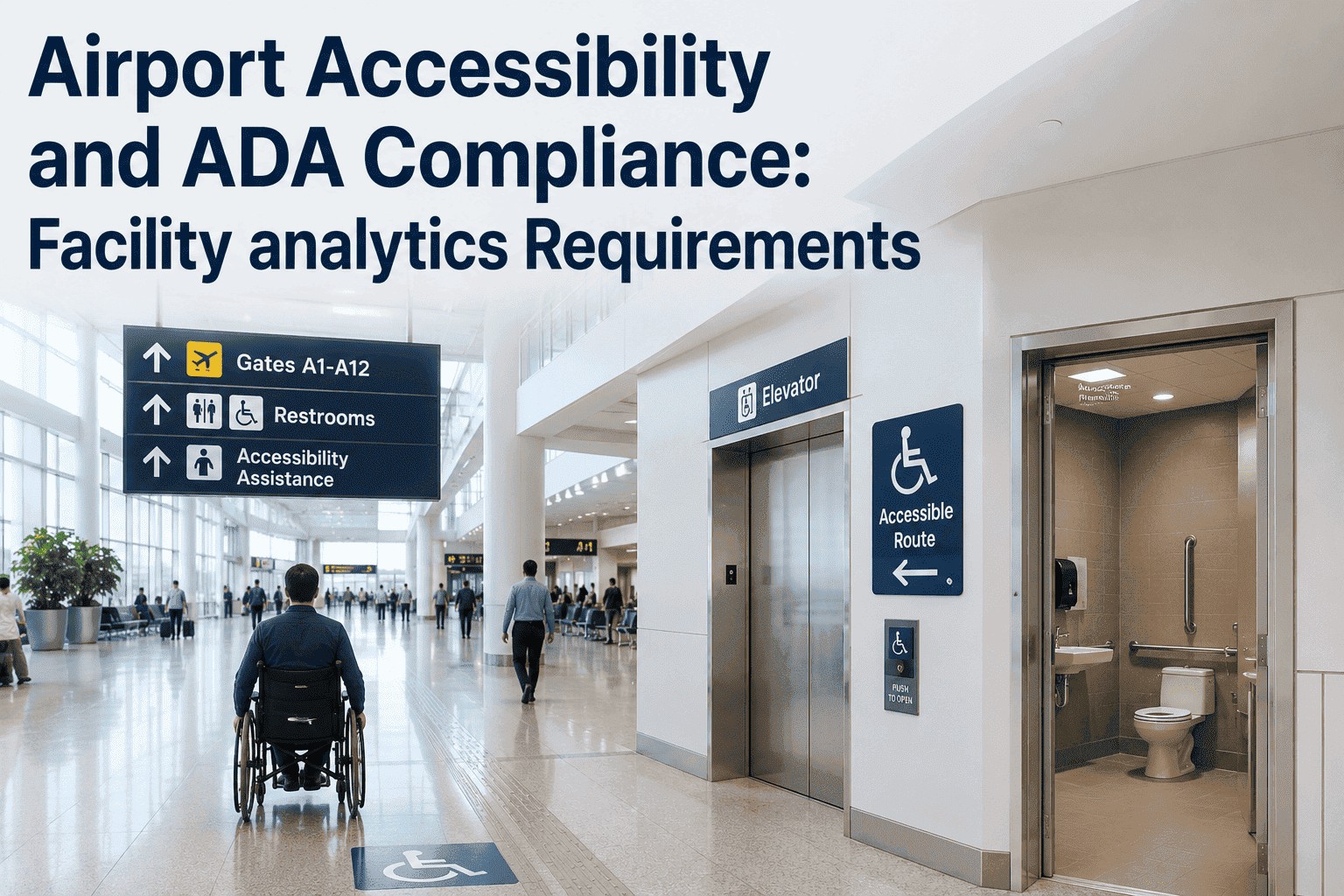
A passenger who uses a power wheelchair arrives at a hub airport for an international connection. The elevator serving her gate concourse is out of service — no estimated repair time posted, no alternative route signposted, no staff notified. She misses her flight. The airport receives a formal DOT complaint. The elevator had not been serviced in eleven months. The repair call was reactive. The compliance exposure was entirely preventable. This is what airport accessibility compliance looks like when it is managed through memory and incident reports rather than structured asset tracking — and it is happening at airports that believe they are compliant because the accessible features were installed correctly years ago.
Elevators · Accessible Restrooms · Wayfinding · Sensory Rooms · ADA Compliance Tracking
ADA Compliance at an Airport Is Not Installed Once. It Is Maintained Every Day — or It Fails.
iFactory's compliance tracking platform registers every accessible facility asset across your terminal — with documented inspection schedules, repair records, and audit-ready reports that demonstrate continuous ADA compliance, not just initial installation.
1 in 4
U.S. adults live with a disability — representing a significant share of every airport's daily passenger volume
5.5M
Passengers requested accessibility assistance at UK airports in 2024 — up from 4.6M in 2023 and 2.5M in 2010
$75K+
Average settlement cost per ADA violation complaint reaching litigation — vs. under $2,000 for a proactive annual inspection programme per asset
Title II
ADA obligation for public airports — requiring not just accessible installation but continuous operational maintenance of all accessible features
What ADA Compliance Actually Requires at an Airport — and Where Most Programmes Fall Short
The Americans with Disabilities Act does not only require airports to install accessible features — it requires them to maintain those features in continuous working condition. Title II (governing public airports) and Title III (governing private terminal operators) both impose an obligation of operational continuity: an elevator that was ADA-compliant at installation but is out of service for 72 hours without a documented alternative accommodation plan is a compliance failure, regardless of how well the original installation was specified. The same applies to accessible restroom equipment, tactile wayfinding surfaces, hearing loop systems, accessible parking markings, and companion care facilities. Colorado's 2024 airport accessibility law (HB24-1452) further requires large hub airports to establish electronic dashboards to track and report compliance shortcomings in real time — a regulatory direction that is expanding across jurisdictions globally. What most airport accessibility programmes lack is not policy — it is execution records. The written programme exists. The inspection happened. But when a DOT audit arrives and asks for the last twelve months of elevator maintenance records, accessible restroom equipment inspection logs, or tactile surface continuity checks, the answer is a filing cabinet, not a report.
The ADA Compliance Gap — What Gets Installed vs. What Gets Maintained
What the ADA Requires
Elevators in continuous operational condition with documented uptime records
Accessible restroom equipment — grab bars, flush controls, door hardware — maintained and inspected on schedule
Tactile paving continuity — no broken or missing detectable warning surfaces on accessible routes
ADA-compliant signage maintained in correct position, contrast, and Braille legibility
Alternative accommodation plans when accessible features are temporarily unavailable
Where Programmes Break Down
Elevator PM overdue — no alert generated, no work order created, failure discovered by passenger
Grab bar reported loose — ticket opened, closed without documented repair confirmation
Tactile surface damage logged in paper inspection sheet — never actioned, sheet filed and not reviewed
Signage replaced after renovation — Braille panels not updated, non-compliance not detected until audit
Elevator outage — no alternative route communicated, passenger complaint filed with DOT within 48 hours
The gap is not between what airports intend and what the ADA requires — it is between the written maintenance programme and the documented execution record. iFactory closes that gap by turning every accessibility obligation into a tracked, scheduled, completed, and audit-ready work order.
Five Accessible Facility Asset Classes — What iFactory Tracks, Schedules, and Documents
Airport accessibility compliance spans every zone of the terminal campus — from departure kerb to gate area — and every category of passenger need, from physical mobility to sensory and cognitive accessibility. iFactory registers each accessible facility asset individually, attaches its applicable compliance standard, and enforces its inspection schedule through automated work order generation.
Asset Class 01
Elevators and Vertical Lift Equipment — Uptime Records, PM Scheduling, and Outage Documentation
Highest Compliance Risk
Elevators are the primary accessible route for passengers using wheelchairs, mobility scooters, and other mobility aids — and the single accessible facility asset most likely to generate a formal ADA complaint when it fails. Section 407 of the ADA Accessibility Guidelines requires elevators to remain in working order; there is no defined grace period for downtime, and first-violation fines can reach tens of thousands of dollars. Colorado's 2024 airport accessibility law specifically requires hub airports to use elevators to transport power wheelchairs from the tarmac to the jetway and to give mobility devices priority access. iFactory registers every elevator and lift unit across the terminal campus with its location, maintenance history, contractor assignments, and uptime record — generating scheduled PM work orders against manufacturer and code intervals, logging outage events with duration and alternative accommodation actions taken, and producing the uptime compliance documentation that a DOT audit requires.
PM scheduling per lift unit
Outage event and duration logging
Alternative accommodation documentation
Asset Class 02
Accessible Restrooms — Equipment Integrity, Companion Care Facilities, and Inspection Cycles
High Frequency Inspection
Accessible restroom facilities are among the most heavily used accessible assets in any terminal — and among the most frequently reported sources of ADA complaints when equipment degrades without scheduled inspection. Grab bars, lever-action flush controls, accessible door hardware, height-compliant fixtures, and ambulant toilet configurations are all subject to wear from high usage frequency. Colorado HB24-1452 additionally requires at least one accessible restroom with a companion care changing table in every terminal. Major airports including SLC, MSP, and Newark have expanded companion care and adult changing provisions in response to the recognition that existing facilities were inadequate for passengers with complex care needs. iFactory registers each accessible restroom by terminal zone, logs each fixture component individually, and generates inspection work orders on the defined cycle — with completion records that identify the technician, the result, and any defects raised for repair actioning.
Fixture-level equipment inspection
Companion care facility tracking
Defect-to-repair work order linkage
Asset Class 03
Wayfinding and Signage Systems — Tactile Surfaces, Braille Panels, Hearing Loops, and Audio Navigation
Multi-Disability Coverage
Accessible wayfinding covers the full spectrum of disability types — visual, auditory, cognitive, and mobility — and represents one of the most distributed asset categories in any terminal. Tactile paving on accessible routes must be continuous and undamaged; a single broken section creates a navigational hazard and a compliance deficiency. Braille and raised-character signage must be mounted between 48 and 60 inches AFF on the latch-side wall, with 18×18 inches of clear floor space — a specification that is frequently disrupted by renovation activity, signage replacement, or fixture repositioning without a formal accessibility review. Hearing loop systems in gate areas, check-in halls, and security briefing zones require functional testing to verify induction output. Colorado HB24-1452 specifically requires large hub airports to incorporate wayfinding technology for visually impaired passengers. iFactory registers every wayfinding asset — tactile panel, Braille sign, hearing loop zone, audio navigation beacon — with its location, compliance specification, inspection schedule, and condition record.
Tactile continuity inspection records
Hearing loop functional test logging
Braille signage compliance records
Asset Class 04
Sensory Rooms and Neurodivergent Facilities — Equipment Condition, Availability Records, and Staff Training Logs
Fastest Growing Requirement
Sensory rooms for neurodivergent passengers are moving rapidly from a differentiating amenity to an expected facility standard at hub airports worldwide. Newark Liberty, SLC, LaGuardia, Seattle-Tacoma, and Minneapolis-St. Paul have all opened or announced dedicated sensory rooms between 2023 and 2025 — and the UK's CAA has reported that accessibility assistance requests at UK airports doubled between 2010 and 2024, with passenger disability categories extending well beyond mobility. A sensory room that is inaccessible because a lighting panel has failed, seating has not been maintained, or the room has been repurposed creates both a passenger experience failure and an inclusivity compliance gap. iFactory registers sensory room equipment — dimmable lighting controls, specialist seating, activity panels, and environmental systems — with scheduled inspection cycles that ensure the room is operationally ready, not just physically present. Staff training programme completion records are also logged per employee, satisfying the staff competency documentation requirements emerging in accessibility regulations.
Equipment readiness inspection cycles
Availability and downtime logging
Staff training completion records
Asset Class 05
Accessible Parking and Ground Transport — Marking Condition, Reserved Space Availability, and Kerb Ramp Integrity
High Visibility Compliance Zone
Accessible parking provisions are among the most visible and most audited aspects of ADA compliance — reserved space markings must be maintained at correct dimensions, access aisles must be unobstructed, and the accessible route from the parking facility to the terminal entrance must be continuous and intact. ADA standards require accessible parking identification signage with the bottom edge at least 60 inches above finish floor level — a specification that is easily disrupted by re-lining activity, signage replacement, or surface resurfacing that does not include an accessibility review step. Kerb ramps providing the transition from parking to accessible walkway are subject to cracking, settling, and edge deterioration that creates both a trip hazard and a compliance gap. iFactory registers each accessible parking bay, access aisle, signage unit, and kerb ramp with its compliance specification and inspection schedule — generating periodic condition checks and logging repairs that demonstrate the accessible route is maintained continuously, not just when complaints arrive.
Parking bay condition inspection
Kerb ramp and route integrity checks
Accessible signage compliance records
Compliance Tracking · Audit Records · Work Order Automation · Asset Registry
A DOT Audit Asks What You Did to Maintain Accessibility. iFactory Has the Answer — Documented, Timestamped, Ready to Export.
iFactory tracks every accessible facility asset — elevators, restrooms, wayfinding, sensory rooms, parking — with inspection records, repair logs, and compliance reports that demonstrate a maintained programme, not just a written one.
The Airport Accessibility Compliance Calendar — Every Obligation, Documented on Schedule
Asset
Inspection Requirement
Compliance Standard
Frequency
Full mechanical PM, door operation, emergency communication, cab condition, and load test
ADA Section 407, ASME A17.1, state elevator codes
Monthly + Annual
Grab bar security, flush control function, door hardware, floor surface, fixture height, companion care table condition
ADA Standards 603–607, HB24-1452 (Colorado)
Weekly + Quarterly
Route continuity walk, damaged panel identification, displacement or cracking, colour contrast legibility
ADA Standards 705, ISO 23599
Monthly
Induction output strength test, coverage zone verification, signage visibility, receiver availability
ADA Section 219, IEC 60118-4
Bi-annual
Mounting height, latch-side placement, Braille legibility, contrast ratio, clear floor space, pictogram condition
ADA Standards 703, 2025 signage updates
Annual
Lighting control function, seating and equipment condition, environmental system check, room availability status
Airport inclusion policy, CAA guidance, ACI accessibility standards
Weekly
"
We received a DOT complaint about an elevator that had been out of service for four days in our international terminal. When we tried to compile the maintenance history for the response, we found the last documented PM was nine months earlier and the outage event itself had no record of when the alternative accommodation process was initiated or communicated to affected passengers. We had done the right things operationally — we had put staff on the accessible route and communicated via intercom — but we had no paper trail. The complaint cost us significantly more to resolve than it would have cost to maintain the elevator on schedule for five years. We deployed iFactory two weeks later, and every elevator across three terminals is now on a documented PM cycle with outage and alternative accommodation records attached automatically.
— Director of Facilities Compliance, Major International Terminal — 17 Years Aviation Infrastructure
Frequently Asked Questions
Conclusion
Airport accessibility compliance is not resolved at ribbon-cutting. It is maintained daily, weekly, monthly, and annually across hundreds of physical assets that serve passengers whose ability to travel independently depends on those assets working. An elevator that fails without a documented alternative accommodation plan, a sensory room with a non-functional lighting system, or a tactile route with a gap that no one logged — these are not administrative oversights. Under the ADA, the Equality Act, and the growing wave of jurisdiction-specific airport accessibility legislation, they are compliance failures with financial, legal, and reputational consequences that vastly exceed the cost of the maintenance programme that would have prevented them.
iFactory's compliance tracking platform turns every accessible facility obligation — elevator PM, restroom inspection, tactile surface check, sensory room readiness, hearing loop test — into a documented, scheduled, completed, and audit-ready record. The written programme already exists at most airports. iFactory makes it demonstrably executed. Book a Demo to see how iFactory maps to your accessible facility asset portfolio, or Talk to an Expert to begin your accessibility asset registry and generate your first compliance inspection schedule.
A Written Accessibility Programme Is Not a Compliant One. iFactory Makes the Difference Visible — and Auditable.
Register every elevator, accessible restroom, wayfinding system, sensory room, and parking facility — and maintain the documented inspection record that proves continuous ADA compliance before the complaint arrives.