Airport ADA accessibility compliance is not a one-time renovation milestone — it is a continuous operational obligation. Title II of the Americans with Disabilities Act applies to public airport operators. Title III applies to private airport operators and tenants. Section 504 of the Rehabilitation Act adds another layer for any facility receiving federal financial assistance — which includes virtually every commercial service airport in the United States. The 2010 ADA Standards for Accessible Design, DOT regulations at 49 CFR Part 27, and FAA AC 150/5360-14A all converge in the same inspection programme. A broken accessible parking sign, a seized elevator, a tactile path interrupted by a temporary construction barrier, or a hearing loop that failed six months ago are not minor maintenance items — each one is a documented non-compliance finding that the FAA Airport Disability Compliance Program will act on. This checklist gives airport operators, facilities managers, and accessibility coordinators a structured inspection framework covering every regulated element from the kerb to the gate. Book a Demo to see how iFactory's Compliance Tracking platform keeps your accessibility inspection records audit-ready, always.
3 Laws
ADA Title II, Section 504, and Air Carrier Access Act apply simultaneously to commercial airport operators
5 Years
complaint records must be retained for 5 years under 49 CFR Part 27 — documentation gaps are findings
48–60"
the required mounting height range for accessible room signage with Braille per 2010 ADA Standards §703
60"
minimum clearance width for accessible routes connecting parking, entrances, gates, and boarding areas
Seven ADA Inspection Zones — From Kerb to Gate
A passenger's accessible journey is only as reliable as its weakest point. One failed element breaks the entire chain — a blocked ramp, an out-of-service lift, or a non-functional TTY invalidates the route that all other elements support.
The Compliance Gap: What FAA Auditors Actually Find
Most ADA deficiencies at airports are not the result of bad design. They are the result of features that were compliant at installation and were never maintained, monitored, or re-inspected.
Elevator Offline, No Alternative
Immediate Title II Violation
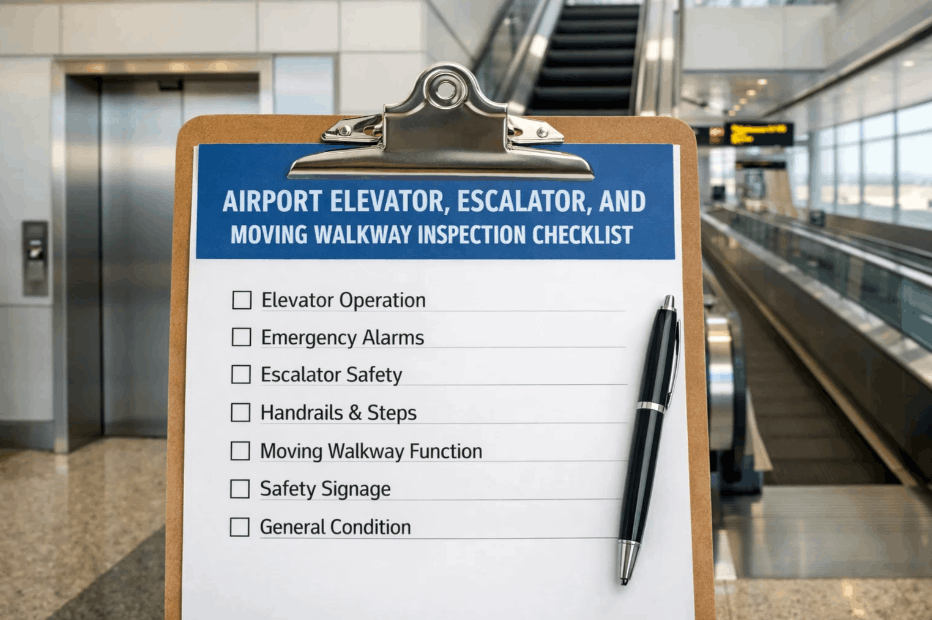
An elevator in the only accessible route to departures gates goes offline without a documented alternative accessible route or passenger notification — every wheelchair user denied access during that period is a documented violation, not a maintenance backlog item
Grab Bar Failure
Injury & Non-Compliance Together
A structurally compromised grab bar that pulls from the wall during use produces a personal injury claim, a liability investigation, and an ADA deficiency finding simultaneously — the inspection that would have caught the loose wall anchor costs a fraction of any one of those three outcomes
Hearing Loop Inoperative
Communication Access Denied
ADA requires communications with passengers with disabilities to be as effective as with other passengers — a non-functioning induction loop at a gate counter means a deaf passenger cannot independently receive the information a hearing passenger receives from the same interaction
No ADA Coordinator on Record
Administrative Finding, Immediate Action Required
FAA audit finds the ADA coordinator post vacant or unpublished — this is a standalone compliance deficiency under 49 CFR Part 27 that the physical condition of the airport cannot offset; it requires immediate corrective action and documented closure
Accessible Route Blocked
Construction Barrier Compliance Failure
A temporary construction hoarding placed across an accessible corridor without an alternative accessible route re-route and signage is a recurring finding at airports undergoing capital works — a predictable failure that an active inspection programme prevents
SAR Area Unmaintained
Service Animal Programme Deficiency
A service animal relief area that is unsanitary, unsigned, or on a route that a wheelchair user cannot access removes the accessible travel option for passengers with service animals — a finding that carries both accessibility and passenger welfare implications
Frequently Asked Questions
Airport accessibility in the United States is governed by three overlapping legal frameworks. The Americans with Disabilities Act (ADA) applies through Title II to public airport operators and through Title III to private operators and commercial tenants. Section 504 of the Rehabilitation Act of 1973 applies to airports receiving federal financial assistance — which includes virtually all commercial service airports — and requires that programmes and facilities be accessible to persons with disabilities. DOT regulations at 49 CFR Part 27 implement Section 504 for airports and specifically require that terminal facilities be readily accessible to and usable by individuals with disabilities, including wheelchair users. The Air Carrier Access Act (ACAA) and its implementing regulation at 14 CFR Part 382 add further requirements for air carriers operating within airport facilities. FAA Advisory Circular 150/5360-14A translates these obligations into specific operational requirements for airport operators. Non-compliance with any one of these frameworks can result in a complaint to the FAA Airport Disability Compliance Program, a DOJ investigation, or private litigation.
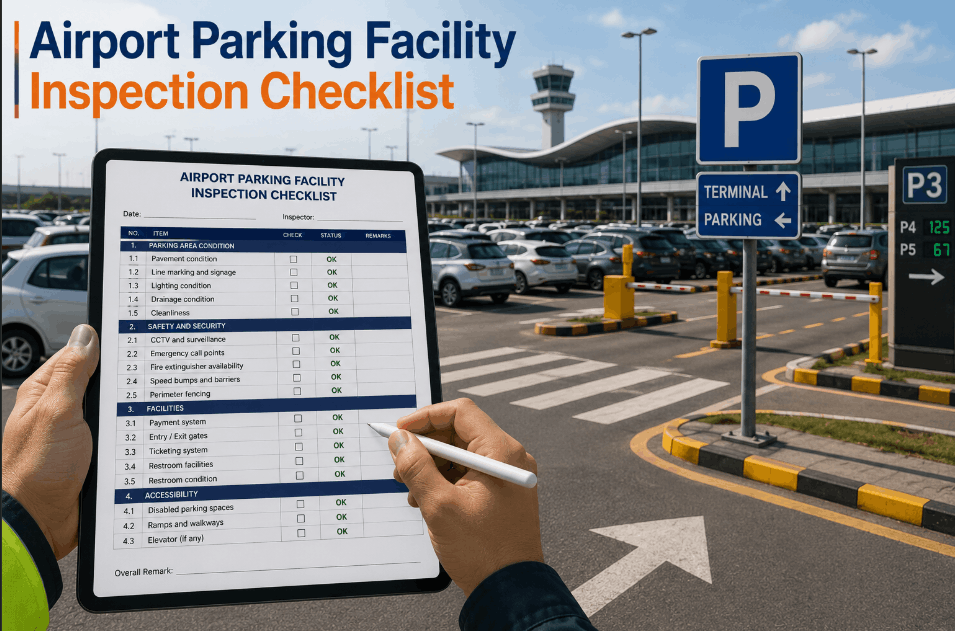
The 2010 ADA Standards for Accessible Design Table 208.2 sets out the minimum number of accessible spaces required based on total parking capacity. For every 6 accessible spaces (or fraction thereof), at least 1 must be van-accessible, with an 8-foot access aisle (compared to 5 feet for standard accessible spaces). All accessible spaces must be identified by the International Symbol of Accessibility (ISA) on a sign with its bottom edge at least 60 inches above the ground surface — this height requirement ensures the sign is visible when a vehicle is parked in the space. Van-accessible spaces must additionally be marked "Van Accessible." Accessible spaces must be located on the shortest accessible route to the terminal entrance, and the route itself must be free of level changes, ponding water, and obstructions. Parking access aisles must be level with a maximum slope of 1:48 in all directions and must connect directly to an accessible pedestrian route to the building entrance. Quarterly inspection of accessible space markings, sign condition, aisle surface, and route integrity is considered the minimum maintenance standard for compliance continuity.
The FAA Airport Disability Compliance Program investigates complaints from passengers with disabilities who have not received the same level of access that the airport provides to all passengers. During a compliance review, FAA reviewers assess both the physical condition of accessible features and the administrative compliance programme. Administrative items reviewed include the designation and publication of an ADA/Section 504 Coordinator, the existence and currency of a complaint procedure, the retention of complaint records for the required periods (1 year active, 5 years summary), the current status of the airport's ADA self-assessment, the inclusion of non-discrimination language in all lessee contracts, and the posting of the FAA Unlawful Discrimination poster. Physical items include the condition and continuity of accessible routes, parking, entrances, restrooms, elevators, gate areas, signage, and communication aids. The primary distinction between a finding and a clean review is documentation — airports that can produce timestamped, technician-attributed inspection and repair records for every accessibility feature are in a substantially stronger position than airports that rely on undocumented staff awareness.
Yes. DOT regulations implementing the Air Carrier Access Act require airports to provide service animal relief areas, and the FAA Reauthorization Act of 2024 reinforced and expanded service animal programme requirements. A compliant service animal relief area must be accessible to passengers with disabilities — meaning a wheelchair user travelling with a service animal must be able to reach and use the relief area independently. Areas must be provided on each side of the security screening checkpoint, since passengers may need to use the relief area after clearing security without re-clearing the checkpoint. The area must be accessible from gate areas on an accessible route, clearly signed from passenger flow paths, and maintained in a clean, usable condition. From a compliance tracking perspective, relief area inspections must appear on a documented, repeatable maintenance schedule — an area that is clean during an audit but has no inspection records demonstrates no programme, which is itself a finding.
iFactory's Compliance Tracking platform creates a structured asset record for every inspectable accessibility feature in your airport — each elevator, accessible restroom, hearing loop, service animal relief area, accessible parking zone, entrance, and route segment becomes a tracked asset with a full inspection history, current compliance status, and next-due inspection date. Inspection schedules are mapped directly to the compliance requirements of 2010 ADA Standards, 49 CFR Part 27, and FAA AC 150/5360-14A, so the platform knows that your hearing loops require monthly functional testing, your elevator uptime requires continuous monitoring and incident logging, and your accessible parking markings require quarterly condition inspection. When a compliance gap is detected — a failed elevator with no alternative route confirmed, a grab bar that fails its load inspection, or a relief area with an overdue maintenance record — iFactory generates a prioritised work order, assigns it to the responsible team member, and tracks it to resolution. For FAA audit purposes, iFactory produces complete, timestamped, technician-attributed inspection records for any asset or zone, across any date range. Pilot programmes for airport accessibility teams typically reach go-live within 4 to 6 weeks.
iFactory Compliance Tracking Platform
Don't Wait for a Passenger Complaint to Discover an Accessibility Gap.
iFactory connects your elevator uptime records, accessible restroom inspection history, hearing loop test results, parking condition assessments, and service animal relief area maintenance logs into a single accessibility compliance view — giving airport operators the audit trail that the FAA expects and the advance warning that prevents passenger harm.
Pilot in 30 days. Full integration in one quarter.