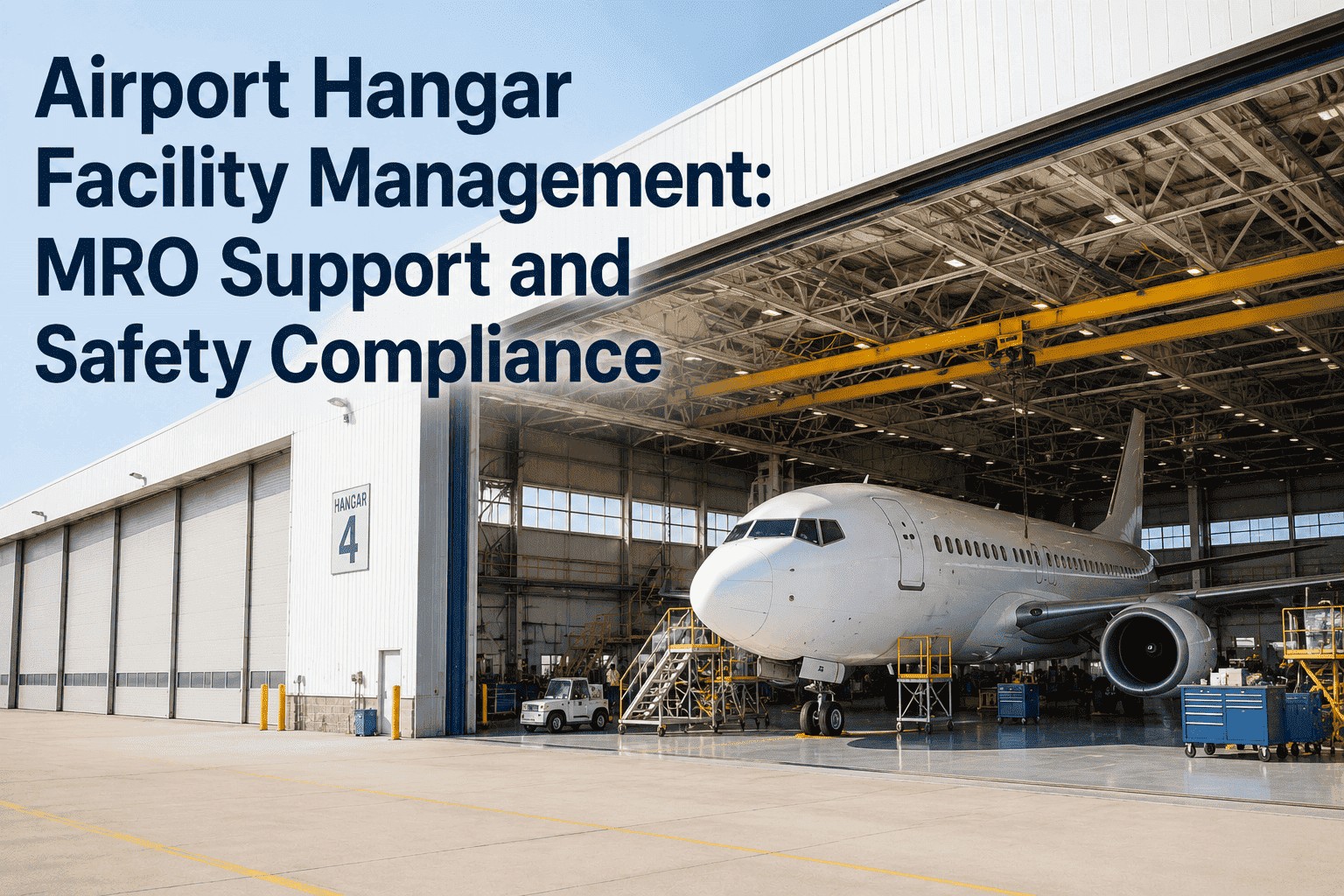
An aircraft hangar is not a warehouse. It is a precision maintenance environment where a single missed fire suppression inspection can ground a facility, a malfunctioning overhead door can delay an aircraft by hours, and an untracked crane service record can trigger an OSHA citation that shuts down MRO operations entirely. Facility managers supporting Maintenance, Repair and Overhaul operations carry a compliance burden that most commercial real estate professionals never encounter — and they carry it in an environment where the cost of failure is measured not in lost retail sales but in grounded aircraft, regulatory fines, and workforce safety incidents. The difference between a hangar that runs clean audits and one that fails them is almost never the quality of the maintenance work. It is whether the records proving that work was done — on time, to standard, against the right asset — exist and are accessible when the inspector arrives.
Hangar Facility Analytics · MRO Compliance · OSHA Tracking · Work Order Management
MRO Hangar Compliance Is Not a Paperwork Problem. It Is a System Problem. iFactory Solves It.
iFactory registers every hangar asset — overhead doors, crane systems, fire suppression, floor coatings, HVAC — into a tracked maintenance and compliance platform built for the inspection cadence MRO operations actually require.
$108B
Global MRO market value by 2030, growing at 4.8% CAGR — every facility dollar spent on compliance directly protects this revenue base
34%
Of OSHA aviation citations involve facility asset record gaps — not operational errors, but documentation failures on equipment that was maintained but untracked
$47K
Average cost of an unplanned hangar overhead door failure — including repair, aircraft repositioning delay, and MRO schedule disruption
62%
Of hangar crane system failures are preceded by a missed or deferred scheduled maintenance task — preventable with structured PM compliance tracking
The Compliance Landscape Every Hangar Facility Manager Operates In
Airport hangar facilities supporting MRO operations sit at the intersection of aviation regulatory requirements, occupational safety standards, fire code obligations, and equipment certification schedules. No single inspection framework covers all of it — which means the facility team must manage compliance across multiple authorities, each with their own inspection cadence, documentation format, and audit expectation. The assets carrying the highest compliance risk are often the least visible in day-to-day operations: the overhead door that was last serviced eight months ago, the fire suppression system whose annual certification is six weeks overdue, the crane hoist whose load test record has not been updated since the previous site manager left.
OSHA Standards
29 CFR 1910 General Industry
Covers overhead and gantry cranes, powered industrial equipment, electrical systems, and walkway surface conditions. Inspection records must be asset-specific and available on demand — not reconstructed from memory or general maintenance logs.
Crane Certification
Electrical Panels
Floor Safety
NFPA Standards
NFPA 409 Aircraft Hangars
Defines fire suppression system type, activation requirements, and inspection frequency for aircraft hangars by group classification. Annual inspection and certification of suppression systems is mandatory — with documentation retained at the asset and facility level for fire marshal review.
Suppression Systems
Hangar Classification
Annual Certification
FAA Advisory Circulars
AC 150/5370-10 Standards
Airport facility standards covering hangar door clearance requirements, ground support equipment movement paths, and facility condition reporting obligations tied to airport operating certificates. Non-compliance affects the operating certificate — not just the hangar lease.
Door Clearance
Operating Certificate
Facility Condition
Five Hangar Asset Systems That Create the Most Compliance and Operational Risk
Not every hangar asset carries the same risk profile. The five systems below account for the majority of compliance citations, operational disruptions, and unplanned capital expenditure in airport hangar facilities. Each one requires a different maintenance cadence, a different inspection standard, and a different documentation format — and each one will fail quietly until the moment it fails loudly.
01
Overhead Hangar Doors — Mechanical Drive, Track, and Safety Sensor Systems
Highest Disruption Risk
Hangar overhead doors are the largest moving mechanical systems in the facility and among the most maintenance-intensive. Drive motor wear, track misalignment, counterbalance tension loss, and safety sensor degradation each follow their own failure curve — and a door that fails in the open position in winter or the closed position during an active MRO cycle is a significant operational event. OSHA requires documented inspection of powered door systems on a schedule consistent with manufacturer specifications. Most hangar doors require quarterly mechanical inspection, annual full-system certification, and documented safety sensor testing before each operational period. Without asset-level tracking, these inspections cluster into informal habits rather than enforced schedules — until a citation or a failure makes the gap visible.
Drive motor service schedule
Track and roller inspection logs
Safety sensor test records
Annual certification tracking
02
Fire Suppression Systems — NFPA 409 Compliance and Inspection Certification
Regulatory Closure Risk
Aircraft hangars classified under NFPA 409 Groups I through IV each carry specific fire suppression requirements — low-expansion foam systems, deluge systems, or closed-head sprinkler configurations depending on aircraft size and hangar construction. Annual inspection, semi-annual discharge testing on certain system components, and documented quarterly visual checks are standard requirements. A fire marshal inspection that finds a suppression system with an overdue certification is not a warning — it is a facility closure order until the certification is completed and documented. iFactory registers each suppression system component as an individual asset with its own inspection schedule, generates work orders at the correct interval, and retains the completed inspection certificate at the asset level for immediate retrieval during any regulatory visit.
NFPA 409 schedule enforcement
Annual certification tracking
Component-level asset records
On-demand audit retrieval
03
Overhead Crane and Hoist Systems — OSHA Load Testing and Periodic Inspection
Workforce Safety Critical
Overhead cranes used in MRO hangars for engine handling, fuselage component movement, and ground support equipment positioning fall under OSHA 29 CFR 1910.179 — which mandates monthly inspections for equipment in regular service, annual thorough inspections, and load test records for any crane that has undergone structural modification or repair. The standard requires these records to be maintained and available for inspection. Facilities that manage crane records in binders, spreadsheets, or informal logs consistently struggle to produce complete documentation under audit pressure — because the records exist but are not organized by asset, date, and inspection type in a retrievable format. iFactory structures crane records at the asset level with mandatory fields for load rating, last test date, inspector credentials, and next scheduled inspection — ensuring the record that exists is the record that survives the audit.
Monthly inspection scheduling
Load test record retention
Inspector credential logging
Modification history tracking
04
Hangar Floor Coatings — FOD Prevention, Chemical Resistance, and Slip Compliance
FOD and Safety Exposure
Hangar floor coatings in MRO environments serve multiple simultaneous functions: foreign object debris (FOD) visibility (high-contrast surfaces make metal debris visible before it reaches aircraft), chemical resistance against hydraulic fluid, fuel, and solvents, and slip resistance compliance under OSHA walkway standards. Coating delamination, crack propagation, and chemical degradation are progressive conditions — a floor that passes inspection in January may have developed significant FOD-risk surface damage by July under heavy equipment traffic. Without a structured condition tracking and recoating schedule, facilities manage floor maintenance reactively, applying patches rather than monitoring the overall condition against a rated service life. iFactory tracks floor zone condition ratings through periodic visual inspections logged as work orders, flagging zones approaching recoating threshold before FOD risk becomes a safety event or an audit finding.
Zone condition rating tracking
Recoating threshold alerts
FOD risk zone mapping
Inspection record storage
05
Hangar HVAC and Ventilation — Temperature Control, Fume Extraction, and Air Quality Compliance
Air Quality and Work Permit Risk
MRO hangar HVAC systems carry ventilation obligations that do not apply to standard industrial buildings. Fuel vapor dispersal requirements during fueling operations, paint booth exhaust specifications during aircraft refinishing, and solvent fume extraction in avionics and component workshops are each governed by OSHA and EPA standards requiring measurable air quality outcomes — not just equipment operation records. A hangar HVAC system that is running but not performing to the ventilation rate required for confined space work permits creates a compliance gap that is invisible until an air quality measurement is taken or an incident triggers a review. iFactory manages HVAC assets at the unit level with separate PM schedules for supply air, exhaust, and specialist fume extraction systems — and links ventilation performance records to the confined space work permits that depend on them.
Unit-level HVAC PM scheduling
Fume extraction records
Ventilation performance logs
Work permit record linkage
An Inspection Without a Record Did Not Happen. iFactory Makes Sure the Record Always Exists.
Every hangar asset. Every inspection. Every work order. Tracked, stored, and retrievable — before the auditor asks, not after.
How iFactory Manages the MRO Hangar Compliance Calendar
MRO hangar compliance is not a once-a-year event. It is a continuous cycle of inspections, certifications, and maintenance tasks distributed across weekly, monthly, quarterly, and annual intervals — each with different regulatory owners, different documentation standards, and different consequences for non-completion. iFactory pre-loads and enforces this calendar at the asset level, so every task is tracked against the right schedule, not the available schedule.
Overhead door safety sensor function test — document pass/fail per door per session
Visual floor condition check — flag any new delamination, cracking, or chemical staining in active work zones
Open work order status review — confirm all reactive maintenance requests are progressing within response targets
Overhead crane inspection per OSHA 1910.179 — document hoist, hook, chain, and brake condition per unit
HVAC filter condition check across main supply air and exhaust units — replace per schedule, log date and technician
Fire extinguisher visual inspection — confirm charge status, tamper seal, and placement per floor plan
Full overhead door mechanical inspection — drive motor, track alignment, counterbalance tension, and limit switches
Fire suppression system visual inspection — check coverage heads, activation sensors, and riser condition per zone
Fume extraction performance measurement — verify airflow rates in paint and solvent zones against work permit standards
NFPA 409 fire suppression system full inspection and certification — store certificate at asset and facility level
Overhead crane thorough inspection and load test per OSHA 1910.179 — update rating, record inspector credentials
Full asset condition review and CapEx forecast update — rate all major systems and project replacement timelines for budget submission
What the Compliance Record Gap Actually Costs
The financial cost of hangar compliance failure is rarely just the fine. It is the sum of the fine, the facility downtime, the MRO schedule disruption, the emergency contractor premium, and the relationship cost with the airline operator whose aircraft is on jacks when the hangar is ordered closed. Understanding where the real cost accumulates is the first step toward understanding why a structured maintenance platform is not an overhead expense — it is risk capital.
OSHA Citation — Crane Documentation Gap
OSHA Penalty (per violation)
$15,625
Facility downtime — crane OOS
$8,000–22,000
Emergency certification contractor
$3,500–8,000
MRO schedule delay (one aircraft)
$12,000–40,000
Total Event Cost Range
$39K–$86K
NFPA Fire Suppression Certification Failure
Fire marshal closure order
Immediate
Hangar downtime — full closure
2–7 days typical
Aircraft relocation and storage
$5,000–18,000
Airline operator penalty exposure
$20,000–80,000
Total Event Cost Range
$30K–$110K
"
We ran a hangar with three overhead cranes and had been managing inspection records in a folder on a shared drive. When an OSHA compliance inspection arrived following an unrelated incident on the airfield, we spent four hours reconstructing crane inspection records from technician emails and contractor invoices. We passed, but it was close — and two records were incomplete. Six months later we had every crane asset registered with its own inspection schedule and all records stored at the asset level. When the follow-up inspection came, we printed the complete record for all three cranes in under two minutes. The inspector said it was the cleanest documentation he had seen at a facility our size.
— Maintenance Manager, Regional MRO Facility — 14 Years Aviation Facility Operations
Frequently Asked Questions
Conclusion
Airport hangar facilities supporting MRO operations carry a compliance obligation that most facility management platforms are not designed for. The assets are specialized, the inspection standards are multi-jurisdictional, the documentation requirements are asset-specific, and the cost of a gap — whether it is a missed crane inspection, an overdue suppression certification, or an untracked floor condition — is not absorbed quietly. It surfaces as a facility closure, an OSHA citation, an airline operator dispute, or a capital emergency that could have been forecast twelve months earlier. The facilities teams that avoid these outcomes do not do so by working harder. They do so by managing every asset against a structured schedule, documenting every inspection before the auditor asks, and having a system that produces the record on demand rather than reconstructing it under pressure.
iFactory's facility management and work order platform registers every hangar asset — overhead doors, crane systems, fire suppression, floor zones, HVAC, and lighting — into a tracked, compliance-ready maintenance calendar with AI-driven scheduling, fault pattern analytics, and on-demand audit record retrieval. Book a Demo to see how the platform maps to your hangar and MRO asset profile, or Get In Touch to begin building your hangar asset registry and compliance calendar from day one.
A Compliance Record That Does Not Exist Cannot Protect Your Facility. iFactory Makes Sure It Always Does.
Every hangar asset tracked. Every inspection documented. Every certification ready before the inspector arrives — not after.