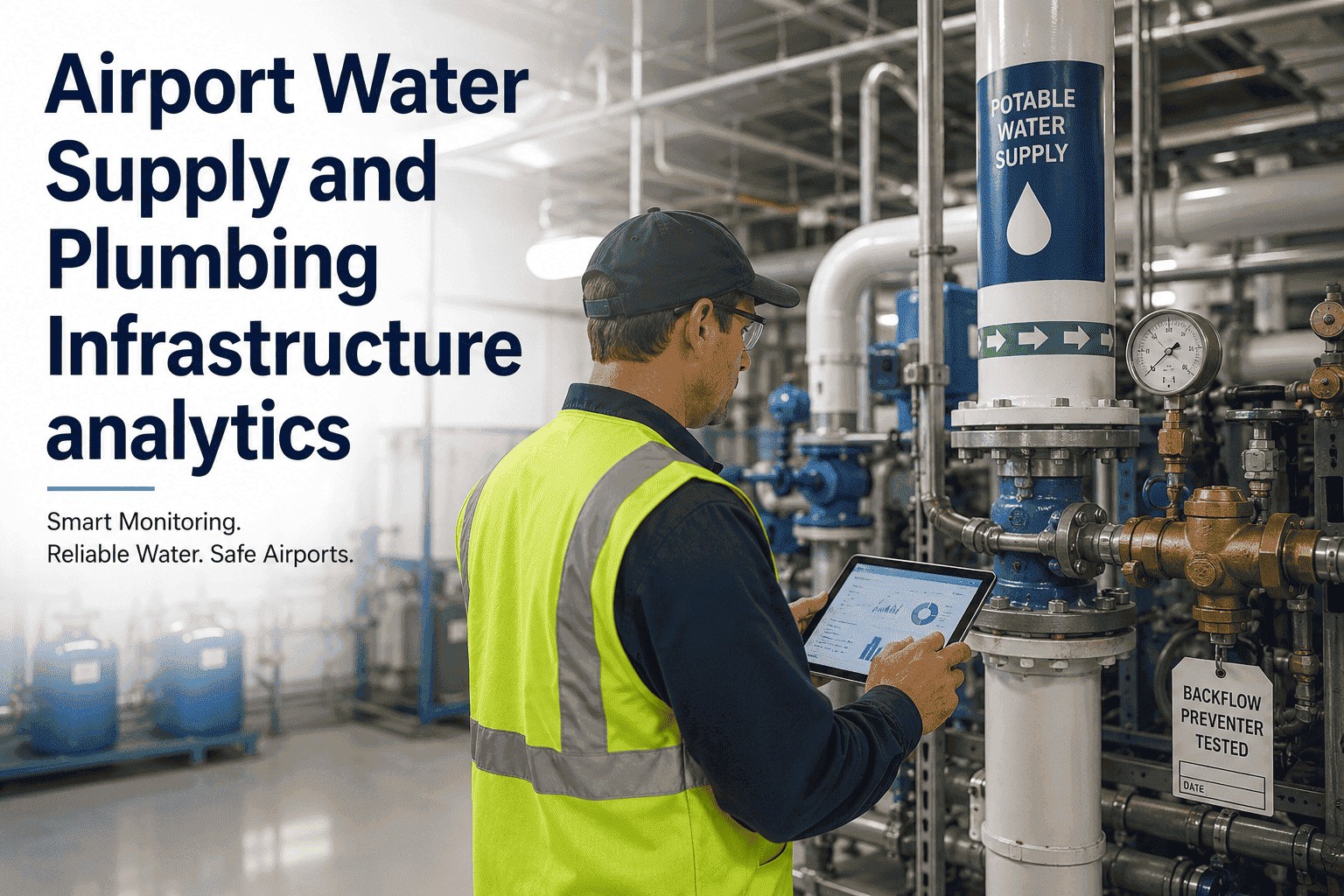
Airport Water Supply and Plumbing Infrastructure analytics
By Grace on May 30, 2026
A large international airport consumes between 400,000 and 3 million gallons of water daily — flowing through terminals, concourses, food courts, maintenance hangars, and cooling systems that together form one of the most complex building water networks in any facility type. Every one of those systems carries a compliance obligation: backflow prevention assemblies require annual certified testing, water management programs mandate weekly flushing of low-use fixtures to prevent Legionella colonisation, and pipe integrity failures in high-traffic terminal zones don't just create maintenance emergencies — they close restrooms, disrupt food concessions, and generate health authority notifications. The facilities that prevent these failures do not do so by reacting faster. They do so by tracking every asset, scheduling every test, and building a documented maintenance record before the failure — not after it.
One Unmanaged Water System Can Shut Down a Terminal. iFactory Makes Sure Every System Is Managed.
iFactory's preventive maintenance platform tracks every water asset across your airport — with scheduled inspections, compliance testing logs, Legionella program documentation, and pipe condition records built in from day one.
Peak daily water consumption at large international airports — equivalent to a mid-size city's daily demand
Annual
Mandatory certified testing frequency for all mechanical backflow prevention assemblies under cross-connection control programs
Weekly
Flushing frequency required for low-use fixtures and dead legs under ASHRAE 188 Legionella water management programs
48%
Of airport facilities managers cite aging pipelines as a major concern, with higher repair costs, frequent leaks, and contamination risk
Airport Water Systems Are Not One System. They Are a Portfolio of Interconnected Risk Points.
Terminal buildings, concourse facilities, airside support buildings, catering units, and cooling plant rooms all share connections to the same water distribution network — but each zone carries different usage patterns, different stagnation risks, different compliance obligations, and different failure consequences. A cooling tower basin failure is a Legionella risk requiring immediate remediation. A backflow assembly that misses its annual test is a cross-connection control compliance violation that the water authority will identify. A dead leg in a remote gate corridor with a rarely-used drinking fountain is a slow-building biological hazard that produces no alarm until a sampling result triggers a response. Preventive maintenance transforms these silent risks into scheduled tasks with documented outcomes — before health authorities, auditors, or a water emergency forces the issue.
What Happens When Each Water System Fails Without a Preventive Program
L
Legionella Colonisation in Stagnant Fixtures
Gate-area drinking fountains and utility corridor showers with low usage accumulate standing water in the 25°C–45°C range — ideal Legionella growth conditions. Without a documented weekly flushing program, colonisation builds undetected. A positive sampling result triggers mandatory health authority notification, potential facility closure, and a full remediation program.
Public Health Risk + Regulatory Notification
B
Backflow Assembly Missed Annual Test
Airports with multiple RPZ valves and double check assemblies protecting fire suppression, irrigation, and food service connections face a large testing portfolio. A missed annual test is not a minor lapse — it is a cross-connection control compliance violation that the water authority tracks by serial number. Overdue assemblies generate formal notices and reconnection fees if service is suspended.
Compliance Violation + Water Authority Notice
P
Pipe Failure in Active Terminal Zone
A pipe joint failure or pressure surge event in a busy terminal corridor closes restroom facilities and triggers food court disruptions. In 2025, Richmond International Airport made headlines when passengers found restroom facilities closed due to water pressure failures. Aging pipeline conditions — corrosion, joint degradation, pressure imbalance — are predictable through inspection history when tracked as assets rather than discovered as emergencies.
Passenger Disruption + Concession Revenue Loss
C
Cooling Tower Biological Sampling Gap
HVAC cooling tower basins concentrate warm, nutrient-rich water and represent the highest Legionella risk in most airport portfolios. Biocide dosing, blowdown cycles, and quarterly biological sampling are required components of most water management programs. A sampling gap — or a sampling result without a documented corrective action — is both a compliance failure and the precondition for an outbreak that carries significant liability.
Highest Legionella Risk + Liability Exposure
The Legionella Risk Map Every Airport Water Manager Needs to Know
ASHRAE Standard 188 and CDC guidance establish a clear risk hierarchy across airport water system types. The assets that pose the greatest Legionella risk are not always the most visible — they are the ones with the warmest stagnant water, the least regular use, and the most direct aerosol exposure pathway to passengers and staff. iFactory maps each asset to its risk tier and applies the corresponding inspection and flushing schedule automatically.
Asset Type
Why It's a Legionella Risk
Required Action
Cooling Towers
Warm basin temperatures and aerosol dispersal create the highest-risk Legionella environment in any airport facility. Biocide levels and blowdown cycles directly determine bacterial load.
Tanks storing water at 77°F–113°F (25°C–45°C) provide ideal growth conditions if thermostat calibration drifts or dead zones develop within the vessel.
Monthly temperature verification, annual tank inspection
Low-Use Fixtures
Gate-area drinking fountains and utility showers used infrequently allow stagnant water to accumulate in terminal dead legs — the primary condition for Legionella colonisation in premise plumbing.
Weekly documented flushing per ASHRAE 188 WMP
Pressure Booster Pumps
Low-pressure events from pump failures push water into dead legs, increasing stagnation risk across entire distribution zones. Pump condition directly determines system-wide Legionella exposure.
PM schedule per manufacturer cycle, pressure monitoring
Main Distribution
High-flow mains serving active terminal areas maintain disinfectant residual and flow velocity that suppresses Legionella growth — managed risk when pipe condition is tracked and pressure is monitored.
Annual pipe inspection, pressure integrity records
A Positive Legionella Sample Without a Flushing Log Is a Health Authority Event. With One, It Is a Maintenance Record.
iFactory schedules every flushing task, logs every temperature check, tracks every backflow test — and keeps the documentation that turns a water quality risk into a managed, compliant program.
Five Water Asset Classes. One Preventive Maintenance Platform. Every System on Schedule.
iFactory registers every water and plumbing asset across your airport campus as a tracked, schedulable unit — with its system type, location, compliance classification, inspection history, and maintenance schedule maintained at the asset level, not reconstructed from scattered paper records when an inspection or sampling event demands them.
Asset Class 01
Backflow Prevention Assemblies — Annual Testing Compliance and Certification Tracking
Cross-Connection Control Compliance
Airports operate dozens to hundreds of backflow prevention assemblies — RPZ valves protecting fire suppression connections, double check valves on irrigation systems, vacuum breakers on food service equipment, and pressure-rated assemblies on aircraft water servicing points. Every mechanical testable assembly requires annual certified testing under cross-connection control programs, with the test report retained and reportable to the water authority. A single overdue assembly is a traceable compliance violation. iFactory registers each assembly by type, location, installation date, and test due date — auto-generates work orders for annual testing, attaches the certified tester's report to the asset record, and exports the water authority compliance register on demand without manual assembly.
Annual test scheduling per assembly
Certified tester report attachment
Water authority register export
Asset Class 02
Cooling Towers and HVAC Water Systems — Biocide Dosing Logs and Biological Sampling Tracking
Highest Legionella Risk Asset
Cooling tower basins present the highest Legionella risk in the airport environment — combining warm water temperatures, aerosol dispersal, and nutrient-rich conditions that support rapid bacterial growth when biocide levels lapse or blowdown cycles are missed. Most water management programs require monthly biological sampling of tower basins, with quarterly culture tests and documented corrective actions for results above action thresholds. iFactory registers each cooling tower unit with its chemical treatment program, logs biocide dosing events against the scheduled dosing calendar, records biological sampling results with lab report attachments, and escalates results above action thresholds to immediate remediation work orders — creating the documented sampling chain that satisfies both ASHRAE 188 requirements and health authority inquiries.
Biocide dosing schedule tracking
Biological sampling result logs
Action threshold escalation
Asset Class 03
Terminal Plumbing Fixtures and Dead Legs — Weekly Flushing Documentation and Stagnation Control
Stagnation and WMP Compliance
Low-use plumbing fixtures — drinking fountains in remote gate areas, showers in utility and crew rooms, faucets in infrequently accessed service corridors — accumulate stagnant water in the temperature range where Legionella grows most effectively. ASHRAE Standard 188 water management programs require weekly flushing of infrequently used outlets and documentation that flushing occurred — not just that it was scheduled. Without a system enforcing and logging this task, flushing schedules are created and forgotten, and the compliance gap between written policy and actual practice grows silently. iFactory registers each low-use fixture as an individual asset with its flushing schedule, generates weekly work orders for each location, and logs the completion with technician ID and timestamp — creating the fixture-level flushing record that an ASHRAE 188 audit requires.
Weekly flushing work orders per fixture
Completion log with technician ID
WMP compliance record export
Asset Class 04
Distribution Pipework and Pressure Systems — Pipe Condition Tracking and Integrity Monitoring
Aging Infrastructure Risk
Distribution pipework in airport terminals ages under continuous pressure cycling, temperature variation, and the mechanical stress of high-usage periods. Corrosion buildup restricts flow, increases leak frequency, and at advanced stages produces contamination risk in the distribution network. Pressure booster pumps maintaining terminal water pressure across multi-story facilities are equally critical — pump seal degradation and impeller wear create the low-pressure conditions that push water into dead legs and distribute bacterial contamination through the supply zone. iFactory tracks each pipe section and pump unit with its installation year, inspection history, and condition rating — generating replacement and PM schedules based on observed condition progression rather than waiting for emergency failure to trigger the response.
Pipe section condition tracking
Pressure booster pump PM scheduling
CapEx replacement forecasting
Asset Class 05
Grease Interceptors and Drainage Systems — Loading-Based Service Scheduling
Food Court and Concession Infrastructure
Airport food courts and concession facilities generate grease loading at a rate tied directly to passenger throughput — which varies significantly between peak travel periods and off-peak days. A grease interceptor serviced on a fixed calendar schedule that doesn't reflect actual loading runs the risk of overflow events during peak periods, triggering trade waste compliance violations and concession shutdowns at the worst possible time. iFactory tracks each interceptor's service history and loading pattern — flagging units approaching capacity threshold based on observed accumulation rates rather than a fixed calendar — and records each pump-out event with the licensed contractor's sign-off and waste manifest, satisfying trade waste authority record requirements.
Loading-based service scheduling
Pump-out event documentation
Trade waste compliance records
The Maintenance Calendar That Keeps an Airport Water Program Compliant Year-Round
Airport water compliance is not a single annual event — it is a continuous schedule of tasks distributed across daily, weekly, monthly, and annual cycles. iFactory pre-configures this schedule across all asset types and enforces it through automated work order generation, so the compliance program runs whether or not the facilities team remembers to initiate it.
Verify hot water return temperature at distribution points
Check cooling tower basin visual condition and water level
Monthly
Biological sampling of cooling tower basins with lab result log
Hot water storage tank temperature verification and documentation
Pressure booster pump visual inspection and seal condition check
Quarterly
Full cooling tower inspection — basin, fill, drift eliminators, structure
Culture testing of high-risk water points per WMP sampling plan
Grease interceptor loading assessment and scheduled pump-out
Annual
Certified testing of all mechanical backflow prevention assemblies
Full pipe integrity inspection — condition rating and replacement forecast update
Water management program review and asset registry update
"
We had a water management program written by a consultant and approved by the health authority. We had flushing schedules in the document and sampling plans in the appendix. What we did not have was any evidence that the flushing was happening on the ground. When a routine sampling result came back elevated and the health authority asked for our flushing records, we had the policy but we could not demonstrate execution. Switching to a digital platform meant that every technician who completed a flushing task created a timestamped record at that fixture. The next time a result was elevated, we had three months of flushing logs to show — and the corrective action was a plumbing issue, not a program failure.
— Facilities Compliance Manager, International Gateway Airport — 11 Years Aviation Facilities
Frequently Asked Questions
iFactory maps the asset hierarchy of a multi-terminal airport campus — terminals, systems, individual assets, and components — and attaches the relevant Water Management Program inspection schedule to each asset type at registration. Weekly flushing tasks are auto-generated per registered fixture. Biological sampling work orders are scheduled per tower and per sampling point. Every completed task creates a timestamped record with the technician ID and any findings noted — exportable as a structured compliance report covering any date range, asset type, or building zone. This is the execution record that turns a written WMP into a demonstrably implemented program. Talk to an Expert to begin your water asset registry and see the first ASHRAE 188-aligned inspection schedule generate automatically.
Each backflow prevention assembly in iFactory is registered with its type (RPZ, DCVA, PVB, SVB), its location, its hazard classification, the licensed tester assigned to it, and its test due date calculated from the last completed test. Annual test work orders are generated automatically and assigned to the tester. When testing is complete, the certified test report is attached directly to the asset record with the tester's name, certification number, and timestamp. Assemblies approaching or past their test due date appear in the compliance dashboard with a visual overdue flag — ensuring no assembly is missed in a large portfolio. Book a Demo to see how the backflow compliance dashboard maps to your current assembly inventory.
When a biological sampling result is logged in iFactory and the recorded level exceeds the action threshold defined in the asset's Water Management Program, the platform automatically generates a high-priority corrective action work order linked to the sampling asset — documenting the triggering result, the required response protocol, and the technician assigned. All subsequent remediation tasks — hyperchlorination, temperature flush, resampling — are created as linked work orders against the same event record, building the complete remediation audit trail that health authorities require when investigating an elevated result. Talk to an Expert to deploy Legionella-aligned sampling and escalation workflows across your airport water assets.
iFactory tracks each pipe section and plumbing system component with its installation year, material type, inspection condition rating, and fault history. As condition ratings are updated through annual inspections, the platform projects end-of-useful-life timelines based on observed deterioration rate — combining installation age with current condition to generate a forward-looking replacement schedule. Finance teams can view a 12, 24, and 36-month CapEx forecast for pipe replacements across all terminals simultaneously, allowing planned capital investment based on actual asset condition rather than last year's emergency repair budget. Book a Demo to see how pipe lifecycle forecasting maps to your campus infrastructure profile.
Conclusion
Airport water infrastructure is not a background utility — it is a compliance-dense, health-critical system that serves tens of thousands of passengers daily across every corner of a complex, multi-building campus. Legionella doesn't send a warning before a positive sample. A backflow assembly doesn't announce when its annual test is overdue. A pipe joint in a terminal wall doesn't telegraph its failure until the floor is wet. Preventive maintenance transforms each of these from silent risks into scheduled tasks with documented outcomes — and the documentation is not just operationally useful, it is the asset that protects the airport when a health authority or water regulator asks what the facility did to prevent the problem.
iFactory's preventive maintenance platform registers every water and plumbing asset across your airport — with compliance-aligned inspection schedules, Legionella program documentation, backflow testing records, and pipe condition tracking that keeps your water infrastructure managed, compliant, and audit-ready. Book a Demo to see how the platform maps to your water asset portfolio, or Talk to an Expert to begin your water asset registry and generate your first compliance-scheduled maintenance calendar.
A water management program that exists on paper but not in practice is not a compliance record — it is a liability document.
iFactory enforces every flushing schedule, logs every backflow test, tracks every sampling result, and makes your water program demonstrably executed — not just written.