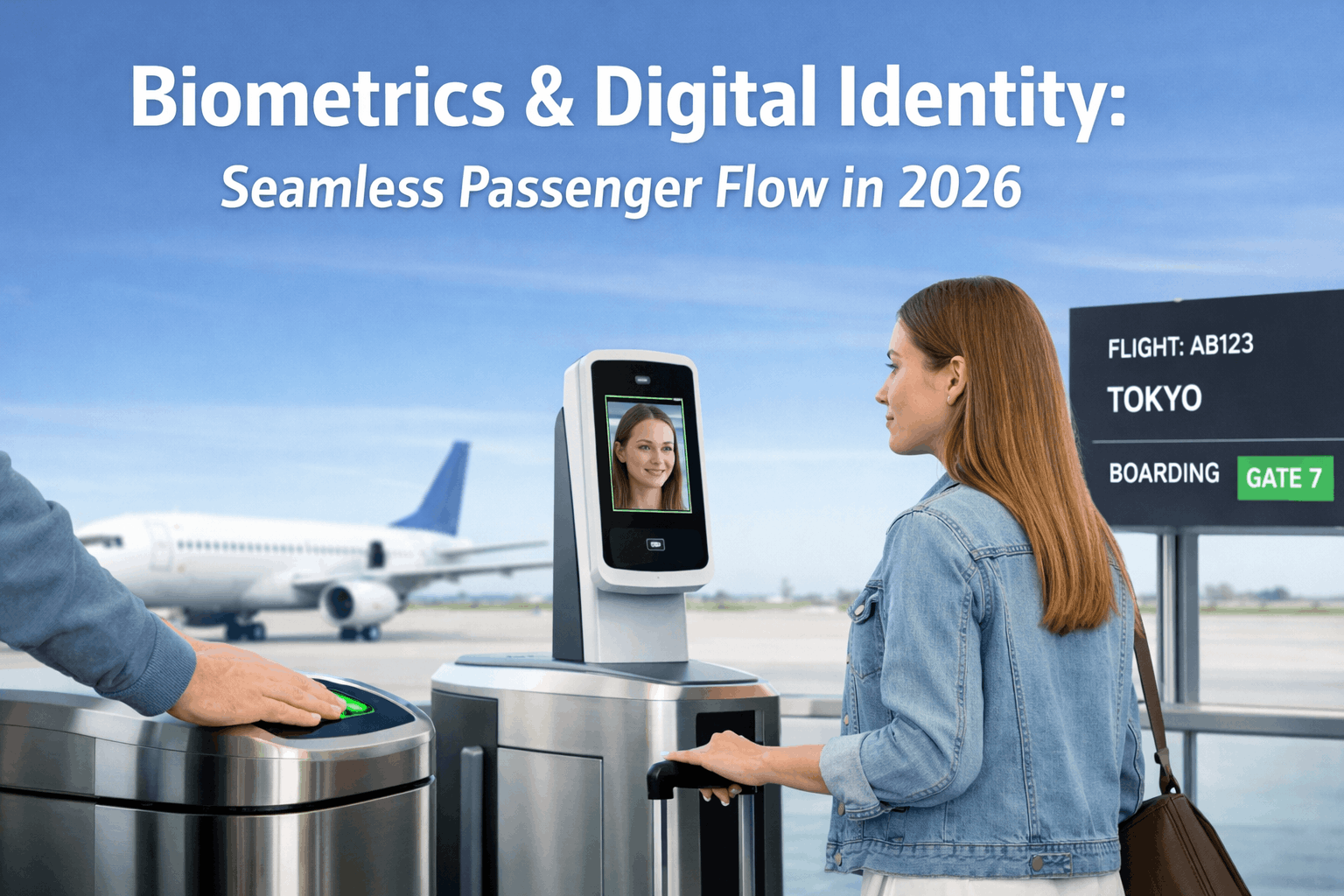
A passenger arriving at a major European hub airport in January 2026 touched her passport to a kiosk at check-in, looked at a camera, and never showed a document again. She walked through bag drop — face matched. Security lane — face matched, no boarding pass scan. Lounge entry — face matched. Boarding gate — face matched, door opened. Total identity verification touches across five airport touchpoints: zero physical documents after the initial enrollment. Total time saved versus the traditional check-in-to-gate journey: 27 minutes. She didn't notice. That was the point. Across the concourse, a different passenger at the same airport experienced the 2024 version of the same journey: queued 14 minutes at check-in for a paper boarding pass, waited 22 minutes at security while staff manually matched faces to passports under fluorescent lights, showed his boarding pass and passport again at the lounge desk, and queued another 12 minutes at the gate while 180 passengers had their boarding passes scanned one by one. Total identity verification friction: 5 physical document presentations, 48 minutes of queueing, and 3 separate interactions where a human visually compared a photograph taken years ago to a face standing in front of them — a task that cognitive science has proven humans perform with only 80–85% accuracy under operational conditions. The gap between these two experiences is not theoretical — it is deployed, measured, and scaling globally. By 2026, IATA projects that 500+ airports will operate at least one biometric touchpoint, with 120+ running end-to-end biometric corridors from curb to gate. The technology is proven. The passenger preference is overwhelming (92% satisfaction rates in deployed corridors). The operational efficiency gain is documented (40% faster boarding, 60% fewer manual identity checks, 30% reduction in staff required at touchpoints). And the infrastructure that makes it all work — biometric cameras, enrollment kiosks, e-gates, network switches, and identity management servers — requires the same predictive maintenance and operational intelligence that every other airport-critical system demands. iFactory's AI platform delivers the operational backbone for biometric airport infrastructure: predictive maintenance of biometric hardware, digital twin simulation of passenger flow through identity touchpoints, real-time system health monitoring, and the CMMS integration that ensures every camera, kiosk, and e-gate operates at the availability level that seamless passenger flow requires. Book a free biometric infrastructure assessment to evaluate your airport's readiness for end-to-end digital identity — or visit our Support Center to explore the platform.
6 Friction Points That Biometric Digital Identity Eliminates
Every physical document presentation in the passenger journey creates a queue, requires staff, introduces human error, and degrades the experience. Six specific friction points account for the 48+ minutes of identity-related delay that passengers endure in traditional airport operations — and that biometric corridors compress to near-zero.
Manual Check-In Document Verification — 8–14 Minutes Queued
Traditional check-in requires a human agent or kiosk interaction where the passenger presents a passport, the system verifies identity against the booking, and a boarding pass is issued. Biometric enrollment at this single touchpoint replaces all subsequent identity checks: the passenger's face becomes their boarding pass, lounge access card, and gate ticket for the entire journey. iFactory monitors enrollment kiosk hardware health — camera calibration, document reader function, and network connectivity — ensuring 99.5%+ kiosk availability during peak enrollment hours.
Security Checkpoint Identity Bottleneck
Security officers visually compare passport photos to faces at 80–85% accuracy — the cognitive limit for unfamiliar face matching. Biometric verification at security achieves 99.7% accuracy in under 2 seconds, eliminating the manual comparison step. iFactory predictive maintenance ensures security-lane biometric cameras maintain calibration and image quality 24/7.
Boarding Gate Queue — 12+ Minutes per Flight
Traditional boarding requires each of 150–300 passengers to present a boarding pass for scanning and optionally show ID — processing at 6–8 seconds per passenger. Biometric boarding gates process passengers at 2–3 seconds each with a walk-through camera — no document presentation, no barcode scanning, no stopping. The result: 40% faster boarding turnaround.
Lounge & Retail Identity Friction
Lounge access currently requires boarding pass + loyalty card presentation. Duty-free purchases require passport for tax-free verification. Biometric identity enables frictionless lounge entry and automated tax-free eligibility — enhancing the commercial experience while eliminating queue points that degrade dwell time available for revenue-generating activities.
Immigration & Border Control Processing
Manual passport inspection averages 45–90 seconds per passenger. Automated biometric e-gates process passengers in 10–15 seconds with higher verification accuracy. For airports handling 50M+ passengers annually, the throughput difference is measured in millions of staff-hours and billions in economic productivity — all dependent on e-gate hardware that must operate at 99%+ availability.
Biometric Infrastructure Downtime — The Hidden Risk
When a biometric camera fails at a boarding gate, that gate reverts to manual processing — creating an instant bottleneck that delays the flight. When an e-gate bank goes offline at immigration, queues build at 150+ passengers per hour. Biometric infrastructure requires the same predictive maintenance discipline as any safety-critical airport system — and iFactory provides exactly that capability.
Planning a biometric deployment or expanding an existing corridor? Book a free biometric infrastructure readiness assessment with our airport technology specialists.
How Digital Identity Creates the Seamless Airport
The seamless passenger journey is not created by installing cameras at touchpoints — it is created by connecting biometric enrollment, identity verification, passenger flow data, and infrastructure health into one intelligent system that works continuously. Here is how data flows from passenger enrollment to seamless gate departure.
Biometric Enrollment at First Touchpoint
Passenger presents passport once. Camera captures biometric template. Identity linked to booking, boarding pass, and all downstream touchpoints in a single enrollment event.
Frictionless Verification at Every Touchpoint
Security, lounge, retail, and boarding — each touchpoint verifies identity in under 2 seconds via camera. No documents presented. No barcode scanned. Passenger walks through naturally.
Infrastructure Monitored & Optimized by AI
iFactory tracks camera health, kiosk availability, e-gate status, and network connectivity — predicting hardware failures before they create passenger-facing bottlenecks.
Biometric Hardware Predictive Maintenance
Every enrollment kiosk, verification camera, e-gate mechanism, document reader, and network switch in the biometric corridor monitored continuously. Camera image quality degradation detected before it affects match accuracy. Kiosk component failures predicted 2–4 weeks ahead. E-gate mechanical wear tracked per open/close cycle. CMMS work orders auto-generated with component, location, and recommended action — ensuring 99.5%+ hardware availability across every touchpoint.
Digital Twin Passenger Flow Simulation
iFactory's digital twin models passenger flow through every biometric touchpoint — enrollment, security, lounge, gate — simulating queue formation, throughput bottlenecks, and dwell time distribution under varying passenger loads. "What happens if enrollment kiosk 3 fails during the 7 AM peak?" "Where does the queue form if we add 200 passengers to the 14:00 wave?" The twin answers with quantified impact and resource redeployment recommendations.
Real-Time System Health Dashboard
Live status of every biometric device across the airport: camera online/offline/degraded, kiosk available/in-use/error, e-gate functional/maintenance/failed, network latency per corridor segment. Operations teams see at a glance which corridors are fully operational and which have degraded touchpoints — enabling immediate staff redeployment to maintain seamless passenger flow even during partial hardware outages.
Identity System Performance Analytics
Match accuracy rates per camera position, enrollment success rates per kiosk, throughput per gate per hour, and false rejection rates tracked continuously. When a camera's match accuracy drops below threshold — indicating lens contamination, lighting change, or calibration drift — iFactory generates a maintenance alert before passengers experience match failures that force manual fallback processing.
See Biometric Infrastructure Monitoring, Digital Twin Flow Simulation & System Analytics Live
iFactory integrates biometric hardware predictive maintenance, passenger flow digital twin, real-time system health monitoring, and identity performance analytics into one platform — ensuring every camera, kiosk, and e-gate operates at the availability level seamless passenger flow demands.
The ROI of Biometric Passenger Flow
Quantified results from airports that have deployed end-to-end biometric corridors with iFactory-managed infrastructure health monitoring across their identity touchpoint portfolio.
Traditional Processing vs. Biometric Corridor: The Gap
Ready to close the gap between document-based processing and seamless biometric flow? Request a custom biometric corridor assessment for your airport.
5-Phase Implementation Roadmap
A phased approach that delivers passenger flow improvements at every stage — starting with highest-impact touchpoints and scaling to a fully connected biometric corridor with predictive infrastructure management.
Infrastructure Audit & Touchpoint Mapping (Weeks 1–4)
Audit all passenger identity touchpoints: check-in, bag drop, security, lounge, gate, immigration. Map existing hardware — cameras, kiosks, e-gates, document readers, network infrastructure. Classify touchpoints by passenger volume, current processing time, and biometric retrofit readiness. Identify highest-impact touchpoints for Phase 1 deployment — typically boarding gates and security lanes where queue time is greatest.
Biometric Hardware Deployment & Integration (Weeks 5–10)
Install enrollment kiosks, verification cameras, and e-gate biometric readers at priority touchpoints. Connect all hardware to iFactory's predictive maintenance platform. Establish baseline health metrics for every device — camera image quality, kiosk component status, e-gate cycle counts, and network latency per touchpoint segment.
Identity System Activation & Testing (Weeks 10–16)
Activate biometric enrollment and verification workflows. Validate match accuracy rates per camera position against operational standards (99.5%+ required). Configure false rejection rate thresholds and fallback processing procedures. Train operational staff on biometric corridor management and exception handling.
Digital Twin & Flow Optimization (Weeks 16–22)
Activate digital twin passenger flow simulation for all biometric touchpoints. Model queue behavior under peak loads, hardware failure scenarios, and seasonal traffic variation. Optimize enrollment kiosk placement, camera positions, and gate assignments based on simulation data. Begin continuous flow monitoring with real-time operational dashboards.
End-to-End Corridor & Continuous Improvement (Week 22+)
Expand biometric verification to all touchpoints — completing the curb-to-gate corridor. Activate commercial integrations (lounge, retail, duty-free). Scale to additional terminals and concourses. AI models continuously improve hardware prediction accuracy and flow optimization as data accumulates over time.
Biometric Touchpoint Categories: What the Digital Airport Requires
Each biometric touchpoint requires different hardware, different accuracy standards, and different maintenance disciplines. Understanding the specific operational requirements per touchpoint category helps airports configure their CMMS for maximum infrastructure reliability across the entire identity corridor.
Enrollment Kiosks
Self-service kiosks with document readers (MRZ/NFC passport scanning), high-resolution cameras for biometric template capture, and touchscreen interfaces. These are the gateway to the entire biometric journey — a failed kiosk during peak enrollment forces passengers into manual processing queues. iFactory monitors camera calibration, document reader health, touchscreen responsiveness, and network connectivity per kiosk.
Verification Cameras
High-resolution cameras at security lanes, lounge entries, and boarding gates that capture and match passenger faces against enrolled biometric templates in under 2 seconds. Camera image quality is critical — lens contamination, lighting variation, or calibration drift degrade match accuracy and increase false rejection rates that force manual fallback. iFactory tracks image quality metrics per camera position continuously.
E-Gates & Automated Border Control
Physical gate mechanisms with integrated biometric cameras, document readers, and barrier controls processing 200–400 passengers per hour per lane. E-gates have mechanical components (barrier motors, sensors, hinges) that wear with every cycle — and a single failed e-gate reduces immigration throughput immediately. iFactory tracks cycle counts, motor current, barrier response time, and sensor alignment per gate.
Network & Identity Management Infrastructure
The biometric corridor depends on network switches, identity management servers, encryption appliances, and data links connecting every touchpoint to the central identity platform. Network latency above 200ms degrades the passenger experience. Server failures disrupt the entire corridor. iFactory monitors network health per segment, server load and redundancy status, and encryption certificate validity — ensuring the invisible infrastructure that connects every touchpoint operates seamlessly.
Expert Perspective
"The airports that will define passenger experience excellence in 2026 are the ones deploying biometric corridors today — but the ones that will sustain that excellence are the ones managing biometric infrastructure with the same predictive maintenance discipline they apply to baggage systems, runway lighting, and HVAC. A biometric camera that fails at a boarding gate during peak departure doesn't just create a maintenance work order — it creates a queue of 180 passengers, a delayed flight, and a passenger experience failure at the single touchpoint that was supposed to be the most impressive moment of the journey. The technology for biometric verification is mature. The missing piece at most airports is the operational backbone: predictive hardware maintenance, real-time system health monitoring, and digital twin flow simulation that ensures every camera, kiosk, and e-gate is operational when every passenger needs it."
Ready to ensure your biometric infrastructure operates at the availability level seamless flow demands? Talk to our aviation technology specialists today.
Compliance & Industry Drivers
Every Passenger Touchpoint Depends on Hardware That Must Never Fail.
iFactory's AI platform delivers predictive maintenance for biometric cameras, enrollment kiosks, e-gates, and network infrastructure — combined with digital twin passenger flow simulation and real-time system health monitoring — ensuring seamless biometric corridors operate at 99.5%+ availability, every touchpoint, every day.