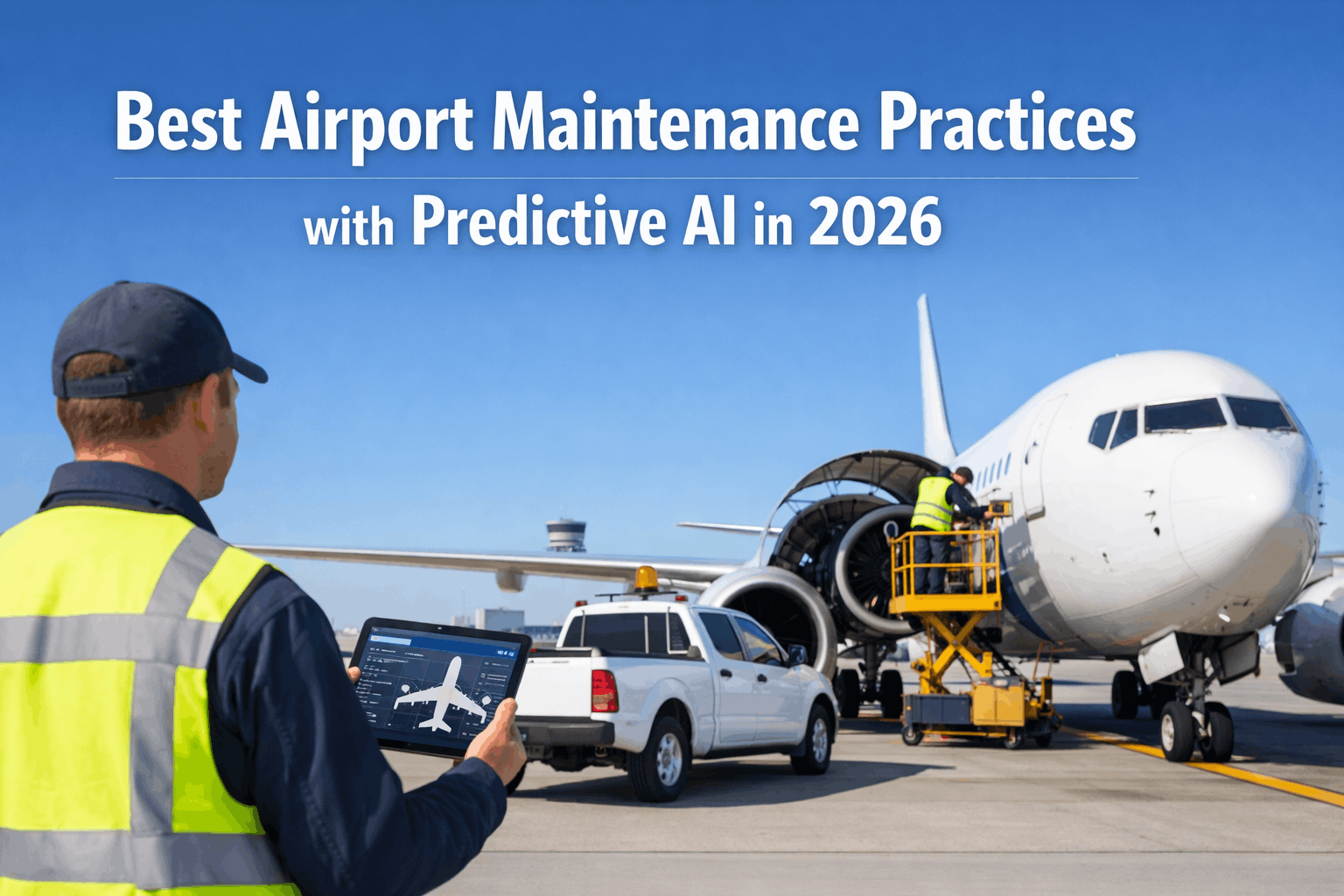
Best Airport Maintenance Practices with Predictive AI in 2026
By Taylor on March 6, 2026
An international airport is a 24/7 industrial operation masquerading as a public building. Behind every smooth passenger experience sits a maintenance infrastructure managing 50,000+ individual assets — runway pavements subjected to 400-tonne aircraft impacts every 90 seconds, baggage handling systems cycling 15,000+ bags per hour through kilometers of conveyor belts, HVAC plants conditioning 500,000+ square feet of terminal space, airfield lighting systems where a single failed approach light can close a runway, jet bridges cycling 300+ docking operations per week, and electrical distribution networks where a transformer failure cascades into gate closures, flight delays, and $50,000–$150,000 per hour in airline penalty claims. Yet most airports in 2026 still maintain these assets the same way they did in 2010 — calendar-based PM schedules that over-service healthy equipment and miss degrading assets between inspections, paper-based work orders that lose 15–25% of maintenance requests in verbal handoffs, and reactive emergency responses that cost 3–5× planned interventions. Predictive AI is rewriting this equation. Airports deploying AI-powered maintenance platforms report 40% reduction in unplanned downtime, 30% lower maintenance costs through condition-based scheduling, 95% failure prediction accuracy at 30-day horizons, and the digital twin simulation capability to model asset degradation scenarios before they impact operations. iFactory's AI platform delivers all of these capabilities from one connected system — purpose-built for the unique combination of safety-critical infrastructure, 24/7 operational tempo, and regulatory complexity that defines airport maintenance. Book a free airport maintenance AI assessment to identify where predictive intelligence can eliminate your costliest unplanned failures.
Airport Predictive AI Maintenance: 2026 Operations Snapshot
30-day warnings, digital twin simulation, zero missed PMs
— ACI World Airport Operations Report 2025; iFactory Platform Outcomes; FAA Infrastructure Maintenance Benchmark Data
Two Maintenance Models: How Airport Programs Are Evolving
Airports operate two fundamentally different maintenance approaches — and the approach they deploy determines whether they prevent operational disruptions or merely respond to them. Traditional programs rely on calendar-based schedules and periodic manual inspections. AI-powered programs use continuous IoT sensor data, machine learning pattern recognition, and automated CMMS integration to predict failures weeks before they impact operations. Understanding both models is essential for building the business case to transition.
Traditional
Calendar-Based Airport Maintenance
1
Fixed PM schedules — same intervals for all assets regardless of actual condition
2
Manual inspections — walkthrough rounds that miss degradation between visits
3
Paper work orders — 15–25% of requests lost in verbal handoffs between shifts
4
Emergency response — failures discovered at impact, repaired at 3–5× planned cost
Detection:Point-in-time — blind between scheduled rounds
Warning Time:Minutes to hours — often at failure
Cost Impact:$50K–$150K/hr in airline delay penalties
AI-Powered
iFactory Predictive Airport Platform
1
IoT sensors stream vibration, temperature, current, and condition data 24/7
2
AI models detect degradation patterns across baggage, HVAC, lighting, and pavements
3
30-day early warnings with failure mode, severity, and recommended action
4
CMMS work orders auto-generated — planned repair during low-traffic windows
Detection:Continuous — 24/7 AI pattern recognition
Warning Time:30 days before failure at 95% accuracy
iFactory Link:Digital twin + CMMS + mobile dispatch
Still running calendar-based maintenance on safety-critical airport assets? Book a free AI readiness assessment to see what continuous predictive monitoring delivers for your specific asset portfolio.
The Operational Cost of Reactive Airport Maintenance
When airport infrastructure fails unexpectedly, the cost cascades far beyond the repair itself. A single baggage handling system failure during peak hours delays thousands of passengers. A runway lighting outage triggers diversions. An HVAC failure in a terminal concourse generates hundreds of passenger complaints and airline penalty claims. Understanding the full cost cascade builds the ROI case for predictive AI investment.
The True Cost of Unplanned Airport Infrastructure Failures
$50–150KPer hour of airline delay penalties from infrastructure failures
50,000+Individual assets in a mid-size international airport
3–5×Emergency repair cost multiplier vs. AI-planned intervention
How iFactory AI Monitors the 5 Critical Airport Asset Categories
Every major airport operational disruption traces to failure in one of five asset categories — and every one of them produces detectable degradation signatures weeks before catastrophic failure. iFactory's AI platform monitors all five categories simultaneously, connecting IoT sensor data to digital twin models that predict failures and auto-generate CMMS work orders before operations are impacted.
Baggage Handling System (BHS) Predictive Analytics
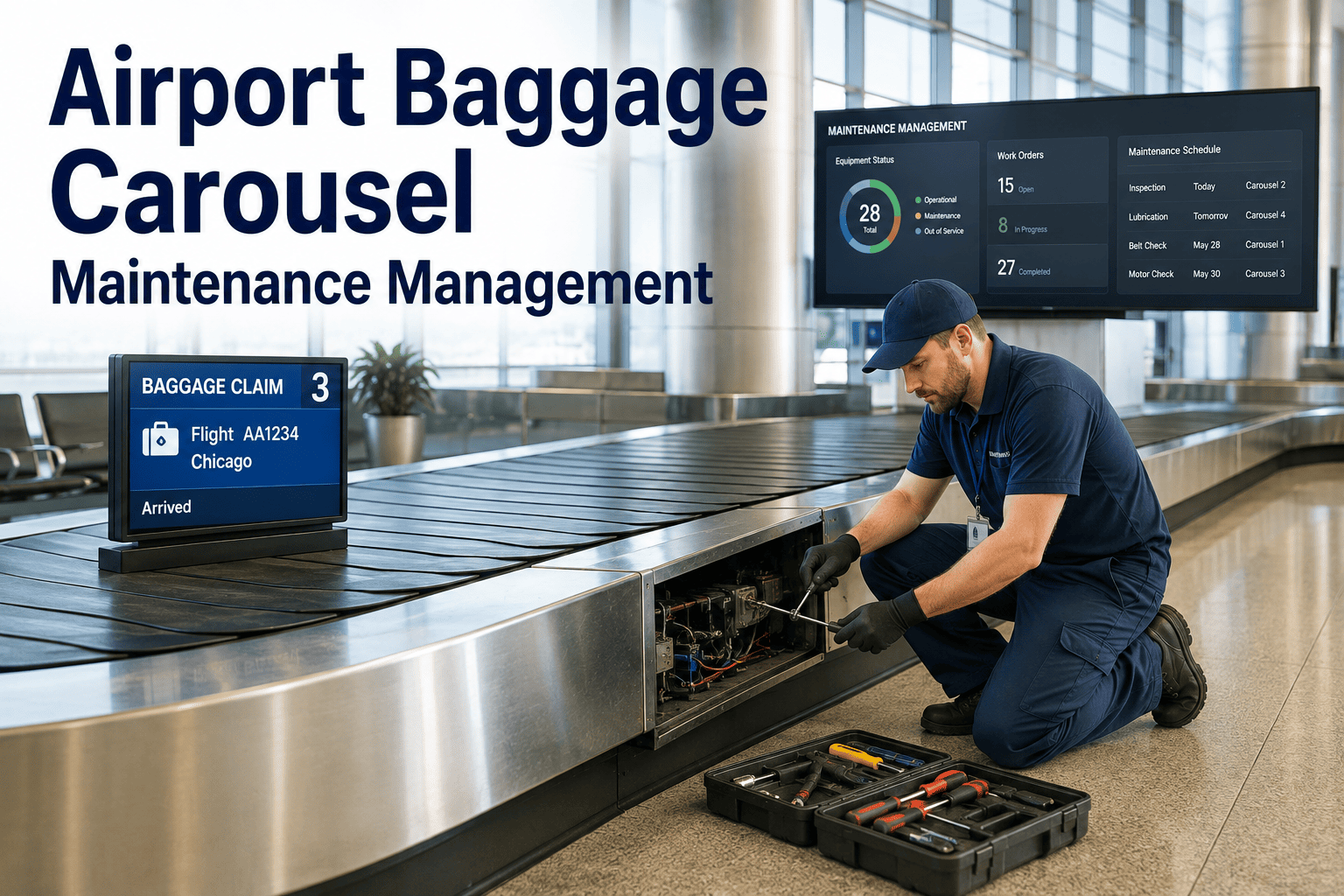
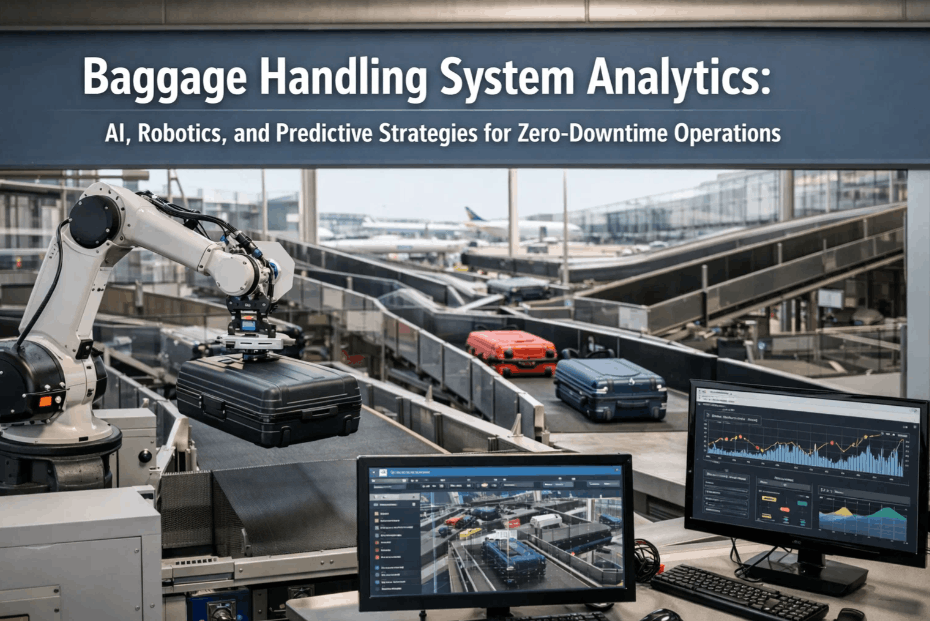
Continuous vibration and motor current monitoring on conveyor drives, diverters, sorters, and make-up carousels detects belt wear, bearing degradation, and motor overload conditions 30+ days before failure. iFactory's AI correlates degradation rates with passenger load forecasts — scheduling BHS maintenance during overnight low-traffic windows that minimize operational impact. Every predicted failure auto-generates a CMMS work order with component, location, failure mode, and parts required.
30-day BHS failure prediction — zero peak-hour baggage system outages
Airfield Lighting & Electrical AI Monitoring
Airfield lighting — approach lights, runway edge lights, taxiway lights, and PAPI systems — is safety-critical: a single failed approach light can trigger a runway downgrade. iFactory monitors lighting circuit current signatures, lamp degradation curves, and constant current regulator (CCR) health continuously. AI detects lamp aging patterns and circuit anomalies 2–4 weeks before failure, enabling planned replacement during scheduled runway closures rather than emergency NOTAM-triggering repairs.
Zero unplanned NOTAM-triggering lighting failures — all replacements planned to runway closure schedule
Terminal HVAC & Building Systems Intelligence
Terminal HVAC systems condition 500,000+ sq ft of passenger-facing space — and account for 40–60% of the airport's energy bill. iFactory's AI monitors chiller performance (approach temperature trending), AHU airflow and filter differential pressure, BAS sensor calibration accuracy, and cooling tower water chemistry. Predictive models identify efficiency degradation and component failure risk, scheduling maintenance to maximize energy savings and prevent the passenger comfort failures that generate airline complaints.
15–25% HVAC energy reduction + zero passenger-impacting comfort failures
Runway & Pavement Condition Digital Twin
iFactory's pavement digital twin ingests runway condition survey data (PCI scores), FOD detection system alerts, weather station feeds (freeze-thaw cycles, precipitation), and aircraft movement counts to model pavement deterioration trajectories. The digital twin predicts when specific pavement sections will reach intervention thresholds — enabling planned rehabilitation during seasonal construction windows rather than emergency closures that disrupt flight schedules and cost airlines millions in diversions.
Monitor All 5 Airport Asset Categories from One AI Platform
iFactory integrates baggage handling analytics, airfield lighting monitoring, terminal HVAC intelligence, pavement digital twin, and jet bridge/gate systems into one connected platform — delivering predictive maintenance across your entire airport asset portfolio.
What separates airports that achieve 98%+ infrastructure availability from those experiencing weekly unplanned failures? It is not maintenance budget — it is whether their monitoring system detects degradation continuously and converts that detection into planned action before operations are impacted.
Scroll to compare
Airport Capability
Traditional Maintenance
iFactory AI Predictive
Baggage Handling
Calendar-based PM — failures during peak hours
Continuous monitoring — maintenance in overnight windows
"The airports achieving the highest infrastructure availability in 2026 are not the ones with the largest maintenance budgets — they are the ones with the best real-time condition intelligence. A mid-size international airport manages 50,000+ assets across runways, terminals, baggage systems, lighting, electrical, and mechanical categories. Calendar-based maintenance across that asset base systematically over-services healthy equipment while missing deteriorating assets between inspections. AI predictive platforms flip this equation: every asset is monitored continuously, every degradation pattern is detected early, and every maintenance intervention is scheduled to the optimal window — overnight for baggage systems, runway closures for lighting, low-occupancy for HVAC. The result is 40% less unplanned downtime, 30% lower total maintenance cost, and an infrastructure availability rate above 98% that calendar programs mathematically cannot achieve."
AI predicts failures 30 days ahead — converting $150K+ emergency events to $5K–$25K planned repairs
30%
Total Maintenance Cost Savings
Condition-based scheduling eliminates unnecessary PM while catching every degrading asset early
95%
Failure Prediction Accuracy
ML models trained on your airport's specific asset behavior — 30-day prediction horizon proven
98%+
Infrastructure Availability
Up from 90–94% calendar baseline — every percentage point protects millions in airline penalty exposure
Ready to see what AI-powered airport maintenance looks like for your facility? Book a personalized demo tailored to your airport's specific asset portfolio and operational profile.
Your Airport Runs 24/7. Your Maintenance Intelligence Should Too.
iFactory's AI platform monitors baggage handling, airfield lighting, terminal HVAC, runway pavement, jet bridges, and electrical systems continuously — delivering 30-day failure predictions, digital twin simulation, and automated CMMS dispatch that keep your airport running at 98%+ availability. See the platform in action.
How does predictive AI work for baggage handling system maintenance?
iFactory deploys continuous vibration sensors and motor current analyzers on BHS conveyor drives, diverters, sorters, and carousel motors. The AI engine learns each component's normal operating signature and detects degradation patterns — bearing wear frequency shifts, belt tracking drift, motor overload trending — typically 30+ days before failure. Because BHS failures during peak hours impact thousands of passengers simultaneously, iFactory correlates predicted failure timelines with flight schedule data to schedule maintenance during overnight low-traffic windows. Every prediction generates a CMMS work order with specific component, failure mode, required parts, and recommended maintenance window. Book a demo to see BHS predictive analytics configured for your system.
Can iFactory predict airfield lighting failures before they trigger NOTAMs?
Yes. iFactory monitors airfield lighting circuit current signatures from each constant current regulator (CCR), tracking individual lamp degradation curves and circuit anomaly patterns. LED approach lights, runway edge lights, and taxiway lights all produce characteristic current draw signatures that change predictably as lamps age toward failure. iFactory's AI detects these aging patterns 2–4 weeks before failure — generating work orders timed to coincide with scheduled runway closures or maintenance windows. This eliminates the unplanned NOTAM-triggering light failures that downgrade runway operations and force aircraft diversions. The system also tracks lamp replacement history per fixture, optimizing bulk replacement cycles to maximize lamp life while preventing failures.
How does the runway pavement digital twin work?
iFactory's pavement digital twin creates a virtual model of every runway, taxiway, and apron section fed by multiple data streams: Pavement Condition Index (PCI) survey results, FOD detection system alerts, weather station data (freeze-thaw cycles, precipitation intensity, temperature extremes), and aircraft movement counts weighted by aircraft type (a 400-tonne A380 impacts pavement differently than a 70-tonne B737). The twin models deterioration trajectories for each pavement section, predicting when PCI will decline to intervention thresholds. This enables planned rehabilitation during seasonal construction windows — typically spring/summer — rather than emergency closures that disrupt flight schedules. Visit our Support Center for pavement digital twin technical documentation.
What IoT sensors does iFactory require for airport predictive maintenance?
iFactory's airport deployment uses five sensor categories mapped to the five critical asset groups: (1) vibration accelerometers and motor current analyzers on BHS conveyor drives, carousel motors, and jet bridge mechanisms; (2) current monitoring on airfield lighting CCR circuits with individual lamp signature tracking; (3) temperature, pressure, and flow sensors on terminal HVAC chillers, AHUs, and cooling towers; (4) pavement condition data from PCI surveys, FOD systems, and weather stations; and (5) electrical distribution monitoring on transformers, switchgear, and UPS systems. Most airports already have 30–50% of this instrumentation installed. iFactory's deployment team conducts a sensor gap assessment during Phase 1 to identify additional instrumentation needed — typically requiring 4–8 weeks of installation before AI models begin training.
How long does deployment take for an airport-wide predictive AI program?
A typical airport-wide deployment runs 14–20 weeks across four phases: Phase 1 (weeks 1–4) covers asset inventory audit, sensor gap assessment, IoT procurement, and data connectivity planning across all five asset categories. Phase 2 (weeks 4–8) installs sensors on priority asset groups (typically BHS and airfield lighting first, as highest operational impact), connects data streams to iFactory's AI platform, and begins model training. Phase 3 (weeks 8–14) expands to remaining asset categories, validates AI predictions against operational data, and calibrates alert thresholds. Phase 4 (weeks 14–20) activates full CMMS integration, mobile dispatch for field crews, digital twin simulation, and executive dashboards. Quick wins — BHS and lighting predictive alerts — are typically live by week 8. Book a scoping call for a timeline specific to your airport's size and asset complexity.