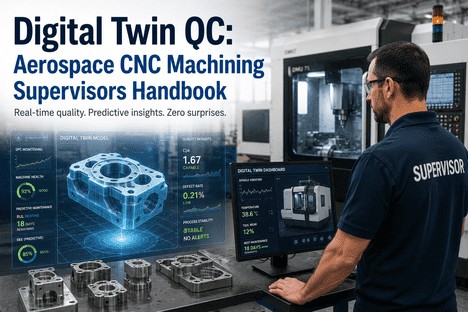
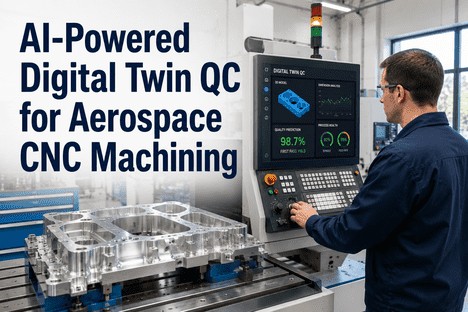
You are 40 minutes into the shift. Machine 3 has been running a titanium bracket operation for the last six hours. No alarms. No operator flags. The part looks fine on the visual check. But somewhere between parts 38 and 52 of this tool run, the bore diameter has drifted 0.009 mm toward the upper tolerance limit — not enough to fail the in-process gauge check, but exactly the kind of slow, invisible creep that ends with a customer NCR three weeks after shipment. You will not know it happened until the corrective action lands on your desk. This is what a digital twin was built to prevent.
Real-Time SPC · Machine Vision · Predictive OEE · AS9100 Traceability
Your CNC Cell Has a Digital Twin. The Question Is Whether It Is Working for You.
iFactory gives aerospace CNC supervisors a live quality twin for every cell — catching dimensional drift, surface finish escapes, and machine degradation signals before they become defects, downtime, or NCRs.
$2.98B
Projected digital twin CNC market value by 2036, growing at 16% CAGR from $589M in 2025
35–50%
Reduction in unplanned downtime achieved by manufacturers deploying predictive maintenance digital twins
70%+
Of aerospace manufacturers are now piloting or deploying digital twin solutions — the highest adoption rate of any manufacturing sector
90%
Failure prediction accuracy demonstrated by AI-driven predictive analytics in validated manufacturing deployments
What a Digital Twin Actually Means for an Aerospace CNC Supervisor
The term gets overused. In aerospace CNC machining, a process digital twin is not a 3D visualisation of your machine and it is not a CAD model of the part. It is a continuously synchronised virtual model of your production cell — updated in real time by sensor data, machine controller outputs, inspection results, and tooling records — that gives you a complete picture of what the cell is doing now, what it was doing an hour ago, and where it is going next. The twin's value is predictive. It does not just reflect current machine state; it models the trajectory of that state against the tolerances and performance thresholds that define acceptable production. When the trajectory is heading toward a limit — whether that is a dimensional tolerance, a surface finish threshold, a spindle load ceiling, or a tool life boundary — the twin fires an alert before the limit is reached. The supervisor intervenes. The defect or breakdown does not happen.
This is the structural difference between digital twin quality control and conventional in-process inspection: inspection tells you the state of the last part; the twin tells you the state of the next fifty.
The Three Layers of a Process Digital Twin in Aerospace CNC Machining
Layer 1 — Machine State Twin
Continuously updated model of spindle load, axis position, vibration signature, thermal compensation values, and coolant pressure. Detects mechanical degradation — bearing wear, ballscrew backlash, thermal drift — before it shows up as dimensional error on the part. This layer is the foundation of predictive maintenance: the twin models remaining useful life for critical machine components and alerts the supervisor when intervention should be scheduled to avoid unplanned downtime.
Layer 2 — Process Quality Twin
Real-time statistical process control model that tracks every monitored feature across every part in the current batch — feeding in-process measurement data from AI vision, probing cycles, or post-process gauging. Self-tuning control limits reflect the current process baseline, not the capability study completed at qualification. This layer answers the supervisor's critical question: which cell, which feature, and which tool is drifting toward a quality limit right now, and how many parts do I have before the first escape?
Layer 3 — Traceability Twin
The complete production context record for every serial-numbered part — linking the quality result for each feature to the programme version, cutting tool lot and life count, material billet, machine, operator, and shift at the time of machining. This is the AS9100 Clause 8.5.2 traceability record that customer escape investigations, FAIR submissions, and audit reviews require — generated automatically from the twin's data stream, not assembled manually from paper records and machine logs after the fact.
Where Predictive Maintenance Pays Off in Aerospace CNC Machining
Unplanned downtime in aerospace CNC operations carries a cost that extends well beyond the idle machine hour. A stalled 5-axis cell running flight-critical components delays the entire downstream production schedule, triggers expediting costs, and — if the failure follows a quality escape — can initiate a customer hold on an entire batch while containment is resolved. The digital twin addresses these failure modes by shifting maintenance from a calendar-based schedule to a condition-based model driven by actual machine performance data. The table below maps the most common CNC downtime causes to the twin-based signals that predict them.
Failure Mode
Without Digital Twin
With Digital Twin
Spindle Bearing Degradation
Detected at catastrophic failure or scheduled replacement — whichever comes first. Often first sign is a scrapped part or machine alarm mid-cycle.
Vibration signature trend alerts supervisor 3–6 weeks before predicted failure. Maintenance scheduled in planned downtime slot. No emergency stoppage.
Thermal Drift on Axis
Dimensional shift discovered at CMM batch check — potentially 40–80 parts affected. Containment scope broad. NCR cycle begins.
Process twin detects dimensional drift against live SPC baseline. Alert fires on part 4 or 5 of the drift event. Supervisor adjusts compensation before any escape.
Accelerated Tool Wear
Fixed change interval either replaces usable tooling early (waste) or misses accelerated wear in hard-batch material (escape).
Quality trend correlation identifies the part count where surface finish or dimensional data begins degrading for the current batch. Tool change triggered by quality signal, not clock.
Fixture Datum Shift
Systematic offset on all features in affected batch. Discovered at end-of-batch CMM or — worse — at customer incoming inspection.
First-off dimensional profile comparison against twin nominal flags batch-level offset immediately. Run stopped at part 1 before systematic batch failure develops.
We were running a fixed 60-part tool change interval on a nickel alloy turbine component. The digital twin showed us the surface finish on the bore feature was consistently degrading from part 42 onward when material hardness was at the upper end of the billet spec. We moved the change to part 40 on hard batches and kept it at 60 on standard material. Scrap on that feature dropped by over 60 percent in the first quarter after the change. The twin told us something our scheduling system never could.
— Quality Systems Lead, Tier 1 Aerospace CNC Operation, Engine Component Programme
How the Supervisor Dashboard Translates Twin Data Into Decisions
A digital twin that generates data the supervisor cannot act on in real time is a reporting tool, not a quality control system. The supervisor dashboard is the operational interface where twin intelligence becomes production decisions — structured around the four questions a shift supervisor needs answered continuously throughout every shift.
Question 01
Which cell is at risk right now?
The live floor view displays every CNC cell feeding twin data as a colour-coded status: green for in control, amber for trending toward a quality or machine limit, red for limit breach or defect detection. The supervisor sees the complete floor priority order in one view — not a machine-by-machine walkround, but a simultaneous picture of all cells ranked by urgency. Amber requires monitoring. Red requires immediate physical response and supervisor authorisation to hold or correct.
Alert reaches the supervisor's mobile device at the same moment the dashboard updates — zero notification lag.
Question 02
How long before the next tool change or maintenance event?
The tool life and machine health panel shows each tool and monitored machine component tracked against its quality and condition trend data. The panel displays a predicted intervention point based on observed drift rate against the current batch — not a static life count set at qualification. Supervisors schedule tool changes and maintenance at the point quality data indicates risk, extending life when the process is stable and pre-empting failures when degradation is accelerating faster than expected.
Data-driven tool life replaces calendar-based intervals — reducing scrap from late changes and tooling waste from early changes simultaneously.
Question 03
Where is quality risk concentrated across the shift?
The Pareto panel ranks quality findings by feature, machine, and shift — revealing systemic patterns that isolated part-level findings cannot surface. A surface finish deviation appearing across three machines on the same bore feature points to a tooling specification issue. The same deviation concentrated on one machine and one shift points to a machine condition or operator factor. Without the cross-cell Pareto, both patterns look like separate incidents. With it, they are escalation-ready data for engineering review before the pattern generates its next NCR.
Pareto findings are exportable as structured quality input — not narrative NCR summaries, but feature-level data that engineering can act on directly.
Question 04
Can I prove every part on this shift was in spec?
Every part processed through the twin receives an automated quality record — serial number, per-feature inspection result, SPC value at time of machining, defect findings with images, and supervisor disposition. The record is linked to the programme version, tool lot, material billet, and machine in use at the time of machining. This is the AS9100 Clause 8.5.2 and AS9102 FAIR traceability chain that customer escape investigations and audit reviews require — generated automatically from the twin data stream, accessible on demand for any part in any batch.
Export the full part record for any serial number in seconds — no manual search through paper logs or machine histories.
Stop Managing Quality Through NCR Response. Start Managing It Through Twin Intelligence.
iFactory's process digital twin gives your CNC cells the real-time SPC, predictive maintenance signals, and AS9100 traceability your quality plan requires — without adding headcount or disrupting production.
Self-Tuning SPC: Why Static Control Limits Fail Aerospace CNC and What Replaces Them
Conventional SPC in aerospace CNC machining runs on control limits set during the initial process capability study — often conducted at qualification, months or years before current production. As tools wear across their life cycles, fixture components settle, material batches vary in hardness, and thermal cycles change with the season, the actual process variation shifts continuously. Static limits become either too tight — generating false alarms that operators learn to dismiss — or too wide, allowing real drift to develop unchallenged until the CMM batch check detects it.
Self-tuning SPC solves this by recalculating control limits dynamically against the current rolling production window — typically the last 20 to 50 parts. The algorithm distinguishes between two types of variation: common-cause variation, which represents the inherent process spread and should adjust the limits upward or downward as the process shifts; and assignable-cause events — sudden step changes or accelerating trends — which should fire an alert and not adjust the limits. Every limit adjustment is logged with a timestamp, the data window that drove it, and the statistical basis for the change, creating an auditable record that demonstrates limits are always current and justified through AS9100 audit reviews.
Self-Tuning vs Static SPC: Four Scenarios That Define the Difference
Scenario
Static SPC
Self-Tuning SPC
New tool installed
Same limits as worn-tool run — too wide for new-tool capability, early drift goes undetected
Limits tighten to match new-tool baseline — drift detected earlier and more sensitively from part 1
Tool reaching end of life
Drift approaches tolerance boundary. No alert until breach. Up to 80 parts affected before CMM detects the batch shift.
Trend alert fires 15–25 parts before the tolerance boundary. Supervisor schedules change while parts are still in spec.
New material batch
Material-driven variation triggers false alarms. Operators desensitised. Real drift events dismissed along with noise.
Limits adjust to new material baseline. False alarm rate drops below 5%. Genuine drift events remain clearly distinguished.
AS9100 audit
Limit rationale from capability study must be re-justified. Process changes since qualification create documentation gaps.
Every limit adjustment logged with timestamp and statistical basis. Auditor sees a living, self-evidencing quality record.
The 90-Day Path from CNC Cell to Live Digital Twin
Deployment is phased to build supervisor confidence through observed accuracy before the twin becomes the primary quality record. The supervisor team validates performance against known results in shadow mode, provides feedback on edge cases, and sets alert thresholds based on real data — not vendor defaults — before live inspection begins. The result is a system the floor trusts because they helped calibrate it.
Sensor Integration and Inspection Specification
Machine controller data streams connected. Critical features identified from drawing, quality plan, and historical NCR data. Camera and sensor positions configured. AI model initialised on good-part and defective-part sample images specific to your cell geometry. No production disruption — the twin runs alongside current operations from day one.
Shadow Mode Validation
Twin inspection runs in parallel with existing inspection methods. Every AI finding compared against CMM results and manual checks. False positive and negative rates documented by feature. Supervisor team reviews outputs daily and flags edge cases for model retraining. Self-tuning SPC baseline established against current production data — not qualification study data.
Live Twin Activation
Twin becomes the primary in-process quality record. Self-tuning SPC activated on validated features. Supervisor alert thresholds set from shadow mode performance data. AS9100 part records begin generating automatically per serial number, linked to programme version, tool lot, and material billet. Predictive maintenance model activated on machine-state data stream.
Optimise and Scale
Pareto analysis across 30 days of live twin data identifies the highest-value features for expanded coverage. Tool life correlation model refined with accumulated quality data. First AS9100 audit with twin-generated part records completed. CMM sampling frequency reviewed and reduced on features with validated AI coverage. Deployment extended to additional cells based on floor-validated ROI from the initial cell.
Conclusion
The shift supervisor in aerospace CNC machining carries accountability for quality outcomes that the conventional inspection model was never designed to support. Manual visual checks and periodic CMM sampling answer the question of whether a sample of parts was in spec. They cannot answer whether every part, on every shift, through every tool interval, was in spec — and in a flight-critical supply chain, that is the question that matters. The process digital twin answers it, continuously, on every part, without adding inspection headcount or slowing cycle time.
What changes for the supervisor is concrete. Instead of waiting for a CMM batch check to reveal a drift event that has already affected 40 to 80 parts, the twin fires an alert when the drift begins — with enough production lead time to intervene before the first out-of-spec part is produced. Instead of a maintenance calendar that treats every machine the same regardless of actual condition, the twin's machine-state model identifies which components are approaching failure and schedules intervention in planned downtime slots before emergency stoppages occur. Instead of a manual traceability exercise that begins after a customer escape, the automated part record is already generated — linking every serial number to every production parameter, ready for export in seconds.
The economics of digital twin adoption in aerospace CNC machining are straightforward: one prevented NCR cycle, one avoided unplanned stoppage on a flight-critical cell, or one contained customer escape that stays within a single batch instead of a full-quarter hold covers a deployment cost multiple times over. The technology is not a future consideration for aerospace CNC supervisors. With over 70 percent of aerospace manufacturers already piloting or deploying digital twin solutions, the competitive and compliance gap between early adopters and those still running on static SPC and periodic CMM is widening every quarter.
Frequently Asked Questions
The Data to Prevent Your Next NCR Is Already in Your Machine. iFactory Makes It Visible.
iFactory's process digital twin gives aerospace CNC supervisors real-time quality visibility, predictive maintenance alerts, and AS9100 traceability records on every part — deployed in 90 days, validated against your own production data before it generates a single compliance record.