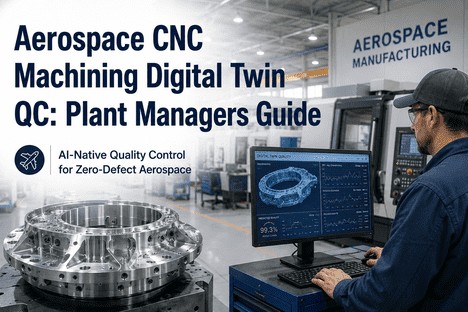
Aerospace CNC Machining Digital Twin QC: Plant Managers Guide
By Grace on June 11, 2026
Your five-axis CNC spindle is cutting titanium at 12,000 RPM. The part has 47 critical dimensions, each toleranced to +/- 0.0005 inches, and you are 38 minutes into a 90-minute cycle when the in-process probe detects a 0.0003-inch deviation on feature 23. By the time your quality team completes the first-article inspection on the finished part, another three hours of production will have run with the same offset, generating anywhere from four to twelve non-conforming components at $3,800 each in raw material alone. Digital twin quality changes this sequence fundamentally — not by detecting the defect after machining, but by simulating the part geometry in real time against the live machine state and flagging the dimensional risk before the tool ever marks the workpiece.
Digital Twin Quality · AS9100 Audit Readiness · Predictive SPC
The Plant Manager’s Guide to Zero-Defect Aerospace CNC Machining with Digital Twin QC
iFactory’s digital twin quality platform gives aerospace plant managers real-time virtual-physical process correlation, self-tuning SPC limits that adapt to tool wear and thermal drift, and automatically generated AS9100 audit records — so every shift produces compliant parts with zero manual documentation effort.
Scrap reduction achievable with digital twin quality correlation on multi-axis aerospace CNC workcenters
68%
Reduction in defect escapes reported by manufacturers using real-time virtual-physical process twin integration
100%
AS9100 audit documentation generated automatically from live process data with full traceability to operator, machine, and tooling
35-45%
Improvement in production efficiency through reduced first-article inspection cycles and elimination of rework loops
What Digital Twin Quality Actually Means for Aerospace CNC Machining
Digital twin quality is not a simulation model you run offline before cutting begins. It is a continuously synchronised virtual replica of the machining process that receives real-time sensor data from the CNC control, spindle load monitors, thermal sensors, in-process probes, and tool wear estimators, and uses that data to maintain a live prediction of every dimension on every part in the active production run. The twin does not wait for post-process measurement. It calculates the expected outcome of each cutting pass against the programmed nominal and flags the moment the prediction exits the tolerance band — before the tool completes the pass that produces the non-conformance.
For plant managers operating in aerospace and defence contracting, the value proposition is direct. An AS9100D-compliant quality system requires documented evidence that every part was produced under controlled conditions. A digital twin quality platform generates that evidence continuously — not as a periodic sampling report, but as a complete dimensional prediction record for every machined feature, linked to the machine state, tool condition, and environmental parameters at the time of cut. When the auditor asks for proof that process control was maintained across all 2,400 parts in a landing gear bracket run, the answer is a single export with every prediction, every alert, and every corrective action recorded by timestamp and operator ID.
Traditional Quality Control vs. Digital Twin Quality — The Difference at Every Stage of Aerospace CNC Machining
Setup & First Article
Traditional
Operator runs first part, sends to CMM, waits 45-90 minutes for inspection report. If out of tolerance, resets and repeats. Setup time averages 3-5 hours per job.
Digital Twin
Virtual first-article simulation runs in parallel with the first cut, validating every dimension against the digital model in real time. Setup time reduced to 1-2 hours with zero-risk offsets delivered directly from the twin.
Production Run
Traditional
In-process probe checks at predefined intervals. Between probes, tool wear and thermal drift accumulate undetected. Defect discovered at final inspection means scrapping the entire batch since the last probe cycle.
Digital Twin
Continuous virtual-physical correlation predicts every dimension after every pass. Thermal drift detected at 0.0002-inch deviation triggers an alert and automatic feed-rate compensation. No batch-level risk, no post-process discovery.
Audit & Compliance
Traditional
Quality engineer pulls CMM reports, machine logs, operator sign-offs, and material certs manually. Audit prep takes 2-3 days. Missing records require chasing operators across shifts to reconstruct.
Digital Twin
Every prediction, alert, offset adjustment, and tool change logged automatically with timestamp and operator ID. AS9100-compliant audit pack generated in under 20 minutes with full traceability from raw material to finished dimension.
The Three Capabilities That Make Digital Twin Quality Work on Your CNC Floor
Digital twin quality in aerospace CNC machining rests on three technical capabilities that work together as a single closed-loop system. Each addresses a specific failure mode in conventional quality control, and each generates records that satisfy AS9100 traceability requirements without operator intervention.
Capability 01
Real-Time Virtual-Physical Correlation
Data refresh: every 1-3 seconds
The digital twin ingests live signals from the CNC controller — axis positions, spindle load, feed rate, coolant temperature, and in-process probe measurements — and maps them onto a finite-element model of the part geometry. Every 1-3 seconds, the twin calculates the expected position of every critical dimension relative to the design nominal. When the correlation between the physical sensor data and the virtual model begins to diverge, the twin flags the specific dimension at risk, the direction of drift, and the estimated time before the tolerance boundary is crossed. This is not a statistical probability. It is a dimensional prediction calculated from the physics of the cutting process as it is happening on your machine right now.
Live dimension prediction
Thermal drift compensation
Tool wear correlation
Capability 02
Predictive SPC with Self-Tuning Limits
Adaptive to tool life & thermal state
Standard SPC systems apply fixed control limits calculated from an initial capability study. In CNC machining, those limits are wrong the moment a new tool is indexed, a coolant temperature change shifts the thermal equilibrium, or the next part in the batch has slightly different material properties. Digital twin SPC recalculates its upper and lower control limits continuously, using the live virtual-physical correlation data as its input. When a new tool is registered, the limits widen slightly to reflect the expected settling period. As the tool approaches end of life and spindle load increases, the limits tighten and the alert threshold moves earlier. The plant manager sees a control chart that reflects the real process capability at every moment, not a static specification band that was calculated three months ago and has not been updated since.
Adaptive control limits
Tool-life-aware alerts
Thermal equilibrium tracking
Capability 03
Closed-Loop Corrective Action and Audit Trail
AS9100 traceable records
When the predictive SPC model fires an alert, the system does not stop at notification. It presents the plant manager with a ranked root cause analysis based on the correlation data — identifying whether the drift is driven by tool wear progression, thermal expansion, or a raw material hardness variation — and recommends a specific corrective action: adjust feed rate by X%, advance tool change by Y parts, or apply a Z-micron offset at the next probing cycle. The manager approves or overrides the recommendation, and the action is executed automatically via the CNC interface. Every step — the alert, the root cause diagnosis, the recommended action, the manager decision, the execution, and the confirmation that the dimension returned to target — is logged with timestamps and operator ID, forming a complete corrective action record that satisfies AS9100 non-conformance and corrective action requirements without a single manual entry.
Ranked root cause diagnosis
Automated corrective action
AS9100 audit trail
The Plant Manager Dashboard: What You See and When You See It
A digital twin quality platform is only as valuable as the information it surfaces to the person accountable for production output. The iFactory plant manager dashboard is built around one design principle: the manager should never need to open a separate report to understand why a part drifted, what was done about it, and whether the fix worked.
Live Machine View
Real-Time Part Geometry Correlation
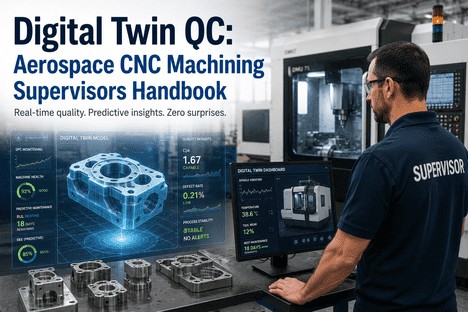
The machine panel displays a 3D model of the current part colour-coded by dimensional status. Green surfaces are within prediction bands. Yellow surfaces show measurable drift trending toward the tolerance boundary. Red surfaces indicate an active alert condition where the predicted dimension has already breached the tolerance limit. The plant manager can see at a glance which machine, which feature, and which direction of drift requires attention, without reviewing a single CMM report or probing log.
Manager action: Identify drifting features before they become non-conformances. Triage by colour code, not report review.
Alert Feed
Predictive Dimensional Alerts with Root Cause Assignment
Every predictive alert fires with a specific diagnosis and recommended corrective action. The alert does not say "dimension out of tolerance on part 47." It says: "Feature 23 bore diameter trending 0.0003-inch oversize. Primary driver: spindle load increase consistent with tool wear on insert 4 at 78% of expected life. Recommended action: advance tool change by 3 parts and apply -0.0002-inch offset at next probe cycle." The manager approves the recommendation with one click. The offset is applied, the tool change is queued, and the alert record is written automatically.
Manager action: Approve the root-cause-based recommendation in one click. The system executes and logs the action.
Production View
Batch-Level Quality Forecast
The production panel aggregates the twin predictions across all active jobs and displays a batch-level quality forecast: estimated yield at current drift trajectory, parts at risk by station, and a schedule-adjusted projection of first-pass yield at shift end. When the forecast drops below the plant target, the system recommends a specific intervention — tool change, thermal stabilisation hold, or feed rate adjustment — calculated to return the batch to the target yield without stopping production unless unavoidable.
Manager action: Review the yield forecast and approve batch-level interventions before quality is affected.
Compliance Log
Automatic AS9100 Audit-Ready Records
The compliance panel aggregates every quality event across the shift into an AS9100-compliant record: every predictive alert with its root cause assignment, every corrective action with the manager approval timestamp, every tool change logged automatically against the part serial number, and the virtual-physical correlation record for each machined feature. At shift end, the system generates a complete quality summary with Cpk by critical characteristic, first-pass yield by part number, and a traceability index linking every quality event to the machine, operator, tool, and material batch. The export takes one click and the record is complete without a single manual log entry.
Manager action: Review shift compliance at handover. Export the full audit pack in under 60 seconds. No manual assembly required.
Your Next AS9100 Audit Pack Was Already Generated While Your CNC Machines Were Cutting Parts.
iFactory builds the compliance trail automatically — every dimensional prediction, every tool wear alert, every corrective action, every Cpk — timestamped, traceable, and exportable without a single manual entry from the plant floor.
Before digital twin quality, our standard approach to aerospace CNC production was to run first-article inspection, then run production in batches of 50, probe-check every 10th part, and hope the CMM results at the end of the shift confirmed everything was within tolerance. The problem was that tool wear and thermal drift don't respect sampling intervals. We had a $47,000 scrap incident on a titanium bulkhead run where the drift started at part 7 and wasnt caught until part 32. With the digital twin correlation platform, we caught the same drift pattern on the next run at part 3, compensated automatically, and finished the batch with 100 percent yield. The ROI on the twin paid for itself on that single job.
— Plant Manager, Aerospace Tier 1 CNC Machining Facility — AS9100D, 5-Axis, Titanium and Nickel Alloy Production
Conclusion
The aerospace plant manager's quality challenge in 2026 is not a shortage of measurement data. Your CMMs produce thousands of data points per shift. Your probing cycles generate dimensional records on every part. Your SPC software can plot control charts for every critical characteristic. The gap is not data. It is the time between the physical event and the quality decision — the minutes and hours during which tool wear and thermal drift accumulate undetected, producing non-conforming parts that will be discovered only at final inspection, when the material cost is already sunk and the schedule impact is already locked in.
Digital twin quality closes that gap by compressing the detection-to-correction cycle from hours to seconds. It replaces sampling with continuous prediction. It replaces fixed SPC limits with adaptive bands that reflect the real process state. It replaces manual audit reconstruction with an automatically generated, AS9100-compliant record that is complete at shift end without anyone typing a single entry.
The technology to run an aerospace CNC facility this way is available today. The plant managers who implement it now will define the quality standard that the rest of the supply chain is measured against through the rest of this decade.
iFactory’s digital twin quality platform is purpose-built for aerospace CNC machining operations — with real-time virtual-physical process correlation, adaptive SPC with tool-life-aware limits, predictive dimensional alerts with ranked root cause assignment, and automatic AS9100 audit documentation that replaces manual log entry. Book a Demo to see the platform configured for your CNC workcentre profile, or talk to an expert about a live walkthrough on your production data.
Frequently Asked Questions
In-process probing is a discrete measurement event. The probe touches a reference surface at a programmed interval, records a single data point, and the machine control compares that point against the programmed nominal. Between probe events, there is no measurement and no quality signal. If thermal drift or tool wear begins 30 seconds after the last probe cycle, it accumulates undetected until the next cycle, which may be 10 or 20 minutes later depending on part complexity. Digital twin quality replaces discrete probing with continuous prediction. The twin calculates the expected dimensional outcome of every cutting pass by correlating spindle load, axis torque, coolant temperature, and tool wear state against a physics-based model of the material removal process. It does not wait for a probe cycle to detect drift. It predicts the drift from the process signals and flags the risk the moment the calculated trajectory exits the tolerance band, regardless of when the next physical probe measurement is scheduled. The probe data, when it arrives, serves to validate and recalibrate the twin model, not as the primary detection mechanism. Talk to an expert about how the twin integrates with your existing probing infrastructure.
The iFactory quality record system is designed to satisfy the documentation and traceability requirements of AS9100 Revision D, ISO 9001:2015, and IATF 16949:2016. The automated compliance records cover the key requirements common to all aerospace quality management standards: control of production process change records with parameter values and limit breach events, corrective action records with timestamps and operator identification, process capability (Cpk) records by critical characteristic, calibration and tool change records linked to production batches, and material traceability linking each quality event to the specific material heat and lot number active at the time of machining. For facilities supplying defence programs, the system also supports ITAR-compliant record segregation and access control, ensuring that export-controlled technical data and quality records are maintained with the required security boundaries. Book a Demo to review the audit record format with your quality manager before deployment.
The core twin model — which maps CNC axis signals, spindle load, thermal data, and tool wear onto dimensional outcomes — is machine-level and process-level, not part-specific. It learns the stiffness characteristics, thermal response curve, and dynamic behaviour of each machine tool, and applies that machine model to any part programmed on that machine. When a new part number is loaded, the twin ingests the CAM program and the design nominal geometry, and it automatically generates the virtual-physical correlation mapping for the new features without requiring a separate model build. The initial calibration for a new machine typically takes one production shift of supervised learning, during which the twin correlates its predictions against probe measurements and CMM results to refine the model parameters. After calibration, the twin operates autonomously for any part run on that machine, and it continues to improve its prediction accuracy as more data accumulates across production runs. Talk to an expert about deployment timelines and machine-level calibration for your specific CNC fleet.
The iFactory platform integrates with CNC controls via MTConnect, OPC-UA, and Fanuc FOCAS protocols covering the majority of aerospace CNC configurations including Siemens 840D, Heidenhain TNC 7, Mazak Mazatrol, and Haas NGC. DCS and SCADA historian integration is supported through OPC-UA, OPC-DA, REST API, and MQTT, enabling data flow from ABB System 800xA, Siemens PCS 7, Rockwell PlantPAx, and OSIsoft PI historian environments. CMM integration is handled through dimensional measurement data import via standard Q-DAS, ASCII, and custom XML formats from Zeiss Calypso, Hexagon PC-DMIS, and Mitutoyo MeasurLink. The platform runs on an edge computing appliance installed at the plant level, with real-time twin calculations performed locally and aggregated quality data synchronised to the cloud for multi-plant reporting and benchmarking. The deployment assessment maps the integration path for each control system, measurement device, and data historian in your specific environment before any hardware installation begins. Book a Demo to discuss integration scope with your control systems and quality engineering teams.
ROI timelines vary by facility size, part mix, and current scrap rate, but the measurable cost avoidance from reduced scrap and rework typically offsets the platform investment within the first three to six months of operation on a single high-value aerospace workcentre. Facilities running titanium, Inconel, or other high-cost alloys with scrap rates above 5 percent on complex five-axis parts typically see full payback within the first production quarter, driven by three factors: elimination of batch-level scrap events through predictive drift detection, reduction in first-article inspection cycle time from hours to minutes, and elimination of the labour cost associated with manual audit record assembly. After the initial payback period, ongoing value accrues through sustained scrap reduction in the range of 30-50 percent, increased effective machine utilisation from reduced rework and re-inspection cycles, and the elimination of the 2-3 day audit preparation window that most AS9100 facilities currently allocate before each certification or surveillance audit. Book a Demo to receive a plant-specific ROI estimate based on your current scrap rate, material costs, and production volume.
Your Next AS9100 Audit Should Be the Easiest One You Have Ever Prepared For. Digital Twin Quality Makes That the Default, Not the Exception.
iFactory’s digital twin quality platform for aerospace CNC machining plant managers — real-time virtual-physical process correlation, adaptive SPC with tool-life-aware limits, predictive dimensional alerts with ranked root cause diagnosis, and automatic AS9100 audit-ready shift documentation. See it configured for your CNC workcentre profile.