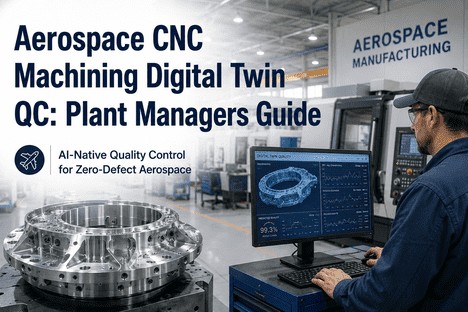
The first-off part for a new titanium housing programme just completed machining on cell 3. The CAM programme was verified offline, the tool paths were simulated, and the setup sheet followed the standard template. The part goes to CMM. Three hours later, the inspection report lands: the bore feature is 0.032 mm out of tolerance. The programme needs adjustment. The tool path is modified, the offsets are recalculated, and the second attempt is loaded into the machine. Another three hours. The second part passes CMM, but the surface finish on the flange face is outside specification. A third iteration is required. Each iteration costs six to ten hours of machine time, occupies the CMM for a full inspection cycle, and consumes material that becomes scrap at the end of the process. By the time the first good part is released to production, the cell has lost 18 to 30 hours of productive runtime, and three parts worth of material have been scrapped. This is the cost of first-off iteration — and it is the single largest source of scrap and cycle time loss in aerospace CNC machining. Digital twin quality control eliminates the iteration. It moves the quality decision from after the cut to before the cut. The digital twin predicts the dimensional outcome of every feature before the tool touches the material, synchronises with the machine in real time during the cut, and confirms the prediction before the part is unloaded. The first part is the good part. The setup iteration is eliminated. The scrap that would have been generated across three attempts is not produced in the first place.
What Digital Twin Quality Control Actually Is — and Is Not
The term digital twin is widely used in aerospace manufacturing, often to describe a 3D visualisation of a machine or a CAD model of a part. A process digital twin for quality control is neither of those things. It is a continuously synchronised virtual model of the production cell that is updated in real time by sensor data, machine controller outputs, inspection results, and tooling records. The twin does not just reflect what the machine is doing. It models the trajectory of every active process parameter against the tolerances and performance thresholds that define acceptable production. When the trajectory is heading toward a limit — a dimensional tolerance, a surface finish threshold, a spindle load ceiling, a tool life boundary — the twin fires an alert before the limit is reached. The operations director intervenes. The defect does not happen. The scrap is not produced.
The Scrap Reduction Chain: How Digital Twin QC Eliminates Scrap at Every Stage
Scrap in aerospace CNC machining is not a single event. It is a chain of decisions and conditions that lead to a non-conforming part. Digital twin quality control breaks this chain at every link — from first-off setup through production run to tool change and material lot transition. Each link that is broken represents scrap that was not produced, rework that was not required, and inspection time that was not consumed.
First-Part-Right: Eliminating the Cost of Setup Iteration
For aerospace CNC operations running high-mix, low-volume production programmes, the single largest source of scrap and cycle time loss is not the production run itself. It is the first-off iteration cycle. Every new part number, every programme revision, every material lot change, and every significant tool change triggers a requalification sequence that typically requires three to five iterations at six to ten hours each. The machine is cutting air or producing scrap for 30 to 50 hours before the first good part is released. The CMM is occupied for the entire period. The material consumed across the iterations is scrapped at the end of the process.
Digital twin quality control eliminates this cycle by predicting the outcome of every feature before the tool engages the material. The twin's machine health layer has modelled the spindle behaviour, thermal compensation state, and axis dynamics. The process quality layer has loaded the programme-specific baseline for the part number. The AI vision inspection layer has been calibrated to the surface finish and dimensional band. When the first part is machined, the twin compares the real-time sensor data against its prediction, confirms conformance within the tolerance band, and releases the part without requiring a separate inspection cycle. The first part is the good part. The setup iteration is eliminated. The CMM shifts from a gate that stops production to a confirmation step that validates the twin's accuracy.
The Operations Director Dashboard: From Scrap Reporting to Scrap Prevention
Digital twin QC transforms the operations director's dashboard from a retrospective view of scrap that has already been produced into a forward-looking view of scrap that can be prevented. Every panel, every metric, and every alert is designed around one objective: keeping every feature on every part within specification on the first attempt.
Every active CNC cell is represented by its digital twin, showing current machine health status, active programme and material lot, predicted outcome for the current part, and conformance status of the last completed feature. Cells where the twin predicts a feature trajectory approaching the tolerance boundary appear with a visual indicator and the specific parameter driving the prediction. The operations director sees not just which cell needs attention but which feature, which tool, and which parameter is projected to drift out of specification and how many parts remain before the predicted escape.
The scrap forecast panel aggregates every active prediction across all cells into a facility-wide scrap risk projection for the current shift and the next shift. Each projected scrap event is listed with the cell, part number, feature, root cause parameter, confidence score, and the intervention that would prevent it. The operations director sees the total scrap cost projected for the next 12 hours if no action is taken, and the specific interventions available to reduce that number. When an intervention is logged, the scrap forecast updates in real time to reflect the new projected outcome.
First-pass yield is tracked per programme, per cell, and per part number, with the digital twin recording whether each feature was predicted and confirmed within tolerance on the first machining cycle. When yield drops on a specific programme, the twin surfaces the pattern: is the yield loss concentrated on a specific feature, correlated with a specific tool lot, or associated with a specific operator shift? The operations director can trace the yield degradation to its root cause without manual investigation across separate systems.
Every prediction, every in-process verification, every feature measurement, and every intervention is automatically logged with the complete context required for AS9100 compliance — timestamps, programme version, tool lot, material lot, operator ID, and machine parameters at time of event. The audit pack view presents this data in the format auditors expect: control chart records per feature per production run, corrective action log with timestamps and effectiveness confirmation, Cpk per key characteristic, and traceability records linking each part to the digital twin state at time of manufacture. The entire audit pack is exportable in minutes.
We introduced digital twin QC on our critical-path five-axis cell 18 months ago. The impact on scrap was immediate and measurable. Our first-pass yield on new programme introductions went from 62% to 94% within the first quarter — meaning we went from scrapping four out of every ten first-off parts to scrapping fewer than one. The CMM utilisation dropped by 40% because the digital twin was confirming features during the machining cycle, and we only used CMM for periodic validation rather than gate inspection. The AS9100 surveillance audit that happened six months after deployment was the easiest we have ever been through. The auditor asked for the feature-level traceability on a specific serial number from the previous year. I opened the dashboard, entered the serial number, and the complete record — machine state, tool lot, programme version, in-process probe results, AI vision inspection, operator disposition — was on screen in under 30 seconds. The auditor said he had never seen response time like that at a Tier 2 supplier.
Operations Director, Aerospace CNC Machining — 5-Axis Titanium and Inconel Components, AS9100 Rev DConclusion: From Iterative Setup to First-Part-Right Production
The operations director's scrap challenge in aerospace CNC machining is not a lack of inspection. It is the structural inefficiency of a quality model that discovers deviations after the part is complete. First-off iteration cycles consume 30 to 50 hours of machine time and scrap three to five parts before the first good part is released. Tool wear drift goes undetected until the CMM confirms the dimensional deviation, by which time a batch of parts may already be affected. Material lot changes trigger full requalification sequences that add days of lead time with no guarantee of first-pass conformance. These are not inspection failures. They are process design failures — and they are the primary drivers of scrap, cycle time extension, and inspection cost in aerospace CNC machining.
Digital twin quality control addresses all three drivers simultaneously. It predicts the dimensional outcome before the cut, eliminating the first-off iteration cycle. It synchronises with the machine in real time during the cut, detecting drift before a second non-conforming part is produced. It recalibrates the process baseline automatically across material lot and tool changes, eliminating requalification time and transition scrap. And every prediction, every verification, and every intervention is recorded with full AS9100 traceability — generated while production was running, not reconstructed before the audit.
For operations directors who are currently managing scrap reactively — investigating batch-scale quality escapes after the CMM confirms them, managing first-off iterations as an accepted cost of programme introduction, and preparing for audits by manually assembling records from separate systems — the change that digital twin QC delivers is measurable and rapid. 30 to 50 percent reduction in scrap. 70 to 90 percent reduction in requalification time. First-pass yield above 94 percent on new programme introductions. And an AS9100 compliance record that is complete, searchable, and exportable on demand without manual preparation.
iFactory's digital twin quality platform is purpose-built for aerospace CNC machining operations — with machine health modelling, real-time SPC with self-tuning limits, AI vision defect detection, and automatic AS9100-compliant documentation that replaces the first-off iteration cycle with first-part-right production. Book a Demo to see the platform configured for your CNC machining cell, or talk to an expert about a live walkthrough on your production data.