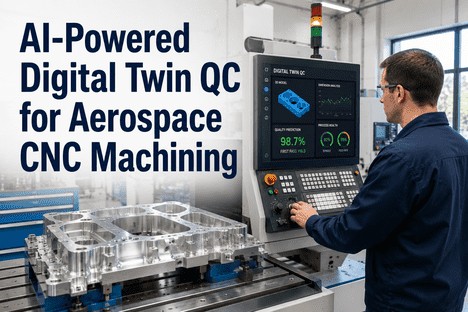
AI-Powered Digital Twin QC for Aerospace CNC Machining

By Grace on June 9, 2026

ai-powered-digital-twin-qc-aerospace-cnc-machining

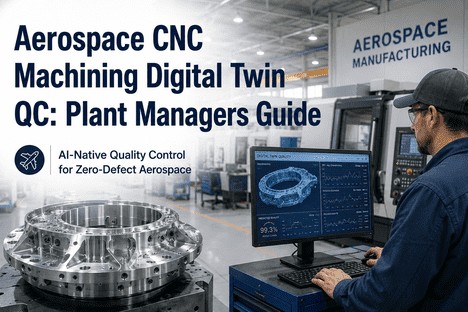
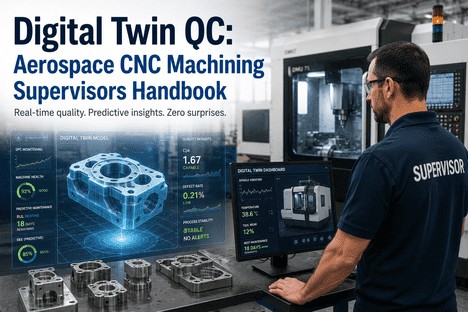
The CNC operator running the next aerospace component does not need to wait for the CMM report to know whether the part is good. The machine spindle already knows. Spindle load, vibration signature, thermal growth, and cutting force are streaming in real time. The question is whether those signals are being compared against the digital twin of the part being cut. When they are, the operator sees a deviation alert before the tool finishes the pass, not after the part reaches the inspection queue. Digital twin QC closes the loop between what the machine feels and what the operator needs to know. First pass yield moves from a retrospective metric to a real-time process signal.

Digital Twin QC for CNC Operators
The Tool Vibration You Ignored on the Last Pass Became the Scrapped Part on Final Inspection. Digital Twin QC Catches It Mid-Cut and Tells You Exactly What to Adjust.
First Pass Yield Is Not a Number on a Dashboard. It Is Every Part That Does Not Come Back.

In aerospace CNC machining, the difference between a first-pass accepted part and a reworked or scrapped part is rarely a dramatic machine failure. It is a cumulative sequence of small deviations that traditional quality control does not detect until the part reaches the CMM or the final inspection station. Tool wear that shifts surface finish by a few microns. Spindle thermal growth that changes a bore diameter by 0.01 mm. Cutting force variation that creates a burr at the transition between two passes. Each of these signals is present in the machine data at the moment it occurs. The problem is not that the data does not exist. The problem is that it is not being synchronized against the digital model of the part in real time.

Mitsubishi Electric and RWTH Aachen University demonstrated in 2026 that an edge-based digital twin running on a CNC machine tool can reduce machining errors caused by workpiece deformation by up to 50 percent by feeding corrective feedback into the control loop at sub-millisecond latency. A separate study published in Processes journal showed that a digital twin integrating deep learning with model-based systems engineering achieved 99.59 percent defect recognition accuracy on aerospace cable fairing machining, with the system autonomously adapting to dynamic cutting conditions without operator intervention.

For the aerospace CNC operator, these advances mean that the digital twin running alongside the cut can detect a tool wear pattern, a thermal deflection trend, or a surface finish deviation before the feature is complete. The operator sees the alert on the display and makes a feed rate adjustment, a tool offset correction, or a coolant flow change on the current part, not the next one. First pass yield improves because corrective action happens within the machining cycle, not after inspection.

What Changes When a Digital Twin Runs Alongside the Cut

The difference between conventional CNC operation and digital-twin-enhanced CNC operation is not theoretical. It is visible on the operator display, measurable in the first pass yield trend, and auditable in the AS9100 traceability record. The comparison below maps what changes at each stage of a typical aerospace CNC machining sequence.

Conventional CNC Operation
Setup and probing
Manual part location. Probe cycle records position. No comparison against digital model for setup verification.
During the cut
Operator monitors spindle load and vibration visually. No real-time comparison of as-cut geometry to CAD.
Post-process inspection
Part moves to CMM or inspection station. Deviation detected after machining is complete. Rework or scrap decision made hours later.

Digital Twin QC Enabled
Setup verified against CAD
Probe data compared to digital model. Fixture offset and part position validated before first cut. Zero setup errors reaching the cut.
In-process geometry feedback
Spindle load, vibration, thermal data streamed into digital twin. As-cut geometry estimated in real time. Deviations flagged mid-pass.
First pass yield confirmed inline
Part quality verified against specification before unclamping. Operator adjusts parameters on current feature, not next part. Rework prevented.
Data flow: CNC sensors right arrow Digital twin right arrow Operator alert right arrow Mid-pass correction
The iFactory Digital Twin QC Workflow: What the Operator Sees at Each Step

iFactory Digital Twin QC is designed for the shop floor. It connects directly to the CNC control, ingests machine data through OPC-UA and MTConnect, synchronizes it against the CAD model, and presents the operator with a clear action signal. The workflow follows four sequential stages that mirror the machining cycle itself.

01
Connect and Synchronize
iFactory connects to the CNC control via OPC-UA or MTConnect. Spindle speed, feed rate, load, vibration, temperature, and axis position stream at sub-second intervals. The digital twin loads the CAD model and aligns machine coordinates to the part coordinate system.
Setup time: under 5 minutes per machine
02
Monitor and Compare
As the machine cuts, the digital twin estimates as-cut geometry from sensor data and compares it to the CAD specification. Eight Western Electric rules plus ML-driven anomaly detection run on every parameter. Deviations are ranked by severity and correlated across spindle load, thermal profile, and vibration signature.
Detection latency: sub-second
03
Alert and Diagnose
The operator display shows a live gauge of deviation status per feature. Green indicates within tolerance. Yellow signals a trend toward the limit. Red triggers an alert with a specific corrective recommendation, such as adjust feed rate by 5 percent, replace tool at next tool change, or verify coolant flow at nozzle 3.
Alert types: Info, Warning, Critical, Stop Ship
04
Log and Improve
Every deviation event, operator response, and corrective action is logged against the part serial number and the machine timestamp. Cp/Cpk is calculated continuously by feature, part number, and shift. Trend reports identify recurring patterns by tool type, material lot, or operator shift, feeding the continuous improvement cycle.
Traceability: 100 percent per AS9100D
iFactory Digital Twin QC In Action
Every second of machine data contains a quality signal. iFactory Digital Twin QC extracts that signal, compares it to the specification, and puts the answer on your display before the chip hits the floor.
Three Wins the Operator Sees from Digital Twin QC

Digital twin QC does not add steps to the operator workflow. It removes uncertainty from the steps the operator already performs. The three outcomes below are documented from aerospace CNC machining operations that have deployed digital twin quality control with inline sensor integration and real-time CAD comparison.

+5-15
FPY Points


First pass yield improvement documented across aerospace CNC machining operations after deploying inline digital twin QC with real-time deviation detection. In-process correction catches deviations before the feature is complete, eliminating the need for secondary operations.
50%
Error Reduction


Machining error reduction documented by Mitsubishi Electric and RWTH Aachen using edge-based digital twin error compensation on CNC machine tools. Real-time correction of workpiece deformation and tool deflection during the cut, verified on production aerospace components.
80%
Inspection Time


Reduction in CMM inspection cycle time when inline digital twin QC replaces offline batch sampling with continuous in-process verification. Inspection transitions from a separate production stage to a parallel process that runs alongside the machining cycle.
The iFactory Advantage: Purpose-Built for Aerospace CNC

iFactory Digital Twin QC is not a generic IIoT platform adapted for quality control. It is a purpose-built digital twin quality system designed for aerospace CNC machining environments. The platform connects to Fanuc, Siemens, Heidenhain, and Mitsubishi CNC controls through native protocols and streams machine data into a synchronized digital model that compares as-cut geometry against the CAD specification in real time.

The operator interface is designed for the shop floor, not the engineering office. A single screen shows the current part, the active feature being machined, the deviation status per critical dimension, and any active alerts with corrective guidance. Alerts are tiered by severity: Info for trends approaching the warning threshold, Warning for deviations requiring attention before the next pass, Critical for out-of-spec conditions requiring immediate action, and Stop Ship for conditions that affect downstream assembly or safety compliance.

Behind the operator display, the system runs eight Western Electric rules plus ML-driven anomaly detection on every parameter, every sample. Control limits self-tune to process variability. Cp/Cpk, Pp/Ppk, and DPMO are calculated continuously and trended by part number, feature, shift, and operator. Deviation events are logged with timestamps, operator response, and corrective action against the part serial number for full AS9100D and NADCAP traceability.

iFactory Digital Twin QC deploys in 10 to 14 weeks from sensor connection to active quality control. The platform runs on an edge computing device at the machine cell, ensuring uninterrupted operation during network outages, and transmits process data to the server for long-term trending and model retraining. Bandwidth requirements are under 10 Mbps per machine.

Conclusion

The CNC operator who consistently achieves high first pass yield in aerospace machining is not the one with the most experience reading CMM reports. It is the one whose quality control system delivers deviation information during the cut, while the tool is still engaged and the correction can be applied to the current feature. Digital twin QC transforms quality assurance from a post-process verification activity into a real-time machining feedback loop that operators can act on before the part is unclamped.

The 5 to 15 point first pass yield improvement documented across aerospace CNC operations that have deployed inline digital twin QC is not a projection. It is a measured result from production environments where machine data is synchronized against the CAD model at sub-second latency and deviation alerts are delivered to the operator before the feature is complete. The 50 percent reduction in machining errors demonstrated by edge-based digital twin compensation confirms that real-time error correction in the CNC control loop is technically achievable and operationally practical. The 80 percent reduction in inspection cycle time confirms that when quality is verified during the machining cycle, final inspection becomes a confirmation step rather than a discovery step.

iFactory Digital Twin QC is purpose-built for aerospace CNC machining. It connects to your existing machine controls through native protocols, compares as-cut geometry against the CAD specification in real time, and delivers actionable alerts to the operator display before the cut is complete. The platform deploys in 10 to 14 weeks and integrates with your existing quality management system and production workflow.
Book a Live SPC Walkthrough
See iFactory Digital Twin QC Running on a Live CNC Machine with Your Part Program. Book a 30-Minute Walkthrough.
Frequently Asked Questions

iFactory connects to Fanuc, Siemens, Heidenhain, and Mitsubishi CNC controls through native OPC-UA and MTConnect protocols. No hardware modification to the machine control is required. An edge computing device installed at the machine cell ingests spindle speed, feed rate, axis position, spindle load, vibration, and temperature data at sub-second intervals. The digital twin loads the CAD model and synchronizes machine coordinates to the part coordinate system during the setup phase. Connection setup takes under 5 minutes per machine and does not interrupt production.

The iFactory operator interface shows the current part model with color-coded deviation status per feature. Green indicates the feature is within tolerance. Yellow signals a trend toward the warning threshold. Red indicates the feature is out of specification or approaching the limit. Each critical dimension is listed with its current estimated value, the specification tolerance, and the Cp/Cpk trend. When an alert triggers, the display shows the specific corrective action, such as adjust feed rate by 5 percent, replace tool at next change, or verify coolant flow. The interface is designed for glance-reading and requires no interpretation of control charts or statistical reports.

Yes. For machines that do not support OPC-UA or MTConnect, iFactory provides a sensor retrofit package that adds spindle load monitoring, vibration sensing, temperature measurement, and axis position tracking without modifying the machine control. The retrofit sensors are mounted externally and connect to the same edge computing device that runs the digital twin. This approach supports any CNC machine regardless of age or control type and allows consistent digital twin QC across mixed-vintage machine fleets. Retrofit installation takes approximately 4 hours per machine and is performed during scheduled maintenance windows.

Every deviation event, operator response, and corrective action is logged with a timestamp, operator ID, part serial number, and machine identifier. Cp/Cpk reports are generated continuously by feature, part number, and shift, eliminating the need for manual capability studies before audits. The system satisfies AS9100D clauses 8.1, 8.5.1, and 8.5.2 for operational planning, controlled production, and traceability. NADCAP AC7118 process parameter documentation is generated automatically. Audit reports are exportable in standard quality audit format and integrate with existing document control platforms through REST APIs. Book a Demo to review the compliance documentation output for your specific quality system.

The deployment timeline from sensor connection to active quality control spans 8 to 12 weeks for a typical CNC machining cell. Phase one covers machine connection and data pipeline setup with a two-week baseline capture. Phase two involves CAD model loading, digital twin calibration, and deviation threshold configuration, taking two to three weeks. Phase three runs the system in shadow mode alongside production for two to three weeks, routing alerts to quality engineer review while model accuracy is validated against CMM results. Phase four activates operator-facing alerts and closed-loop feedback. The platform is designed for incremental deployment across a machine fleet, allowing you to pilot on one cell and scale across the facility.

Every Machined Surface Carries a Quality Signature That Traditional Inspection Finds Too Late. iFactory Digital Twin QC Reads That Signature in Real Time and Puts the Correction on Your Screen Mid-Cut.
iFactory Digital Twin QC for aerospace CNC machining. Real-time CAD comparison, Western Electric rules, and closed-loop corrective feedback. Purpose-built for shop-floor operators and line technicians.

Share This Story, Choose Your Platform!