You are 47 parts into a titanium bracket run. The CNC cell has not thrown a single alarm. Your operator's check looked clean. Your last CMM pull was at part 20 and everything was in spec. What you do not yet know is that your bore diameter has been drifting 0.0008mm per part since part 31 — a trend that will cross the lower tolerance boundary at part 68, affecting 21 parts before your end-of-batch CMM finds it. For aerospace quality engineers still relying on static SPC limits and periodic sampling, this is not a hypothetical. It is a quarterly event. Predictive SPC for aerospace CNC machining exists to close this gap — detecting the drift before the breach, quantifying process capability in real time, and giving quality engineers the statistical foresight to intervene before the first nonconforming part is produced.
Predictive SPC · Live Cpk · AS9100 Traceability · Aerospace CNC Quality
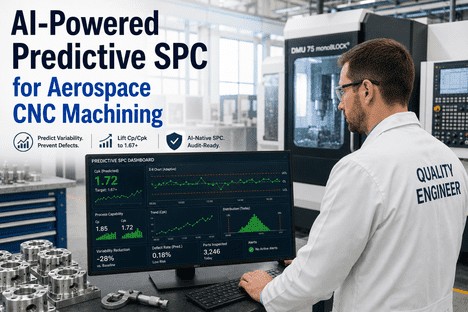
AI-Powered Predictive SPC for Aerospace CNC Machining
iFactory gives aerospace quality engineers a live predictive SPC engine for every CNC cell — tracking Cpk in real time, detecting drift before it becomes a breach, and generating AS9100-ready traceability on every part, every shift.
1.67+
Sustained Cpk achieved by aerospace plants running AI-native predictive SPC — the Six Sigma benchmark for flight-critical features
68%
Fewer out-of-control events reported by manufacturers replacing manual SPC sampling with real-time AI process monitoring
0.6 ppm
Defect rate at Cpk 1.67 — compared to 2,700 ppm at Cpk 0.9, the level at which most static SPC programmes still operate
$5.6B
Aerospace CNC machining services market in 2025, growing at 4.1% CAGR — with quality compliance as the primary competitive differentiator
Why Static SPC Is No Longer Enough for Aerospace CNC
Statistical process control has been the quality backbone of aerospace manufacturing for decades — and for good reason. Control charts, capability indices, and Western Electric rules remain statistically sound. The problem is not the theory. The problem is the implementation: static control limits set at qualification, manual data entry at sampling intervals of five to ten parts per hour, and a reaction loop that fires an alert only after an out-of-control condition has already been recorded in the data.
In a 5-axis titanium machining cell running at 15-minute cycle times, that reaction loop can allow an entire shift's production — 32 parts — to drift past the control limit before the next scheduled sample closes the gap. The mathematical reality is unforgiving: a process running at Cpk 0.9 generates 2,700 defects per million parts, even though 97.3% of individual units still pass a go/no-go check. The defects exist in the tail of the distribution. Static SPC does not see the tail. It sees the mean, sampled infrequently, measured against limits that may have been set when the machine was new and the tooling was fresh.
Aerospace quality requirements have moved beyond what the original SPC implementation model was designed to support. AS9100 Rev D, NADCAP process approval requirements, and OEM-specific quality plans increasingly demand continuous process monitoring, live Cpk evidence, and traceability that links every part to the exact process state in which it was produced. Static SPC, with its quarterly capability studies and manual chart reviews, cannot generate that evidence. Predictive SPC, running on an AI-native monitoring platform, can — and does, on every part, without adding a single headcount to the quality team.
The Cpk Gap: What Your Process Is Actually Doing Between Samples
Cpk Level
Defects Per Million
Status
Cpk 0.9
2,700 ppm
Process is generating defects. Every shift is a customer risk.
Cpk 1.00
2,700 ppm
At the edge. One material batch change tips you over.
Cpk 1.33
64 ppm
Industry minimum for most aerospace applications. AS9100 baseline.
Cpk 1.67+
0.6 ppm
Six Sigma target. Where AI-native SPC consistently delivers.
What Predictive SPC Actually Does Differently
Predictive SPC is not a faster version of manual SPC. It is a structurally different approach to process control — one that monitors every part, recalculates capability continuously, and fires an alert when the data predicts a future breach rather than recording a breach that has already occurred. The four operational differences that matter most to an aerospace quality engineer are these:
Continuous vs Sampled Monitoring
Manual SPC samples 5 to 10 data points per hour from a process generating hundreds of parts. The data between samples is invisible to the control chart. AI-native predictive SPC ingests data from every part — from in-process sensor streams, vision inspection results, and machine controller outputs — updating the control chart in real time after every cycle. There is no blind window between samples.
Dynamic vs Static Control Limits
Static control limits, set at process qualification and unchanged for months or years, become progressively less accurate as machine condition, material batches, and tooling lots change. Adaptive limits recalculate against the live rolling production window — typically the last 20 to 50 parts — so they always reflect the current process baseline. False alarm rates stay below 5%. Real drift events remain clearly distinguishable from material noise.
Trend Prediction vs Breach Detection
Conventional SPC reacts when a point crosses a control limit. Predictive SPC projects the current trend trajectory and fires a predictive alert when the data indicates a breach is likely within the next 10 to 25 parts — giving the quality engineer time to intervene while all parts in the current run remain in specification. The distinction between reacting to a nonconformance and preventing one is where NCR costs are eliminated.
Live Cpk vs Qualification Snapshot
Cpk in a conventional operation is a number from a capability study completed at qualification — representing the process as it was configured on a specific day with specific tooling and material. Live Cpk is recalculated with every part, reflecting the actual current capability of the process in this batch, at this point in the tool's life, on this machine. When Cpk falls below threshold, the quality engineer knows before the CMM batch check, not after the customer finds the escape.
Our static SPC programme was generating false alarms every time we changed material batches on the titanium housing run. Operators had learned to dismiss them. When we deployed AI-native predictive SPC, the dynamic limits absorbed the batch-to-batch noise, false alarms dropped below 4%, and we caught a genuine thermal drift event on part 19 of a 60-part run that would have affected 41 parts before our end-of-batch CMM found it. Our Cpk on that feature went from 1.24 to 1.71 sustained across the next three production blocks.
— Quality Engineer, Tier 1 Aerospace Structural, Titanium Housing Programme
The Five Process Events That Destroy Cpk Mid-Run
Process capability does not degrade uniformly or predictably. In aerospace CNC machining, there are five identifiable process events that account for the majority of mid-run Cpk collapse — and each produces a signature in the data stream that predictive SPC can detect before the nonconforming part is produced.
01
Progressive Tool Wear
Cutting tool deflection increases as the tool wears, producing a slow dimensional drift that is invisible on any individual part but visible as a trend across 15 to 30 consecutive parts. Predictive SPC detects the gradient and schedules a change before the distribution tail crosses the tolerance boundary.
02
Thermal Expansion Mid-Shift
Machine spindle and structural members expand as temperature stabilises during the first 90 minutes of a shift, then continue to shift with ambient temperature changes through the day. This thermal drift affects every linear axis simultaneously — producing a multivariate signature that single-feature static SPC cannot decode but AI-native predictive SPC identifies as a thermal event rather than a process fault, enabling thermal compensation before tolerance impact.
03
Material Batch Hardness Variation
Titanium and nickel alloy billets vary in hardness within the specification band, changing the cutting response, chip load distribution, and resulting surface finish. A new billet at the upper hardness limit changes the process distribution immediately — which static SPC misreads as an out-of-control event. Adaptive SPC distinguishes this as a common-cause shift, updates the baseline, and preserves alarm sensitivity for genuine quality events.
04
Fixture Wear and Clamp Force Variation
Workholding components wear gradually, introducing micro-movement in the fixture that appears in the data as increasing variation on positional features. This signature — widening distribution with no shift in mean — is invisible to a chart watching for mean drift but is clearly detected by a capability-focused predictive SPC system watching the standard deviation trend alongside the mean.
05
Coolant Concentration Drift
As coolant concentration drifts outside optimal range, lubrication changes at the cutting interface, affecting surface finish on bore walls and sealing faces. This process event has no dimensional signature in the early stages — it appears first as a surface finish trend in vision inspection data. Integrating coolant sensor data into the predictive SPC model produces an early composite alert that dimensional measurement alone would miss until the surface specification is breached.
Get a Free Cpk and Compliance Audit for Your CNC Cell
iFactory's quality engineers review your current Cpk data, SPC configuration, and AS9100 traceability structure — and identify exactly where predictive SPC would close the capability and compliance gap in your operation.
How iFactory Predictive SPC Works in a Live CNC Environment
The architecture of a predictive SPC deployment in an aerospace CNC machining operation has four integrated layers. Each layer adds a capability that the previous one cannot deliver alone — and it is the integration of all four that produces the predictive quality control outcome aerospace quality engineers need.
Layer 1
Real-Time Data Ingestion
iFactory connects directly to CNC machine controllers via OPC-UA, MTConnect, and FANUC/Siemens native interfaces — collecting spindle load, axis position, feed rate, and programme state on every cycle without manual data entry. In-process measurement devices, vision inspection outputs, and post-process gauge data feed into the same stream. The result is a complete, automatically populated per-part data record with no operator intervention required.
Layer 2
Adaptive Control Charting
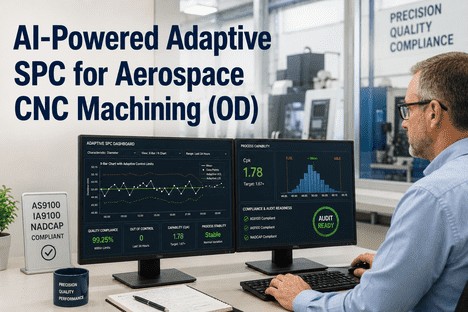
Every monitored feature runs a live X-bar/R or I-MR chart updated after every part. All eight Western Electric rules are evaluated in real time. Control limits recalculate dynamically against the rolling production window, distinguishing common-cause variation from assignable-cause events. Every limit change is logged with a timestamp and statistical basis — creating an auditable limit change record that AS9100 auditors can review without any manual documentation effort.
Layer 3
Trend Projection and Predictive Alerting
The ML trend engine analyses the current directional drift rate across all monitored parameters and projects the trajectory forward. When the projected path indicates a control limit breach within the next 10 to 25 parts, a predictive alert fires — to the quality engineer's dashboard, mobile device, and the machine operator's interface simultaneously. The alert includes the predicted breach point, the current drift rate, the most probable root cause from historical pattern matching, and the recommended intervention: tool change, offset adjustment, or fixture inspection.
Layer 4
Live Cpk and AS9100 Record Generation
Process capability indices — Cp, Cpk, Pp, Ppk — are recalculated after every part and displayed on the quality engineer's dashboard alongside the control chart. When Cpk falls below the configured threshold (typically 1.33 for standard aerospace features and 1.67 for flight-critical features), a capability alert fires before the process reaches a specification breach. Simultaneously, every part generates a complete AS9100-ready record: serial number, per-feature capability result, control chart state, programme version, tool lot and life count, material billet, and operator ID — available for audit or FAIR submission without any additional assembly effort.
Predictive SPC and AS9100: What Changes at Your Next Audit
AS9100 Rev D Clause 8.5.1 requires in-process monitoring and measurement at appropriate stages of production. Clause 8.5.2 requires traceability linking every product to the production context in which it was made. Clause 8.4.1 requires evidence that suppliers are consistently meeting quality requirements. In a conventional operation, satisfying these three clauses during an audit requires assembling documentation from multiple systems — CMM records, machine logs, tool change records, inspection reports, and material certifications — that were never designed to be linked automatically.
In a predictive SPC environment, the compliance evidence is generated automatically as part of the production cycle. The in-process monitoring record is the SPC system output — every chart, every data point, every adaptive limit change, timestamped and linked to the part serial number. The traceability record is assembled in real time, not reconstructed after the fact. And the Cpk evidence submitted for supplier qualification or OEM surveillance audit is not a capability study from last year — it is the live capability trend from the current production block, covering every part produced since the last tool change.
For aerospace quality engineers preparing for AS9102 First Article Inspection Report submission, iFactory generates the capability data in FAIR-compatible format — with dimensional results, statistical analysis, and traceability evidence automatically linked to the ballooned drawing reference. The FAIR package that previously required two days of manual assembly is generated in seconds from the production data that already exists in the system.
Before Predictive SPC
Cpk from qualification study, 12+ months old. Audit evidence assembled manually from disconnected systems. FAIR package built over two days. Traceability gaps create audit findings.
The Difference
Live capability evidence vs historical snapshot. Automatic record generation vs manual assembly. Predictive alerts vs reactive containment. Closed compliance gaps vs audit risk.
With Predictive SPC
Cpk updated after every part. AS9100 record generated automatically at production. FAIR data exported in seconds. Zero documentation gaps for audit review.
The Quality Engineer's Real-Time Dashboard
A predictive SPC platform generates value only if the quality engineer can act on its output in the moment it is produced. The iFactory quality dashboard is structured to answer the five questions that define the quality engineer's decision loop through every shift — without requiring navigation through multiple systems or manual data aggregation.
Live Floor Status
Which cell has an active quality risk right now?
Every CNC cell displayed as green, amber, or red — in control, trending toward a limit, or breached. Floor-wide priority order without physically walking the floor. Mobile alert fires simultaneously with dashboard update.
Drift Prediction
How many parts before the next intervention?
Predicted intervention point calculated from observed drift rate — not a fixed tool life count. Schedule the tool change or offset adjustment at the data-indicated risk point, before any part is out of spec.
Live Capability
What is the current Cpk for this feature?
Real-time Cpk for every monitored feature, updated with every part. Not the qualification-era snapshot — the actual current capability of the process in this batch, with this material, at this point in tool life.
Compliance Record
Can I pull the AS9100 record for any part in seconds?
Every part carries a complete linked record: serial number, feature results, SPC state at machining, programme version, tool lot and life count, material billet, and supervisor disposition — searchable and exportable before the part leaves the cell.
Multivariate SPC: When One Feature Is Not Enough
Single-feature SPC watches one dimension and alerts when that dimension drifts. It is sufficient for simple turned components with a handful of critical features. It is not sufficient for complex 5-axis aerospace brackets, turbine structural components, or hydraulic manifolds where multiple interdependent features must remain in spec simultaneously, and where the root cause of any drift event affects several features at once.
Multivariate SPC monitors every critical feature simultaneously and uses Hotelling's T-squared statistic and machine learning anomaly detection to identify the combined signature of a process event — the pattern across all monitored features together — that no individual control chart would detect in isolation. A thermal drift event in a 5-axis cell shifts bore diameter, perpendicularity, and surface finish simultaneously but at different rates. The multivariate model recognises the thermal signature and identifies the event class before any single feature reaches its alert threshold. The quality engineer receives a root-cause diagnosis alongside the alert, not just a data point that has crossed a line.
This is the SPC architecture that matches the actual complexity of aerospace CNC machining — not an inspection layer added on top of a process, but an integrated quality intelligence system that understands the process well enough to predict its failure modes before they produce nonconforming parts.
Conclusion
The aerospace quality engineer running a conventional SPC programme is doing the right thing with the wrong tool for the current scale of the problem. Static limits set at qualification, sampling intervals that leave 90% of parts uninspected, and Cpk snapshots that age from the moment they are produced — these are not quality control failures. They are the correct outputs of a system designed for a different era of production speed, part complexity, and compliance expectation.
Predictive SPC running on an AI-native platform changes the fundamental economics of the quality problem. The Cpk 0.9 process generating 2,700 defects per million parts is not a process that needs better inspectors — it is a process that needs a tighter feedback loop. Moving from Cpk 1.0 to Cpk 1.67 cuts the defect rate by 4,500 times. That improvement does not come from more frequent manual sampling. It comes from monitoring every part, updating capability in real time, and predicting the drift events that static SPC only discovers after they have already created nonconforming parts.
The compliance outcome is equally concrete. The AS9100 traceability record that currently requires manual assembly across multiple systems is generated automatically at the time of production. The FAIR package that takes two days to compile is available in seconds. The audit finding about outdated control limits is eliminated because every limit is current, logged, and statistically justified. iFactory deploys in 90 days, validates against your own production data, and delivers Cpk 1.67+ sustained capability before the end of the first production block. The gap between operations running predictive SPC and those still relying on static sampling widens every quarter.
Get a Free Cpk and Compliance Audit for Your CNC Cell
iFactory's quality engineers review your current Cpk data, SPC configuration, and AS9100 traceability structure — and show you exactly where predictive SPC would close the capability and compliance gap in your operation.
Frequently Asked Questions
Your Process Is Already Generating the Data to Prevent the Next NCR. iFactory Makes It Predictive.
iFactory's predictive SPC platform gives aerospace quality engineers live Cpk monitoring, adaptive control charting, trend-based predictive alerts, and AS9100 traceability on every part — deployed in 90 days, validated against your own production data before it generates a single compliance record.