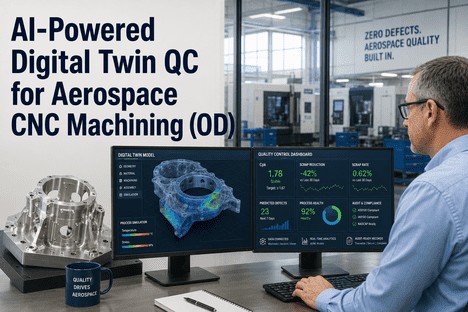
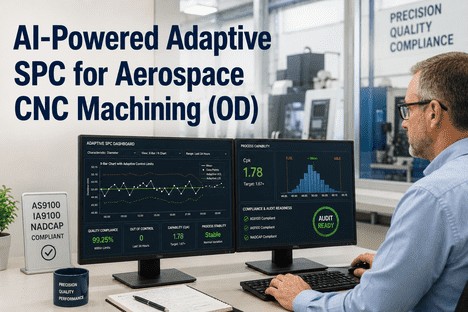
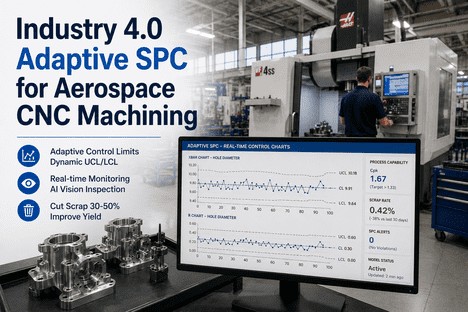
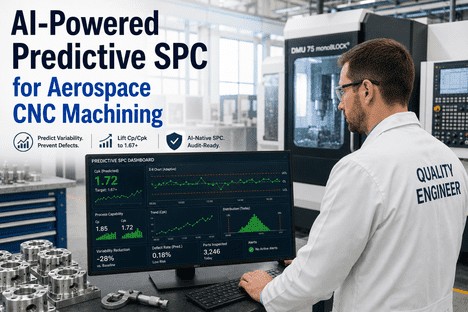
AI-Powered Adaptive SPC for Aerospace CNC Machining
By Grace on June 10, 2026
Your aerospace CNC machining cell is running titanium impellers on a five-axis center. The first 47 parts pass CMM inspection within tolerance. Part 48 shows a bore 0.003 mm above nominal. Part 49 drifts another 0.002 mm. Part 50 -- flagged by the CMM at +0.008 mm from nominal -- triggers the out-of-spec alert. The batch is stopped. 14 parts are quarantined. The root cause investigation finds that tool wear progression combined with a 2-degree Celsius ambient temperature shift across the second shift pushed the process mean past the upper tolerance boundary. All 14 quarantined parts are scrap. The Cpk for the week drops from 1.64 to 1.28. The AS9100 auditor reviewing your SPC records asks for the control limit revision history and the corrective action documentation tied to the drift event. Static control limits -- calculated during the PPAP study six months ago and never updated -- show no out-of-control signal until part 50. The data that predicted the drift existed in your CNC spindle load trend, your in-process probe readings, and your coolant temperature log from part 35 onward. Reactive SPC read none of it. Adaptive SPC reads all of it -- and alerts the quality engineer before the first out-of-spec part is made.
AI Adaptive SPC · Real-Time Drift Detection · Self-Tuning Control Limits · AS9100 Audit-Ready Records
The Cpk Drop That Produced Last Month's Scrap Was Visible in Your CNC Data 40 Parts Before the CMM Flagged It. Adaptive SPC Reads It in Time.
iFactory's adaptive control limits engine ingests real-time CNC probe data, spindle load, thermal sensors, and tool life counters -- forecasting dimensional drift and Cpk degradation before the first out-of-tolerance part reaches the CMM.
Cpk target for safety-critical aerospace features under AS9100 -- sustainable only when control limits adapt to the current process state, not the PPAP qualification state
10-50x
Faster drift detection vs traditional Shewhart charts -- sub-sigma alerts catch tool wear and thermal drift before they produce dimensional nonconformances
30-50%
Scrap reduction reported by aerospace CNC operations using adaptive SPC -- preventing dimensional drift from becoming out-of-spec production
2-6 hrs
Lead time that adaptive drift detection provides before a dimensional tolerance breach -- the intervention window that static SPC never opens
Why Static SPC Limits Fail in Aerospace CNC Machining
The control limits on your SPC chart were calculated during your PPAP or AS9100 qualification study -- typically from 25 to 30 subgroups collected across a controlled production window on a single shift with a new tool, stable coolant temperature, and consistent ambient conditions. Those limits were correct for that process state. They are progressively less correct with every variable that shifts as production continues: tool wear progression that moves the process mean 0.003 mm per 50 parts, ambient temperature swings of 3-8 degrees Celsius between day and night shifts, coolant concentration variation that changes thermal dissipation at the cutting edge, material batch-to-batch hardness variation, and spindle bearing wear that increases runout over weeks of operation. Static UCL and LCL remain anchored at qualification values while the actual process distribution shifts, widens, and drifts around them. The result is a control chart that appears stable -- no Western Electric rule violations -- while the process is actively moving toward the specification limit. The quality engineer sees no signal. The CMM flags the failure. The scrap is already produced.
The Four Drift Drivers That Static SPC Misses -- and Adaptive Limits Track Continuously
Driver 1 -- Tool Wear
Progressive Cutting Edge Degradation
As a cutting tool wears, the cutting forces increase, heat generation rises, and deflection grows. A bore that measures +0.002 mm from nominal on a fresh tool will measure +0.011 mm at end of tool life -- before any visual edge failure. Static SPC sees no violation until the measurement exceeds the fixed UCL. Adaptive SPC tracks the monotonic drift rate and projects when the feature will breach tolerance, triggering a pre-emptive tool change or offset adjustment.
Drift velocity: +0.002 to +0.004 mm per 10 parts on titanium -- detectable by adaptive limits at part 12, not at part 48
Driver 2 -- Thermal Shift
Ambient and Process Temperature Variation
A 3-degree Celsius ambient temperature change produces approximately 0.007 mm of Z-axis column growth on a typical VMC. Day-to-night shift transitions commonly produce 4-6 degree swings. Coolant temperature rises across a production run, changing the thermal equilibrium of the machining zone. Static SPC absorbs these shifts as unexplained variation, widening the process spread and reducing Cpk. Adaptive SPC correlates thermal sensor data with dimensional measurements, detecting temperature-driven drift as a distinct pattern and adjusting the expected mean accordingly.
Thermal compensation: adaptive limits model 0.0023 mm per degree C and pre-emptively recenter the expected process band
Driver 3 -- Material Variation
Lot-to-Lot Hardness and Machinability Shifts
Titanium 6Al-4V and Inconel 718 exhibit measurable hardness variation between mill-certified batches. A harder lot increases cutting forces by 8-15%, accelerating tool wear and shifting the dimensional baseline. Aerospace suppliers receiving material from multiple certified sources see this variation every batch change. Static SPC treats it as random noise. Adaptive SPC detects the systematic shift in spindle load and dimensional trend at batch changeover, adjusting control limits to the new material regime before dimensional drift develops.
Batch detection: adaptive models flag spindle load increase above 12% of baseline as material-driven regime change
Driver 4 -- Machine Condition
Spindle and Axis Degradation Over Time
Spindle bearing wear, ball screw backlash progression, and guideway wear all change the machine's positional capability gradually over months of operation. A machine that held Cpk 1.67 at last PM cycle may be running at Cpk 1.33 six months later without any single failure event. Static SPC shows increasing variation but no assignable cause. Adaptive SPC tracks the variance trend independently from the mean trend, distinguishing machine degradation from tool wear and triggering proactive maintenance alerts that restore capability before scrap increases.
Variance tracking: adaptive limits widen UCL/LCL when variance increases, narrow them after PM -- maintaining detection accuracy at every machine condition state
Static Control Limits Miss the Drift That Produces Scrap. Adaptive Limits Catch It at Sub-Sigma Resolution -- 40 Parts Before the CMM Does.
iFactory's adaptive SPC engine continuously recalculates UCL, LCL, and expected mean from a rolling window of live CNC probe data, spindle load, and thermal readings -- distinguishing common-cause drift from assignable-cause events.
How Adaptive Control Limits Work in a CNC Machining Cell
Adaptive control limits are not a different control chart. They are a continuous recalculation layer that sits above the standard X-bar-R or X-MR chart structure, updating the control limit parameters as new data arrives while preserving the compliance documentation that AS9100 and customer quality audits require. The ML model evaluates the current process distribution against recent history -- typically 50 to 200 subgroups -- and distinguishes between common-cause variation that should update the limits and special-cause variation that should trigger an alarm.
Engine
Data Fusion
Multi-Source Ingestion -- CNC, CMM, Sensor, and PLC Data Unified Into One Model
The adaptive model ingests in-process probe measurements from Renishaw, Blum, or Marposs probing cycles; spindle load and power draw from the CNC controller; vibration and acoustic emission sensors for chatter detection; coolant and ambient temperature sensors; tool life counters and tool change logs; and CMM measurement results as they become available. All data streams are synchronized to a common timestamp and feature identifier. The ML model maintains a rolling feature window -- 50 to 200 subgroups -- across every CTQ characteristic simultaneously. This is the same data set the quality engineer reviews when investigating a scrap event. Adaptive SPC reads it while the parts are still in the machine.
Engine
Limit Tuning
Self-Tuning UCL, LCL, and Centreline -- Updated Every Subgroup
The model recalculates the control limits using a weighted rolling window of recent subgroups, giving more weight to recent data while retaining enough history to establish statistical significance. The centreline tracks the current process mean. The UCL and LCL track the current process spread. The ML layer applies an independent variance tracker: when variance increases due to tool wear progression, the adaptive limits widen to maintain appropriate false alarm rates. When variance decreases after a tool change or PM event, the limits narrow to improve detection sensitivity. The result is a control chart where the limits reflect what the process is actually doing now -- not what it was doing at PPAP qualification six months ago. Every limit update is logged with a timestamp for audit documentation.
Engine
Drift Alert
Ranked Alert With Root Cause Attribution -- Not a Raw Sensor Flag
When the adaptive model detects a statistically significant drift in process mean or variance, the alert delivered to the quality engineer is not a generic OOC notification. It is a ranked finding: the CTQ characteristic drifting, the current drift velocity and projected time-to-tolerance-breach, the top contributing process variable (tool wear, thermal shift, material change, or machine degradation), and a recommended corrective action. The quality engineer sees: "Bore A diameter trending +0.003 mm per 10 parts. Predicted out-of-tolerance at part 62. Primary driver: tool wear progression on tool 4. Secondary: coolant temperature 2.1 degrees above baseline. Recommended: execute tool offset adjustment of -0.005 mm and verify with next probe cycle." The intervention is specific, quantified, and immediate.
Engine
Cpk Tracking
Continuous Cpk on Every CTQ -- Live Trend, Forecast, and Control Limit Breach Prediction
Cpk is calculated continuously on every key characteristic against its tolerance limits -- updated with every new in-process probe measurement and CMM result. The quality engineer sees the live Cpk trend for the current tool life window, the projected Cpk at current drift trajectory, and the forecast time to Cpk dropping below the minimum acceptable threshold. Self-tuning SPC limits dynamically adjust for tool wear and thermal conditions -- eliminating the false alarm surge that static limits generate every time the machine transitions between cold start and thermal equilibrium. The system distinguishes between common-cause variation that reflects normal machining behaviour and assignable-cause events requiring engineer response. Cpk trend data for every characteristic is stored and searchable for AS9100 and customer audit review.
What Changes When a Quality Engineer Uses Adaptive SPC Instead of Static SPC
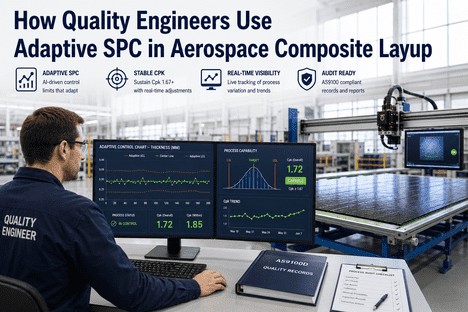
Sustaining Cpk 1.67+ on safety-critical aerospace features is not a single-event achievement. It is a continuous operating condition that requires a fundamentally different relationship with process data. Adaptive SPC changes four specific behaviours in how quality engineers manage CNC machining cells.
1
Tool Life Management Shifts From Fixed Count to Condition-Based Control
Fixed tool life windows are set to the worst-case condition -- the tool change happens at 200 parts regardless of whether the tool is cutting titanium at 100% spindle load or aluminium at 40% load. The result is premature tool changes that increase cost and tool changes that are too late for the hardest material lot. Adaptive SPC tracks the actual drift rate of each CTQ characteristic and alerts the quality engineer when the drift velocity indicates the tool is approaching the end of its useful life for the current operating conditions -- not when a fixed counter expires. Operations using condition-based tool life control report 20-30% increase in usable tool life while simultaneously reducing scrap from end-of-life tool failure.
Before: Change tool at 200 parts regardless of actual wear state. After: Change tool when drift velocity indicates tolerance breach within 8 parts.
2
Shift Handover Transitions From Report Review to Live Risk Review
The traditional shift handover in CNC aerospace machining involves reviewing the previous shift's quality report -- which parts were produced, which passed CMM, which required rework. This is a rear-view mirror conversation. Adaptive SPC changes the handover to a forward-looking risk review: the incoming quality engineer opens the live dashboard and sees which CTQ characteristics are showing drift trends, the current Cpk for each critical feature, any tool wear alerts active on the cell, and the forecast time-to-tolerance-breach for the highest-risk characteristics. The conversation shifts from "we scrapped four parts on third shift" to "bore A is trending +0.003 mm per 10 parts -- we need to execute a tool offset adjustment before the next batch.
Before: Review the previous shift's failures. After: Review the current shift's risks before they become failures.
3
Offset Adjustments Become Proactive Instead of Reactive
In static SPC, the tool offset is adjusted after a measurement shows the feature has drifted past a threshold -- typically when the X-bar chart signal or a CMM result exceeds the alarm limit. This is a reactive adjustment: the drift was occurring across the previous parts, and the correction only prevents further drift. Adaptive SPC calculates the drift velocity from the trend of the last 10-20 in-process probe measurements and projects the time to tolerance breach. The quality engineer receives an alert with a recommended offset adjustment before the drift produces an out-of-spec part. The adjustment is made proactively, maintaining the process centred in the tolerance band across the entire tool life rather than cycling between under-correction and over-correction.
Before: Adjust offset after CMM flags drift. After: Adjust offset when drift velocity model predicts breach in 8 parts.
4
Audit Evidence Is Generated by the System, Not Assembled Manually
Every AS9100 and customer quality audit requires documented evidence that the SPC system was operating correctly, control limits were maintained, out-of-control events were responded to, and corrective actions were effective. In static SPC environments, this evidence is assembled manually from shift logs, emailed notifications, and paper control charts -- a process that consumes 8-12 hours per audit preparation cycle. Adaptive SPC generates all of this documentation automatically: a timestamped log of every control limit update with the calculated parameters, every drift alert with the process state at alert time, every quality engineer response, and the Cpk trend for every characteristic across the audit period. Exportable, searchable, and structured to satisfy AS9100 clause 8.5.1 and 10.2 requirements.
Before: Manual evidence pack assembled from shift notes and exported control charts. After: Automated timestamped audit trail per characteristic, per event, per intervention.
"
We were running static SPC on a five-axis cell machining titanium structural components for a major aerospace prime. Our control limits were calculated during the PPAP run in March. By September, the machine had undergone a spindle rebuild, we had switched coolant suppliers twice, and we were running a different titanium alloy lot every week. The control chart showed no alarms -- the limits were so wide from accumulated variation that no single measurement could trigger a violation. We were inspecting parts, not controlling the process. The adaptive SPC deployment changed that in the first week: the model detected a bore drift trend on part 12 of a 200-part run that was caused by a 2-micron tool offset error. Static SPC would have caught it at part 50, after 38 parts had drifted off nominal. Adaptive SPC caught it at part 12, after 1 part was affected. The offset was corrected. The remaining 188 parts ran centred. That single event paid for the system.
How Adaptive SPC Compares to Static SPC Across a Production Year
The difference between adaptive and static SPC is not measured in a single batch. It accumulates across production quarters as tool wear cycles, material lot changes, thermal seasons, and machine degradation events occur. Static SPC treats every new condition as an unexplained deviation from the PPAP baseline. Adaptive SPC recalibrates to every new condition as it emerges.
Quality Outcome
Static SPC
Adaptive SPC
Scrap rate from dimensional drift
3-8% -- detected at CMM, after drift has already produced out-of-spec features
0.3-1.2% -- drift detected at sub-sigma level, corrected before tolerance breach
Cpk consistency across production
Cpk fluctuates 1.1-1.7 across tool life cycles -- high at tool change, declining toward end of life, recovering after each offset adjustment
Cpk holds 1.6-1.85 -- continuous adjustment keeps process centred, drift compensation maintains capability across entire tool life window
False alarm rate
8-15 false alarms per cell per week -- static limits trigger on thermal shift and material variation that operators learn to ignore
1-3 actionable alerts per cell per week -- adaptive limits distinguish common-cause from special-cause, operators trust every alert
Tool life utilisation
Fixed life window -- tools changed at conservative count, 15-25% of useful life left on every change
Condition-based -- tools changed when drift velocity indicates end of useful life, 20-30% increase in usable tool life
Audit preparation time
8-12 hours per audit -- manual collection of control charts, shift logs, OOC response records, and Cpk studies
Export in 15 minutes -- all records timestamped, searchable, and structured per AS9100 and customer audit requirements
Conclusion
Aerospace CNC machining operates at the intersection of the tightest dimensional tolerances in manufacturing and the most variable physical processes in production. Tool wear, thermal expansion, material variation, and machine degradation are not exceptions to normal operation -- they are normal operation. The question is whether your SPC system detects them before they produce scrap or after.
Static control limits treat every shift in the process as noise. Adaptive control limits treat every shift as information -- distinguishing common-cause changes that should update the process baseline from assignable-cause events that require immediate intervention. The result is not a marginal improvement in detection speed. It is a structural change in the quality control model: from reacting to CMM failures to preventing them, from managing Cpk through corrective action after the fact to sustaining it through continuous, real-time process centering.
iFactory's adaptive SPC platform is purpose-built for quality engineers in aerospace CNC machining operations -- delivering self-tuning control limits on every CTQ characteristic, real-time drift detection with root cause attribution, continuous Cpk tracking against AS9100 and customer-specified targets, and automated audit documentation that eliminates the manual evidence assembly cycle. Book a Demo to see the adaptive SPC engine running on a CNC machining use case matched to your cell configuration, or talk to an expert about a free Cpk and audit-readiness assessment for your aerospace operation.
Frequently Asked Questions
AS9100 Rev D clause 8.5.1 requires documented evidence that production processes are controlled and monitored. AS9102C requires SPC data for key characteristics. Customer quality audits typically require Cpk trend data, control limit revision history, and documented response to out-of-control conditions. Adaptive SPC meets all of these requirements by generating a timestamped record of every control limit update -- including the calculated UCL, LCL, and centreline parameters, the number of subgroups in the calculation window, and the reason for the update (common-cause shift vs. event-triggered adjustment). Every drift alert, every quality engineer response, and every offset adjustment is logged automatically. The audit trail is structured to satisfy the same documentation requirements as static SPC -- with the advantage that adaptive updates are documented proactively rather than reconstructed from shift notes after the fact. Talk to an expert about configuring adaptive SPC documentation for your specific AS9100 audit requirements.
False alarms decrease with adaptive SPC -- typically from 8-15 per cell per week down to 1-3 actionable alerts. The reason is that adaptive limits distinguish between common-cause variation that should update the process baseline and special-cause variation that requires intervention. Static limits alert on both equally -- a thermal shift of 3 degrees that moves the process mean by 0.005 mm triggers the same Western Electric rule violation as a tool breakage event. Operators learn to ignore the thermal alarms, which means they occasionally miss the actual tool failure signal. Adaptive SPC tracks the thermal sensor data independently, recognises that the mean shift correlates with a known temperature change, and updates the limits accordingly -- producing an alert only when the residual drift after thermal compensation indicates a true assignable cause. The result is fewer alerts, higher signal-to-noise ratio, and operator trust in every notification. Book a Demo to see adaptive SPC running on live CNC machine data with false alarm filtering demonstrated.
The adaptive SPC model works with data sources already available in most aerospace CNC machining cells: in-process probe measurements from Renishaw, Blum, or Marposs probing systems (typically output as G-code macro variables or data file exports), spindle load or power draw from the CNC controller via MTConnect, OPC-UA, or direct PLC interface, coolant and ambient temperature sensors (or machine-mounted thermal sensors), tool life counters from the CNC controller or tool management system, and CMM measurement results from the quality lab system. If you have a process historian or data collection system already aggregating this data, iFactory integrates with it directly. If you do not, the platform includes connector modules for the most common CNC control families -- Fanuc, Siemens, Heidenhain, and Mitsubishi -- and for CMM systems from Hexagon, Zeiss, and Mitutoyo. Most cells can be connected within 2-4 weeks of deployment start. Talk to an expert about data availability requirements for your specific CNC cell configuration.
Short-run and low-volume production is where adaptive SPC provides the most value relative to static SPC. Traditional X-bar-R charts require 20-25 subgroups to establish statistically valid control limits -- a requirement that is impossible to meet on a 50-part production run of a complex aerospace component. Adaptive SPC uses a combination of historical data from similar features, machine learning models that correlate process parameters with dimensional outcomes, and Bayesian updating that adjusts limits as each new measurement arrives. The model can provide meaningful control limits from as few as 5-10 parts by leveraging data from geometrically similar features on previous part numbers. The result is that short-run cells -- which typically run without any SPC at all because traditional limit-setting is impractical -- gain live process control with adaptive limits that improve in accuracy with every part produced. Book a Demo to see adaptive SPC configured for a short-run aerospace cell with mixed part numbers.
The Dimensional Drift That Produced Last Month's Scrap Was in Your CNC Probe Data 40 Parts Before the CMM Flagged It. Get a Free Cpk and Audit-Readiness Assessment.
iFactory's adaptive control limits engine forecasts dimensional drift and Cpk degradation 40-80 parts before tolerance breach, sustains Cpk 1.67+ across tool wear cycles and material lot changes, and generates the AS9100-compliant audit records that customer quality assessors require -- all without adding to the quality engineer's reporting burden.