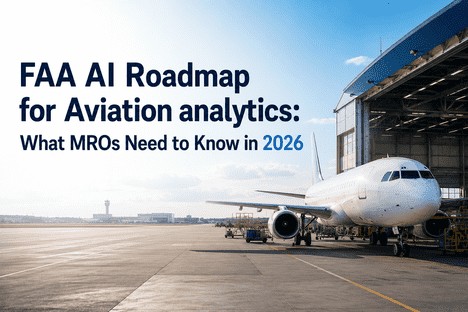
The FAA published its first-ever Roadmap for Artificial Intelligence Safety Assurance in July 2024. If you run a Part 145 repair station, this document is not academic. It is the blueprint for how the agency will assess every AI-assisted tool, predictive model, and automated compliance system your MRO adopts. The window to align your analytics infrastructure with FAA expectations is open today. It will not stay open indefinitely.
FAA REGULATORY INTELLIGENCE
FAA AI Roadmap for Aviation Analytics
What MROs Need to Know in 2026
The FAA has drawn a line on AI safety assurance. Here is how the agency's guiding principles will reshape MRO compliance, predictive analytics, and digital recordkeeping — and what to do before your next audit.
74%
MRO leaders prioritizing AI adoption in 2026
30-40%
Reduction in unplanned downtime with AI
31
Pages in the FAA AI Safety Assurance Roadmap
7
Guiding Principles for AI in Aviation
THE REGULATORY SHIFT
Why the FAA AI Roadmap Changes Everything for MROs
For decades, aviation maintenance operated on a straightforward regulatory premise: if a process, tool, or system could demonstrate deterministic repeatability, it could be certified. AI upends that premise entirely. Machine learning models do not follow fixed instruction paths. They learn from data, adapt to patterns, and produce outputs that vary with input — making traditional safety assurance methods insufficient.
The FAA roadmap directly acknowledges this gap. It introduces a phased framework for evaluating AI systems across the entire aviation ecosystem, from onboard autonomy to ground-based MRO analytics. For repair stations, the implications are immediate: any AI-powered tool used in maintenance tracking, predictive diagnostics, compliance monitoring, or parts forecasting will need to demonstrate safety assurance under the FAA's emerging standards. The era of deploying AI tools without regulatory scrutiny in MRO environments is over.
!
The Compliance Gap
Most MROs currently using AI-powered analytics have no FAA-approved safety assurance framework for those tools. The roadmap closes this gap by requiring demonstrable methods for validating AI outputs used in maintenance decisions.
R
The Risk Exposure
Repair stations using AI without documented safety assurance methods face audit findings, certificate action, and liability exposure in the event of maintenance errors linked to unvalidated AI recommendations.
!
The Timeline Pressure
The roadmap is a living document — it will evolve. Early adopters who align their compliance analytics platforms now will face significantly lower transition costs than those who wait for enforcement deadlines.
THE 7 GUIDING PRINCIPLES
Decoding the FAA's AI Safety Assurance Framework
The roadmap is built on seven core principles that will guide every AI safety determination the FAA makes. Each principle carries specific implications for MRO operations deploying analytics, diagnostics, or compliance automation. Here is what each means in plain language and in practice.
01
Work Within the Aviation Ecosystem
AI systems must integrate into existing aviation safety frameworks, not bypass them. For MROs, this means AI-powered compliance tools must operate within the existing Part 145 quality system — augmenting it, not replacing it. Your software must document how it meets the same regulatory standards your manual processes do.
Part 145 Alignment
02
Focus on Safety Assurance and Enhancements
The FAA draws a line between safety of AI and using AI for safety. MRO analytics platforms must pass both tests: they must be demonstrably safe themselves, and they must contribute measurable safety improvements. Predictive maintenance alerts, for example, must be validated against real-world outcomes before they can be relied upon for release decisions.
Safety Validation
03
Avoid Personification
AI is a tool, not a human. This is not philosophical — it is structural. The FAA insists on unambiguous human accountability for every decision influenced by AI. In an MRO context, no predictive model output or automated compliance flag can substitute for a certified technician's sign-off. Your workflow must preserve human decision authority at every critical juncture.
Human Accountability
04
Differentiate Learned vs. Learning AI
Static AI models trained on fixed datasets require different assurance methods than continuously learning systems. For MRO compliance software, this distinction dictates validation frequency. A learned model that flags overdue ADs against a static database needs one-time validation. A learning model that adapts its predictions based on new fleet data needs ongoing, documented monitoring.
Validation Strategy
05
Take an Incremental Approach
The FAA does not expect overnight compliance. The roadmap explicitly supports phased integration, starting with lower-risk applications. For MROs, this is a strategic advantage. Deploy AI in administrative compliance tracking first — AD management, qualification monitoring, document control. Build experience and data. Then extend into predictive maintenance and diagnostic decision support.
Phased Deployment
06
Leverage the Safety Continuum
Not every AI application carries the same risk level. The safety continuum allows lower-risk AI uses to gain certification experience before critical applications. MRO analytics that monitor tool calibration or track technician certifications sit lower on the continuum than AI that recommends engine release decisions. Start low, prove safety, then climb the continuum.
Risk Tiering
07
Leverage Industry Consensus Standards
The FAA will not reinvent the wheel. It will adopt and adapt industry consensus standards developed by bodies like SAE International, EUROCAE, and ASTM. MROs should align AI compliance platforms with emerging standards such as SAE AIR6988 and EUROCAE ED-324, which define AI safety assurance methods for aviation. Your software vendor must demonstrate standard alignment.
Standards Alignment
IFACTORY REGULATORY COMPLIANCE MODULE
Is Your MRO AI-Ready for the Next FAA Audit?
iFactory's Regulatory Compliance Module is built to align with the FAA's AI safety assurance framework — so your analytics infrastructure meets roadmap expectations today, not after a finding.
MRO COMPLIANCE ENFORCEMENT
How the FAA Roadmap Changes MRO Audits and Inspections
The roadmap does not create new regulations. It creates a framework for interpreting how existing regulations apply to AI-assisted maintenance environments. That distinction matters because it means the FAA can evaluate your AI tools under current authority — including FAR Part 145 requirements for quality control, training, and recordkeeping. Your next audit may already include AI-specific questions.
Q
Quality Control Systems
If your MRO uses AI to prioritize inspection tasks, flag discrepancies, or generate work orders, the FAA will expect documented evidence that the AI output meets the same standard as human-generated findings. This means traceable model validation records, bias testing, and performance monitoring logs.
T
Training Program Coverage
Part 145 requires training on all equipment used in maintenance. AI tools are equipment. Your training syllabus must include AI system limitations, override procedures, and bias awareness. The FAA roadmap specifically flags automation bias — the tendency for technicians to over-trust AI recommendations — as a human factors risk requiring active mitigation.
R
Recordkeeping Integrity
AI-generated maintenance records must meet the same retention, accuracy, and traceability standards as manually created records. If your compliance software auto-populates logbooks or generates AD compliance documentation, the FAA will want to see the validation trail linking the AI output back to its source data and decision logic.
CURRENT VS. AI-COMPLIANT MRO
Where Your MRO Stands Against FAA AI Expectations
MRO Operational Area Comparison
| Operational Area |
Current Typical MRO |
FAA AI-Compliant MRO |
Gap |
| AD/SB Compliance Tracking |
Manual cross-reference or basic database search |
AI-powered continuous monitoring with automated applicability filtering |
+80% coverage |
| Predictive Maintenance Alerts |
Rule-based triggers with high false-positive rates |
ML models validated against fleet outcomes with documented accuracy thresholds |
Documentation gap |
| Technician Qualification Tracking |
Spreadsheet or disconnected HR system |
AI-verified qualification status with real-time task-authorization checks |
+60% accuracy |
| Work Order Generation |
Manual creation after inspection findings |
AI-prioritized, severity-ranked, resource-optimized work orders |
42% faster |
| Safety Reporting |
Reactive, paper-based or basic digital forms |
AI pattern recognition across maintenance data for proactive safety flags |
New capability |
| Document Control |
Manual revision tracking, prone to version errors |
AI-automated revision control with compliance-linked audit trails |
95% faster |
ACTION ROADMAP
Five Steps to FAA AI Compliance for Your MRO
The roadmap provides a framework but not a checklist. Based on the document's guiding principles and the FAA's stated priorities, here is the actionable sequence MROs should follow to align their analytics and compliance infrastructure with regulatory expectations.
01
Inventory Every AI-Supported Process in Your MRO
Conduct a complete audit of every tool, script, model, or automated workflow that uses AI or ML in your operation. Include predictive maintenance modules, compliance flagging systems, document auto-classification, parts forecasting, and scheduling algorithms. Map each to its safety relevance tier on the FAA safety continuum.
02
Document Model Validation and Performance Baselines
For each AI tool, create a validation record that includes training data provenance, model architecture, accuracy metrics, known limitations, and human override procedures. The FAA will expect to see evidence that your AI tools have been tested against the specific maintenance contexts in which they are deployed.
03
Integrate AI Tools Under Your Part 145 Quality System
Your quality control manual should explicitly address AI-generated outputs as data sources that feed into — but do not replace — human maintenance decisions. Define the review authority levels, override triggers, and documentation requirements for each AI-assisted workflow.
04
Deploy an FAA-Aligned Compliance Analytics Platform
Replace disconnected spreadsheets and siloed tracking systems with a centralized regulatory compliance module that automates AD/SB monitoring, qualification tracking, document control, and audit trail generation — all within an FAA-compliant framework that supports both learned and learning AI validation.
05
Establish Continuous Monitoring and Revalidation Cycles
For learning AI systems, define revalidation intervals tied to model update frequency. Maintain a living performance log that tracks model accuracy, drift, and false-positive/negative rates against actual maintenance outcomes. This log becomes your primary evidence in an FAA audit of an AI-assisted process.
74%
Of MRO Executives Prioritizing AI
AeroDynamic Advisory reports that nearly three-quarters of MRO leaders rank AI adoption as a top-3 strategic priority for 2026. The FAA roadmap now provides the regulatory language to evaluate those investments.
4.8x
Emergency Repair vs. Planned Cost Multiplier
IATA benchmarks confirm emergency repairs cost nearly five times planned maintenance. AI predictive analytics validated under FAA standards directly target this cost gap.
$74B
Global MRO Market by 2026
Oliver Wyman projects the global MRO market will reach $74 billion. Operators with FAA-compliant AI analytics will capture disproportionate market share through lower costs and higher dispatch reliability.
68%
Of AI Adopters Report Faster Audits
MROs using AI-powered compliance tracking report significantly faster audit cycles, with automated evidence retrieval reducing preparation time from weeks to hours.
FAA-ALIGNED COMPLIANCE PLATFORM
Align Your MRO Analytics With the FAA AI Roadmap
iFactory's Regulatory Compliance Module automates AD/SB tracking, qualification management, document control, and audit trail generation — built to meet the FAA's AI safety assurance expectations for Part 145 operations.
FREQUENTLY ASKED QUESTIONS
What Aviation Professionals Are Asking About the FAA AI Roadmap
Does the FAA AI Roadmap create new regulations for MROs?
▼
No. The roadmap does not create new regulations. It establishes a framework for how the FAA will interpret existing regulations — including FAR Part 145 — when evaluating AI-assisted maintenance processes. The key shift is enforcement posture: inspectors can now cite AI-specific concerns under existing authority. The roadmap signals that the FAA will expect documented AI safety assurance even before formal rulemaking is complete. MROs that proactively align with the framework reduce audit risk and position themselves ahead of regulatory evolution.
What is the difference between learned AI and learning AI in the FAA context?
▼
Learned AI refers to static models trained on a fixed dataset that do not change after deployment. An example is a model trained on historical AD compliance records that flags overdue actions against a known database. Learning AI refers to models that continue to adapt and update their parameters based on new data after deployment. The FAA requires different safety assurance methods for each. Learned AI can be validated once at deployment. Learning AI requires continuous monitoring, periodic revalidation, and documented performance tracking throughout its operational life. For MRO compliance software, this distinction determines your validation burden and audit evidence requirements.
How should MROs document AI tool validation for FAA audits?
▼
Documentation should cover five areas: training data provenance (where the data came from, its quality, and its relevance to your specific maintenance context), model architecture (what type of AI/ML is used and why), performance metrics (accuracy, precision, recall, false-positive and false-negative rates measured against a held-out test dataset), known limitations (edge cases where the model underperforms or should not be relied upon), and human override procedures (clear rules for when and how a technician can override an AI recommendation, with documentation requirements for each override). This documentation should be maintained as a living record, updated whenever the model or its deployment context changes.
Can an MRO use AI for compliance tracking without FAA approval?
▼
Yes, within limits. The FAA does not pre-approve every AI tool used in MRO operations. However, the quality system required by Part 145 must demonstrate that all tools and processes used in maintenance produce safe, reliable outcomes. If an AI-powered compliance tracking system generates outputs that directly influence maintenance decisions — such as AD compliance status, inspection intervals, or return-to-service determinations — the MRO must be able to demonstrate that the system is validated, reliable, and properly integrated into the quality control framework. The roadmap makes it clear that ignorance of AI-specific risks is not a defense. Proactive validation is strongly recommended.
What is the timeline for FAA AI enforcement in MRO environments?
▼
The roadmap is a living document, meaning it will be updated as the FAA gains experience with AI assessments. The agency has indicated a phased approach consistent with its safety continuum principle. Lower-risk AI applications — administrative compliance tracking, document management, qualification monitoring — will be assessed first, with enforcement expectations evolving through 2026 and into 2027. Higher-risk applications involving direct maintenance decisions will follow a longer timeline as industry consensus standards mature. However, early alignment is strongly recommended: enforcement posture tends to tighten faster than formal timelines suggest, and MROs that wait risk audit findings and retrofit costs.
START YOUR FAA AI COMPLIANCE JOURNEY
Ready to See How iFactory Aligns With the FAA AI Roadmap?
iFactory's Regulatory Compliance Module is purpose-built to automate FAA compliance tracking within an AI safety assurance framework. See it in action with a 30-minute demo tailored to your Part 145 operation.