Most aviation fleet managers believe they have real-time visibility into aircraft health — but the reality on the hangar floor and across flight operations tells a different story. Telemetry refresh intervals running 15 to 45 minutes behind live flight data, retrieval errors during peak departure banks, and siloed data streams that never converge into a single fleet operational picture are costing airlines and MRO operators millions in preventable AOG (Aircraft on Ground) events, unscheduled maintenance, and compliance exposure. If your analytics platform cannot surface an engine anomaly or a hydraulic pressure drift before it produces an operational grounding, you do not have real-time visibility — you have a reporting delay with a modern interface. To see how purpose-built AI-driven aviation analytics closes the fleet visibility gap, Book a Demo with the iFactory aviation intelligence team today.
FLEET OPERATIONAL RISK ANALYSIS
Is Your Aviation Fleet's Predictive Data Actually Real-Time?
iFactory delivers genuine real-time fleet intelligence for aviation operators — eliminating data silos, AOG telemetry delays, and the analytics visibility gap that drives unscheduled downtime and FAA/EASA compliance risk.
35%
Average reduction in unscheduled fleet downtime with AI-driven analytics
$180K
Average hourly cost of an AOG event including passenger re-accommodation
99.2%
Predictive accuracy for engine health and component failure precursors
72+ Hrs
Lead time for predictive failure detection before operational disruption
The Real-Time Data Visibility Problem Hiding Inside Aviation Fleet Operations
Why "Connectivity" Doesn't Mean "Readiness" in MRO
The term "real-time analytics" has been so aggressively marketed across aviation software that fleet operators often assume connectivity equals visibility. It does not. An aircraft sensor transmitting data every 100 milliseconds via ACARS or Satcom means nothing operationally if the analytics layer aggregating that signal refreshes on a 45-minute post-flight batch cycle or routes through a middleware layer that never surfaces a critical drift to the maintenance team. The analytics visibility gap in aviation is not primarily a telemetry problem — it is a data architecture problem compounded by legacy reporting design that was never built for the zero-latency requirements of modern fleet management. Airlines that have invested in connected aircraft without replacing their underlying analytics pipeline are experiencing the same AOG blind spots as fleets with no predictive monitoring at all.
5 Root Causes of Real-Time Analytics Failure in Aviation Fleets
Diagnosing the Visibility Gap Before It Becomes an AOG or Compliance Event
01
Data Silos Across Disconnected MRO Systems
Aviation fleets typically operate Flight Data Recorders, CMMS platforms, Inventory ERPs, and Regulatory Compliance tools as completely separate data ecosystems. When analytics software queries these systems independently, the result is fragmented fleet intelligence — each system showing a different slice of truth at a different point in time. Real-time analytics requires unified data ingestion across every flight and ground system, not sequential queries to disconnected silos. Operators can
Book a Demo to see how iFactory eliminates cross-system data fragmentation.
02
Post-Flight Batch Reporting Disguised as Real-Time Dashboards
Many aviation analytics platforms are architected around post-flight data dumps — pulling data only after landing and rendering updated health scores. A post-flight reporting cycle presents data that is already too late to prevent a mid-route failure or an immediate turnaround delay. On high-velocity flight schedules where turn times are under 60 minutes, post-flight analytics delivers insights after the operational damage has already occurred. The underlying data pipeline must be continuous, not episodic.
03
Hangar-Level Network Latency Creating Blind Zones in Maintenance Data
Operational technology networks in maintenance hangars are often segmented or geographically isolated — creating unmonitored data transfer gaps between aircraft systems and analytics layers. When edge-to-cloud data synchronization is not architecturally validated, maintenance events that occur in remote hubs never reach the central analytics platform in time to drive fleet-wide decisions. iFactory solves this with on-premise GPU AI nodes at each hangar, ensuring zero-latency processing.
04
Platforms Built for Historical Audits Rather Than Predictive Action
A significant category of aviation software was designed for post-incident audits and management review — not for real-time technician decision support. These platforms lack the event-driven alerting architecture required to surface a component drift at the moment a mechanic can still perform a corrective action before the next departure. If your analytics platform tells you what happened rather than what is about to fail, it is a reporting tool, not a predictive intelligence system.
05
Retrieval Errors and Data Integrity Failures During Peak Flight Banks
Analytics platforms that perform adequately during mid-day lulls frequently exhibit retrieval failures and timeout errors during peak departure and arrival banks — exactly when fleet intelligence is most critical. Simultaneous data streams from hundreds of aircraft stress analytics infrastructure in ways that generic vendor demos never replicate. Aviation fleets who only validate performance during off-peak windows are buying a system that will fail them precisely when AOG risk is highest.
The Strategic Move from Monitoring to Autonomous Fleet Intelligence
Closing the Loop Between Predictive Insights and Physical Hangar Execution
Predictive analytics in 2026 is no longer a standalone software exercise — it is the foundation of autonomous hangar operations. ifactory's platform doesn't just surface a predictive maintenance alert; it triggers a cascade of automated events that optimize the entire turnaround window. When an AI model identifies a developing turbine temperature anomaly, the platform automatically queries the inventory ERP for the required replacement part, checks AMR (Autonomous Mobile Robot) availability for parts delivery, and schedules the specific technician with the required FAA certification for that engine type. This level of integrated intelligence is what separates ifactory from legacy analytics tools that merely present data for human interpretation. Learn more about our ROS2 robotic integration by Booking a Demo today.
AI Knowledge Capture & Tribal Logic
Our platform uses advanced NLP and machine learning to ingest and codify the "tribal knowledge" of your most senior maintenance engineers. By digitizing decades of experience in identifying subtle mechanical "sounds" or behavioral quirks of specific airframes, ifactory ensures that your predictive accuracy remains high regardless of personnel turnover.
Digital Twin Stress Simulation
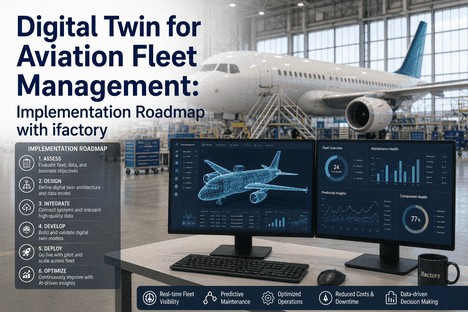
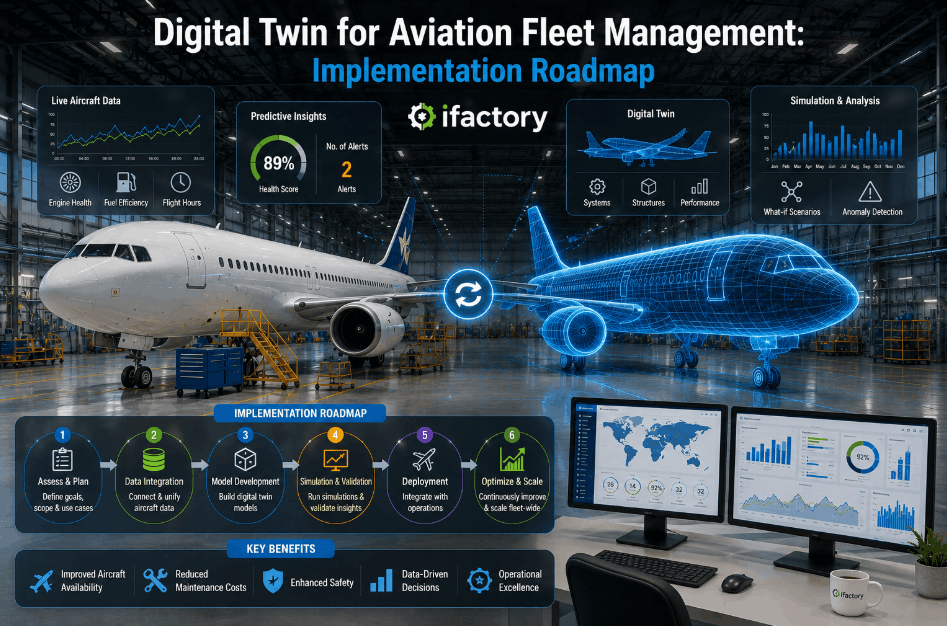
Every aircraft in your fleet is mirrored by a high-fidelity digital twin that simulates mechanical fatigue based on specific flight routes, weather conditions, and pilot handling styles. This allows for hyper-local maintenance planning — servicing a high-altitude regional jet differently than a long-haul trans-oceanic carrier.
Visual AI Drone Inspections
Through our ROS2-based drone integration, ifactory automates the visual inspection of fuselages, wings, and tail assemblies. AI computer vision identifies lightning strikes, bird impact damage, and fastener fatigue with 4x higher accuracy than manual scaffolding-based inspections, reducing hangar time by 18 hours per heavy maintenance check.
Autonomous Work Order Generation
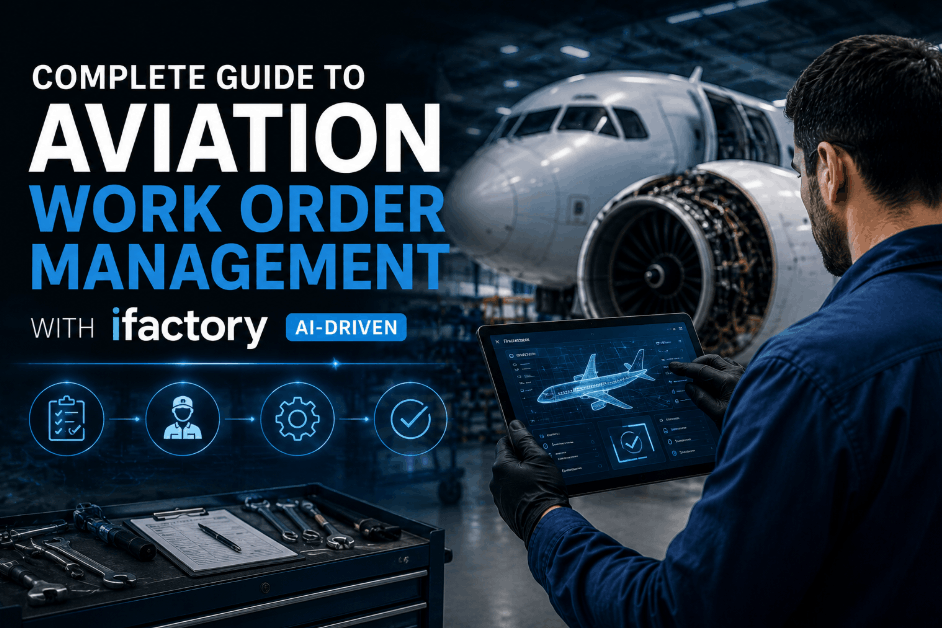
We eliminate the "administrative lag" by pushing predictive alerts directly into your CMMS (SAP, Oracle, Maintenix) as pre-populated work orders. By the time the aircraft touches down, the tools, parts, and labor are already staged at the gate, transforming an unplanned fault into a routine 30-minute turn-around task.
How Analytics Data Silos Amplify Aviation Fleet Risk
The Cost Structure of Fragmented MRO Visibility
The financial impact of analytics data silos in aviation extends well beyond the immediate cost of a part replacement. When fleet intelligence is fragmented, the downstream consequence is a compounding risk profile that affects engine lifecycles, fuel efficiency, and regulatory audit readiness. A component drift that a unified real-time analytics platform would surface in minutes can propagate undetected for days across a siloed environment — transforming a $2k seal replacement into a $2M engine overhaul and an unplanned grounding. Aviation fleet directors who want to quantify their current visibility gap exposure can Book a Demo for a structured fleet intelligence gap assessment.
| Aviation Analytics Failure Mode |
Primary Fleet Impact |
Secondary Risk |
Annualized Cost per 20 Aircraft |
| Data Silo Fragmentation |
Unscheduled AOG Events |
Passenger Delay Costs |
$450K – $1.2M |
| Batch-Cycle Telemetry Delay |
Undetected Component Drift |
Premature Part Replacement |
$280K – $650K |
| Hangar Network Blind Zones |
Deferred Maintenance Overlooked |
FAA/EASA Compliance Audit Gaps |
$150K – $400K |
| Reporting-Only Analytics |
No Predictive Fault Alerting |
Increased Mean Time to Repair |
$110K – $320K |
| Peak Load Data Loss |
Critical Health Log Missing |
Airworthiness Recertification Delay |
$90K – $500K |
Fixing the Aviation Analytics Visibility Gap: A Practical Framework
Five Diagnostic Steps for Fleet Maintenance Directors
Step 01
Measure Telemetry-to-Action Latency on High-Value Assets
Trigger a simulated fault or drift on an engine sensor and measure the precise time elapsed until your fleet analytics platform surfaces it to the maintenance control center. Document this latency during peak arrival banks. Most airlines find their actual "real-time" latency is measured in hours, not seconds.
Step 02
Inventory Disconnected Fleet Data Sources
Map every source of fleet health data — including FDR logs, ground robotics inspection data (ROS2), and manual pilot squawks — and identify which are excluded from your central AI analytics model. These unconnected sources are active blind zones that prevent predictive accuracy.
Step 03
Validate Edge Node Presence at Primary Maintenance Hubs
Determine if your analytics platform runs entirely in the cloud or if it features local GPU nodes at your hangars. For aviation, cloud-only polling architectures add prohibitive latency to massive flight data processing, making true predictive maintenance impossible during turn-around windows.
Step 04
Assess Mobile-First Dispatch Capability for Mechanics
An analytics alert that only appears on a desktop in the maintenance office but not on a mechanic's mobile device at the gate adds critical minutes to every response cycle. This physical delay is a hidden cost that directly contributes to flight delays.
Step 05
Require a Multi-Asset Proof-of-Concept on Live Flight Data
Negotiate a POC using 12 months of your specific fleet's engine and airframe telemetry. A platform that cannot demonstrate 99%+ predictive accuracy on your actual historical failures will not protect your operational schedule in 2026.
The Regulatory Risk of Analytics Failure: FAA and EASA Compliance
Airworthiness Documentation in an Analytics Latency Environment
The regulatory dimension of analytics failure in aviation carries direct compliance liability. Regulatory bodies require fleet operators to maintain unbroken, timestamped maintenance logs and to demonstrate that every aircraft is airworthy before departure. An analytics platform that loses data integrity during peak loads or stores health records in disconnected silos cannot reliably meet these requirements. iFactory's unified intelligence layer creates an immutable, audit-ready data chain for every asset in the fleet. Learn how AI-driven compliance automation eliminates documentation gaps by scheduling a Book a Demo with our aviation engineering team.
FAA Airworthiness Documentation Gap
Analytics platforms that fail to capture key health data elements continuously create logbook gaps that cannot be reconstructed. Regulatory penalties for documentation non-compliance often exceed the cost of the analytics platform itself.
EASA Part-M Continuous Surveillance
Continuous surveillance requirements cannot be met by batch-cycle analytics. A 40-minute telemetry gap during a critical flight phase is a regulatory exposure event that undermines your safety management system (SMS).
Retailer and Cargo Partner Audits
Major cargo partners and charter clients increasingly require real-time electronic health records as a condition of contract. Data integrity failures during peak periods will generate audit findings that threaten commercial agreements.
AOG Remediation Audit Trails
Your ability to prove correct remediation of an AOG event within the required safety window depends entirely on the queryability of your analytics data. Fragmented records make regulatory success unpredictable and dangerously slow.
Frequently Asked Questions
What causes real-time analytics data failure in aviation fleets?
Primary causes include post-flight batch ingestion pipelines, data silos across disconnected MRO and Flight Ops systems, and hangar-level network latency. These failure modes produce delayed health scores that arrive too late to prevent AOG events or departure delays.
How does iFactory eliminate aviation data silos?
iFactory uses a unified data ingestion layer that normalizes signals from flight data recorders, ground robotics (ROS2), and CMMS platforms into a single real-time operational context. This provides a "single source of truth" for the entire fleet across all global hubs.
Why is on-premise AI important for aviation hangars?
Aviation flight data files are massive. Processing them in the cloud adds significant latency and security risk. By deploying physical GPU AI nodes directly at the hangar, iFactory ensures that predictive analysis happens at the edge—delivering results in milliseconds while keeping sensitive data entirely on your secure network.
What is the typical ROI timeline for iFactory fleet analytics?
Fleet operators typically see measurable reductions in unscheduled AOG events within the first 60 days. Full platform payback, driven by reduced maintenance labor and eliminated emergency part sourcing, is consistently achieved within 12 to 14 months.
Does iFactory support visual inspection via drones?
Yes. Through our ROS2-based drone integration, iFactory automates visual fuselage and wing inspections using AI computer vision. This identifies lightning strikes, bird impacts, and structural fatigue significantly faster and more accurately than manual inspections, reducing heavy maintenance check times.
How does the 'AI Knowledge Capture' feature work for aviation?
We use machine learning to ingest historical maintenance notes and digitize the 'tribal knowledge' of your senior engineers. This creates a permanent, searchable intelligence layer that helps junior technicians identify complex faults based on the historical success patterns of your most experienced personnel.
Can iFactory simulate specific aircraft stress via Digital Twins?
Absolutely. Every airframe is mirrored in a digital twin that simulates mechanical stress based on actual flight routes, landing weights, and environmental exposure. This allows for individualized maintenance scheduling that maximizes the lifespan of each specific aircraft in your fleet.
ELIMINATE YOUR FLEET VISIBILITY GAP
Get a Real-Time Analytics Gap Assessment for Your Aviation Fleet
Our aviation intelligence team will measure your actual telemetry-to-action latency, map your MRO data silo architecture, and deliver a structured visibility gap analysis — showing exactly what delayed data is costing your operation in preventable AOG events and unscheduled maintenance spend.