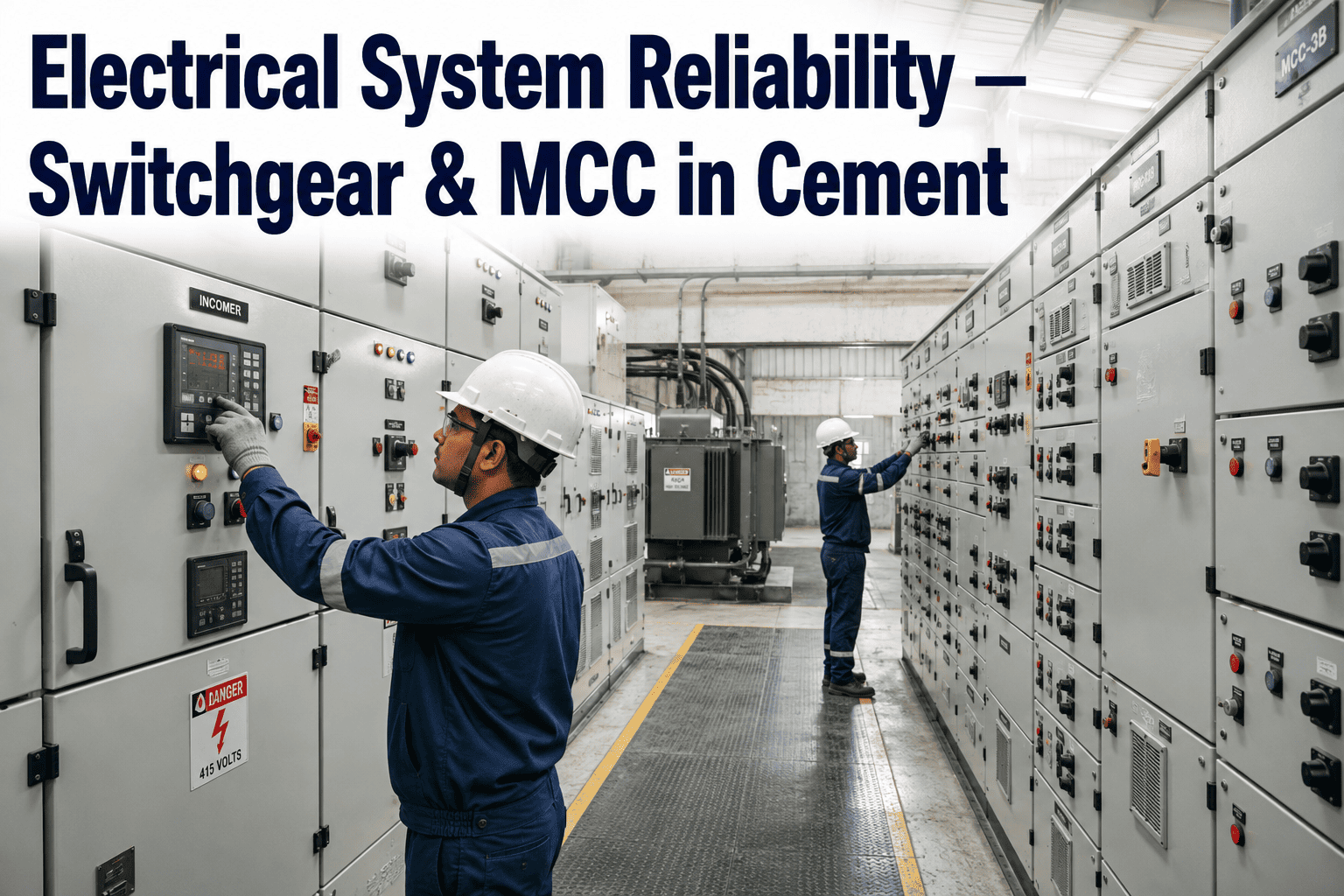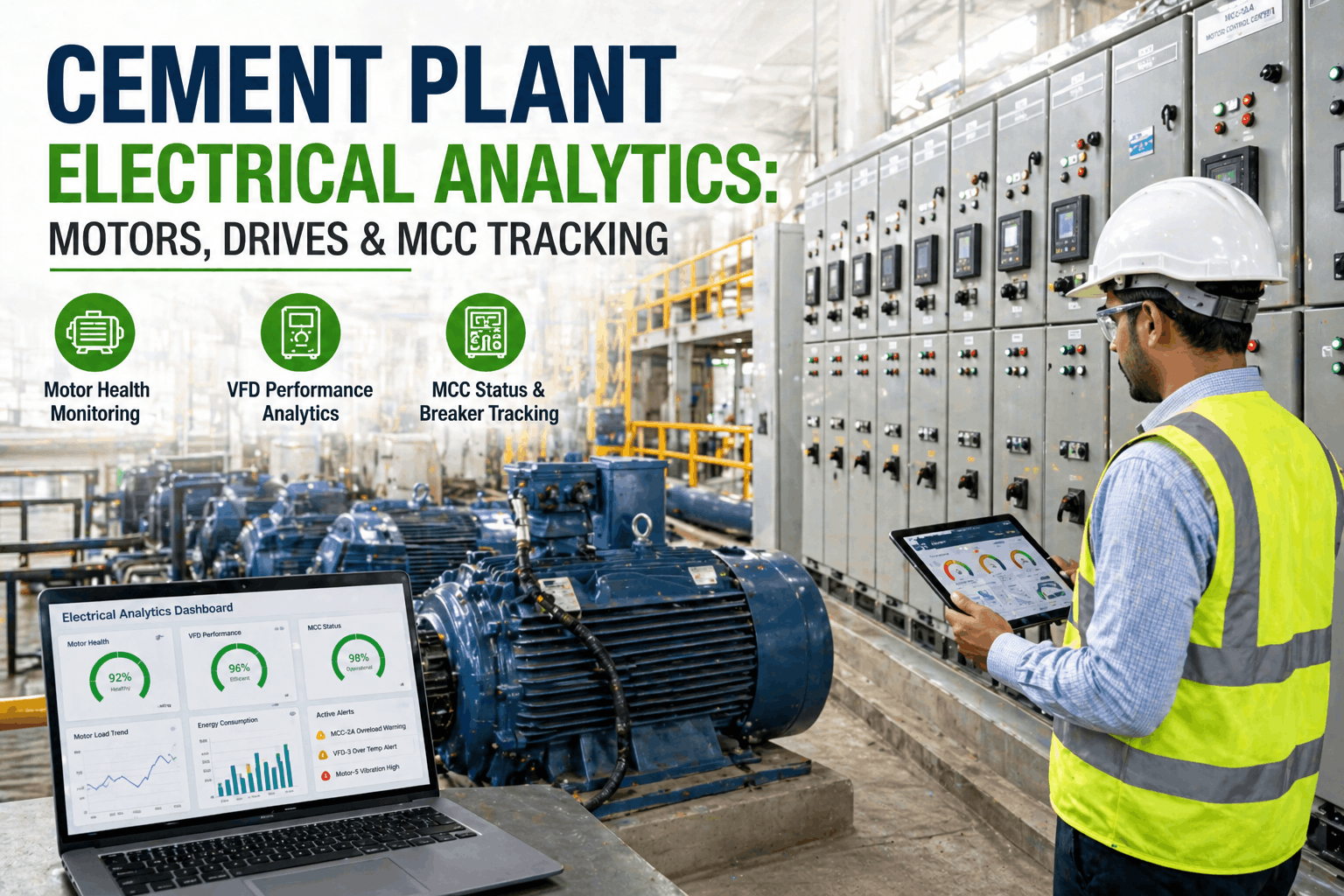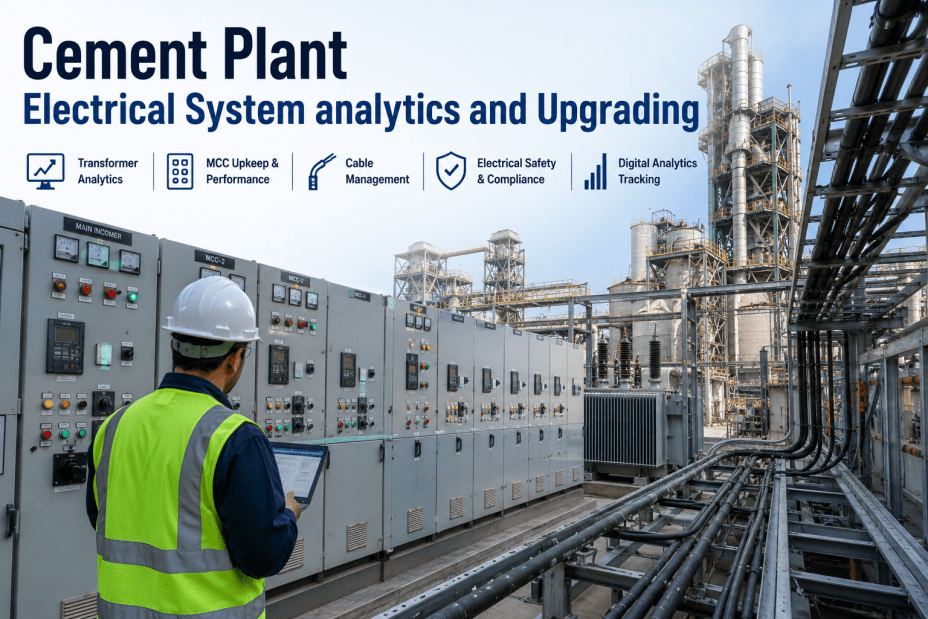
The electrical system at a typical 3,500 to 4,500 TPD cement plant represents approximately 12 to 18% of the plant's total replacement value and 100% of its production capacity — because when the electrical system stops, every motor, every drive, every control system, and every environmental compliance monitor stops with it. Most U.S. cement plants operate electrical infrastructure that was installed during the original plant construction or major expansion phases — 22 to 48 years ago for the primary power distribution system, 15 to 35 years ago for the MCCs and switchgear, and 10 to 25 years ago for the transformers serving the raw mill, kiln, finish mill, and baghouse systems. The maintenance strategy for electrical assets at most cement plants is predominantly run-to-failure for non-critical assets, time-based for critical assets (transformer oil sampling every 3 to 5 years, thermography every 1 to 2 years during shutdown), and reactive for everything else — with the consequence that electrical system failures account for 24 to 32% of unplanned production downtime at a typical U.S. cement plant. Transformer insulation degradation that develops over 5 to 8 years is detected only when the protection relay trips on differential current — not when the dissolved gas analysis trend first indicated developing thermal fault activity. MCC bucket corrosion that started 14 months before the arc flash event was visible in the annual thermography scan, but the temperature trend was compared against the previous year's single data point rather than analyzed as a continuous trend against ambient conditions. The electrical system data that would reveal these developing problems exists — in the protection relay event logs, the thermography report PDFs, the oil sampling laboratory certificates, and the weekly MCC infrared scan photos — but it is not connected, trended, or compared against thresholds in a way that allows the electrical maintenance team to move from reactive response to predictive intervention. iFactory's Preventive Analytics and Asset Tracking modules give cement plant electrical maintenance and reliability teams the digital infrastructure to monitor every transformer, MCC, switchgear lineup, cable circuit, and protective relay in the plant — tracking condition trends, scheduling and recording inspections, comparing thermal images across time, and predicting when each electrical asset will require intervention before the failure occurs. Book a Demo to see iFactory's electrical system analytics platform configured for your plant's power distribution and motor control infrastructure.
Cement Plant Electrical System Asset Profile — Transformer, MCC, Switchgear, Cable, and Relay Population by Process Area
Understanding the electrical system analytics requirements for a cement plant requires mapping the electrical asset population by process area — quantifying the transformers, MCCs, switchgear lineups, cable circuits, and protective relays that serve each production unit. The asset profile below presents the typical electrical asset population for a 1.5 million ton per year dry-process cement plant, organized by process area and electrical system tier.
Electrical System Analytics Applications — Five High-Impact Use Cases for Cement Plant Electrical Maintenance Teams
The five analytics applications below represent the highest-impact use cases for real-time monitoring and predictive analytics in cement plant electrical systems. Each application addresses a specific failure mode or performance gap that iFactory has documented across deployments at U.S. cement plants with electrical system populations of 1,200 to 2,800 tracked electrical assets per facility.
Transformer Dissolved Gas Analysis Trending — Identifying Thermal and Electrical Faults Before Relay Operation
Power transformers serving cement plant kilns, mills, and baghouse systems operate under continuous load cycles that produce predictable gas generation patterns in the insulating oil. When a developing thermal fault (overheating contacts, core circulating currents) or electrical fault (partial discharge, arcing) begins to generate characteristic gases — hydrogen, methane, ethylene, acetylene, carbon monoxide — the gas concentrations rise at rates that are detectable through serial DGA sampling months or years before the transformer reaches a fault condition that causes a protection relay trip. iFactory's transformer DGA trending module records each oil sample result in the asset database, calculates the gas generation rate and the key gas ratios (Duval triangle, Rogers ratios, IEC ratio method), and compares the actual gas generation trend against the IEEE C57.104 threshold criteria for transformer fault condition classification — generating a predictive alert when the trend projects that gas concentrations will reach the next severity classification level before the next scheduled oil sample.
MCC Thermal Image Trend Comparison — Detecting Connection Degradation and Imbalance Developing Between Thermography Scans
Motor control centers at cement plants — both 480 V and medium-voltage lineups — are the most thermally stressed electrical assets in the plant because they operate continuously in environments with cement dust accumulation, vibration from adjacent equipment, and ambient temperatures at the MCC room that can reach 45 to 55 degrees Celsius during summer months. Annual thermography scans capture the temperature profile of each MCC bucket, breaker, and bus connection — producing a thermal image that the electrical team reviews, records as "acceptable" or "needs attention," and stores in a PDF with the previous year's scans. The weakness of this approach is that a 12-month comparison interval misses developing connection degradation that begins 6 to 8 months into the cycle and accelerates exponentially in the final 2 to 3 months before failure. iFactory's thermal image trend comparison module records each thermography scan in the asset database, overlays the current thermal image on the previous year's scan with temperature delta mapping, and tracks the temperature trend at each connection point across successive scans.
Switchgear Condition Monitoring — Operating Mechanism, Contact Resistance, and Insulation Integrity
Medium-voltage switchgear at cement plants typically operates 15 to 45 years between major rebuilds — with the operating mechanisms, main contacts, arc chutes, and bus insulation aging at different rates depending on the number of switching operations, the fault current exposure, and the environmental conditions in the switchgear room. iFactory's switchgear monitoring module tracks the operating mechanism cycle count and accumulated wear (for draw-out breaker types), records contact resistance measurements from each maintenance shutdown and compares them against the manufacturer's maximum allowable value and against the previous measurement trend, and tracks bus insulation integrity through periodic partial discharge testing and insulation resistance measurement results recorded in the asset database.
Cable Circuit Condition Assessment — Insulation Resistance Trending, Sheath Condition, and Thermal Loading
Medium-voltage and low-voltage cable circuits at cement plants are the most widely distributed electrical assets — running through cable trays, underground duct banks, and overhead trays from every MCC to every motor, heater, and control panel in the plant. Cable insulation degrades at rates determined by thermal loading (cable temperature relative to the conductor insulation rating), environmental exposure (cement dust, moisture, chemical attack), and mechanical stress (vibration, abrasion at cable tray support points). iFactory's cable circuit condition assessment module tracks the insulation resistance (IR) and polarization index (PI) measurements from each periodic cable test, comparing the actual values against the IEEE 43 recommended minimum values and against the cable's own measurement history to identify developing insulation degradation.
Protective Relay Event Sequence Analysis — Coordinating Multiple Relay Events for Root Cause Identification
When an electrical fault occurs at a cement plant — a transformer differential trip, a feeder overcurrent operation, a ground fault on an MCC bucket — the protective relays generate event records that contain the sequence of operations, the fault current magnitude, the fault duration, and the pre-fault voltage and current values. At most cement plants, these event records are downloaded from each relay individually during the post-fault investigation and analyzed in isolation — making it difficult to correlate the operation of upstream and downstream relays, identify relay coordination issues that caused a wider outage than necessary, or distinguish between a permanent fault and a transient condition that should have been cleared without a trip.
Electrical System Upgrade Stages — The Sequence of Infrastructure Modernization for Cement Plants
The transition from aging electrical infrastructure to a modern, analytics-enabled electrical system follows a five-stage deployment sequence that aligns capital investment capacity, production risk tolerance, and technology maturity. Each stage builds on the infrastructure of the previous stage and delivers measurable electrical system reliability improvement that can be tracked against industry benchmarks and plant-specific historical performance.
Conventional vs. Analytics-Driven Electrical Maintenance — Cost and Reliability Comparison
The comparison between conventional time-based or run-to-failure electrical maintenance and analytics-driven condition-based electrical maintenance is documented across U.S. cement plants that have deployed iFactory's electrical system analytics platform. The table below presents the cost and reliability comparison for the primary electrical asset categories at a 1.5 million ton per year cement plant with 1,800 tracked electrical assets.
| Electrical Asset Category | Conventional Maintenance Approach | Annual Conventional Cost | Analytics-Driven Approach | Annual Analytics Cost | Reliability Improvement |
|---|---|---|---|---|---|
| Power Transformers (15–25 MVA) | Biennial oil sampling + annual thermography recorded in PDF; no trend analysis between samples | $6,000–$14,000 | Quarterly DGA trending in iFactory with Duval triangle and gas rate analysis; continuous bushing monitoring; predictive alert at IEEE 1.5x normal gas generation rate | $12,000–$24,000 | 75–90% reduction in unplanned transformer outages; 8–16 week early warning on developing faults |
| MCC Lineups (480 V + MV) | Annual thermography recorded as static image; visual comparison against previous year single image | $8,000–$18,000 | Annual thermal imaging with iFactory overlay comparison and temperature delta mapping; hourly connection temperature trend recording; automated alert at 20-degree C delta above ambient | $10,000–$20,000 | 60–80% reduction in MCC bucket failure events; 3–6 month early warning on developing connection degradation |
| Medium-Voltage Switchgear | Biennial visual inspection + contact resistance measurement during planned shutdown; no trend tracking between events | $10,000–$22,000 | Annual contact resistance trend tracking in iFactory; continuous PD monitoring on main bus; operating mechanism cycle counting with wear curve tracking; predictive replacement advisory | $18,000–$35,000 | 50–70% reduction in switchgear failure events; 6–12 month early warning on bus insulation degradation |
| Cable Circuits (MV + LV) | No systematic cable condition monitoring; run-to-failure for all but critical feeder circuits | $2,000–$6,000 (failure response only) | Insulation resistance and polarization index trend tracking for critical feeders; thermal loading monitoring for high-current circuits; sheath condition survey every 3 years with iFactory trend recording | $8,000–$18,000 | 40–60% reduction in unplanned cable circuit failures; 12–24 month early warning on insulation degradation reaching critical level |
| Protective Relays | Biennial or triennial testing and calibration; event records stored in relay software and reviewed only after a trip | $12,000–$25,000 | Annual testing with results recorded in iFactory asset database; automated event record upload and sequence-of-events analysis; relay coordination verification every 3 years with digital coordination study | $14,000–$28,000 | 40–60% reduction in unnecessary outage duration from coordinated relay operation; 20–30% reduction in false trip events from coordination verification |
Electrical System Analytics Platform Capabilities — What iFactory's Electrical Module Delivers
iFactory's electrical system analytics module is configured to track every category of electrical asset in the cement plant through a unified platform that supports asset-specific inspection checklists, condition data trending, threshold-based alerts, and maintenance work order integration. The platform capabilities are organized by electrical asset category to align with the responsibilities of the plant's electrical maintenance team and the specific data types generated by each asset category.
- Dissolved gas analysis (DGA) sampling schedule management with automated reminders; gas concentration trend plotting; Duval triangle and key gas ratio calculation per IEEE C57.104
- Predictive alert generation when gas generation rate projects that IEEE severity classification will increase before next scheduled sample; alert includes suspected fault type and recommended follow-up action
- Thermography scan comparison with temperature delta mapping; load profile tracking for correlation between DGA gas generation and transformer loading events
- Thermal image overlay comparison with temperature delta visualization; per-bucket and per-connection temperature trend tracking across successive thermography scans
- Contact resistance measurement trend tracking; operating mechanism cycle count and wear curve tracking for draw-out breakers; partial discharge data recording and trend analysis for MV switchgear bus
- Predictive alert at 20-degree C connection temperature delta above ambient; automatic work order generation for connections exceeding threshold with priority ranking by delta magnitude
- Insulation resistance and polarization index trend tracking for critical cable circuits; compare against IEEE 43 minimum recommended values and circuit's own measurement history
- Motor current signature analysis (MCSA) data recording for critical motors; trend tracking of rotor bar health, air gap eccentricity, and bearing condition; predictive alert for developing motor anomalies
- Predictive remaining life calculation for cable circuits based on IR trend and thermal loading history; motor maintenance scheduler based on actual run hours and condition data rather than calendar interval
- Protective relay testing and calibration schedule management; event record upload and archive with automated sequence-of-events analysis for multiple relay operations
- Relay coordination study management; arc flash hazard label tracking per NFPA 70E with label renewal calendar; electrical safety PPE matrix per asset category and task type
- NFPA 70E electrical safety training tracking and certification renewal; electrical incident reporting with root cause analysis linked to the involved asset and relay event data
Expert Review: What Cement Plant Electrical Leaders Say About Electrical System Analytics
I manage electrical maintenance at a 2,800-tpd cement plant in the Midwest that operates two kiln lines with electrical infrastructure originally installed in 1971 (Line 1) and 1998 (Line 2). The 1971 Line 1 transformer that serves the kiln main drive and the preheater fans is a 20 MVA oil-filled unit that has been in continuous service for 55 years. The OEM recommended transformer oil sampling every year — with additional sampling after any through-fault or lightning strike event, which means 3 to 5 samples per year for an outdoor transformer in the Midwest. Before we deployed iFactory's DGA trending module, the oil samples were sent to the laboratory, the results came back as a PDF report, the report was filed in the transformer folder in the electrical engineering office, and nobody looked at it again until the next sample was taken. The DGA was an annual compliance activity, not a trending and prediction activity. The report from August 2022 showed that the ethylene concentration had increased from 28 ppm to 52 ppm — a gas that indicates the presence of a thermal fault in the oil (overheating above 300 degrees Celsius in the cellulose insulation system). The report from November 2022 showed ethylene at 61 ppm. The report from February 2023 showed ethylene at 74 ppm. No one in the electrical engineering team saw the increasing trend because each report was reviewed in isolation when it arrived. The transformer failed in April 2023 with an internal winding fault that produced a differential current exceeding the protection relay threshold. The fault was detected by the relay, the transformer was tripped offline within 3 cycles, and the kiln line was down for 9 days while the replacement transformer was trucked in from a regional transformer repair facility. The failure investigation revealed that the ethylene trend had been projecting a thermal fault condition for 8 months before the failure — and that a dissolved gas analysis on the trend should have triggered an internal inspection and oil regeneration or transformer replacement during a planned outage. The total cost of the failure was $1.8 million in emergency transformer replacement cost, expedited transportation, and lost production. iFactory's DGA trending module would have alerted the electrical team when the ethylene generation rate exceeded the IEEE 2.0x normal rate threshold — generating a predictive notification 6 months before the failure, with enough lead time to plan an internal inspection and oil treatment during a scheduled kiln shutdown. That single event justified the full electrical system analytics deployment for our plant. We now have DGA trending on all 14 power transformers, thermal image comparison on 28 MCC lineups, contact resistance trending on 42 switchgear breakers, and IR trend tracking on 160 critical cable circuits. In the three years since deployment, we have had exactly one transformer failure — and that was on a 480 V unit where the DGA sampling interval was still being configured. The power transformers, MCC connections, and switchgear contacts that the platform tracked all received corrective action before any of them reached the failure condition. That is the difference between managing electrical assets through PDF reports and managing them through a connected analytics platform.
— Electrical Maintenance Manager, U.S. Cement Plant — 22 Years Industrial Electrical Maintenance — Certified Maintenance and Reliability Professional (CMRP) — IEEE IAS Cement Industry Committee MemberConclusion
Electrical system failures at U.S. cement plants account for 24 to 32% of unplanned production downtime — more than any single mechanical system category — because the condition data that would reveal developing electrical faults is collected but not connected. Transformer DGA samples are taken annually or biennially and filed as PDF reports without trend analysis. MCC thermography scans are captured during shutdown and compared against a single previous image rather than trended across multiple scans. Cable insulation resistance is measured and recorded in a test sheet that is filed in the maintenance office until the next test cycle. Protective relay event records are downloaded after a trip and analyzed in isolation without integration with upstream and downstream relay data.
The data that would prevent the majority of electrical system failures at cement plants already exists — in the DGA laboratory certificates, the thermography report PDFs, the IR test sheets, the relay event logs. iFactory's Preventive Analytics and Asset Tracking modules give cement plant electrical maintenance and reliability teams the digital infrastructure to connect that data, trend every condition parameter, compare every measurement against every previous measurement, and generate predictive alerts before the developing fault reaches the protection relay trip threshold. The transition from PDF-based electrical asset management to analytics-driven condition monitoring is not a technology project — it is an electrical reliability management discipline that determines whether a 55-year-old power transformer operates safely for another decade or becomes a $1.8 million emergency replacement and lost production event. Book a Demo to see how iFactory's platform manages transformer DGA trending, MCC thermal image comparison, switchgear condition monitoring, cable circuit assessment, and protective relay event analysis for cement plant electrical infrastructure.
Frequently Asked Questions
iFactory works with both existing test data (DGA laboratory results, thermography images, IR test measurements, relay event records entered after each inspection or trip event) and continuous sensor data (transformer bushing monitors, partial discharge sensors, motor current signature analyzers). Most cement plants begin with existing test data and add continuous monitoring on a subset of critical assets over time.
iFactory's thermal image comparison module uses temperature delta above ambient rather than absolute temperature as the comparison baseline — ensuring that images taken at different ambient temperatures (summer thermography at 38 degrees C vs winter thermography at 10 degrees C) are directly comparable for connection degradation trend detection.
Yes. iFactory tracks arc flash hazard label data per NFPA 70E for every switchgear lineup, MCC bucket, and panelboard — including incident energy level, arc flash boundary, required PPE category, and label expiration or review date. The platform generates label renewal reminders and tracks electrical safety training certifications for each team member.
iFactory's electrical system analytics module is typically deployed in 4 to 8 weeks — including transformer and MCC asset inventory, DGA data migration (3 years of historical laboratory results), thermography image import and baseline comparison, protective relay database setup, and team training. Book a Demo for a site-specific deployment scope and pricing estimate.
Yes. iFactory supports COMTRADE and IEEE C37.111 event record import from all major protective relay manufacturers including SEL, GE, ABB, Siemens, Beckwith, Basler, and Schweitzer. The platform normalizes event data from different relay types into a unified sequence-of-events format for coordinated root cause analysis.