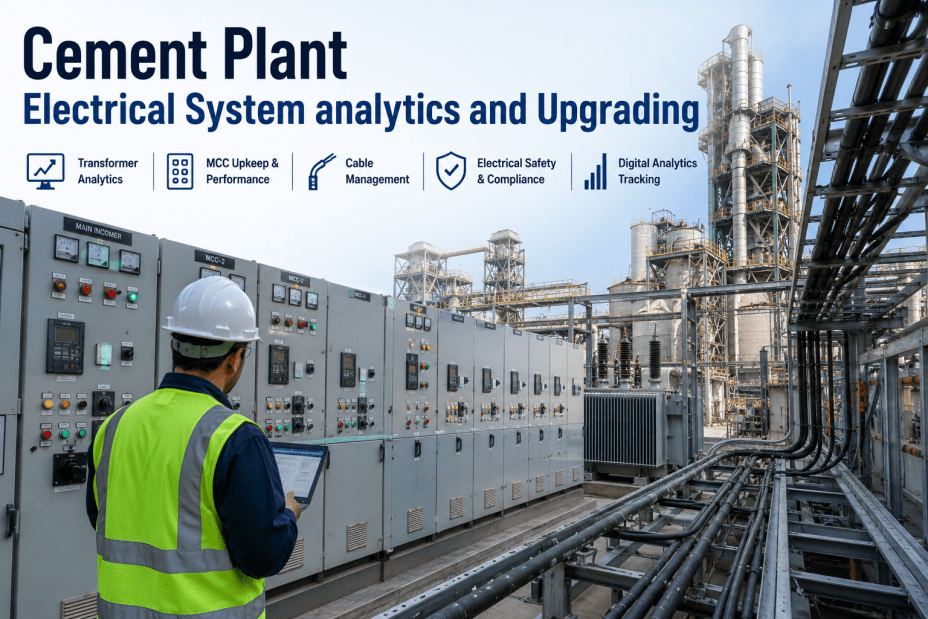
Cement plant electrical infrastructure has undergone a fundamental transformation. What was once treated as a back-office maintenance function — isolated MCC panels and periodic breaker tests reviewed days after a trip — is now redefining how industrial facilities manage reliability, energy intensity and capital investment in real time. In 2026, leading cement producers are no longer asking whether to invest in an electrical analytics platform; they are asking how quickly they can consolidate fragmented motor and drive data into a unified Electrical Control Tower that prevents failures across their entire asset network. If your electrical infrastructure still lives in departmental silos, Book a Demo to see how iFactory's intelligence software converts raw electrical telemetry into enterprise-grade decision support.
Turn Your Electrical Analytics Into a Strategic Control Tower
iFactory's electrical analytics platform unifies motor health, VFD performance, MCC status, and power quality into a single operational intelligence layer — purpose-built for cement plant enterprises.
Why Cement Plant Electrical Analytics Has Outgrown the Cost Center Model
For decades, electrical maintenance in cement plants was defined by what it could not do. Disconnected motor protection relays, MCC logs that lagged reality by weeks, and VFD systems that generated fault codes without surfacing operational intelligence — these were the building blocks of the cost center model. Electrical data existed only to investigate why a kiln stopped, not to prevent the stop in the first place.
That model is being replaced at pace. The catalysts are structural: the massive power draw of modern mills has eliminated the buffer of manual oversight; harmonic distortion from high-HP VFDs has made grid stability more fragile; and the rising cost of large-motor relining has made reactive maintenance economically untenable. The cement manufacturers absorbing these pressures while growing profitably share a single structural advantage — their electrical analytics platform has been repositioned from a reporting tool to a strategic control tower that connects motor telemetry to executive decision-making in real time.
— VP of Engineering, Global Cement Group
The Five Pillars of a Cement Plant Electrical Control Tower
Building a strategic electrical control tower in cement manufacturing requires architectural decisions that go beyond basic SCADA monitoring. The platforms generating measurable enterprise value share five foundational capabilities that distinguish them from conventional MCC dashboards.
Unified Power Distribution Infrastructure Visibility
A control tower requires a single data layer that ingests from substations, MCCs, and VFDs simultaneously — normalizing disparate power data into a unified model that makes cross-site power factor and load benchmarking structurally possible.
Real-Time Motor Health Scoring (APM)
APM for cement motors means continuous health scoring of critical kiln and mill drives. Algorithms evaluate winding temperatures, current balance, and partial discharge in real time, converting telemetry into precise maintenance timing recommendations.
VFD & Harmonic Analytics Integration
High-HP drives on ID fans create electrical noise. Control tower analytics identify harmonic signatures that threaten motor insulation and MCC stability, prescribing drive parameter adjustments to maximize both energy efficiency and asset life.
Automated MCC Compliance & Safety Intelligence
In cement plants, electrical safety is non-negotiable. A control tower integrates breaker trip history, arc-flash boundary logs, and LOTO verification records into an automated compliance layer that converts audit prep into a continuous state.
Enterprise Decision Support for Capex Visibility
When the CFO and Plant Lead share the same view of motor health trends across the enterprise, capital allocation for VFD upgrades or motor rewinds is informed by live data rather than historical guesswork.
From Electrical Monitoring to Strategic Decisions: The Data Flow That Changes Everything
The most significant shift in electrical analytics is structural. The control tower model changes who owns the output. In the legacy model, electrical data produced reports consumed by local electricians, rarely reaching executives in a form that drove strategy. In the control tower model, the same motor telemetry flows simultaneously to three decision layers: the plant team who need immediate failure prevention; the site leadership who need daily availability benchmarks; and enterprise executives who need portfolio-level asset health to plan million-dollar motor replacements. To see this architecture in action, Book a Demo of our multi-site visibility dashboard.
Electrical Performance Analytics: Where the Control Tower Generates Immediate ROI
Electrical performance analytics is the highest-frequency output of a cement control tower — the continuous stream of motor loading, harmonic distortion, and power quality data that determines whether your electrical system is a profit driver or a hidden drain.
Real-Time Motor Load Factor Optimization
Identify motors running at inefficient load levels. Control tower analytics correlate electrical draw with mill throughput, identifying 'oversized' or 'strained' motors that are wasting energy or approaching thermal overload.
Harmonic Distortion Mitigation for Grid Stability
High-speed drive switching on large fans can pollute the plant grid. The platform monitors Total Harmonic Distortion (THD) across MCCs, prescribing filter adjustments before noise causes sensitive PLC crashes or motor overheating.
Voltage Sag & Swell Analysis Across All Site Feeders
Correlate plant-wide equipment trips with external utility events. Analytics identify if your kiln stops are caused by local motor faults or upstream power quality issues, focusing maintenance resources on the actual root cause.
Drive Performance & Cooling System Intelligence
Monitor VFD heat-sink temperatures and fan speeds. The platform identifies when a drive's internal cooling is failing, preventing 'over-temperature' trips that would otherwise stop critical production fans.
AI-Driven Electrical Visibility vs. Traditional Maintenance: A Direct Comparison
| Capability Dimension | Traditional Electrical PM | AI Electrical Control Tower | Strategic Impact |
|---|---|---|---|
| Motor Failure Prediction | Hours (manual thermal scan) | Days to weeks (AI patterns) | Eliminate catastrophic motor burnouts |
| VFD Optimization | Reactive (fix on trip) | Proactive (efficiency tuning) | Annual power savings of 5-8% |
| Compliance Documentation | Manual Logbooks / Excel | Automated continuous records | Permanent state of safety audit readiness |
| Harmonic Mitigation | None / Ad-hoc check | Real-time THD tracking | Protect sensitive control electronics |
| Decision Latency | Reactive (post-mortem) | Predictive (pre-event alert) | Convert emergency cost to planned ROI |
Ready to Turn Your Electrical Data Into a Strategic Asset?
See how iFactory's electrical control tower gives cement plants the motor health, drive performance, and power quality intelligence to operate with absolute reliability.
Frequently Asked Questions: Cement Plant Electrical Analytics
What is an "Electrical Control Tower" and how does it differ from a standard MCC dashboard?
A standard dashboard shows you what is happening now (e.g., current draw). An Electrical Control Tower provides enterprise-wide visibility and predictive intelligence — correlating motor health, VFD performance, and power quality to predict failures and prescribe energy-saving adjustments across every site in your network.
How does iFactory monitor the health of large slip-ring mill motors?
We monitor a combination of winding temperatures, current balance, and partial discharge signatures. By fusing this data with motor start-up current patterns, our AI identifies insulation degradation and brush wear weeks before they lead to an unplanned trip or motor burnout.
What are the benefits of monitoring VFD harmonic distortion?
High-power VFDs on ID fans create Total Harmonic Distortion (THD) that can cause sensitive PLC controllers to crash and other motors to overheat. Real-time THD tracking allows you to tune filters and drive parameters to protect the stability of your entire plant control system.
Can we implement electrical analytics without replacing our old MCCs?
Yes. iFactory is designed to "Ingest and Augment." We can pull data from existing protection relays and smart meters via Modbus/Ethernet. For older "dumb" MCCs, we can deploy non-intrusive current and thermal sensors that clip onto existing cables without requiring a major electrical shutdown.
How does the platform help with electrical safety and arc-flash compliance?
The platform automates the tracking of breaker testing, protection relay calibrations, and MCC maintenance records. By ensuring every critical safety asset is tested on schedule and documenting the results, you maintain a continuous state of audit readiness for safety regulators and insurance providers.
How long does it take to see the first ROI from electrical analytics?
Immediate ROI often comes from identifying motor loading inefficiencies and power quality issues (sags/swells) that cause nuisance trips. More significant ROI from downtime prevention (predicting motor failure) typically materializes within 2–3 months as the AI learns the health baseline of your critical drives.
What is MTBEF and why is it our primary electrical KPI?
Mean Time Between Electrical Failures (MTBEF) measures the reliability of your electrical system. Unlike total downtime, it focuses specifically on electrical root causes. Improving MTBEF is the fastest way to stabilize kiln production, as electrical trips are often the most difficult and time-consuming to troubleshoot.
Build the Electrical Control Tower Your Enterprise Strategy Requires
iFactory's industrial analytics platform transforms motor health, drive performance, and power quality into a unified strategic control tower — giving cement plant executives the real-time visibility to lead reliability with precision rather than respond to failures with urgency.