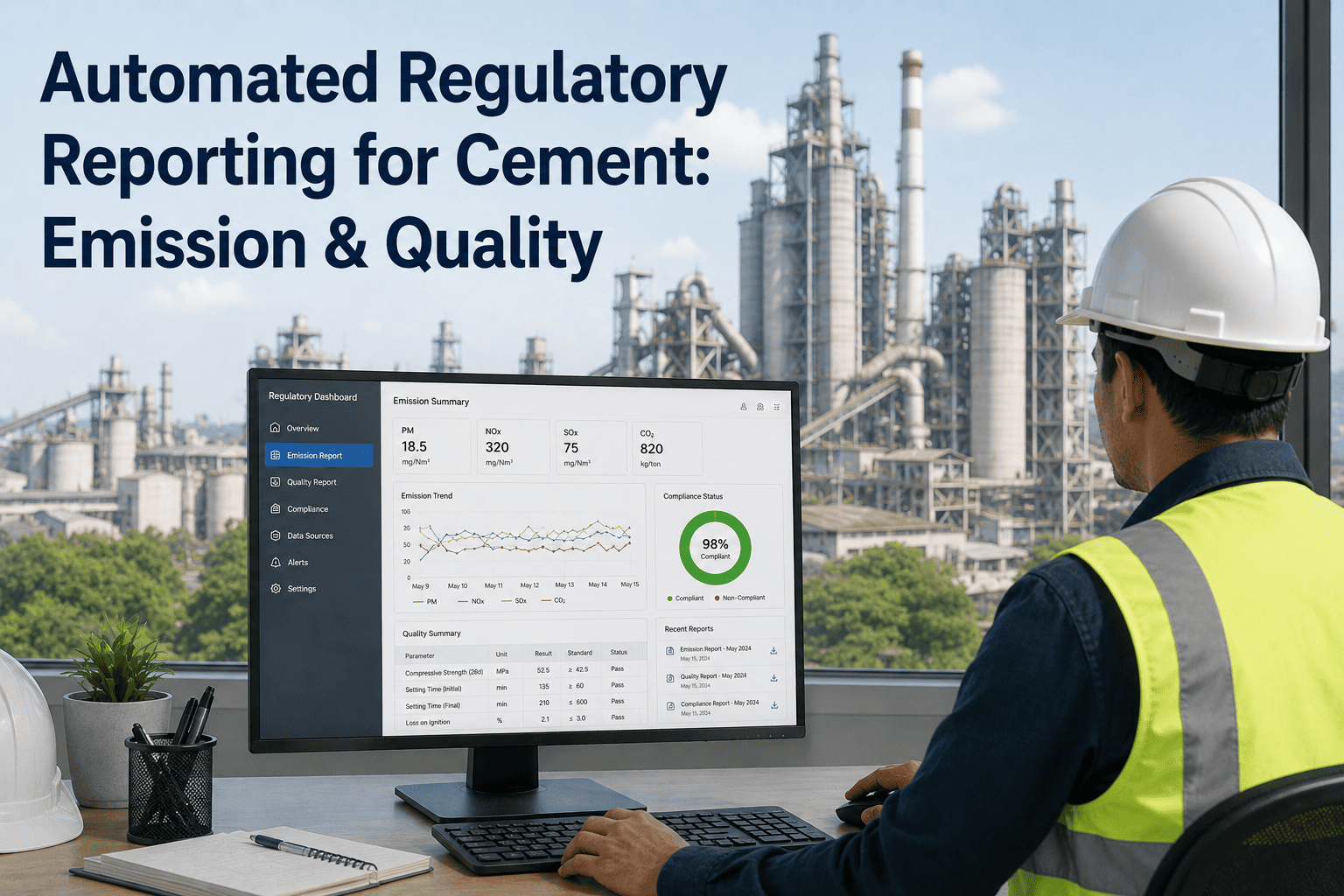
In modern cement manufacturing, regulatory compliance has evolved from a periodic audit requirement into a real-time operational necessity. Every cement facility operates under a complex web of environmental and safety mandates — from NESHAP and PC MACT emission standards to MSHA quarry safety protocols — and yet most plants still manage compliance through disconnected spreadsheets, manual logbooks, and last-minute audit scrambles. The gap between what regulatory agencies demand and what legacy monitoring systems deliver is where non-conformance penalties, operational stops, and reputational risks breed. Understanding how to automate compliance management for cement assets is the foundation of a proactive, "always-ready" inspection posture. If you want to see how leading cement manufacturers close this gap with real-time compliance intelligence, you can book a demo of our compliance management platform today.
Is Your Cement Plant Prepared for an Unannounced Inspection?
Deploy real-time emission tracking, automated MSHA/OSHA safety workflows, and audit-ready documentation — all in one unified compliance platform.
What Digital Compliance Management Means for Cement Plants
Regulatory compliance in cement manufacturing is the internationally recognised framework for managing environmental impact and worker safety. Within cement operations, digital compliance extends this framework into the cloud: continuously capturing, processing, and surfacing data from CEMS (Continuous Emissions Monitoring Systems) and safety sensors to verify that parameters are being met in real time. For manufacturers operating in high-scrutiny regions, the requirements of an environmental and safety programme are non-negotiable. Regulatory frameworks including the EPA’s PC MACT and NESHAP, as well as MSHA safety standards, all mandate documented monitoring, verification records, and corrective action evidence — and the volume of compliance documentation required makes manual systems structurally inadequate.
Modern compliance platforms address this by connecting directly to plant equipment — kiln stacks, clinker coolers, baghouses, and safety interlocks — and delivering continuous verification data that is audit-ready by design. The shift from reactive documentation to proactive compliance analytics is not just a technology upgrade; it is a structural improvement in how cement manufacturers control and demonstrate regulatory adherence at every point in the process. You can book a demo to explore how real-time compliance monitoring works across different cement asset categories.
Environmental Emission Tracking
Continuously monitor NOx, SO2, CO, and particulate matter at the kiln stack. Automatically flag threshold breaches before they become reportable violations.
Safety Standard Automation
Digitalize MSHA/OSHA safety protocols, including confined space entry, LOTO, and falling object protection, with time-stamped verification and operator sign-off.
Corrective Action Tracking
When a deviation is detected, the platform initiates a structured corrective action workflow — capturing the resolution evidence required for regulatory inspectors.
Waste & Water Management
Track water discharge quality and hazardous waste disposal cycles, ensuring that every byproduct of the cement process is handled within regulatory boundaries.
Inspection Readiness
Maintain an "Always-Ready" audit trail. Retrieve any report, calibration record, or safety log instantly during unannounced inspections by regulatory bodies.
Reporting Transparency
Generate automated monthly, quarterly, and annual regulatory reports, reducing the administrative burden on environmental and safety teams by up to 80%.
Cement Plant Compliance Requirements by Category: Industry Benchmarks
Not all cement assets carry the same compliance burden. The specific monitoring requirements, reporting thresholds, and documentation obligations vary significantly by asset type and the regulation being controlled. The table below provides a benchmark overview of compliance requirements by category, supporting more precise programme design. For any facility where compliance analytics is being formalised or upgraded, understanding the per-asset obligation is essential. To build a configuration mapped to your specific plant's equipment list, you can book a demo with our compliance engineering team.
| Compliance Area | Primary Regulation | Monitoring Type | Reporting Frequency | Violation Risk |
|---|---|---|---|---|
| Kiln Stack Emissions | EPA NESHAP / PC MACT | Continuous (CEMS) | Monthly / Quarterly | Extreme |
| Quarry & Plant Safety | MSHA Part 46 / 48 | Training & Incident Logs | Annual / As-Needed | High |
| Clinker Cooler Dust | PC MACT Opacity | CPMS (Continuous PM) | Continuous | Critical |
| Hazardous Waste | RCRA Standards | Disposal Tracking | Per Shipment | High |
| Water Discharge | NPDES Permits | pH, TSS, Temp | Monthly (DMR) | Medium |
| LOTO / Confined Space | OSHA 1910.147 / 146 | Permit-to-Work Tracking | Audit-Based | Critical |
These benchmarks represent standard U.S. and EU cement industry requirements and should be validated against your specific local permits and carbon pricing schemes. To build a compliance roadmap for your facility, you can book a demo with our regulatory specialists.
How Digital Compliance Architecture Works in Cement Manufacturing
The architecture of a robust digital compliance programme operates across five interconnected layers — from the CEMS sensor at the kiln stack to the board-level ESG dashboard. Understanding how these layers interact is essential for environmental managers and plant directors who are evaluating whether their current manual reporting is fit for modern audit demands. Leading cement manufacturers who have implemented data-driven compliance programmes consistently report faster audit preparation, zero non-conformances, and higher confidence in their real-time safety controls.
Asset-Level Data Ingestion
Sensors, CEMS units, and safety interlocks transmit real-time process data — NOx levels, particulate matter, oxygen content, and safety states — directly into the compliance platform, eliminating manual data entry at the source.
Threshold Comparison Engine
Incoming data is continuously compared against your specific permit limits (PC MACT, NESHAP, local air permits). Deviations trigger immediate automated alerts — enabling environmental managers to intervene before a breach becomes a violation.
Corrective Action Workflow
When a threshold is exceeded, the platform initiates a structured corrective action workflow — capturing who was notified, what adjustments were made, and the timestamped evidence that the process returned to compliance.
Safety Permit Integration
Critical high-risk tasks like confined space kiln entry or LOTO are managed within the platform. Sign-offs, atmospheric readings, and rescue plans are captured in the same compliance record as environmental data.
Audit-Ready Reporting Layer
All monitoring records, corrective actions, and safety permits are compiled into structured reports — exportable on demand in formats aligned with EPA, MSHA, and state-level regulatory requirements.
Regulatory Requirements for Cement Assets: What Digital Management Delivers
Compliance requirements form one of the most documentation-intensive components of any cement plant operation. Every emission point requires a defined monitoring frequency, a validated calibration record, and a timestamped log — all of which must be available for inspection. Traditional paper-based compliance logs fail this requirement systematically: records are missing, illegible, or unable to be retrieved during unannounced visits. Digital compliance management addresses all three failure modes. Scheduled tasks are assigned automatically, completion is recorded in real time, and non-compliance is flagged immediately — creating a traceable, tamper-resistant record that satisfies inspectors across all major environmental and safety agencies. You can book a demo to see how automated compliance management integrates with your existing plant documentation.
Regulations require periodic calibration and validation of all Continuous Emissions Monitoring Systems (CEMS). Digital scheduling enforces these intervals, preventing undocumented overruns that create legal exposure during audits.
Quarry safety depends on mandatory training hours for all personnel. Digital compliance platforms manage these training logs, surfacing expired certifications automatically and ensuring every person on-site is legally compliant.
Every threshold breach must be followed by a documented corrective action. Digital platforms automate the capture of these actions, ensuring that "close-out" evidence is attached to the violation record for inspector review.
Inspectors demand that compliance can be proven for any given hour over the past 2-5 years. Digital systems provide this persistent history, eliminating the manual reconciliation that consumes environmental team capacity before every audit.
— Environmental Manager, Northern Cement Works
Manual vs. Digital Compliance: The Performance Gap
The difference between manual compliance reporting and a digital compliance management programme is structural. Facilities that have transitioned from paper-based records to real-time digital monitoring consistently report measurable improvements across every dimension, from deviation detection to audit outcomes. The comparison below helps environmental managers and operations directors articulate the business case for compliance investment to corporate leadership. When expressed in terms of audit risk, penalty exposure, and administrative efficiency, the case for digital compliance is typically decisive. To understand what a transition would look like for your facility, you can book a demo with our regulatory specialists.
| Compliance Dimension | Manual / Paper-Based | Digital Compliance Platform | Operational Gain |
|---|---|---|---|
| Threshold Breach Detection | Minutes to days (retroactive) | Seconds (real-time alert) | Critical |
| Audit Preparation Time | 2–5 days of manual search | Zero (Always-Ready status) | High |
| Corrective Action Capture | Inconsistent (missing sign-offs) | 99%+ (automated workflow) | High |
| Reporting Administrative Cost | High (manual data consolidation) | Low (one-click generation) | Medium |
| Non-Conformance Risk | High (unseen breaches) | Extremely Low (proactive control) | Critical |
| MSHA/OSHA Training Compliance | Difficult to verify in real-time | 100% visible on site dashboard | High |
Stop Fearing Your Next Regulatory Audit. Start Using Real-Time Intelligence.
Our compliance management platform gives cement plants the real-time tracking, automated reporting, and audit-ready documentation needed to satisfy NESHAP, PC MACT, and MSHA/OSHA mandates.
Frequently Asked Questions: Cement Plant Regulatory Compliance Management
What is digital compliance management and how does it help cement plants?
Digital compliance management is the use of real-time data, automated threshold monitoring, and digital documentation systems to manage regulatory mandates. It helps cement plants by consolidating emissions data (CEMS), safety permits, and training records into a single, audit-ready platform — eliminating the risk of unseen violations and reducing audit preparation time from days to minutes.
Can the platform handle EPA NESHAP and PC MACT emission standards?
Yes. The platform is designed to ingest data from Continuous Emissions Monitoring Systems (CEMS) and Continuous Particulate Monitoring Systems (CPMS). It continuously compares stack emissions against NESHAP and PC MACT limits, providing real-time alerts and automated reporting that satisfies EPA and state-level environmental requirements.
How does the system support MSHA quarry safety compliance?
iFactory digitalizes MSHA Part 46 and Part 48 training requirements, tracking mandatory training hours for every employee and contractor on-site. It also manages safety inspections and incident reports, ensuring that your quarry operations are always prepared for MSHA unannounced inspections with verified, time-stamped records.
What happens when a threshold breach is detected?
The platform immediately triggers an automated alert to environmental and plant managers. It then initiates a structured corrective action workflow, requiring operators to document the cause of the breach and the steps taken to resolve it. This documentation is automatically attached to the compliance record as closure evidence for regulatory review.
Does the platform eliminate the need for manual regulatory reporting?
While the system doesn't replace the legal requirement for submission, it automates 80–90% of the work. It consolidates all the necessary data into the correct regulatory formats, allowing environmental teams to generate monthly DMRs (Discharge Monitoring Reports) or quarterly emission summaries with a single click, rather than manually reconciling spreadsheets for days.
How long does it take to implement a digital compliance programme?
Initial implementation — including connecting existing CEMS data and setting up safety permit workflows — typically takes 6–10 weeks. This allows the plant to reach a "Baseline Compliance" status where current permits are being monitored and documented automatically. Full deployment across all environmental and safety modules usually follows a 4–6 month roadmap.
Is my data secure and audit-trail protected?
Yes. All data is encrypted and stored with full version control and tamper-resistant audit trails. Every change to a record, sign-off, or calibration log is time-stamped and attributed to a specific user, ensuring that your compliance records are legally defensible and meet the highest standards of data integrity required by regulatory agencies.