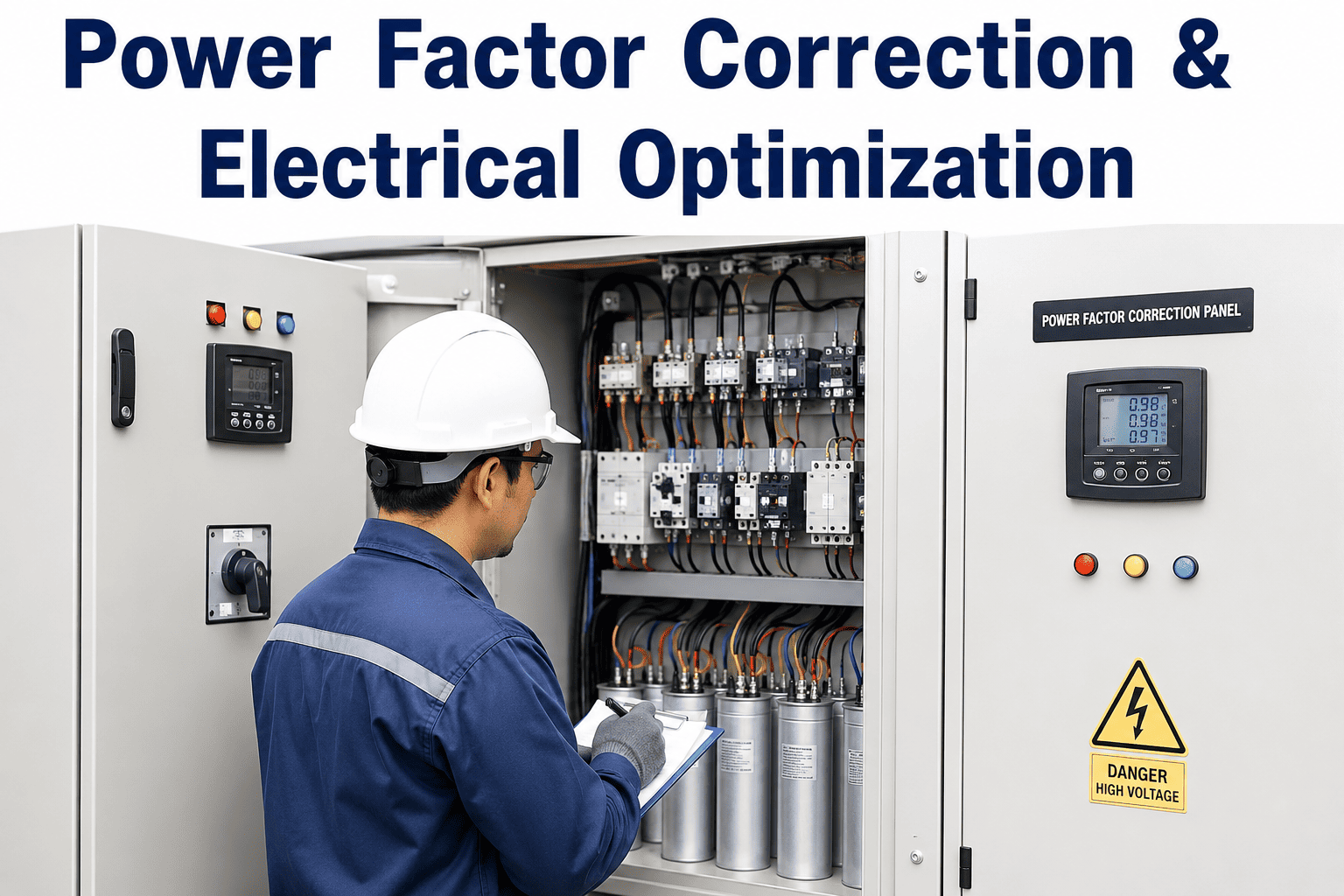
A cement plant running a 5,000 tonne-per-day line pulls power through kiln drives, raw mills, cement mills, and a bank of large induction fans that together can push plant-wide power factor down into the 0.75-0.85 range on a bad day. Utilities notice long before the plant does, because most reactive power penalty clauses trigger automatically the moment the meter drops below 0.90 or 0.95, quietly inflating every demand-charge line item on the monthly bill. The fix is not a new transformer or a renegotiated tariff — it is a properly sized capacitor bank, tuned to the plant's actual harmonic profile, correcting the exact loads causing the drag. Book a demo to see where your plant's power factor stands today.
Power Factor Correction & Electrical Optimization for Cement Plants
Cut demand charges, eliminate reactive power penalties, and free up transformer capacity across kiln, mill, and fan circuits without touching production output
Why Cement Plants Run Poor Power Factor Without Knowing It
Cement production is one of the most motor-intensive processes in heavy industry, and that is exactly why power factor problems hide in plain sight. Every large induction motor, every VFD-driven fan, and every partially loaded drive pulls reactive current that the plant pays for but never turns into product.
The Real Cost of a 0.80 Power Factor
Demand charges are billed on kVA, not kW, so a plant drawing 400 kW of real, useful power at a 0.77 power factor is actually being metered on roughly 520 kVA of apparent power. Correcting that same load to a 0.96 power factor drops the billed demand to around 420 kVA, releasing the difference as pure capacity the plant already owns but never uses. Most utility penalty structures compound this further, adding a percentage surcharge to the entire demand charge for every point the power factor sits below the 0.90 to 0.95 threshold, which means a plant running consistently at 0.80 can be absorbing a double penalty: inflated apparent power and a separate low-power-factor surcharge stacked on top of it.
A single feeder audit usually finds this gap within a day. Book a demo and bring your last three utility bills to the call.
Where to Correct Power Factor First on a Cement Line
Not every motor deserves its own capacitor. The highest-value corrections concentrate at a handful of predictable points across a typical cement plant electrical layout.
Capacitor Sizing Reference by Target Power Factor
Correction sizing is a simple multiplier applied to the real load in kW. The table below shows how much kVAR is generally required per 100 kW of load to reach common target power factors from a starting point of 0.80, which is a typical uncorrected reading on a cement feeder.
| Starting Power Factor | Target Power Factor | Approx. kVAR per 100 kW | Typical Application |
|---|---|---|---|
| 0.80 | 0.90 | 32 | Minimum correction to clear penalty threshold |
| 0.80 | 0.95 | 52 | Standard target for most utility contracts |
| 0.80 | 0.98 | 62 | Recommended target for continuous kiln and mill loads |
| 0.75 | 0.95 | 66 | Heavily loaded feeders with older motors |
Fixed Banks vs. Automatic Switched Banks
Choosing between fixed and automatic correction is less about budget and more about how steady the load actually is. Kiln drives, raw mills, and cement mills run for long, continuous stretches at a fairly predictable load, which makes them ideal candidates for fixed capacitor banks sized once and left in place. Crushers, conveyors, elevators, and packing lines behave very differently, cycling on and off through the shift, which means a fixed bank sized for peak load would over-correct during idle periods and risk pushing the feeder into a leading power factor. An automatic switched bank with a microprocessor-based controller solves this by monitoring power factor continuously and staging capacitor banks in or out in real time, holding the target regardless of which auxiliary equipment happens to be running at that moment. Most cement plants end up running both types side by side: fixed correction at the motor terminals of the major continuous loads, and a switched bank at the main distribution board covering everything else.
Harmonic Filtering: The Step Most Cement Plants Skip
Plain capacitor banks and VFD-driven fans do not always coexist safely. Nonlinear loads inject current at the 5th, 7th, 11th, and 13th harmonics, and a standard capacitor bank sitting on the same feeder as a mill or fan drive can resonate with those harmonics instead of correcting the fundamental power factor. The practical fix is a detuned or actively filtered capacitor bank, sized specifically for feeders carrying VFD load, which costs more upfront but avoids capacitor failures, nuisance fuse operation, and overheating that plagues plants that install standard banks without checking the harmonic profile first.
What Plants Typically See After Correction
Stop Paying a Penalty for Power You Never Used
A power factor and harmonic audit on your kiln, mill, and fan feeders usually takes one site visit to scope. See exactly where your plant's kVAR is leaking before your next utility bill lands.
Frequently Asked Questions
Get Your Plant's Power Factor Audited
Every billing cycle your kiln, mill, and fan feeders run uncorrected, the same penalty repeats quietly on the invoice. Find out exactly how much capacity and cost is sitting unclaimed on your electrical system.