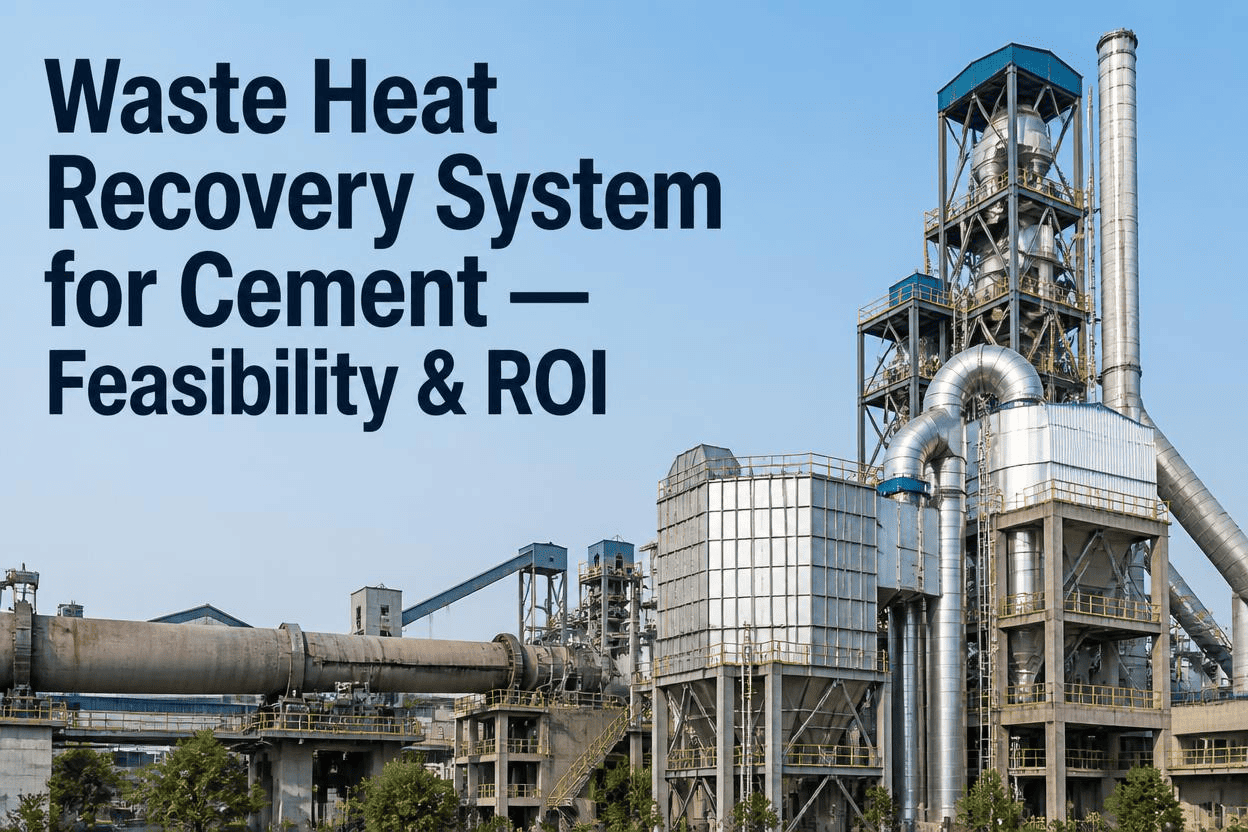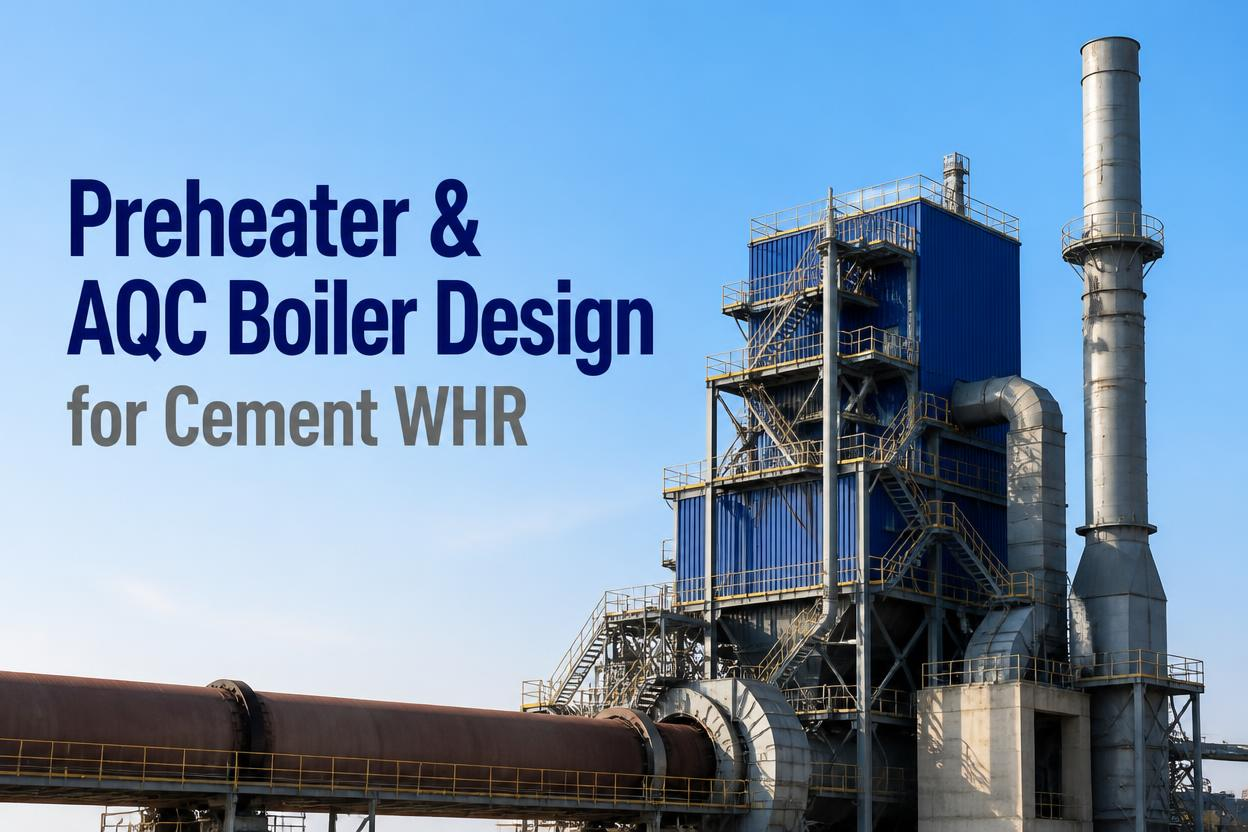
Two boilers decide whether a cement plant's waste heat recovery system hits its projected output or quietly underperforms for the next fifteen years: the suspension preheater (SP) boiler catching kiln exhaust gas, and the air quenching cooler (AQC) boiler catching hot air off the clinker cooler. Get the heat exchange area, tube arrangement, or dust handling wrong on either one, and the plant either loses generation capacity or spends the next decade fighting tube erosion and unplanned cleaning stops. This is the design logic that separates a boiler pair that runs quietly for years from one that becomes a maintenance headline. If your kiln line is being scoped for PH and AQC boilers right now, book a demo to see how continuous thermal monitoring keeps both boilers performing to spec.
Two Boilers, Two Very Different Gas Streams
The SP boiler and the AQC boiler are not interchangeable designs scaled up or down — they handle gas streams with different temperature behavior, dust characteristics, and flow patterns, and treating them as the same equipment is one of the most common early design mistakes.
The Dust Problem Every Boiler Design Has to Solve
Dust is not a side issue in cement WHR boiler design — it is close to the central engineering constraint. Both PH and AQC exhaust streams carry abrasive particulate that can erode tube surfaces, form coating deposits, and block gas passages if the boiler geometry doesn't account for it from the start.
Design Countermeasures That Actually Work
None of the dust-related risks above are unsolvable — they are addressed through specific, well-established design choices rather than generic overengineering.
Sizing Logic: What the Boiler Design Actually Depends On
| Sizing Input | Why It Matters |
|---|---|
| Kiln capacity (tonnes/day) | Sets the total exhaust gas volume both boilers need to handle |
| Preheater stage count | Fewer stages generally leave more recoverable heat in the exhaust gas |
| Gas volume per kg clinker | Determines heat exchange surface area needed for target output |
| Specific heat capacity of exhaust | Feeds directly into the thermal energy calculation per boiler stage |
| Dust concentration profile | Drives tube spacing, velocity limits, and cleaning system design |
A typical mid-sized kiln line — roughly 3,000 tonnes per day with a five-stage preheater — is a common reference point used in published sizing methodologies, though every plant's actual gas volume and dust profile should be measured rather than assumed from a template.
SP Boiler vs. AQC Boiler: A Side-by-Side View
| Aspect | SP (Preheater) Boiler | AQC (Cooler) Boiler |
|---|---|---|
| Gas source | Kiln exhaust exiting top preheater stage | Hot air from clinker cooler mid-tapping |
| Typical count per line | Often one or two units | Typically one unit |
| Dust characteristic | Fine raw meal particulate | Clinker dust, generally coarser |
| Primary design focus | Cyclone efficiency and gas distribution | Aeration control and mid-tap placement |
Heat Exchanger Tube Arrangement Choices
Once the gas volume, temperature, and dust profile are established, the physical arrangement of the boiler's heat exchange tubes becomes the next major design decision, and it directly affects both efficiency and long-term maintenance burden. Both horizontal and vertical boiler configurations are used in cement WHR installations, and the choice often comes down to available plant layout as much as thermal performance. A vertical arrangement is common for AQC boilers specifically because it allows dust to fall through the tube bank under gravity rather than settling on horizontal surfaces where it would accumulate and require more frequent cleaning. Tube spacing within the bundle is another critical variable — too tight and dust bridges between tubes accelerate fouling, too wide and the boiler's physical footprint and cost grow without a proportional gain in heat transfer. Bare tubes, rather than finned tubes, remain the standard choice for the dustiest sections of a cement WHR boiler, since fins would trap particulate far more aggressively than a smooth tube surface, even though finned tubes can offer better heat transfer in cleaner industrial applications.
Commissioning Checks Before Steady-State Operation
A boiler that looks correctly designed on paper still needs verification once it's actually running on live kiln exhaust, because real dust loading and gas flow patterns rarely match design assumptions exactly. Early commissioning should include verifying actual gas velocity against design targets at multiple points along the boiler, confirming that soot-blowing or rapping systems are cycling on the intended schedule rather than a generic default, and establishing a baseline temperature-delta and pressure-drop reading across the boiler while it's known to be clean. That baseline becomes the reference point every future fouling assessment gets compared against — without it, a plant has no reliable way to tell whether a given pressure drop reading represents normal operation or an early warning sign. Plants that skip this baselining step often end up guessing at cleaning schedules for the life of the boiler, cycling between over-cleaning that wastes maintenance hours and under-cleaning that lets efficiency quietly erode between inspections.