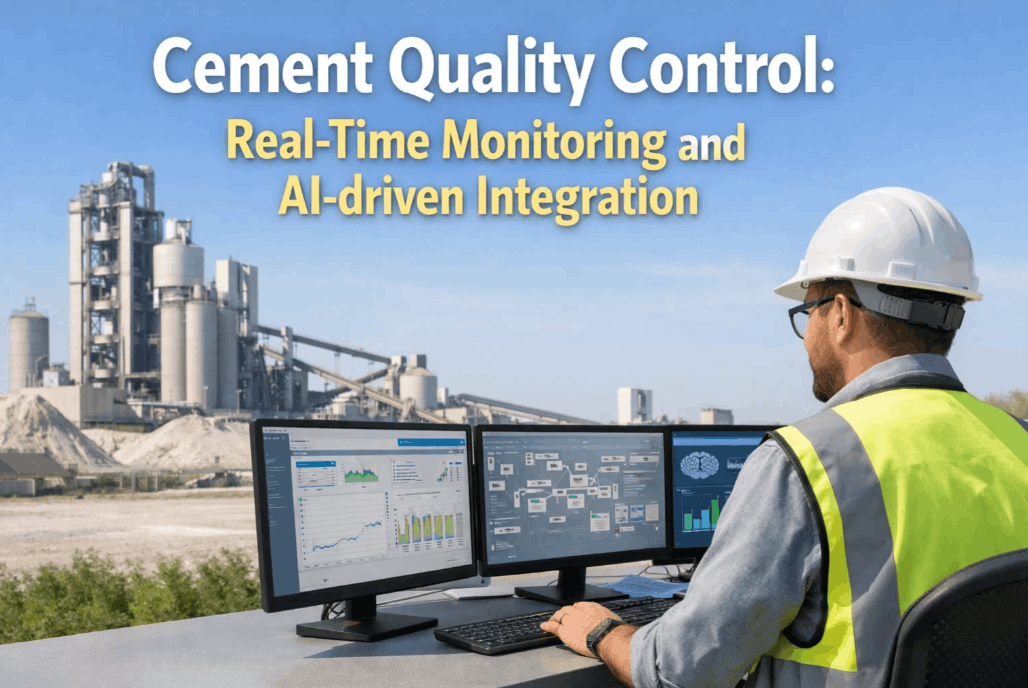
In 2026, cement quality is no longer measured only at the end of the production line — it is actively managed at every stage, from raw limestone quarrying through clinker formation to final grinding and dispatch. The manufacturers pulling ahead of the market are not those with the newest kilns or the largest capacity. They are the ones who have embedded artificial intelligence into their quality control architecture, enabling real-time parameter monitoring, predictive defect prevention, and automated statistical process control that operates faster and more consistently than any manual inspection regime ever could.
AI Quality Control · Cement Industry · 2026
How Top Cement Manufacturers Use AI to Achieve 60%+ Defect Reduction in 2026
AI real-time monitoring, predictive quality analytics, and automated SPC are rewriting the rules of cement quality management — permanently and measurably.
60%+
Defect rate reduction with AI quality systems
4×
Faster quality deviation detection vs manual SPC
$1.8M
Avg. annual savings from reduced waste and rework
99.2%
Product specification compliance achievable with AI
Why Traditional Quality Control Is No Longer Enough
Cement manufacturing involves hundreds of interdependent process variables — raw mix chemistry, kiln temperatures, clinker mineralogy, mill operating parameters, and water-to-cement ratio behavior — each of which influences the final product's compressive strength, setting time, and durability. Traditional quality control approaches rely on periodic laboratory sampling, manual data entry, and post-process analysis. By the time a lab result indicates a quality deviation, tens of thousands of tonnes of product may already have been produced outside specification.
The industry's tolerance for this lag is shrinking rapidly. Infrastructure project specifications are tightening. Regulatory bodies in major construction markets are enforcing stricter conformance standards. And customers who receive non-compliant cement are not just filing complaints — they are switching suppliers. Manufacturers who get support gain the capability to close this quality gap permanently with an AI monitoring layer that never blinks, never takes a lunch break, and never misses a parameter drift.
Where AI Quality Control Intervenes in the Cement Process
AI monitoring is active at every stage — not just at the end of the line
01
Raw Material Intake
AI analyzes quarry blending ratios, limestone CaCO₃ variability, and moisture content in real time — compensating for raw material inconsistency before it enters the process.
02
Raw Mill & Kiln Feed
Continuous LSF, SM, and AM ratio monitoring with automated corrective setpoint adjustments. Kiln feed chemistry held within tighter tolerances than manual blending allows.
03
Clinker Formation
Kiln temperature profiles, burnability index, and free lime predictions tracked in real time. AI identifies under-burning risk up to 40 minutes before it affects clinker mineralogy.
04
Cement Grinding
Blaine fineness, particle size distribution, and SO₃ content monitored continuously. AI adjusts mill parameters to maintain product specification without manual intervention.
05
Dispatch & Compliance
AI generates automated conformance certificates with full traceability back to raw material batch, production parameters, and lab verification data for every dispatch lot.
See iFactory AI Quality Control in a Live Cement Environment
Purpose-built for cement manufacturers managing complex, multi-stage quality parameters
Real-Time Parameter Monitoring: The Core of AI Quality Management
The foundation of AI-driven quality control is continuous, high-frequency data ingestion from sensors, analyzers, and process instruments distributed across the plant. Online analyzers — cross-belt XRF analyzers at the raw mill feed, process gas analyzers on the preheater exit, and particle size analyzers on the cement mill discharge — generate quality-relevant data points every 30 to 60 seconds. In a traditional plant, this data flows into a historian and gets reviewed by a process engineer hours later. In an AI-enabled plant, every data point is evaluated against a predictive quality model in real time.
iFactory's quality AI engine uses these continuous data streams to detect parameter drift patterns that precede quality deviations — typically 20 to 60 minutes before the deviation becomes a measurable product defect. This prediction window is the critical difference between proactive quality management and reactive quality firefighting. Cement plant quality managers who book a demo with iFactory consistently describe this early warning capability as the single most transformative aspect of the platform.
Raw Mix LSF
Every 60 sec
45–90 min advance warning
$12K–28K per batch
Clinker Free Lime
Every 30 sec
30–50 min advance warning
$35K–80K per kiln run
Blaine Fineness
Every 45 sec
15–30 min advance warning
$8K–18K per silo
SO₃ Content
Every 30 sec
20–40 min advance warning
$15K–40K per dispatch lot
Compressive Strength
AI prediction, continuous
Real-time virtual lab result
Customer return + penalty cost
Automated SPC: Removing Human Latency from Quality Decisions
Statistical Process Control has been a cornerstone of industrial quality management for decades. The problem is not SPC as a methodology — it is the human latency that traditional SPC introduces. A process engineer reviewing control charts at the end of a shift cannot respond to a process drift that began four hours earlier. An AI-powered automated SPC system running on iFactory's platform does not have this limitation. It applies the same statistical logic — control limits, capability indices, run rules — but does so continuously, with automatic alert generation and, where permitted, automatic corrective action triggers.
For cement manufacturers, automated SPC driven by AI means that control limit violations are flagged within seconds and routed to the appropriate process controller or quality engineer before the process drifts further. Manufacturers who get support configure their SPC rules once, and the AI engine enforces them around the clock without exception — no missed shift handovers, no operator fatigue, no documentation gaps.
Traditional SPC
Control chart reviewed every 2–4 hours
Violations detected after the fact
Manual corrective action logging
Shift-dependent consistency
Paper or spreadsheet records
No predictive capability
iFactory AI SPC
Continuous real-time monitoring
Violations flagged within seconds
Automated action triggers and logging
Consistent 24/7 enforcement
Full digital audit trail per batch
Predictive deviation forecasting
Raw Material Variability: The Quality Challenge AI Solves Best
Raw material variability is the most persistent and difficult-to-manage source of quality deviation in cement manufacturing. Limestone deposits are inherently heterogeneous — CaCO₃ content, silica ratio, and clay mineral presence vary across the quarry face, between benches, and even within a single blast. Traditional quality management deals with this variability through blending piles and periodic lab sampling, which works approximately. AI quality control handles it precisely.
iFactory's raw material compensation module uses online XRF analyzer data combined with quarry blend composition records to continuously update the kiln feed target — adjusting mill separator speeds, belt blending proportions, and additive dosing in real time to hold raw mix chemistry within tighter tolerances than manual blending ever achieves. The result is a more consistent kiln feed, a more stable burning zone, and a more uniform clinker mineralogy that directly translates to lower compressive strength variability in the final product. To see how iFactory handles your plant's specific raw material profile, book a demo with our cement quality specialists today.
60%+
Defect Rate Reduction
Across finished product lots measured against pre-AI baseline. Driven by early parameter deviation detection and automated corrective action.
73%
Fewer Customer Complaints
Product consistency improvement directly reduces non-conformance reports and return requests from construction clients.
28%
Reduction in Rework & Waste
Off-spec product that previously required re-grinding or disposal is dramatically reduced through upstream quality intervention.
$1.8M
Average Annual Savings
From combined reduction in waste, rework, laboratory overhead, and quality-related production delays.
4×
Faster Deviation Response
AI detection-to-action cycle is four times faster than manual SPC review and correction workflows.
Virtual Lab and Predictive Strength Testing
One of the most commercially valuable capabilities of AI quality control in cement manufacturing is virtual laboratory testing — the ability to predict 28-day compressive strength from process parameters collected during production, without waiting 28 days for the physical test result. This is not estimation — it is a machine learning model trained on thousands of matched process-parameter and lab-result data pairs that has learned the precise relationship between kiln operating conditions, clinker mineralogy, and final product performance.
For cement manufacturers, virtual strength prediction enables real-time product certification decisions, faster inventory release, and early identification of production runs that will fall below specification — while there is still time to intervene. Manufacturers who get support can activate the virtual lab module for compressive strength, setting time, and expansion predictions simultaneously — transforming laboratory testing from a bottleneck into a verification step.
iFactory AI Quality · Cement Manufacturing
Achieve 60%+ Defect Reduction at Your Cement Plant in 2026
iFactory's AI quality control platform gives cement manufacturers the real-time monitoring, predictive analytics, and automated SPC they need to deliver consistent, specification-compliant product — every batch, every shift.
Frequently Asked Questions
How does AI quality control differ from traditional statistical process control in cement manufacturing
Traditional SPC relies on human review of control charts at intervals — typically every few hours. AI quality control applies the same statistical logic continuously, in real time, across hundreds of parameters simultaneously. It also adds predictive capability that traditional SPC lacks: instead of only detecting that a process has gone out of control, AI systems forecast when it is likely to drift based on early pattern signals, giving operators a response window before the deviation impacts product quality.
What data sources does iFactory use for cement quality monitoring
iFactory integrates with online XRF analyzers, process gas analyzers, particle size analyzers, kiln process data historians, SCADA systems, laboratory information management systems (LIMS), and manual lab entry interfaces. The platform consolidates all of these data streams into a unified quality intelligence layer, eliminating the silos between process data and quality data that prevent effective root cause analysis in traditionally managed plants.
How accurate is iFactory's virtual lab compressive strength prediction
In documented cement plant deployments, iFactory's virtual strength model achieves prediction accuracy within 2–4% of physical 28-day compressive strength results, with the model improving further as it accumulates more plant-specific data. The model is trained on a combination of iFactory's cross-plant dataset and each individual plant's historical process and lab records, ensuring that it reflects the specific kiln chemistry and clinker characteristics of the deployment environment.
Can iFactory's AI quality system handle multiple cement product grades simultaneously
Yes. iFactory supports multi-grade quality management, where each product specification — OPC, PPC, PSC, blended cements — has its own target parameter ranges, control limits, and virtual lab models. When the production schedule switches grades, the AI system automatically transitions to the relevant quality model and alerts the team to any process parameters that need adjustment to maintain compliance with the new specification. Grade transition management, which is historically a high-risk quality period, is significantly more controlled with AI oversight.
How does iFactory help reduce customer complaints related to cement quality
Customer complaints in cement typically stem from batch-to-batch inconsistency in strength, setting time, or workability — even when all batches nominally meet specification. AI quality control reduces this variability by holding process parameters within tighter tolerance bands than manual control achieves, resulting in more consistent within-specification performance. iFactory also provides automated conformance documentation with full production traceability, enabling faster and more credible response to any quality queries that do arise.
How long does iFactory's AI quality module take to show measurable results
Most cement plants deploying iFactory's AI quality control module report first measurable quality improvements within 30–60 days of full sensor integration and model activation. Initial gains come primarily from real-time deviation alerting reducing the time that out-of-specification process conditions go undetected. Full defect reduction impact — including predictive quality modeling benefits — typically becomes statistically significant within 3–4 months as the AI models build plant-specific knowledge from accumulated production data.