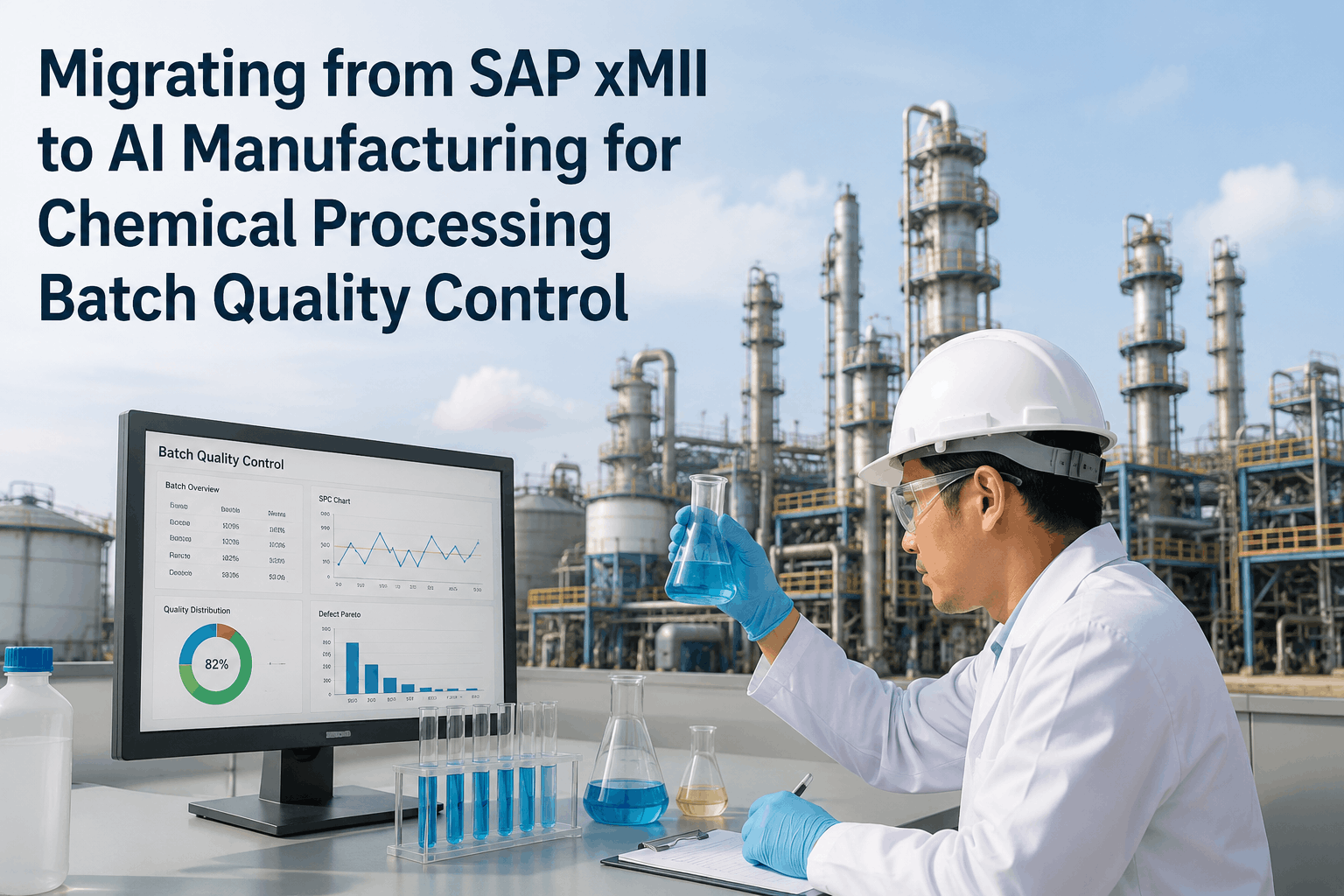
SAP has officially confirmed that SAP xMII mainstream support ends December 31, 2030 — a deadline that has already pushed thousands of chemical processing plants to begin replacement planning. The pressure is not only contractual: legacy xMII SPC modules were designed for univariate threshold logic, and modern batch chemistry now generates 2,700 defects per million units even when 97.3% of batches pass inspection. Scrap that should never have been produced is being shipped, reworked, or quarantined every shift. iFactory's AI-native SPC replacement platform delivers 30–50% scrap reduction within six months of go-live — fully replacing SAP xMII SPC functionality with predictive multivariate intelligence, available as on-premise, cloud, or hybrid deployment, and live in 8 weeks. Book an AI SPC Migration Workshop to map your replacement path.
2030
SAP xMII end-of-support deadline — replacement planning is no longer optional
30–50%
Scrap reduction with AI-native SPC vs. legacy xMII threshold logic
60%+
Reduction in quality-driven downtime after xMII SPC replacement
8 wks
Full replacement deployment — on-prem, cloud, or hybrid
Why Chemical Plants Are Replacing SAP xMII SPC Now
The xMII end-of-support announcement was the trigger, but it was not the reason. Chemical processing plants running xMII SPC have been quietly absorbing scrap and rework costs for years that the system was structurally incapable of preventing. The 2030 deadline simply made it impossible to defer the conversation any longer. Below are the six forcing functions driving xMII SPC replacement programs across operating chemical plants in 2026.
P1
SAP xMII Sunset — Dec 2030
SAP confirmed end of mainstream xMII and ME support on December 31, 2030. SAP's strategic successor is Digital Manufacturing on BTP — but heavy xMII customizations require redesign, not lift-and-shift.
P2
Univariate Logic Cannot Scale
xMII SPC was built for one-variable-at-a-time monitoring. Modern batch reactors emit 40–200 correlated signals per phase — every multivariate interaction is invisible to xMII.
P3
Scrap Costs Keep Rising
Rework cost per off-spec chemical batch averages $18,000–$52,000. Plants running legacy SPC discard 6–12% of output to scrap that AI-native SPC would have caught at the precursor stage.
P4
Alarm Fatigue Is Quietly Disabling Quality
xMII fires 50–80 false-positive alarms per week. Operators stop reacting within weeks. Actual deviation catch rate collapses to ~51% — half of real problems pass through unflagged.
P5
Custom BLS Code Is Unmaintainable
Decades of xMII customization, BLS transactions, and SSCE pages have become technical debt no SAP DM migration path will absorb cleanly. Replacement is often cheaper than redesign.
P6
No Predictive Capability
xMII reports what happened. AI-native SPC predicts what will happen. With 1–8 hour forecasting horizons, plants prevent off-spec batches instead of documenting them.
2030 Will Arrive Faster Than Your Migration Plan. Start the Replacement Conversation Now.
iFactory's AI SPC Migration Workshop is a 90-minute working session with your quality, process, and SAP teams — we map your current xMII SPC footprint and deliver a tailored replacement plan with timeline, ROI, and scrap-reduction projection.
The 5-Step xMII SPC Replacement Decision Framework
Not every xMII SPC workload should be replaced the same way. The right replacement path depends on what xMII is actually doing in your plant today — and where the scrap is being generated. Use this five-step framework to qualify your replacement scope before any vendor conversation. Contact the full xMII SPC migration checklist tailored to chemical processing.
Classify Your xMII Workload
Question: Is xMII MES-heavy, integration-heavy, or analytics-heavy?
If xMII is mostly running BLS transactions and quality dashboards (analytics-heavy), a best-of-breed AI SPC platform replaces the most expensive part at the lowest risk. MES-heavy workloads may need SAP DM or hybrid coexistence.
Inventory Custom Code & Dependencies
Question: How many BLS transactions, xMII queries, SSCE pages, and Java enhancements exist?
Tag each as Keep, Retire, Transform, or Replace. Heavy custom code means SAP DM clean-core architecture will require full redesign anyway — replacement becomes equally fast.
Map Scrap Generation Points
Question: Where in the batch lifecycle does scrap actually originate?
Most scrap traces to multivariate drifts xMII could never see — feed composition, thermal profile, mixing dynamics. AI-native SPC fuses all signals into a single predictive batch health score.
Confirm Deployment Constraints
Question: On-premise, cloud, hybrid? Data residency rules? Edge latency requirements?
Hazardous chemical sites and EU/APAC plants often require on-premise air-gapped deployment. Multi-site North American operators usually choose cloud. iFactory supports all three — same AI, same outcomes.
Select Replacement Architecture
Question: Full SAP DM, best-of-breed AI SPC, or hybrid?
For chemical processing batch quality, best-of-breed AI SPC (iFactory) typically delivers fastest scrap reduction. Hybrid coexistence with SAP DM is also supported for organizations on the SAP DM roadmap.
On-Premise, Cloud, or Hybrid — Your Plant's Deployment, Your Choice
Chemical plants do not all share the same IT posture. A specialty polymer site in Germany operates under data sovereignty rules that require air-gapped infrastructure. A multi-site fine chemical group in the US wants centralized cloud dashboards across 14 plants. A biotech facility in Japan needs edge inference plus cloud-side learning. iFactory delivers identical AI-native SPC capability across all three deployment modes — the choice is yours; the scrap reduction is the same. Talk to our deployment architects about which model fits your plant.
ON-PREMISE
Air-gapped. Data stays in your plant.
✓Edge-installed on your hardware or iFactory industrial appliance
✓Zero internet connectivity required for AI inference
✓Full data sovereignty — every byte stays inside your firewall
✓Aligns with ISA-95, ISA-99, IEC 62443
Best fit: Hazardous chemical processes, regulated EU/APAC sites, defense-adjacent manufacturing
CLOUD
Managed, scalable, always up-to-date.
✓Zero infrastructure — no servers to maintain
✓Continuous AI model updates deployed automatically
✓Multi-site rollout — onboard plants in days, not months
✓SOC 2 Type II, ISO 27001 certified hosting
Best fit: Multi-plant operators, fast-scaling specialty chemical groups, OPEX-preferred budgets
HYBRID
Edge inference + cloud analytics.
✓Real-time AI inference at the edge — sub-second alerts
✓Cloud-based model training across plant fleet
✓Selective data egress — anonymized aggregates only
✓Operates even during WAN outages
Best fit: Multi-site chemical groups with mixed regulatory environments
⚙
Same AI models. Same SAP integration. Same scrap reduction outcomes. Deployment mode affects infrastructure and IT policy alignment — not capability or results.
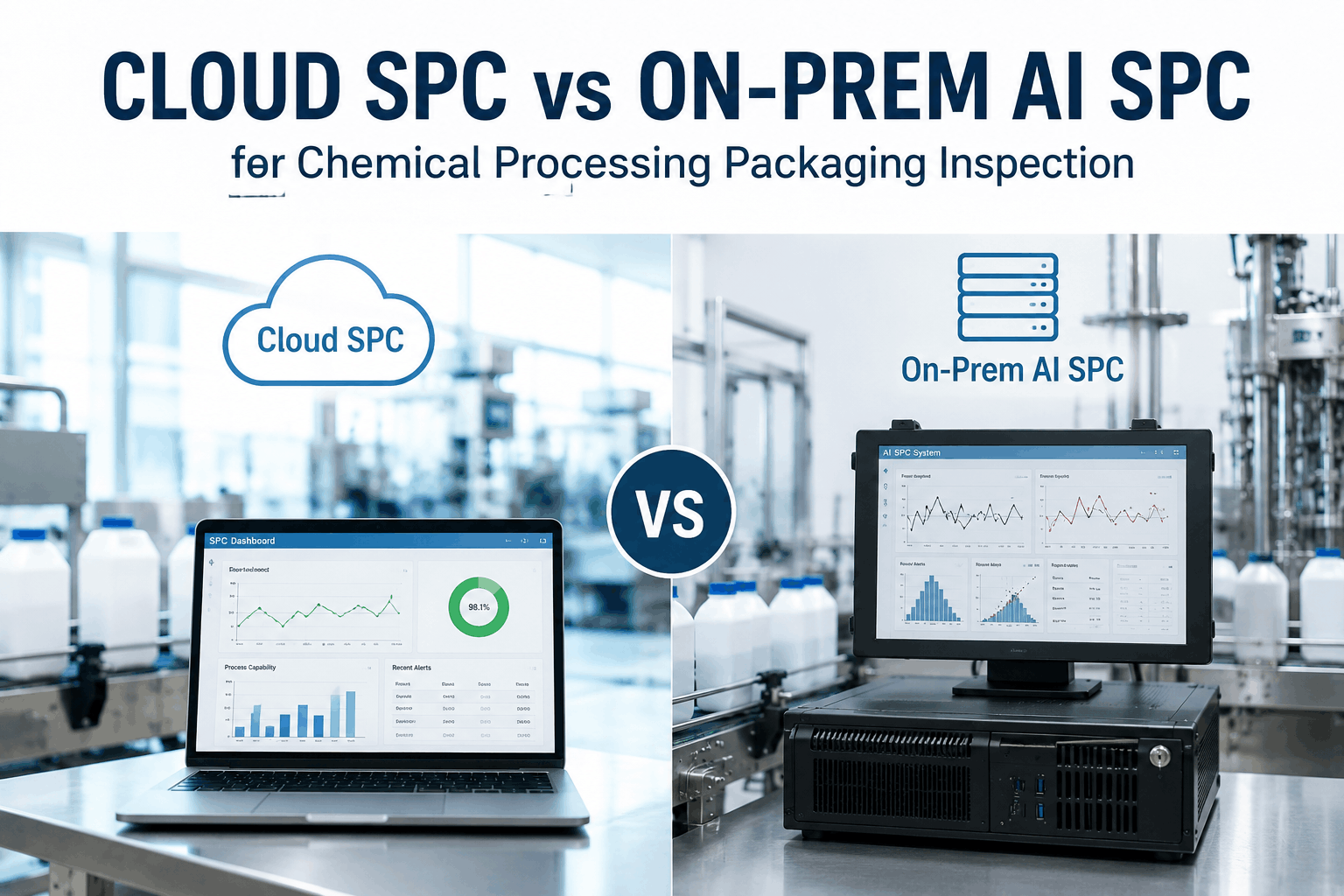
Cloud SPC vs. On-Prem AI SPC: Side-by-Side Comparison
For most chemical processing plants, the deployment question comes down to two practical considerations: where the batch data legally has to live, and how fast you want to onboard additional plants. This table breaks down the real differences without marketing fog.
| Dimension |
Cloud AI SPC |
On-Premise AI SPC |
| Infrastructure |
Managed — zero servers in your plant |
Edge appliance or your hardware |
| Data Residency |
Cloud-hosted (SOC 2, ISO 27001 region of choice) |
Plant-local only — never leaves your network |
| Internet Required |
Yes — continuous connection to platform |
No — fully air-gapped operation possible |
| Model Updates |
Automatic, continuous |
Scheduled via your change-control process |
| Multi-Site Rollout |
Days per plant — central dashboards |
Per-site deployment, 1–2 weeks each |
| Compliance Posture |
SOC 2 Type II, ISO 27001, GDPR-ready regions |
ISA-95, ISA-99, IEC 62443, FDA Part 11 friendly |
| CapEx vs. OpEx |
OPEX — subscription |
Mix — appliance CapEx + subscription |
| Scrap Reduction Outcome |
30–50% — identical to on-prem |
30–50% — identical to cloud |
Whatever Your Deployment Posture — The Scrap Reduction Is the Same.
iFactory's deployment architects map your IT policy, data residency rules, and multi-site plans to the right deployment mode in a single workshop session.
The 8-Week xMII SPC Replacement Timeline
iFactory's xMII SPC replacement program is structured so your plant never loses production. Legacy xMII SPC continues running in parallel during the entire deployment — the new AI layer is built in shadow mode, validated against your historical batches, then promoted to live alerting in measured, reversible stages.
Weeks 1–2
Discovery & xMII Inventory
Catalog every xMII SPC chart, BLS transaction, and quality dashboard currently in production
Map scrap generation points across batch lifecycle — identify multivariate blind spots
Confirm deployment mode: on-premise, cloud, or hybrid
Weeks 3–4
AI Model Baseline & Pilot
Train multiway PCA and LSTM models on 60–90 days of historical batches
Activate pilot AI SPC on 3–5 highest-scrap-rate batch processes
Legacy xMII SPC continues in parallel — zero production risk
Weeks 5–6
Calibration & Expansion
Refine graded alert thresholds based on pilot precision and recall data
Expand AI SPC coverage to full batch fleet
Train operators on new Safe / Warning / Critical workflow
Weeks 7–8
Cutover & xMII Decommission
Cut over from legacy xMII SPC to iFactory AI SPC as primary system
Compliance reporting activated — FDA Part 11, EU GMP Annex 11, REACH
First scrap reduction baseline report delivered
SCRAP REDUCTION OUTCOMES BY WEEK 8
Chemical plants completing the 8-week xMII SPC replacement consistently report dramatic scrap reduction with zero production downtime during the migration.
30–50%
Scrap reduction vs. legacy xMII SPC baseline
60%+
Quality-driven downtime reduction
100%
Production uptime maintained during migration
Real Scrap Reduction Outcomes from xMII Replacement Programs
Each of the following outcomes is drawn from a chemical processing plant that completed the xMII SPC replacement to iFactory's AI-native platform. Six-month post-cutover data, measured against the previous 12-month xMII baseline.
An 8-reactor specialty polymer plant was scrapping 9.4% of monthly output to molecular weight deviations that xMII univariate SPC charts could not detect upstream. iFactory's multivariate batch trajectory model fused monomer composition, catalyst loading, and thermal profile signals — catching drift events 4–6 hours earlier than xMII would have flagged them. Six months post-cutover, scrap fell to 5.0% of output, the equivalent of $2.6M annualized recovery. Deployment: on-premise (data sovereignty requirement).
47%
Scrap reduction (9.4% → 5.0% of output)
$2.6M
Annual scrap cost recovered
96%
Drift detection accuracy at precursor stage
A fine chemical manufacturer running 12 esterification reactors on xMII SPC was firing 50–80 false-positive alarms per week. Operators had stopped trusting the alerts — actual deviation catch rate had dropped to 51%. iFactory's graded AI alerting reduced weekly actionable alerts to under 6 while raising catch rate to 94%. Cycle time fell from 18.4 hours to 15.2 hours per batch. Deployment: cloud (multi-site operator).
41%
Scrap reduction in 6 months
3.2 hrs
Batch cycle time reduction per reactor
88%
False-positive alarm reduction
A biotech chemical facility was losing $540K annually to fermentation inefficiencies that xMII could not isolate. Manual endpoint determination identified suboptimal conversion only after visible purity deviation. iFactory's correlation models identified all 5 active inefficiency patterns within 48 hours of go-live. Deployment: hybrid (edge inference + cloud-side model improvement).
38%
Scrap reduction across 10-batch train
48 hrs
Time to identify all 5 inefficiency patterns
$1.1M
Annual scrap + yield value recovered
What Chemical Plant Teams Say About xMII Replacement
We had been carrying 9% scrap as "normal" for years because xMII never told us otherwise. Within six months of cutover, we were at 5%. The difference was multivariate detection at the precursor stage — something xMII was structurally incapable of.
Director of Plant Operations
Specialty Polymer Plant, Germany
Our IT mandate was on-premise only — no cloud egress for batch data. iFactory's edge appliance was operational in 10 days. Same AI capability we would have gotten in the cloud, fully inside our firewall.
Manufacturing IT Director
Fine Chemical Plant, France
We rolled out the cloud version across 6 plants in 9 weeks. Centralized scrap-reduction dashboards across our whole fleet — something xMII never gave us even within a single plant.
VP of Manufacturing Excellence
Multi-Site Chemical Group, USA
The migration was the smoothest SAP-adjacent project we have ever run. Zero production downtime. xMII stayed up during validation, AI SPC ran in parallel, cutover was a 30-minute config change. Scrap dropped immediately.
Plant Quality Manager
Biotech Manufacturing, Japan
Frequently Asked Questions
Do we have to replace SAP xMII, or can we wait until 2030?
You can wait — but the scrap cost compounds every month. Plants typically lose $200K–$2M per year to scrap that AI-native SPC would catch at the precursor stage. The 2030 deadline is a contractual forcing function; the scrap economics are an operational one. Most plants that have run the cost analysis start replacement planning 24–36 months before end-of-support.
Is iFactory available on-premise, in the cloud, or both?
Both — and hybrid. iFactory delivers identical AI-native SPC capability across on-premise (air-gapped, edge-installed), cloud (SOC 2 Type II, ISO 27001), and hybrid (edge inference + cloud-side training) deployments. The choice of deployment mode does not affect AI capability, SAP integration depth, or scrap reduction outcomes — it only affects infrastructure ownership and IT policy alignment.
Can we run iFactory and SAP xMII in parallel during the migration?
Yes — and we recommend it. iFactory runs in shadow mode alongside xMII through Weeks 3–6, validating AI predictions against your real batches before any cutover. Cutover itself is a controlled, reversible configuration change. Plants completing iFactory migration consistently maintain 100% production uptime during the transition.
What happens to our SAP ERP integration after xMII is replaced?
iFactory integrates directly with SAP S/4HANA, SAP ECC, and SAP QM via standard interfaces (OData, REST, RFC, BAPI). All quality data, inspection results, and batch records that previously flowed through xMII to SAP continue to flow — through iFactory's modern API layer instead of legacy BLS transactions. SAP master data remains untouched.
Does iFactory support hybrid coexistence with SAP Digital Manufacturing?
Yes. SAP recommends a hybrid coexistence model where SAP DM takes over standard MES transactions while best-of-breed analytics platforms handle predictive quality and SPC. iFactory is designed to operate as the AI-native SPC layer in this architecture — connecting to SAP DM via Integration Suite while delivering scrap reduction outcomes SAP DM does not natively provide.
What scrap reduction can we realistically expect?
Across deployed chemical processing plants, scrap reduction has consistently fallen in the 30–50% range within 6 months of cutover. The exact number depends on your baseline scrap rate, batch chemistry complexity, and operator response speed. The AI SPC Migration Workshop includes a tailored scrap-reduction projection for your specific plant configuration.
Replace SAP xMII SPC. Cut Scrap by 30–50%. Live in 8 Weeks. On-Premise or Cloud.
The 2030 deadline is real. The scrap cost is real. The replacement path is proven across operating chemical processing plants — with zero production downtime during cutover and identical outcomes whether you deploy on-premise, in the cloud, or hybrid.
On-premise, cloud, or hybrid — your choice
30–50% scrap reduction within 6 months
100% production uptime during migration
FDA Part 11, EU GMP Annex 11, REACH ready
8-week fixed deployment — no scope creep