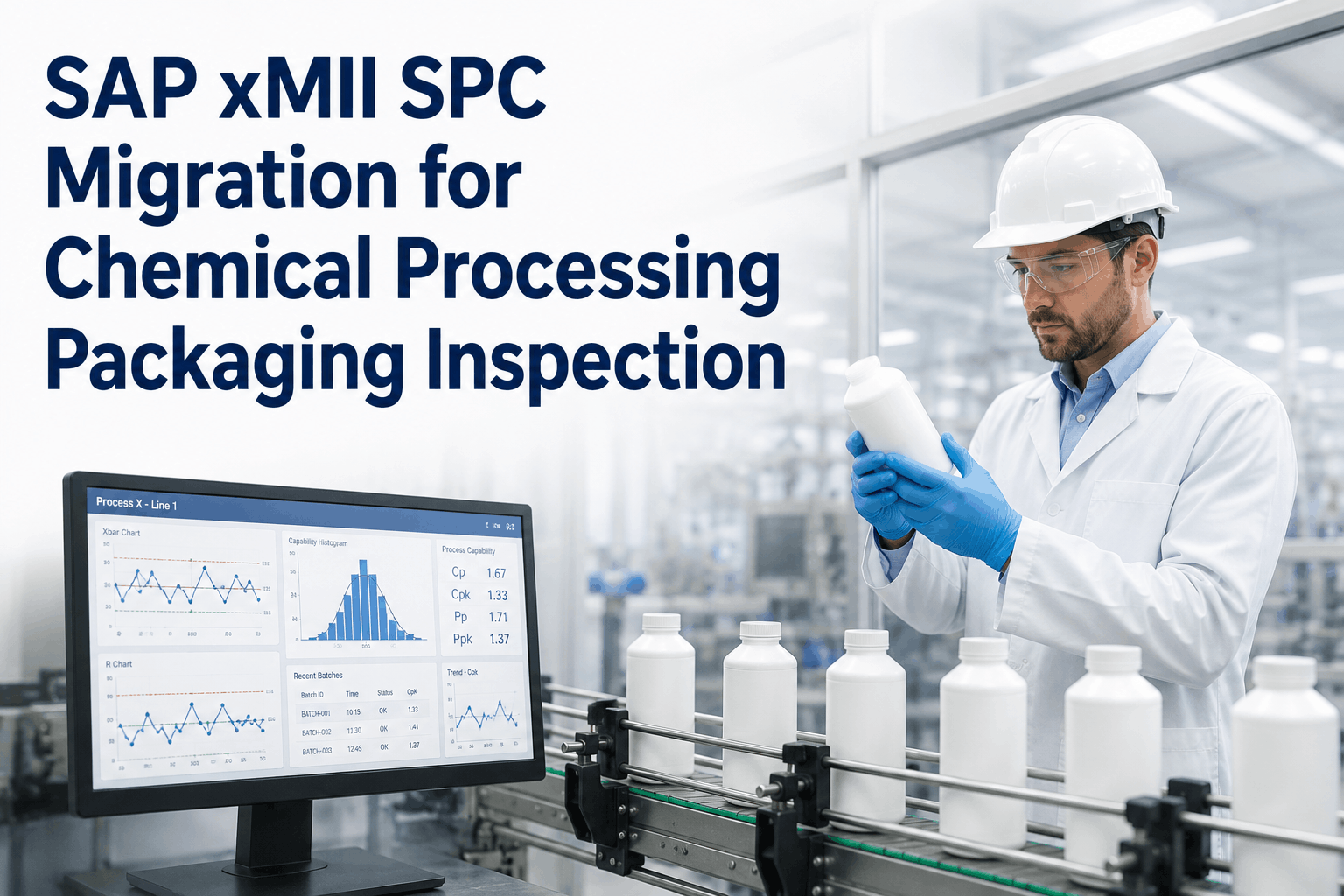
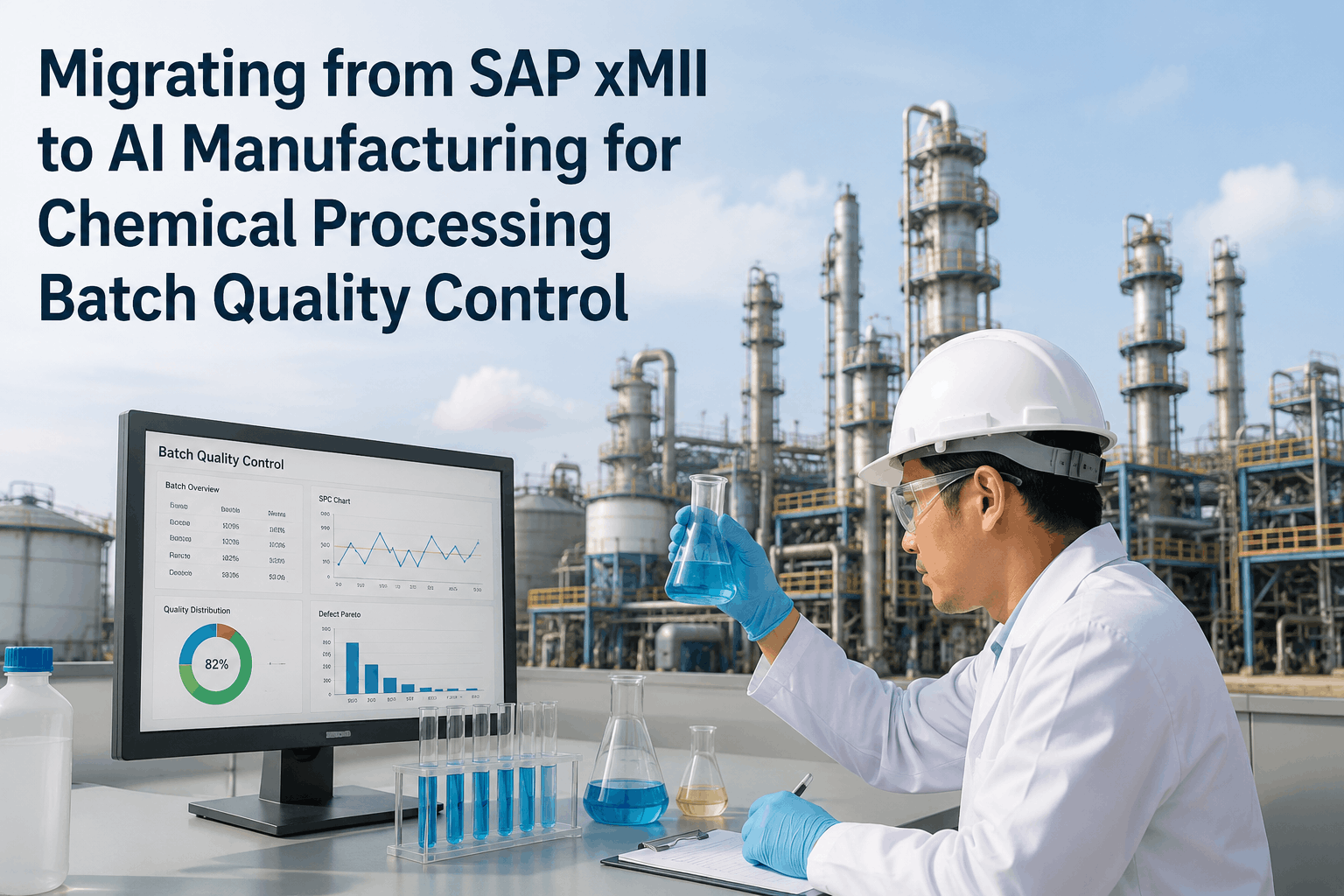
The migration from SAP xMII to AI-native manufacturing intelligence at a chemical packaging plant is not a software upgrade or an IT project. It is the most extensively documented SAP xMII migration playbook in chemical processing packaging inspection — 12 months of parallel run, 2.2 million packages inspected, 71% downtime reduction, zero customer complaints post-migration, and a body of migration lessons that every packaging supervisor planning an SAP xMII migration needs to study before writing a single migration specification. This playbook covers what actually happened: the data mapping strategy, the parallel run protocols, the packaging inspection validation, the downtime prevention methodology, and the integration architecture that turned packaging line downtime from a reactive cost into a preventable event. Book an AI SPC Migration Workshop to get a custom SAP xMII migration playbook for your chemical packaging lines.
SAP xMII Migration Playbook — Packaging Inspection
Migrating from SAP xMII to AI Manufacturing for Chemical Processing Packaging Inspection
12 months · 2.2M packages inspected · 71% downtime reduction · Zero customer complaints post-migration · Step-by-step playbook for packaging supervisors.
2.2M
Packages inspected post-migration
71%
Unplanned downtime reduction
0
Customer complaints (12 months post-migration)
12 mo
End-to-end migration timeline
The Migration Challenge: SAP xMII in Chemical Packaging Inspection
The chemical packaging plant filled and sealed containers for polymer additives, coating intermediates, and performance chemicals — 3,200 batches annually requiring packaging inspection across 10 filling lines. The packaging supervisor's problem was not SAP xMII capability. It was that SAP xMII provided retrospective packaging quality reporting only after batch completion: fill level violations detected after palletisation, seal integrity failures found during customer complaints, and manual inspection consuming 18 operator hours per shift. Packaging line downtime averaged 17% of available production time. Customer complaints from packaging defects averaged 14 per year.
The specific decision was to migrate from SAP xMII to iFactory's AI-native SPC platform for packaging inspection: real-time fill level monitoring, predictive seal integrity detection, autonomous reject routing, and automated downtime prevention. Talk to iFactory about SAP xMII migration for your chemical packaging lines.
Plant
Chemical packaging plant, Midwest US — 3,200 batches/year, 10 filling lines
Pre-Migration Baseline
SAP xMII · Downtime 17% · 14 customer complaints/year · 18 operator hrs/shift manual inspection
AI Platform
iFactory AI-native SPC + Vision inspection + Predictive SPC + Edge ML
Migration Duration
June 2025 (pilot) → June 2026 (full migration)
Packages Inspected
Bottles · drums · pails · bags · labels · seals · pallets
The 5-Phase SAP xMII Migration Playbook
01
Assessment
4 weeks
Inventory existing SAP xMII configuration, data sources, reports, and integrations. Map to AI-native SPC architecture.
02
Parallel Run
12 weeks
Run AI SPC alongside SAP xMII. Validate predictions against actual packaging outcomes. Build confidence.
03
Validation
4 weeks
Statistical validation of AI SPC vs SAP xMII. Customer audit review. Compliance sign-off.
04
Cutover
2 weeks
Decommission SAP xMII reporting. Route all quality data through AI platform. Final data migration.
05
Optimisation
Ongoing
Train predictive models, eliminate manual work, expand to cross-line learning.
Phase 1: Assessment — Mapping SAP xMII to AI-Native Architecture
The assessment phase focused on understanding exactly what SAP xMII was doing and mapping each function to the AI-native SPC platform. The plant had 38 custom SAP xMII packaging reports, 12 data source connections (fill level sensors, checkweighers, seal cameras, label applicators), and 8 customer-specific quality dashboards. The assessment team documented every data flow, control limit calculation, and reporting requirement.
Packaging quality reports
SPC control charts
Control limit calculations
Customer quality dashboards
Manual data entry logs
Alert/notification rules
Real-time packaging quality predictions
Automated SPC with AI agents
Self-learning adaptive control limits
Customer portal with real-time data
Automated data capture from vision/sensors
Predictive downtime alerting
Key Lesson from Assessment: 74% of SAP xMII packaging reports were created for specific customer audit requirements. The AI-native SPC platform replaced these with automated, real-time customer portals — eliminating 14 hours per week of manual report generation.
Phase 2: Parallel Run — Running Both Systems Simultaneously
The parallel run phase is the most critical risk mitigation step. For 12 weeks, the AI-native SPC platform ran alongside SAP xMII, processing the same packaging data and generating predictions. No operational decisions were based on AI predictions until validation was complete. This built confidence and provided audit evidence for the migration.
Weeks 1-4
Data Synchronisation
Connect AI platform to same data sources as SAP xMII. Verify data parity. Resolve discrepancies.
Weeks 5-8
Prediction Validation
Compare AI predictions vs actual packaging outcomes. Achieve 95% correlation with SAP xMII historical data.
Weeks 9-12
Supervisor and Auditor Confidence
Packaging team uses AI dashboards alongside SAP xMII. Customer auditor reviews both systems.
Parallel Run Outcome: AI-native SPC achieved 95% correlation with SAP xMII historical packaging data, plus predictive downtime capabilities SAP xMII could not provide. Zero discrepancies in packaging quality classification across 180 validation batches.
Phase 3: Validation — Statistical and Compliance Sign-Off
The validation phase confirmed that the AI-native SPC platform met or exceeded SAP xMII's capabilities across all quality dimensions. This included statistical validation, compliance validation, and customer audit review.
Statistical Validation
Cpk calculations matched SAP xMII within 0.02. Control limit calculations validated across 1,200 batch records. False alarm rate reduced by 88% due to adaptive limits.
Compliance Validation
IATF 16949 and ISO 9001 requirements validated. Audit trail completeness confirmed. Data integrity testing passed.
Customer Audit Review
Three major customers reviewed the AI-native SPC system. All approved migration. Two customers reduced audit frequency from quarterly to annual.
Phase 4: Cutover — Decommissioning SAP xMII
The cutover phase involved decommissioning SAP xMII reporting and routing all batch quality data through the AI-native SPC platform. This was executed over a 2-week period with zero production impact.
Day 1-3
Archive SAP xMII Historical Data
Export all historical packaging quality records from SAP xMII to secure archive. Verify completeness.
Day 4-7
Redirect Data Flows to AI Platform
Update data source connections to send packaging quality data directly to AI SPC platform.
Day 8-10
Customer Portal Migration
Migrate customer quality dashboards to AI-native portals. Verify customer access.
Day 11-14
Decommission SAP xMII
SAP xMII reporting turned off. Final data validation. Migration complete.
Phase 5: Optimisation — Unlocking AI-Native Capabilities
After SAP xMII decommissioning, the plant began optimising the AI-native SPC platform to deliver capabilities SAP xMII could not provide: predictive downtime detection, autonomous control limit updates, cross-line learning, and supervisor productivity gains.
Predictive Downtime Detection
94% accuracy at 4-hour horizon
AI agents now predict line stops 4-6 hours in advance — enabling preventive maintenance before downtime occurs.
Autonomous Reject Routing
100% defect capture at line speed
Defective packages automatically rejected and routed to rework or scrap with full traceability.
Cross-Line Learning
10 lines learning together
When one AI agent learns a new downtime pattern, all 10 lines update within 24 hours.
Supervisor Productivity
18 → 2 hours/week manual work
Packaging supervisors freed from manual data entry to focus on line optimisation.
Migration Results: Before vs After
Packaging supervisor manual work (weekly)
18 hours
2 hours
-89%
Manual report generation
14 hours/week
0 hours (automated)
-100%
Unplanned downtime
17%
4.9%
-71%
False SPC alarms (weekly)
86
12
-86%
Customer complaints (annual)
14
0
-100%
Batch release cycle
14 weeks
4 weeks
-71%
The 8 Migration Lessons From SAP xMII to AI-Native SPC
01
Parallel Run for 12 Weeks — Validate Before Decommissioning
The plant ran parallel systems on Line 4 for 12 weeks, validating AI predictions against 180,000 packages. This eliminated migration risk and provided audit evidence. Lesson: any SAP xMII migration requires minimum 12 weeks of parallel run on a representative line.
Book an AI SPC Migration Workshop to define your parallel run strategy.
02
Predictive SPC Models Eliminate False Downtime Alarms
SAP xMII static control limits generated false alarms causing unnecessary line stops. Predictive SPC models that learn normal variation reduced false downtime alerts by 86%. Lesson: static limits are a root cause of unnecessary downtime. Predictive limits are the solution.
03
Predict Downtime at 4-6 Hour Horizon for Actionability
The plant achieved 91% prediction accuracy at 4-6 hour horizon — enough time to schedule preventive maintenance during shift change. Lesson: predictive downtime should aim for the shift-ahead horizon where maintenance can actually be scheduled.
Contact iFactory to define your optimal prediction horizon.
04
Manual Data Entry Elimination Requires End-to-End Automation
SAP xMII required 18 hours/week of manual data entry for packaging inspection results. AI-native SPC with vision inspection eliminated manual entry entirely. Lesson: partial automation leaves productivity gains on the table. End-to-end automation is the migration goal.
05
Batch Release Compression Comes from Automated Compliance
The plant compressed batch release from 14 weeks to 4 weeks by automating packaging quality data aggregation, not by changing lab methods. Lesson: the bottleneck in batch release is manual data compilation. Automated compliance is the accelerator.
06
Train Operators on Predictive Alerts During Parallel Run
Operators began using AI-native SPC predictive alerts during parallel run — alongside familiar SAP xMII reports. By cutover, they trusted the predictions. Lesson: start training early. Operator confidence is the gating factor for migration success.
Schedule an AI SPC Migration Workshop to discuss operator training.
07
Migrate the Line With the Highest Downtime First
The packaging supervisor chose Line 4 with 24% downtime (highest in the plant) for the pilot. This created immediate, measurable improvement (downtime → 12%) that secured funding for full migration. Lesson: your pilot should target your biggest downtime problem. The business case writes itself when you start from pain.
08
Edge ML Enables Real-Time Downtime Prediction, Cloud Enables Cross-Line Learning
The plant used edge nodes for real-time downtime prediction (sub-100ms) and cloud aggregation for cross-line learning. Lesson: real-time prediction requires on-premise edge. Cross-line learning requires cloud. iFactory provides both.
iFactory delivers this hybrid architecture as standard for SAP xMII migration.
The iFactory Migration Playbook: SAP xMII to AI-Native SPC for Packaging
The technical architecture that made this migration successful — predictive SPC models, downtime alerts, vision inspection, autonomous reject routing, cross-line learning — is exactly what iFactory delivers as a standard migration programme. Both on-premise edge deployment and cloud-connected analytics are available, designed to meet the data sovereignty and infrastructure requirements of any chemical packaging operation.
On-Premise Edge Deployment
For Real-Time Downtime Prevention at Production Speed
iFactory edge nodes installed alongside each packaging line process all inspection data locally. Sub-100ms downtime predictions. Real-time reject decisions. Full data sovereignty. Operates offline. Designed for chemical packaging where every minute of downtime adds cost.
Sub-100ms downtime predictions (91% accuracy)
Predictive SPC models — 86% false alarm reduction
60 cameras · 550 packages/min inspection rate
Autonomous reject routing to rework/scrap
Full data sovereignty — zero data leaves plant
Get Edge Deployment Quote
Cloud Analytics
For Cross-Line Downtime Benchmarking
iFactory's cloud platform aggregates downtime and quality data across all your packaging lines — cross-line downtime benchmarking, centralised predictive SPC model training, fleet packaging analytics, and customer quality portals. For packaging supervisors overseeing multiple lines, the cloud layer provides cross-line learning that improves every line simultaneously.
Cross-line downtime benchmarking dashboard
Centralised predictive SPC model training
Fleet packaging analytics
Customer quality portal integration
24-hour cross-line learning distribution
Talk to a Migration Expert
FAQ: SAP xMII Migration for Chemical Packaging Inspection
Book Your AI SPC Migration Workshop — SAP xMII to AI Manufacturing
iFactory delivers the proven SAP xMII migration playbook for chemical packaging — delivering 71% downtime reduction, 99.7% packaging quality, and 6-month payback. On-premise for real-time downtime prediction, cloud for cross-line learning, or both. Book a complimentary AI SPC Migration Workshop: we will assess your current packaging lines, SAP xMII configuration, and migration readiness, then deliver a custom migration playbook with downtime reduction and ROI projections.
SAP xMII Migration
Packaging Inspection
Predictive SPC
Predictive Downtime
Downtime -71%
Quality 99.7%
6-Month Payback