SAP xMII built its reputation connecting shop floor operations to SAP ERP — bridging the gap between PLCs, SCADA systems, and enterprise data that previously had no common language. For chemical processing plants, it handled batch data capture, quality notifications, and the operator displays that plant teams relied on daily. But SAP xMII is now at an inflection point. SAP has discontinued strategic development on xMII, it is not an integral component of S/4HANA, and its architecture limits the real-time AI analytics that modern chemical batch quality control demands. The migration is not optional — it is a question of when and how well it is executed. Book the AI SPC Migration Workshop and get your xMII migration playbook built on your actual estate — not a template.
SAP xMII → AI Manufacturing · Migration Playbook
Stop Running a Platform
SAP Stopped Investing In.
iFactory's proven 5-phase SAP xMII migration playbook for chemical processing — data mapping, parallel run, AI-native SPC deployment, and process stability from day one. On-premise or cloud.
Why Chemical Processors Are Migrating from SAP xMII Now
The xMII migration decision is being forced by three converging pressures — not one. Understanding all three is essential to building a business case that secures executive approval and project budget.
01
SAP S/4HANA Mandatory Migration
SAP has set a mandatory ECC end-of-support deadline (extended to 2030). xMII is not a strategic component of S/4HANA — it complicates the migration and creates a parallel technical debt problem. 40–70% of xMII Workbench artifacts in long-running deployments are unused, redundant, or replaceable by modern platform configuration (iFactory migration analysis, 2025). A full lift-and-shift of all xMII artifacts is almost always the wrong economic decision.
02
Architecture Limits on AI Quality
xMII's BLS transaction architecture, SSCE page display model, and batch-oriented data integration were designed for a world before real-time IoT sensor streams, multivariate AI monitoring, and predictive batch outcome forecasting. SAP DM's clean-core model eliminates direct database access — existing BLS transactions, xMII queries, and SSCE pages must be redesigned, not lifted. This is the migration challenge and the opportunity simultaneously.
03
Process Stability Demands Predictive SPC
Chemical batch quality control on xMII monitors what happened. Competitive chemical processors in 2026 need to know what is about to happen. AI manufacturing copilots — real-time multivariate monitoring, predictive batch outcome forecasting, adaptive SPC control limits — require a data architecture that xMII cannot provide. The migration is also the quality transformation.
Before You Migrate: The xMII Estate Inventory
The first mistake in every failed xMII migration is starting with architecture decisions before completing the estate inventory. iFactory's migration methodology begins with a full artefact catalogue — every BLS transaction, query template, display template, MDO, KPI, alert, custom action block, operator display, and data server connection in your xMII environment is tagged: retire / replace / transform / keep. Start your estate inventory — book the AI SPC Migration Workshop.
xMII Artefact Classification — The Four Tags
RETIRE
Unused, redundant, or built for one-time projects. Check audit logs and last-run timestamps. Plants are consistently surprised how much MII content was built and never used again. Average: 40–70% of total artifact inventory.
No migration work required — document and decommission
REPLACE
Functionality replicated by standard iFactory AI platform configuration — OEE calculation, batch record capture, quality notification routing, operator dashboards. No custom development required.
Configure in iFactory — no migration of legacy code
KEEP
SAP integrations and data connections that continue to function during parallel run period — ERP interfaces, historian connections, SCADA integrations that remain valid through cutover. Typically fewer than 10% of artifacts.
Maintain in parallel — migrate at cutover
The 5-Phase Migration Playbook
Data Architecture Analysis — Document all data sources, DCS connections, historian integrations, LIMS interfaces, and SAP ERP integration points currently managed through xMII. Every connection is mapped to its business process.
xMII Artefact Inventory — Catalogue every BLS transaction, query template, operator display, KPI, and custom action block. Tag each as retire / replace / transform / keep. Count the artifacts in each category — this number drives the migration timeline and cost estimate.
Batch Quality Root Cause Analysis — Analyse 12–24 months of batch quality data to identify off-spec patterns, deviation frequencies, and the process parameters with highest predictive impact. This shapes the AI SPC model design in Phase 3.
Process Stability Baseline — Measure current batch consistency metrics (Cpk, off-spec rate, rework frequency) that will serve as the baseline against which AI-native SPC improvements are measured post-migration.
Exit Criteria: Artefact inventory complete · All connections mapped · Baseline KPIs documented · Business case approved
iFactory Platform Architecture — Design the target state: DCS and IoT connections (OPC-UA, MQTT, Modbus), LIMS integration, SAP S/4HANA QM interface via OData, historian federation for historical data continuity. On-premise vs. cloud deployment decision confirmed at this stage.
Data Mapping and Transformation Rules — Map every xMII data element to its iFactory equivalent. Batch records, quality parameters, KPI definitions, and operator display data all require explicit mapping. Historical data migration strategy confirmed — complete migration vs. read-only archive access during hypercare.
BLS → AI Workflow Translation — For each artefact tagged TRANSFORM, design the iFactory AI equivalent. iFactory's AI copilot accelerates this translation — analysing BLS transaction logic and generating equivalent AI workflow configurations. Reduces transformation work by 75% vs. manual redesign (Nova Intelligence / Kyndryl benchmark, April 2025).
Operator Dashboard Redesign — SSCE operator pages do not migrate to modern platforms. This is the opportunity to redesign operator interfaces around actual workflow needs — real-time batch status, AI alerts, SPC control charts — rather than recreating legacy page layouts.
Exit Criteria: Architecture approved · Data map validated · BLS translation designs reviewed · Operator UI prototypes signed off
iFactory Platform Configuration — Deploy iFactory AI platform (on-premise appliance or cloud instance). Configure DCS connections, historian federation, SAP QM interface, and LIMS integration. Standard connectors complete in 5–10 business days — no custom middleware development required for standard scenarios.
AI SPC Model Training — Using the historical batch data identified in Phase 1, train multivariate AI models for each product family. Models learn the process parameter patterns that predict batch quality outcomes — temperature, pressure, agitation speed, feed rates, raw material properties. Minimum 50 historical batches per product grade for initial model deployment.
Predictive Batch Quality Prototype — Deploy prototype AI SPC on live DCS data (shadow mode — monitoring without alert generation). Validate prediction accuracy against batches in production. Demonstrate to plant quality team that the model correctly predicted deviation in historical batches it was not trained on.
GMP Validation Documentation — For regulated chemical processing, initiate GAMP 5 Category 4 validation documentation. iFactory's validation package includes IQ/OQ/PQ templates, audit trail specification, and electronic records compliance documentation for FDA 21 CFR Part 11 / EU GMP Annex 11.
Exit Criteria: Platform live on shadow data · AI model accuracy validated · SAP QM integration tested · GMP validation initiated
Parallel Operation — Run both xMII and iFactory simultaneously. Operators continue to use xMII for production decisions; iFactory runs in parallel, generating alerts and SPC records independently. This is the critical validation that iFactory produces equivalent (or better) results across real batches — not test scenarios. Minimum one stable quarter before xMII decommission consideration.
KPI Equivalence Verification — At the parallel run midpoint, verify that iFactory and xMII agree on batch status, quality decisions, and KPI values for the same production period. Discrepancies are root-caused and resolved before cutover. Zero-discrepancy KPI alignment is the cutover gate criterion.
Operator Training and Sign-Off — Operators trained on iFactory dashboards, AI alert interpretation, and SPC chart reading. Training completion and sign-off for each shift team is a hard cutover prerequisite — production never stops because of system unfamiliarity.
AI Alert Calibration — During parallel run, AI alert thresholds are calibrated based on operator feedback. False-positive alerts that operators consistently dismiss are tuned. The goal: every alert fired in production is actionable and leads to a documented response.
Exit Criteria: KPIs match · Operators signed off · Cutover playbook rehearsed · Fallback decision tree documented
Site-by-Site Cutover in Waves — Cut over by production unit or site, not all at once. First unit goes live on iFactory; hypercare team on-site for 2 weeks. Only after first unit is stable does the second unit cut over. This approach contains migration risk and builds operator confidence progressively.
Hypercare Period — iFactory specialists on-site (or remote for cloud deployment) for the first 4–6 weeks post-cutover. All production decisions have expert backup. Every AI alert is reviewed together with the plant team. Model recalibration if drift is detected in production conditions not covered by the training set.
xMII Decommission — After one stable quarter on iFactory, xMII moves to read-only archive mode. Audit documentation refreshed. SAP xMII license return process initiated. Server decommission plan executed per IT change management. Resist early decommission pressure — one stable quarter is the minimum.
AI Optimisation Backlog Activation — Post-migration, the AI improvement backlog begins: additional predictive use cases (raw material variability correlation, energy optimisation, predictive equipment maintenance), cross-unit quality benchmarking, and advanced compliance reporting are activated sequentially as the team builds confidence on the new platform.
Exit Criteria: Every site stable · xMII decommissioned or read-only · Audit pack refreshed · AI optimisation roadmap active
Process Stability KPIs: What AI Manufacturing Delivers vs. xMII
Process Stability Before and After Migration
Off-Spec Batch Rate
Detected end-of-batch — full batch at risk
36% reduction — in-process detection before batch fails
Deviation Detection Speed
Post-batch lab result: 8–24 hr after deviation
AI detects multivariate drift in-process: 4–6 hrs before batch end
Process Consistency (Cpk)
Calculated from periodic lab samples — low statistical power
Calculated from 100% of in-process sensor readings per batch
SPC False Alarm Rate
Static control limits — high false alarm rate on grade changes
Adaptive limits — 40%+ false alarm reduction (2025 AI-SPC study)
Batch Record Closure
Manual transcription: 2–4 hours per batch
Automatic from sensor data: <30 minutes, GMP-compliant
Product Consistency
Baseline — batch-to-batch variation unmodelled
44% improvement — raw material correlation eliminates systematic variation
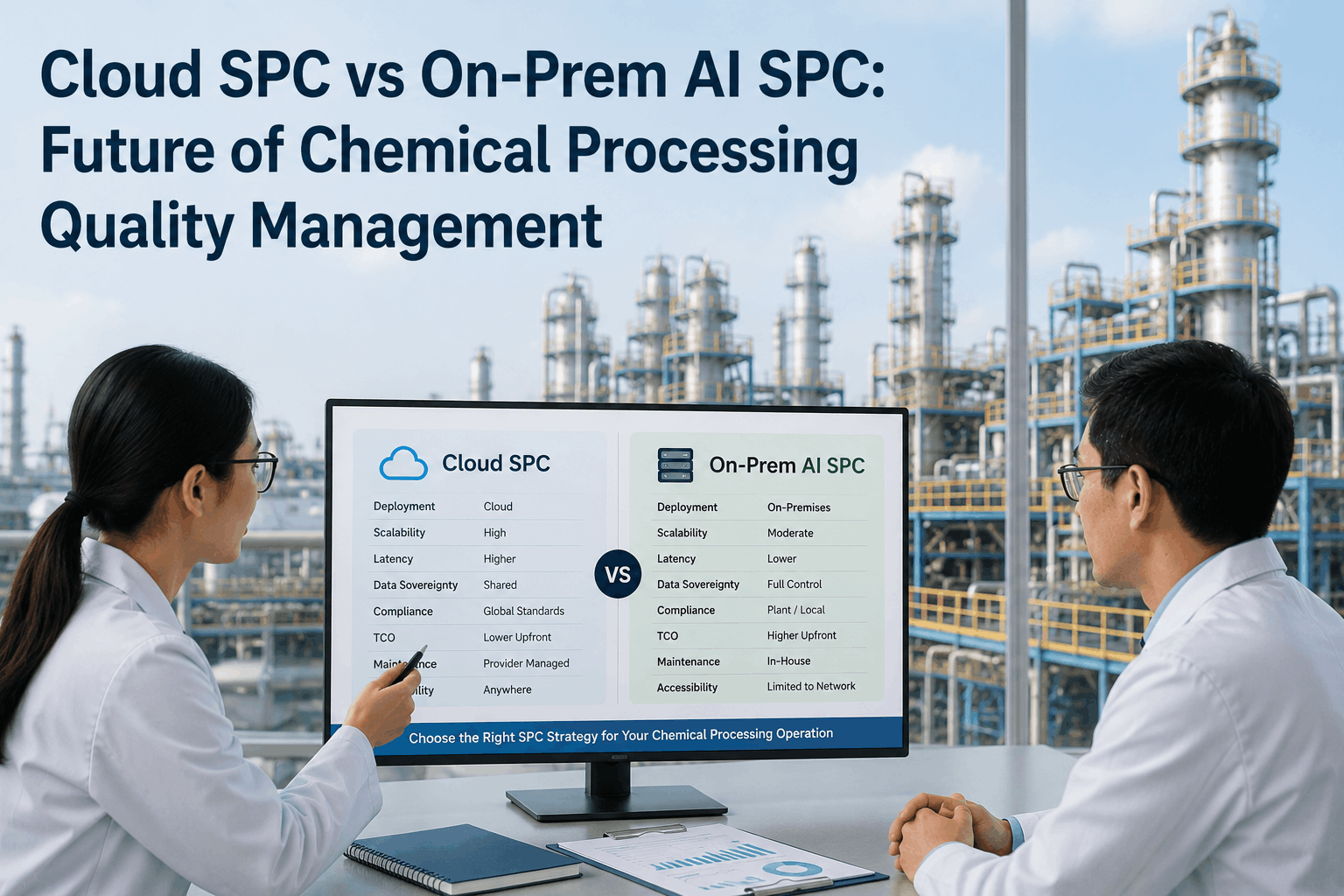
On-Premise & Cloud: iFactory Deployment for Chemical Processing
Chemical batch formulation data, process parameters, and yield outcomes are competitively sensitive — and in regulated environments, they are legally protected. iFactory gives you the choice of where your data lives, processed according to your governance requirements. Ask our team about the right deployment model for your regulated chemical environment.
On-Premise
Full Data Sovereignty
All batch data, AI models, and GMP records stored inside plant network
No external transmission of formulation or process parameter data
Real-time DCS integration — sub-second parameter monitoring, no cloud latency
FDA 21 CFR Part 11 / EU GMP Annex 11 — tamper-evident on-premise audit log
Validated per GAMP 5 Category 4 for regulated chemical manufacturing
Discuss On-Premise Migration
Cloud
Multi-Plant Analytics
Cross-plant batch quality benchmarking and consistency analytics
Enterprise quality leadership dashboards — accessible globally
AI model improvement from multi-plant batch data — broader training set
Regulatory submission data packages generated automatically
Ideal for specialty chemical groups with multi-site xMII estate
Discuss Cloud Migration
The Migration Workshop: Your xMII Estate in 4 Weeks
AI SPC Migration Workshop
4 Weeks. Your Data. Your xMII Estate. Your Migration Roadmap.
iFactory brings the checklist, the tooling, and the chemical processing AI SPC expertise. You bring your xMII configuration and batch history data.
Week 1
xMII Estate Inventory
Complete artefact catalogue. Every BLS transaction, display, KPI, and integration tagged retire / replace / transform / keep. You will know exactly what the migration involves before committing to scope.
Week 2
Batch Quality Analysis
12–24 months of batch data analysed. Off-spec patterns, root causes, and process stability gaps identified. Top 3–5 AI SPC use cases ranked by ROI — with your actual batch data, not industry benchmarks.
Week 3
AI Model Prototype
Prototype AI SPC model on your historical data. Demonstration: what the model would have predicted on three recent off-spec batches. Your quality team evaluates the model before any production deployment.
Week 4
Migration Roadmap + Business Case
Full 5-phase migration plan, on-premise vs. cloud recommendation, validated ROI case using your batch data, and Phase 1 project initiation package ready for executive approval.
FAQ: SAP xMII to AI Manufacturing Migration for Chemical Processing
How long does an SAP xMII migration for chemical processing typically take?
Full migrations following the 5-phase playbook typically complete in 7–9 months for a single-plant chemical processing deployment. The parallel run phase (Phase 4) is the longest single phase because it requires at least one stable production quarter before cutover consideration. Plants that attempt to accelerate by skipping the parallel run consistently encounter post-cutover quality discrepancies that cost more time to resolve than the parallel run would have taken. Multi-site migrations are sequenced in waves — each site adds approximately 4–6 months after the first site is stable. iFactory's migration tooling reduces implementation time by up to 80% vs. manual xMII-to-modern-platform migration through automated artefact analysis and BLS-to-AI translation (iFactory, 2025).
What happens to our historical batch quality data from xMII during migration?
Historical data strategy has two components: data needed for AI model training (12–24 months of process parameter and quality outcome records) is migrated to iFactory's data lake as part of Phase 2–3 work. Older historical records — batch records, quality notifications, audit trail data — can be migrated to iFactory's archive or maintained in SAP QM S/4HANA as read-only historical records. For regulated chemical processing, GMP batch records must remain accessible for the required retention period (typically 1 year past product expiry, minimum 5 years) — iFactory's on-premise archive satisfies this requirement with tamper-evident storage and full audit trail access. Complete historical data migration with enhanced analytics capabilities is included in the standard iFactory xMII migration package.
Can iFactory AI manufacturing replace the xMII manufacturing copilot functionality?
Yes — and it extends it significantly. xMII's operator displays provided real-time production status from DCS and ERP data. iFactory AI manufacturing copilots add to this foundation: natural language queries against production data ("why did this batch deviate?"), AI-generated root cause summaries when deviations are detected, recommended corrective actions with confidence scores, and predictive alerts before the deviation occurs. For chemical plant operators, the copilot experience shifts from "reading a dashboard and deciding" to "receiving an AI recommendation and confirming." The transition from xMII operator displays to iFactory copilot dashboards is supported by a dedicated operator training programme in Phase 4 of the migration.
What is the integration approach for SAP S/4HANA QM during and after the xMII migration?
iFactory connects to SAP via standard OData and BAPI interfaces — the same interfaces SAP provides for third-party system connectivity. During the parallel run, xMII continues to handle SAP ERP integration while iFactory's integration is validated in shadow mode. At cutover, iFactory takes over as the primary SAP integration layer: batch records and usage decisions post to SAP QM via OData, production confirmations route to SAP PP, quality notifications are created automatically when AI alerts fire. No ABAP development is required for standard scenarios. The integration handles both the current ECC environment during the migration period and the target S/4HANA environment post-migration — ensuring the xMII migration and the S/4HANA migration can proceed on independent timelines without creating an integration gap.
How does iFactory handle GMP validation requirements for regulated chemical plants?
iFactory provides a GAMP 5 Category 4 validation package for regulated chemical manufacturing environments — covering IQ (Installation Qualification), OQ (Operational Qualification), and PQ (Performance Qualification) documentation templates. The platform's electronic records architecture satisfies FDA 21 CFR Part 11 and EU GMP Annex 11 requirements: unique user IDs for all system interactions, tamper-evident audit trail, electronic signatures with authority validation, and secure record storage with access controls. On-premise deployment ensures the validation environment is fully within the plant's control — no cloud tenancy changes can affect the validated system state without plant IT approval. Validation documentation is prepared during Phase 3 and executed during the parallel run so GMP compliance is in place before cutover, not after.
Book the migration workshop to review validation requirements for your plant.
What ROI should we expect from migrating from SAP xMII to iFactory AI manufacturing?
ROI comes from three sources: process stability improvement (36% off-spec batch reduction, 44% product consistency improvement — iFactory chemical plant data 2026), operational efficiency (batch record closure from 2–4 hours to under 30 minutes per batch, 28% lab testing efficiency improvement from reduced false-positive investigations), and xMII licensing and maintenance cost elimination. Chemical manufacturers typically achieve positive ROI within 5.3 months of iFactory deployment. The migration investment is recovered through scrap and rework avoidance before the parallel run phase ends for most chemical batch operations running at current off-spec rates of 3–8%. Migration cost itself is reduced by 75% vs. manual xMII port through iFactory's AI-assisted artefact translation tooling.
SAP xMII Migration + AI SPC
Book the Migration Workshop.
Know Your xMII Estate in 4 Weeks.
iFactory delivers your xMII artefact inventory, AI SPC prototype on your batch data, and complete migration roadmap in 4 weeks — before you commit to migration scope or budget. On-premise or cloud.
5-Phase Migration Playbook
Parallel Run Included
On-Premise & Cloud
GMP / GAMP 5 Validation
75% Faster Than Manual Port



.png)